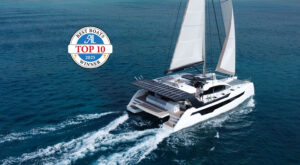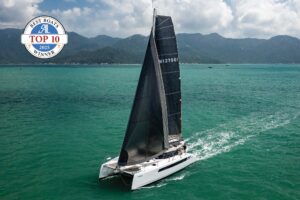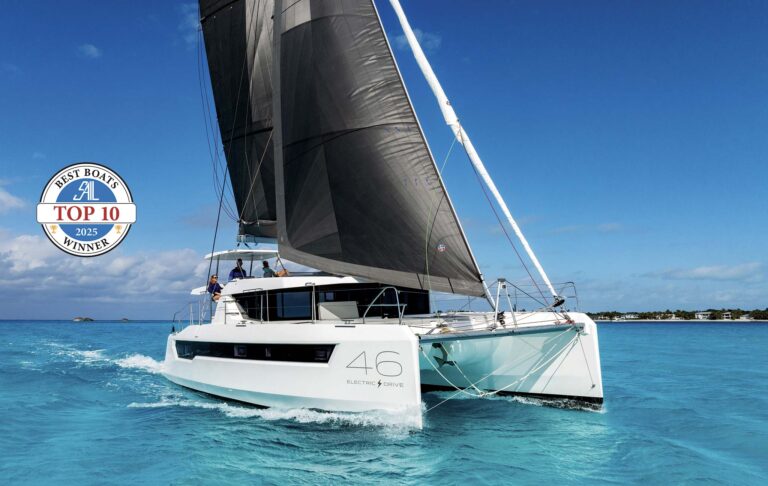
The Excess line of cruising catamarans launched in 2019 with a value proposition that was a little sketchy—the product didn’t match the brand promise. The vague attempt at providing a thrilling new experience was heaped onto a barely revamped Lagoon platform and frankly, I wasn’t buying it. But six years later, the line includes three from-scratch models that are making waves in the cruising multihull space. The latest to splash is the 43-foot Excess 13, which fulfilled all that once-promised thrill as we hauled the mail on a cold and windy test day.
I joined Excess brand director Thibaut de Montvalon and product manager Herve Piveteau on a blustery outing on the Chesapeake. To say that the conditions were ideal would have been an understatement. The Bay’s flat waters combined with a perfect true wind of 15-22 knots. “A boat is a toy,” said de Montvalon. “So go let’s go play with it.”
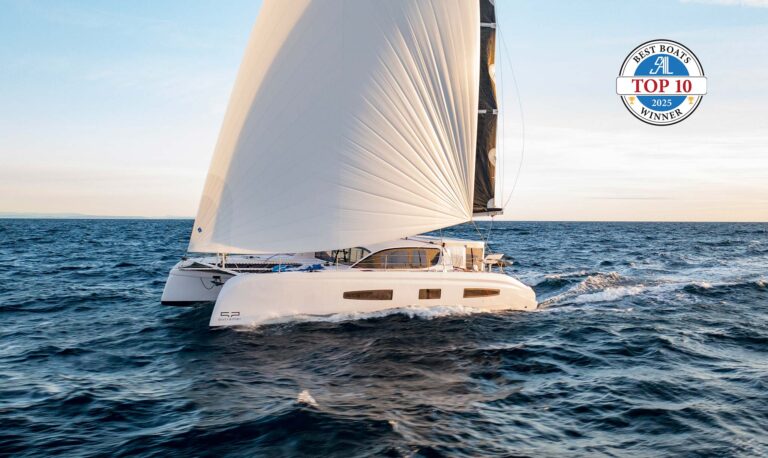
The Excess 13 slots into the line between the Excess 11 (39 feet) and the Excess 14 (46 feet). The newest model looks somewhat like a premium performance cat but is a family-friendly cruiser with 1,237 square feet of upwind sail area as standard. However, we sailed the Pulse Line edition with a taller mast and another 100 square feet of canvas. At our disposal, we had a square-top mainsail and an overlapping genoa with a simplified 3D ring system that makes headsail adjustments and tacking easier.
In 20-22 knots of breeze, we sailed 10-11 knots at 70 degrees apparent wind angle (AWA). At 40 degrees AWA and 15 knots of true wind, we sailed at 8.5 knots and even pinched up to 30 degrees before we tacked. The helm with direct (rather than hydraulic) steering was light all the way through the tacks and 30 degrees is unusually high for a cruising cat. We popped the 818-square-foot Code 0 attached to the composite bowsprit and soon, rooster tails appeared in our twin wakes. We had such a romp that time passed quickly.
The Excess 13 is straight-forward and unfussy with lines that are led right to where they’ll be most useful. The primary helm is to starboard with all lines led to jammers and two Harken winches, one of which can (and should) be electric. The traveler runs along the transom bulkhead behind the seat but is also controlled from the starboard helm.
She’s intuitive and forgiving rather than twitchy and demanding like some high-performance cats. Our test sail on the Excess 13 was, hands-down, the highlight of a week of sailing lots of great new boats.
The signature mark of the Excess line is the twin helms positioned aft on the hulls with compact individual Bimini covers over each side. The Excess 13 added a sunshield over the MFDs which will make them easier to see and cooler to touch although the little wings do make a tempting target to grab when stepping down from the side deck. The double helm seats are deeper and more comfortable to accommodate two adults, and they lift up and outboard to offer excellent access to the transoms when at anchor.
The positioning of the wheels makes backing into a slip easy with great sight lines aft and surprisingly good visibility forward to the opposite bow through the large (untinted) salon windows. Engine throttles are on starboard although there’s an option to add them to both sides for easier close-quarters maneuvering. Under power with the upgraded 40-hp Yanmar diesels, we cruised comfortably at 7.2 knots and 2400 rpm.
For this model, Excess switched from VPLP naval architects to Marc Lombard Design Group. The hulls are still asymmetrical, meaning the outboard sides are fuller and rounder while the inboard sides are flatter and more vertical. This moves the center of buoyancy outboard for better stability and reduces interference drag between the hulls. The bows are inverted and free of the surface with an “exposed forefoot” which makes for snappier tacking.
The cabin house is farther aft so the rig sits forward, outside of the salon and on deck where it’s framed by steps leading from the foredeck to the coachroof. Her low profile also means even short crew can stand on the Bimini and manage the main in the sail bag without problems.
Four new features include the black anodized stanchions, side wind scoops, cork soles in the cockpit, and foldup transoms. The dark stanchions work well with the boat’s orange trim for an aesthetic that’s a defining look for the brand. The scoops are integrated into the cabin house on the sides. They pop open to funnel air into the cockpit, which we didn’t really need on our cold day and I’d like to see how well they work in a hot anchorage. The cork cockpit sole felt great under foot, and although everything was wet that day, we were surefooted.
In a departure from the design of her siblings, the Excess 13 has twin foldup sugarscoop transoms. The benefits of closed transoms include enhanced safety when cruising with kids or pets, a shorter LOA when paying for a slip in a marina, and better access to the dinghy on the davits with the transoms extended.
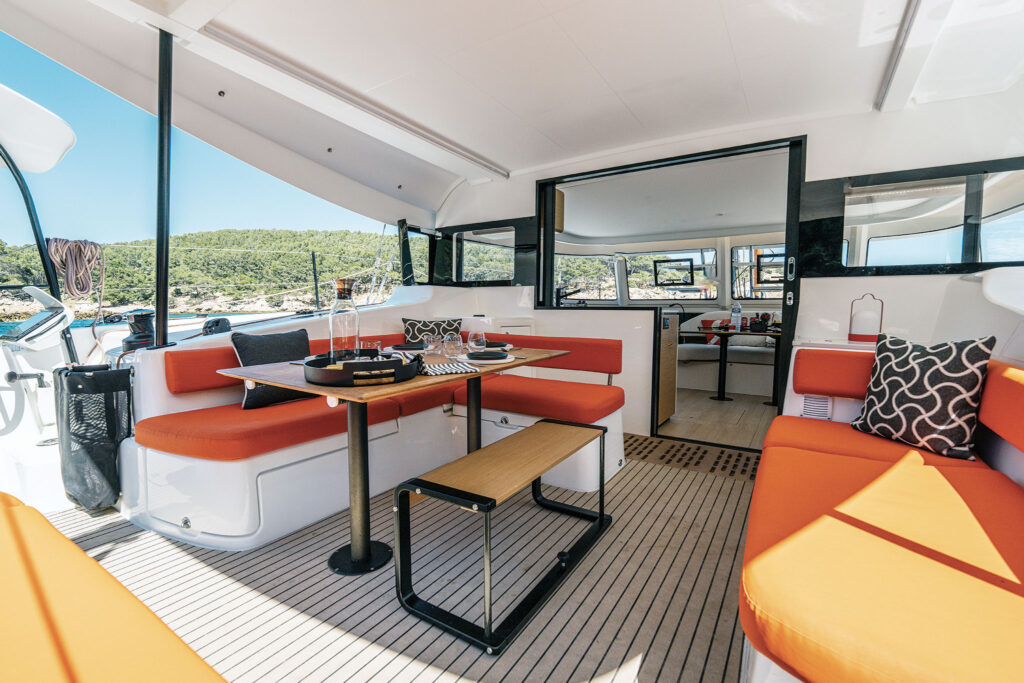
The cockpit is flush with seating options including a transom seat, a dinette to port, and a double lounge to starboard. Between the dinette and the galley window is a latitudinal narrow strip of space that terminates at a cabinet on the port side. Excess is pitching it as bonus space where people will gather to keep the chef company. Instead, it may become a designated space to add a drinks cooler or toss fins and shoes to keep them from being underfoot. Of course, that risks the space becoming a giant exterior junk drawer, so we’ll see how cruisers use it.
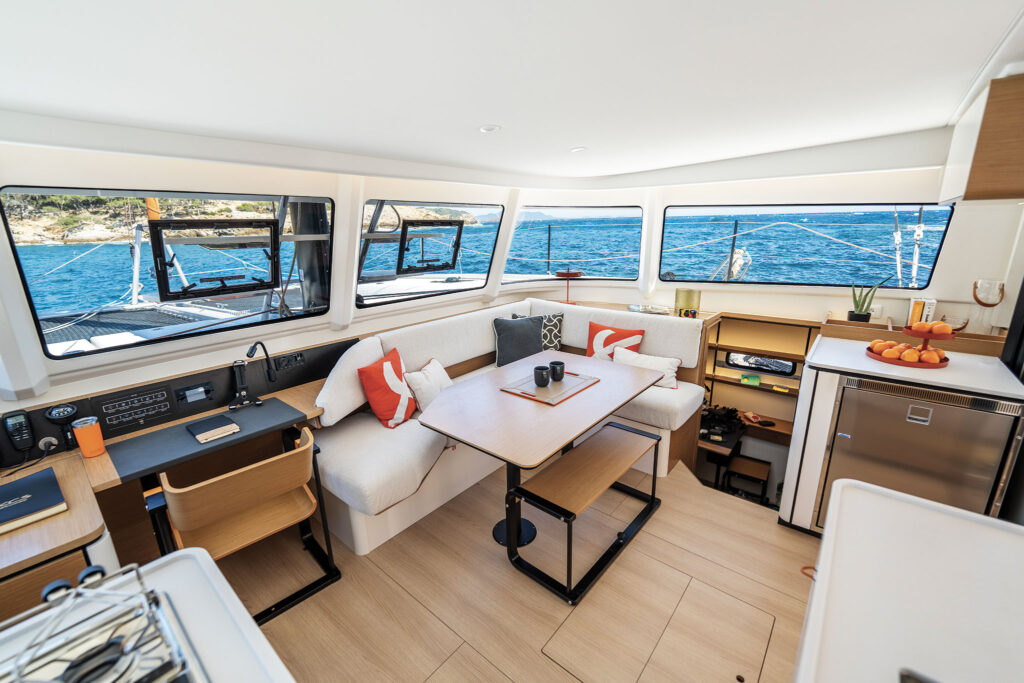
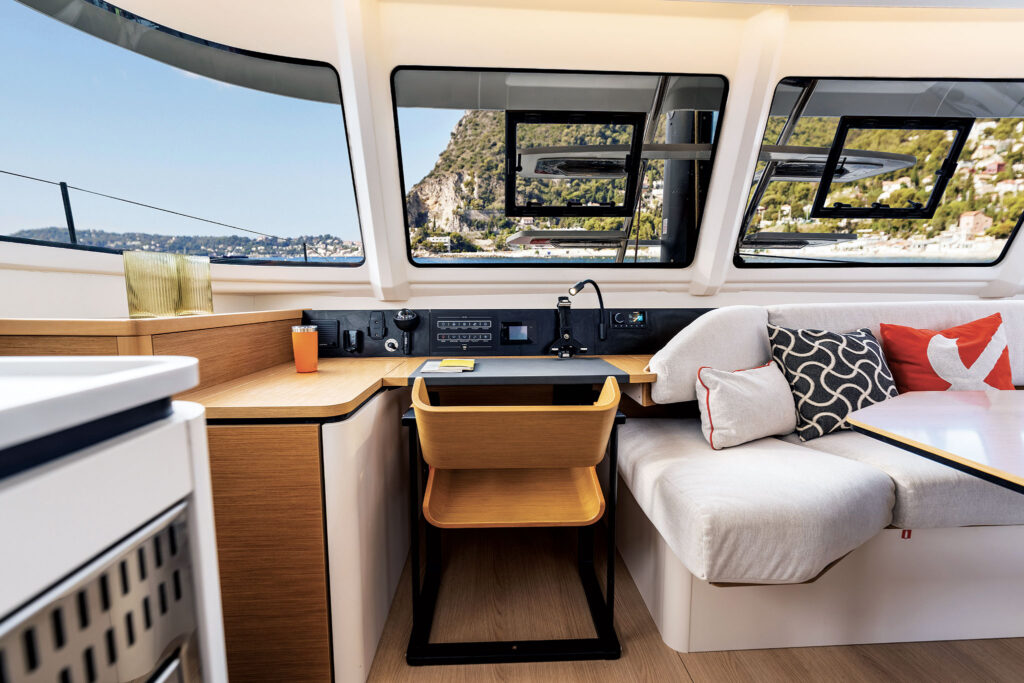
Inside, I’d like to have seen a double sink and more frontloading refrigerated space in the galley, but skippers can rejoice about the dedicated nav station. This is the large nerve center of the boat, and it has a greater presence than the even one on the bigger Excess14.
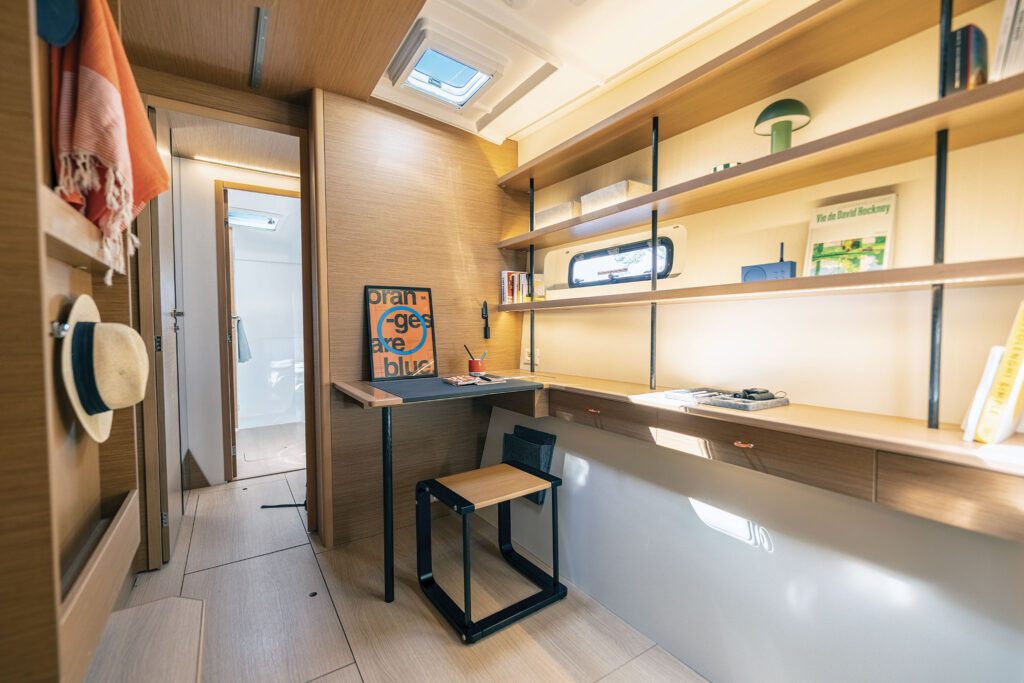
The new model is available with three or four cabins. Our boat had the owner’s configuration with the master stateroom in the starboard hull where Excess flipped the script and put a large bed into the bow and an even larger head with a massive shower stall aft. There’s even a faux double vanity where the sink is one trough but has two faucets. Between the bed and the head is a walk-in closet of sorts, a vanity desk, and long open shelves. These look great but a more practical approach would be enclosed space to hold the necessities of a cruising life. The port side holds two cabins with equally sized beds, and two heads with a Jack-‘n-Jill shared shower stall.
“Over 70% of our new owners are sailors switching from monohulls to catamarans,” says de Montvalon. “Another 20% are complete beginners who want to learn and are intrigued by what we’re doing with the Excess line.”
A well-equipped Excess 13 will run approximately $750,000 and that includes key upgrades like the Pulse Line performance package, larger engines, genset, air conditioning, electric winches, and davits—all options I would say are must-haves. That pushes up near the pricing of the Excess 14, and I wondered about cannibalization. Why wouldn’t buyers just step up to the larger flagship? But Excess isn’t worried. “The Excess 13 is the sweet spot,” says de Montvalon. “It has the latest innovations that we believe will entice boaters looking for technology and the freshest design.”
I turned from skeptic to Excess brand champion two models ago, and I’m only getting more convinced that Excess offers something unique in the market. Maybe the best evidence of this was that I completely lost track of time on test day and had to be persuaded (pushed) to return to the dock for the next sea trial. Yes, a boat is a toy, and I just wanted to keep on playing.
LOA 42’ 7” (50’ 2” Pulse Line)
Beam 23’ 9”
Draft 4’ 10”
Displacement 23,480 lbs dry
Sail Area 1,216 sq ft upwind (1,313 sq ft Pulse Line)
Power 2x 29-hp (2x 40-hp upgrade)
Fuel/water 2x 53 gallons fuel/ 79 gallons water
Designer Marc Lombard Yacht Design Group
Builder/website excess-catamarans.com
As-Tested Price $750,000
January/February 2026