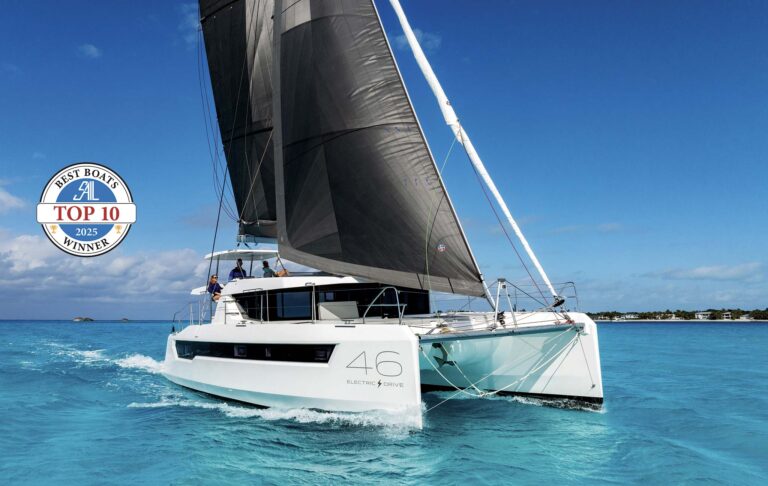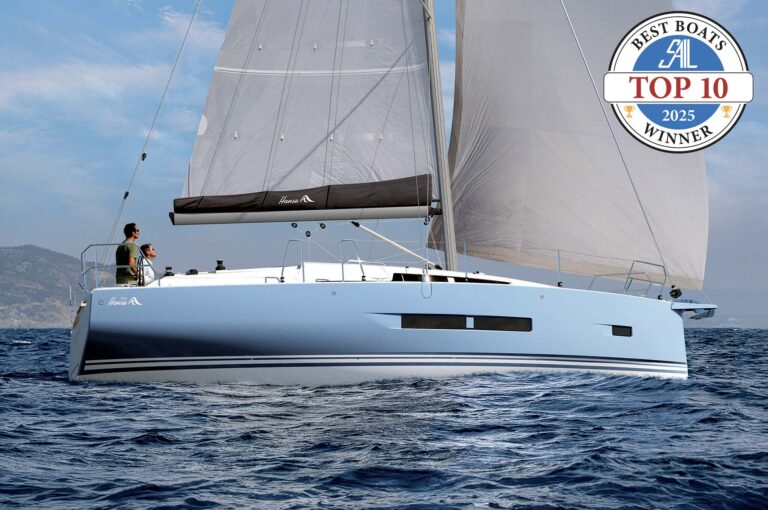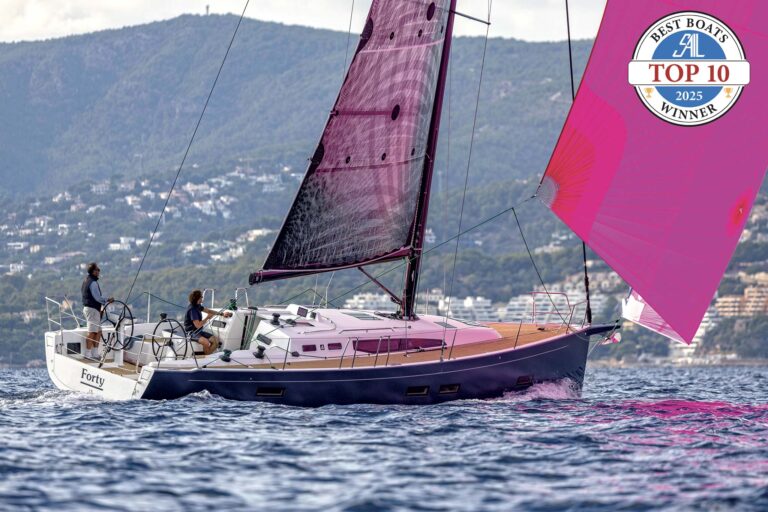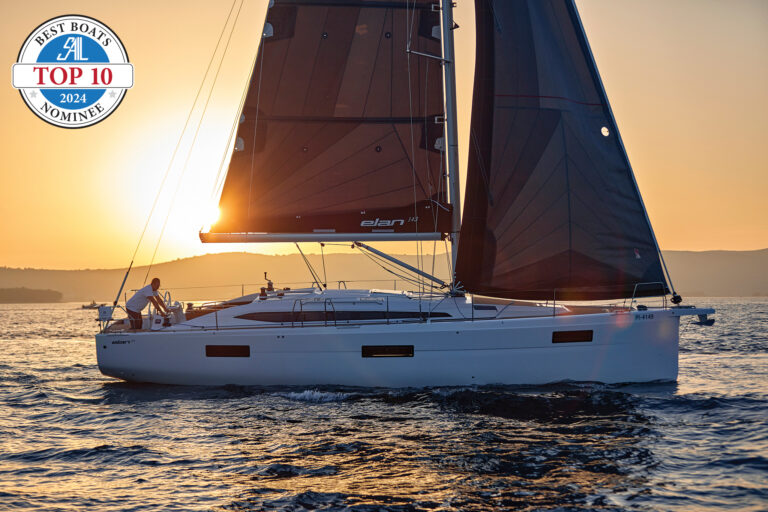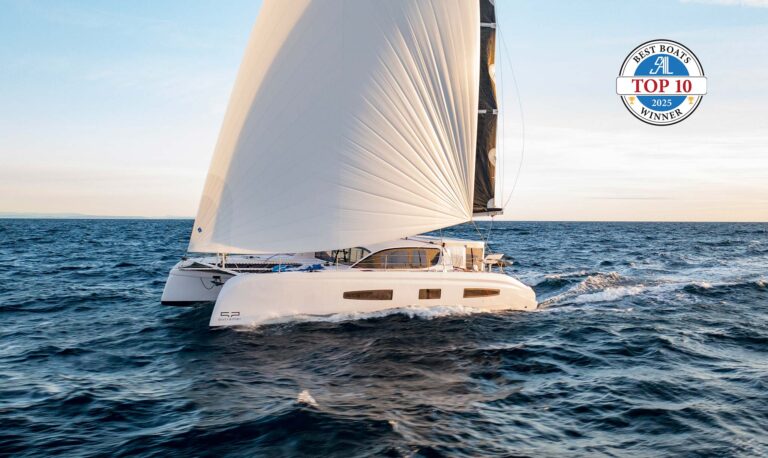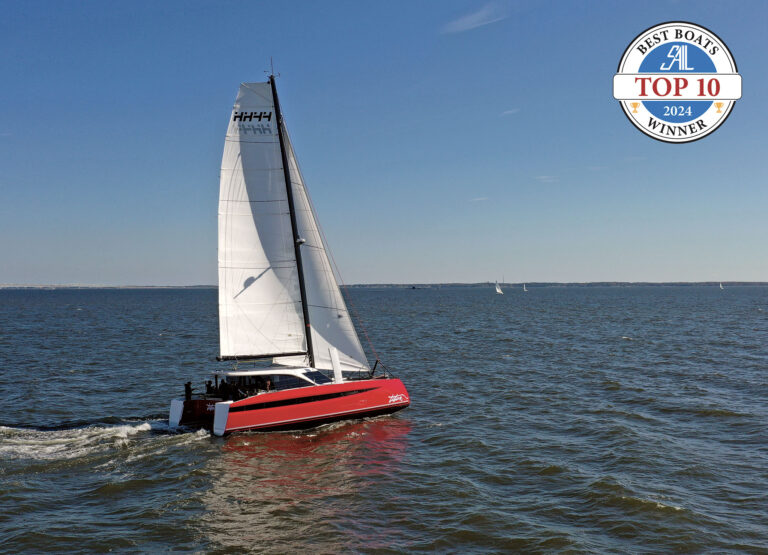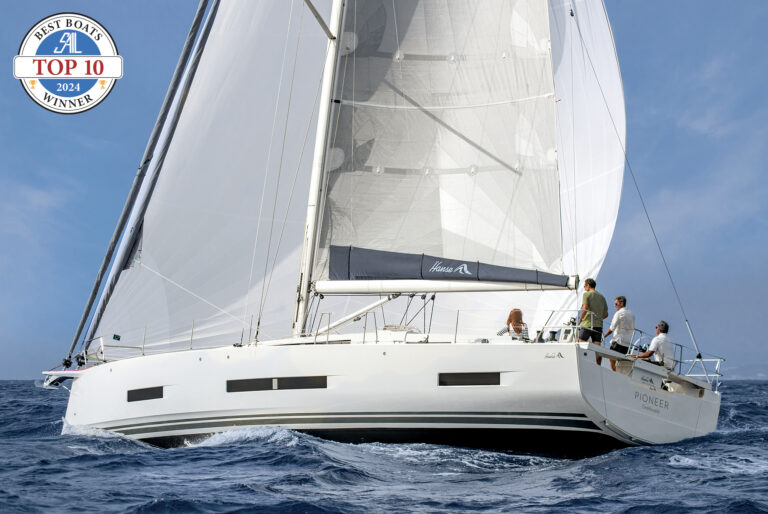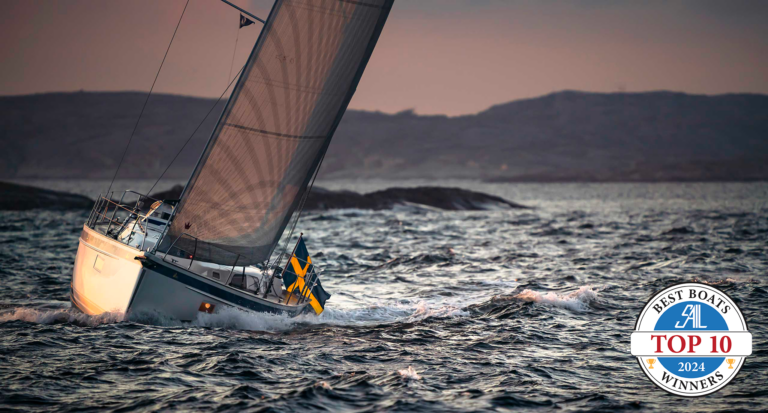
Ater months of testing, walkthroughs, reviews, and deliberations, we’re proud to announce the Top 10 Class of 2026. These boats fall across a spectrum of LOAs, numbers of hulls, and price points, and they represent a true diversity of sailing experiences, from classy little trimarans to beautiful, innovative bluewater cruisers. For years, the trend at boat shows has been “bigger is better,” but this year we were excited to see an exceptional push to bring small and mid-size models back into the conversation. These models were often the stars of the show, and designers have really made an art of small boats with big ambitions. That being said, there was no shortage of big boats with the wow-factor as well, as you’ll see in the next pages. The boats receiving our Top 10 award this year represent fresh design ideas, technological advances, and industry trends that will become the classic boats of tomorrow.
Collectively, we considered nearly 40 different models in 2025 and had the difficult task of narrowing it down to just 10. SAIL’s review team considers every model that debuts at an American boat show and is available for us to test each calendar year. Rather than comparing boats to each other, we consider how well each model fulfills its own design brief, with an acknowledgement to its impact on the overall market. This makes testing fairer and more nuanced in a diverse design landscape, so we can focus on the best innovations, smartest details, and most impressive execution of ideas. So without further ado, let’s introduce the class of 2026.
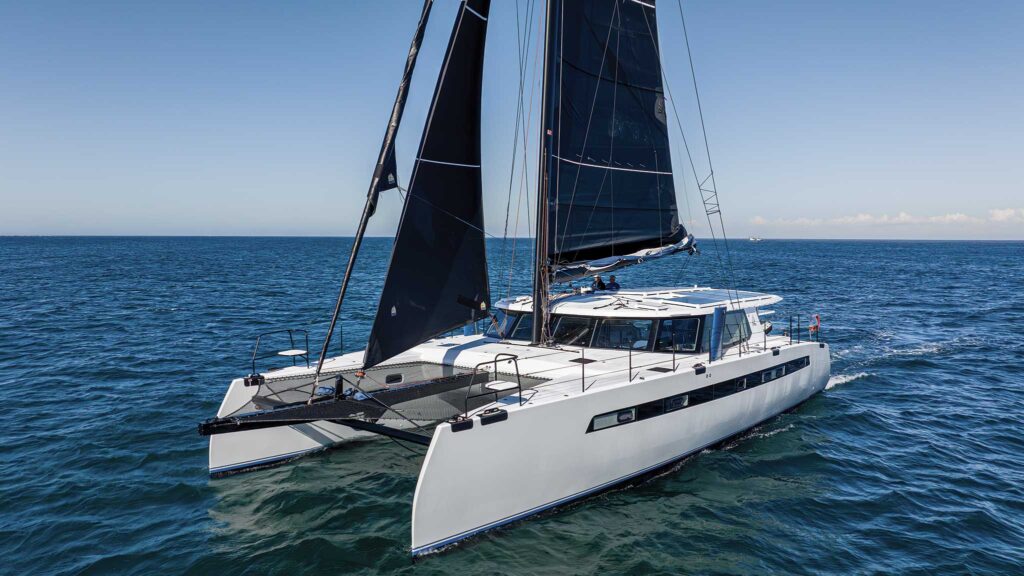
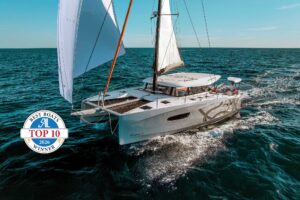
Balance 580
Judges remarks: “When it comes to a semi-custom boat, the choices an owner makes really dictate how well the boat comes out, but with Balance’s wealth of experience making comfortable cats with a performance edge, any version of the 580 is sure to be an excellent sailer.”
The 580 is a sporty, highly customizable big sister to the Balance line. We were impressed by the innovation and adaptability of this design, and the performance under sail was a cut above. The fastest and leanest of the offerings from Balance, this model has performance in its design brief, with a carbon reinforced structure, closed cell foam core hulls, and handcrafted foam core furniture, all to reduce weight onboard. Combined, this allows the boat to sail at wind speed in 8-16 knots of breeze. Thanks to high aspect daggerboards, it also points well for a big cat.
The helm station is to starboard, with a VersaHelm that can be raised or lowered. A hardtop extends almost all the way aft, protecting the cockpit from sun exposure and providing extra room for mounted solar panels. Inside an open-plan cockpit and salon allow for indoor-outdoor living (our test boat had room for yoga for two per the owner’s specifications). The salon has wrap-around windows for 360 degree visibility and an excellent sense of light and space. Balance Catamarans
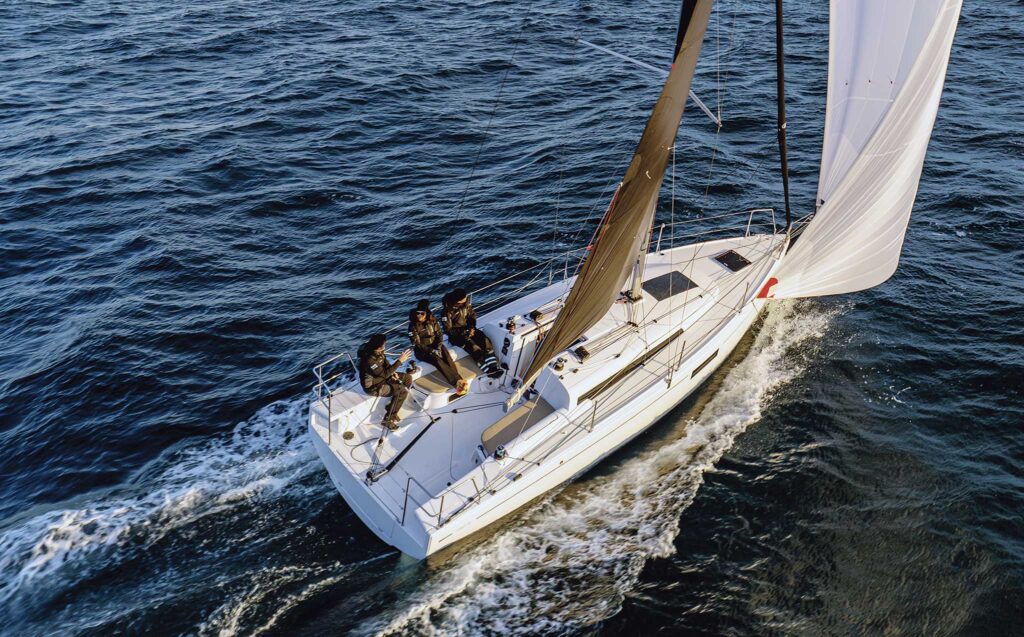
Beneteau First 30
“I love a boat that’s built for someone specific, when the designers have a specific market in mind and really take the time to get to know their prospective owners so that they can innovate and truly create something perfectly suited for them.”
Let’s be honest, this is not going to be the biggest, flashiest, or most comfortable boat on the dock. Beneteau has other models for that. Instead, with this design brief the company aimed for something else entirely: fun at an accessible price point. During our test sail, it was mentioned that this boat’s competition isn’t a similarly sized classic like the J/105 or something new like the Club Swan 28. Instead, it was a wind surfer or kite board. The designers recognized that there are nearly endless ways to enjoy your time on the water, so in order to bring and, crucially, keep people in sailing, it was going to take a fast, fun boat that planed easily, wasn’t too complicated, and could be sold at a price point that would entice first-time boat owners. (It’s not everyone that can stomach the yard bill or elbow grease of a fixer upper.)
With the First 30, Beneteau delivered on that promise in a big way, as evidenced by the 100 hulls sold before the First 30 even made its U.S. debut. The sailing is intuitive without being dumbed down, and a small crew can manage it with space for passengers, beginners, or kids. We sailed the boat on a blustery day on the Chesapeake, and though helming (by tiller) took a little muscle, taking a reef did the trick to fix that without impacting the sporty feel. Belowdeck, things are super simple and designed to keep weight and cost down while still providing the necessary amenities to enjoy a short cruise. All in all, an excellent execution of a design brief targeting an underserved part of the market. Beneteau
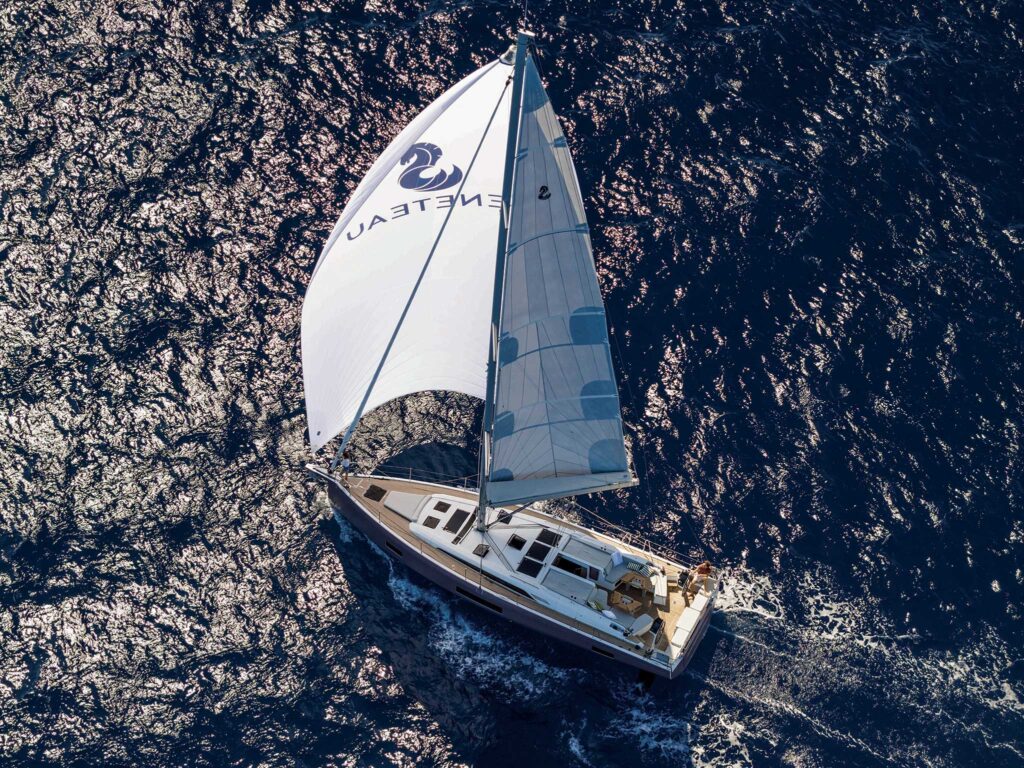
Benteau Oceanis 52
“Each puff brought real acceleration of the slippery hull of the Oceanis 52, and the helm remained fingertip-light. We immediately started a race with the nearest boat and she showed off what she can do on a breezy day.”
Beneteau ushers in the 8th generation of its Oceanis line as the “.1” series morphs into the next iteration. The Biscontini-designed Beneteau 52 replaces the 51.1 as the flagship which squeezes in just below the “Oceanis Yacht Series” that starts at 54 feet.
Benefiting from dealer and owner feedback, the 52 offers a cockpit that’s 30% larger than her predecessor and a new layout that Beneteau is calling their “diamond shape.” Twin settees with two tables form a comfortable social space with enhanced line stowage below. Twin wheels and four winches create a well-designed working cockpit with the throttles atop the starboard binnacle. The transom seat between the wheel lifts to reveal an optional outdoor galley at the drop-down transom. All in all, the result is an elegant, comfortable boat with well considered details. Beneteau
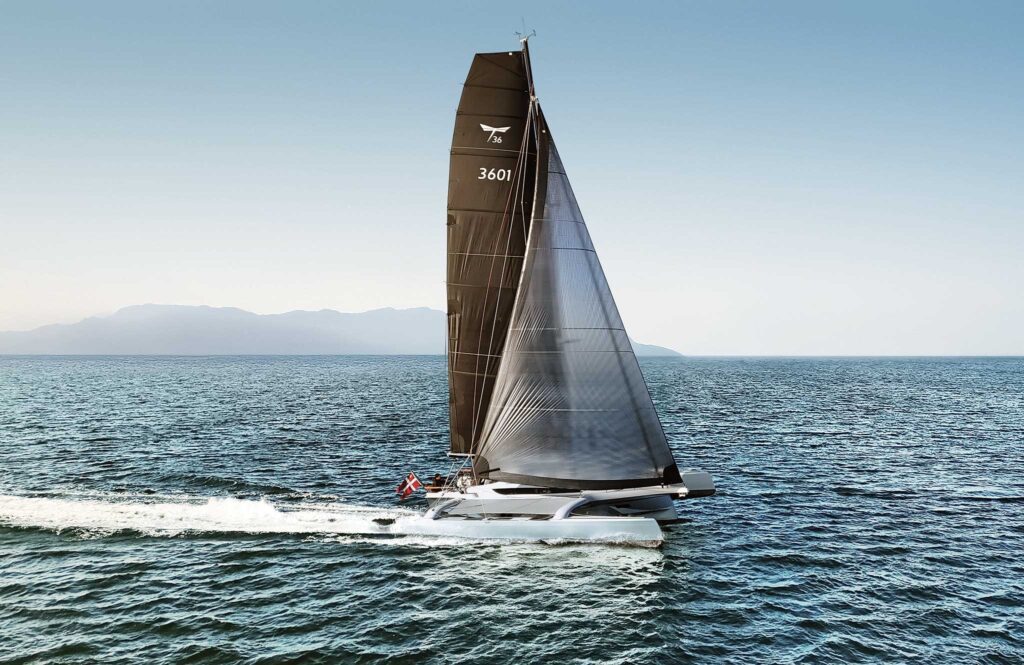
Dragonfly 36
“20 knots of boatspeed without breaking a sweat? Not a problem, even singlehanded. Matching the windspeed is a casual undertaking. The exceptional craftsmanship and innovation hit every inch of the Dragonfly 36—the functionality built into this platform is impressive. It was tough to head back to the dock and fight the urge to continue cruising the 36 throughout Denmark and northern Europe for the rest of the season.”
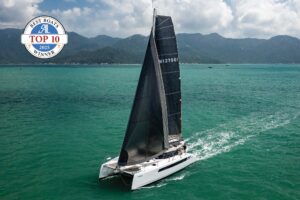
The Dragonfly 36 operates at an entirely different level. While this trimaran would be capable of performing well on a race course, it was envisioned as a performance cruiser and simply exceeds expectations on that front. This is an adventure platform. And a very fast one at that. Dragonfly reinvented their already impressive folding technology by shifting to integrated composite components, increasing stiffness and longevity—like previous models, the amas fold in closely to the main hull to allow for docking in a monohull slip and more flexibility for storage and transport on land. The twin-helm cockpit is designed for shorthanded sailing but leaves plenty of room for guests to be clear of the action. The flexible sail plan, stability, and smooth motion (from the wave-piercing hull), leave any sailor comfortable, and with plenty of room to hit the accelerator. Below deck, the main cabin is warm and bright, with an impressive 6’6” of headroom. It’s easy to imagine yourself gathered around the table with six other friends, recounting the day getting to your remote anchorage and deciding where to rendezvous tomorrow. Dragonfly Trimaran
Excess 13
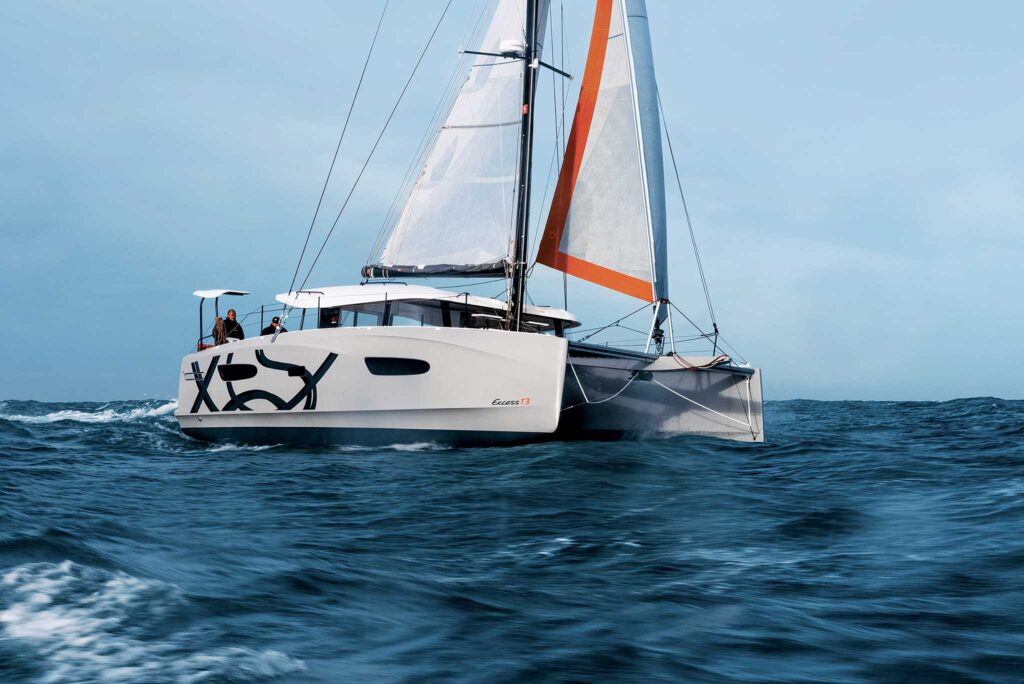
“Our test sail on the Excess 13 was, hands-down, the highlight of a week of sailing lots of great boats. She’s self-assured, delivering double digit speeds while building confidence in the crew.”
The Excess line of cruising catamarans launched just six years ago with a value proposition that was sketchy at first but changed with the arrival of brand director Thibaut de Montvelon who made the design live up to its promise. The Excess 13 is now the third model in the current line and the 43-footer hauled the mail on a cold and windy test day.
A signature mark of the Excess line is the twin helms aft on the hulls that are designed to contribute to the feeling of wind-in-the-hair sailing. The positioning of the wheels makes backing into a slip easy with excellent visibility. Surprisingly, you can actually see through the large salon windows to the opposite bow as well. With her low profile and angled coachroof, the Excess 13 looks more like a premium performance cat than a family-friendly cruiser, but she’s designed for easy handling and loads of comfort. Excess Catamaran
HH52
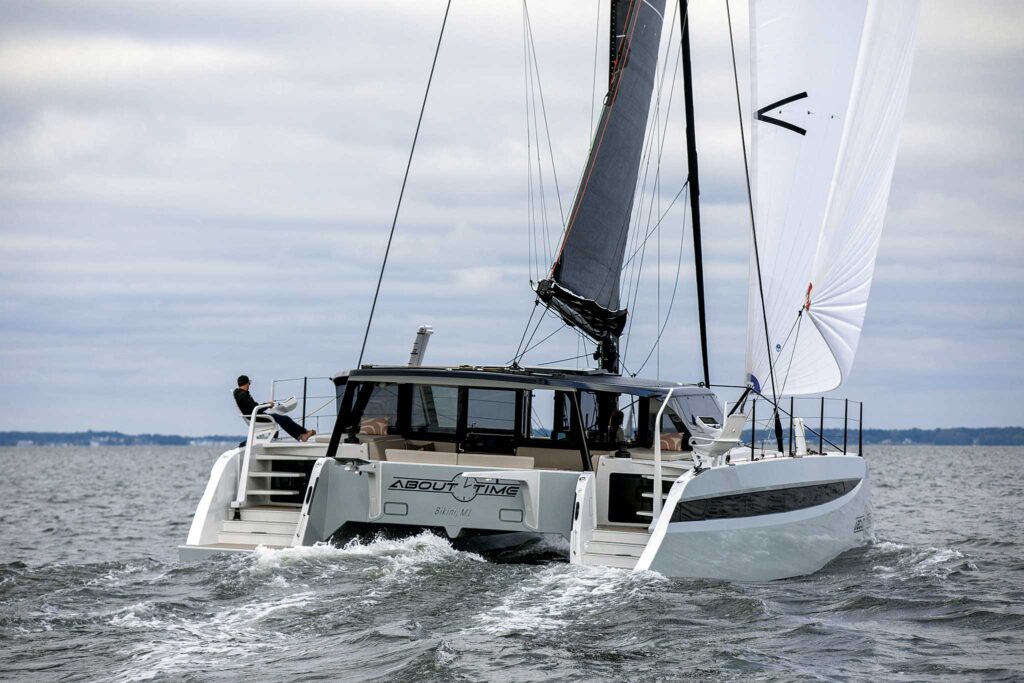
“The bigger and more techy a boats get, the more often you lose that the sense of being in touch with the wind and the waves. Not so on the H52. The outboard helms really deliver that wind-in-your-hair, joy-of-sailing feeling to the luxury package of a 53-footer.”
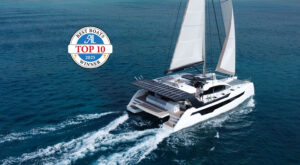
The HH52 is a machine, highly customizable and engineered for luxury and performance. It comes in an Ocean Cruising (50/50 e-glass/carbon) or Sport Cruising (100% carbon fiber) version. Line controls are led to a forward working cockpit between the mast and an interior helm fit to run a space launch. It’s a well engineered space with most everything in arm’s reach, though for some, an easy step up to the main deck level will be needed to get to higher things on the mast. Turning sheaves are cleverly placed around the cockpit to help make the best use of the winches and save you from any “creatively” run lines.
One standout option on this boat is the tiller steering by way of two aft seats that bring the driver’s sightlines outboard of the lifelines for a real flying-over-the-water feeling. An integrated display with controls for adjusting the mainsheet and traveler via electric winch really ushers in a new version of push-button sailing. Tiller steering on a 50+ foot boat probably won’t be the usual way owners get around, but for a gentle twilight cruise or a speed run when the wind is up, there will be nothing like it. HH Catamarans
J/7
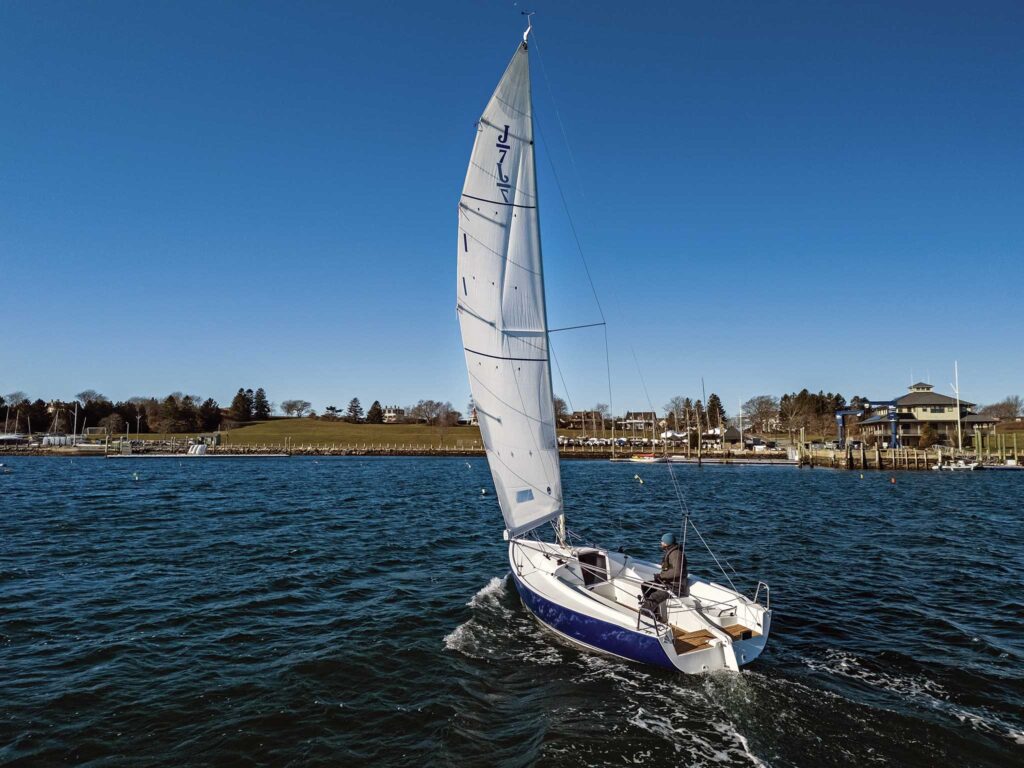
“It may have been a cold December day when we first sailed the J/7 out of Sail Newport, but the smiles and smooth maneuvers kept us warm and wanting more. From the moment I stepped on board, it was clear J/Boats put as much thought into this design as one of twice this size—everything just lines up and it’s beautiful to sail.”
The J/7 answers the call for honest and straightforward sailing. While it is similar in size to the J/22, that is about all it shares—it’s an entirely fresh design. The helm is beautifully balanced, with a perfect amount of feel, and whether stepping on the rail or sailing upwind, there is a considerable increase in stiffness. This design is quick and doesn’t hesitate to accelerate with the puffs. A spacious cockpit, with seating options to reflect the conditions or your preference (outboard or inboard), also includes comfortable seating aft of the helmsman, amidst the semi-open transom, giving it an edge on being an exceptional teaching platform. The J/7 is manageable alone or with friends, and with either the main, jib, or the combination. This concept of balanced flexibility extends to an optional sprit for an asymmetrical spinnaker, or the ability to use a conventional spinnaker and a pole. The rigging is straightforward, even forgoing a traveler for a bridle. The basic interior allows simple overnights in an anchorage of your choice, and the trailerable aspect places dry sailing and traveling to regattas within easy reach. J/Boats
Jeanneau Sun Odyssey 415
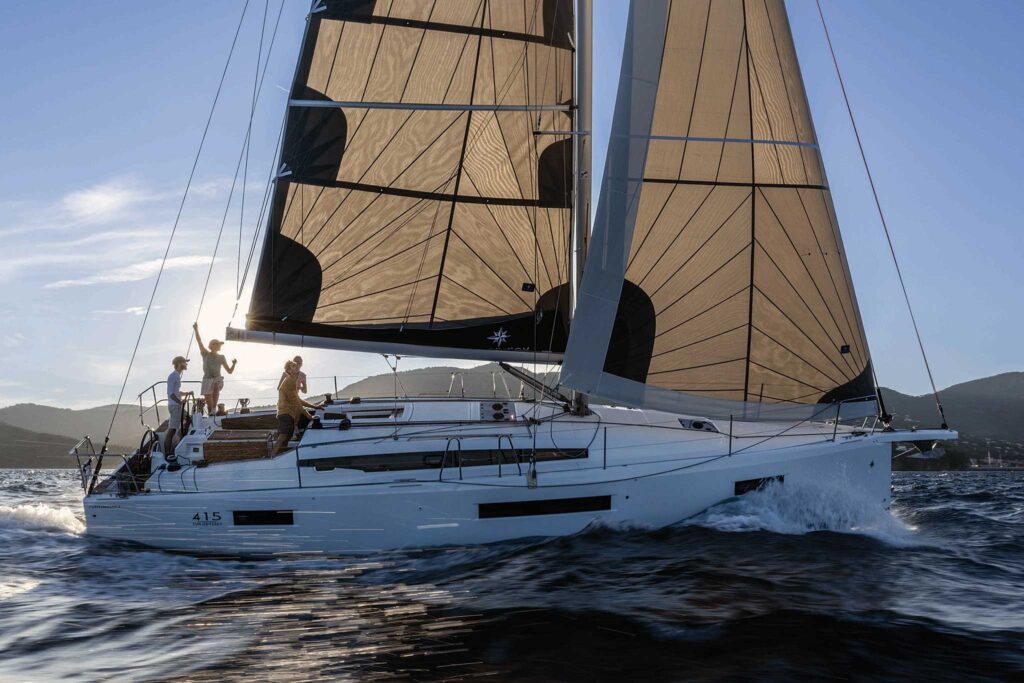
“On our test sail in 15-18 knots of true wind, the 415 held her own against boats with a longer waterline while feeling like an easy-going cruiser that won’t overpower either her crew or their wallet.”
With a new keel, the same twin rudders and the same rig as her predecessor, the new Jeanneau Sun Odyssey 415 represents an evolutionary rather than revolutionary change. The new design was created on the Jeanneau 410 hull and added a revamped deck and interior. Twin wheels are just ahead of the manual drop transom with plenty of space left outboard for Jeanneau’s signature walk around deck that means no more climbing over the cockpit coaming. The rig offers an overlapping genoa for better performance and a taller mast in the Performance Pack for respectable performance. Below, three cabins are available although perhaps the best use of space is one aft cabin and a stowage room with a single large head. Jeanneau opted to return to a more traditional layout with a L-shaped galley aft to port and a desk with fore and aft seats to starboard. Jeanneau Yachts
Lagoon 38
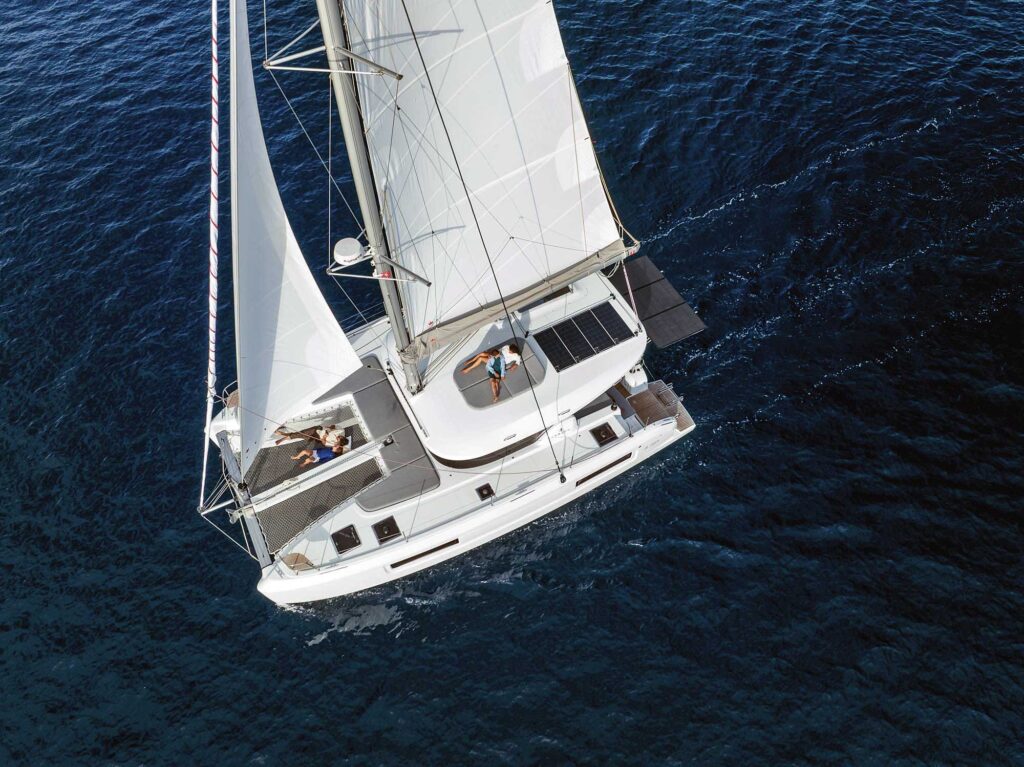
“Lagoon has spent years trying to design the next iteration of a small and accessible cat and with Lagoon 38, they’ve created a tidy package that has all it needs to live up to and possibly surpass her phenomenally successful predecessor.”
Approximately 1,000 units of the Lagoon 380 were built and now the new Lagoon 38 is poised to try and fill those big shoes. The new platform leverages all the space a small cat can offer. The cockpit feels like one on a boat five feet longer and the overall use of deck space has been optimized from the asymmetrical forward trampoline to the sunbed on the Bimini. The galley is in a straight line against the forward bulkhead, which opens up the salon that flows along the port side to the cockpit. The owner’s version offers an enormous shower aft and a wide bed forward that’s made possible by the hard chine which widens the hull above the waterline. Total upwind sail area is 836 square feet with a self-tacking jib for easy short-handed sailing. Lagoon Catamarans
Pegasus 50
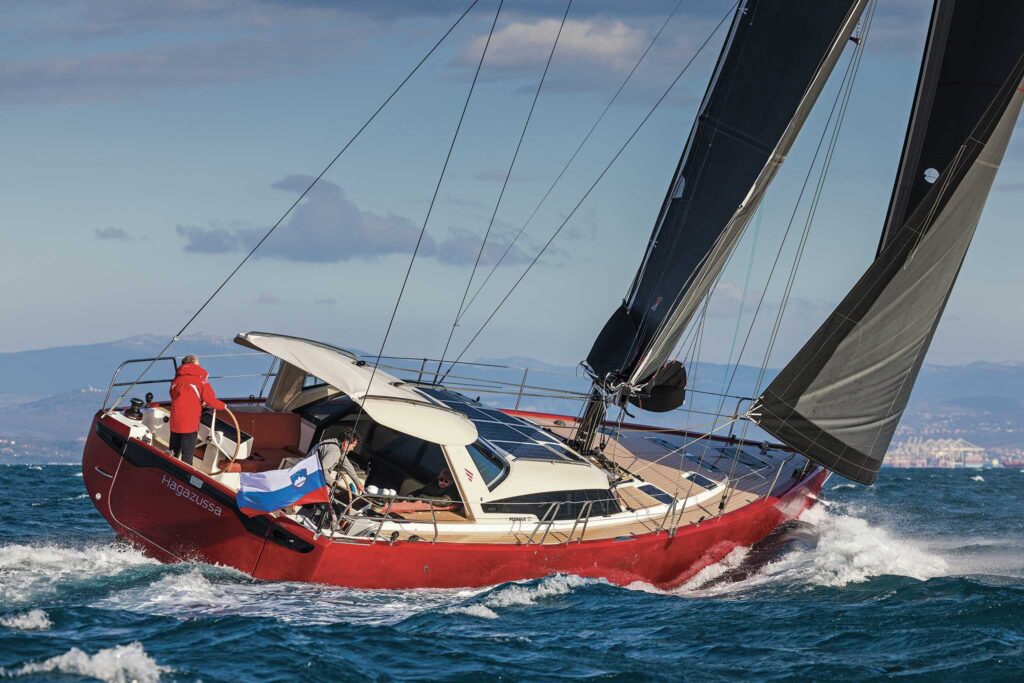
“It’s not often that the whole review team goes through a boat independently, and the immediate conclusion for all of us is ‘yes, that’s a winner,’ but there’s something irresistible about the Pegasus 50.”
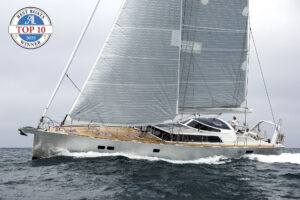
We knew the Slovenian-built Pegasus 50 was going to be a standout from first glance, and it’s elegant, classic lines belie a true feat of innovation and engineering. Designed with the bluewater passagemaker in mind, stellar sailing was a top priority, achieved by taking some cues from the racing world. Case in point is the America’s Cup-inspired tandem keel, which maintains the boat’s longitudinal stability without compromising on speed potential. Carbon is used throughout to keep the boat light and responsive. The mast has been moved aft, putting the most power in the sails that are easiest to shorten if need be, while simultaneously shortening the boom, which keeps weight low and improves the boat’s motion. All of this comes together to create one of the smoothest, most refined sailers on the market. Pegasus Yachts
Belowdecks, the real stand out is a gimbaled salon table/booth that can be canted as one unit in order to make a level surface for eating or working while at sea. In the galley, drawers have designated shapes to keep everything exactly in place (all accessories down to the bed linens and silverware come with the boat on delivery), and it’s attention to these sorts of details really set this boat apart as true blue water sailor’s dream boat.
Special Mention
XR 41
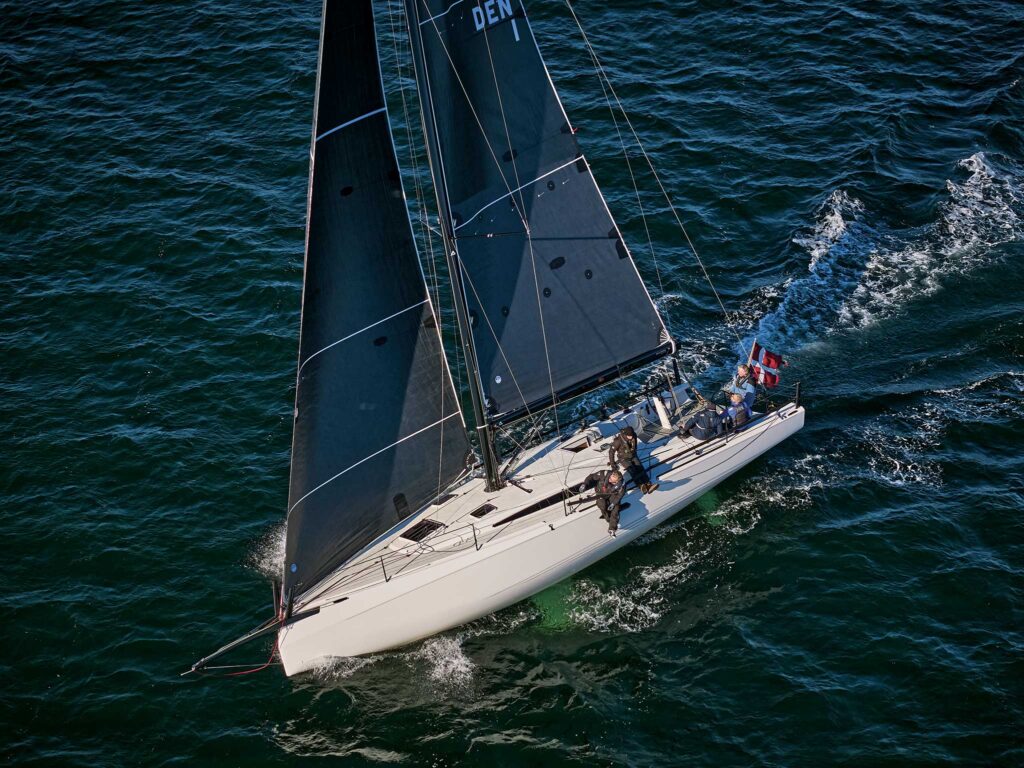
SAIL’s Top 10 Best Boats competition celebrates the best of new design and innovation. However, since our criteria stipulates that a boat is eligible only if it debuts in the United States that calendar year, boats that don’t make it to stateside shows in a timely manner can be left out of consideration. That’s why this year we’re awarding our special mention to X-Yachts and their fantastic new XR 41.
X-Yachts set ambitious goals when they launched the XR 41. Not only did they aspire to win the ORC world championship in year one, but they also intended for it to be a flexible enough platform to cruise. And they delivered on all of it. The XR 41 won the world championships in Tallinn, Estonia in August of 2025 (an XR 41 also took second place), and the clever modular interior allows comfort to quickly be swapped in for cruising with the family. The cockpit is efficiently laid out, with details even going as far as the angles on deck to keep the crew as dry as possible. Impressive Danish craftsmanship throughout locks in a stiff and stylish hull, while the systems onboard are composed of the latest reliable technology.
The XR 41 was designed from the ground up, and it shows in every aspect. The ORC title is just the beginning—expect to see much more from this design. And though it’s a special mention because it’s not in the U.S. yet, deliveries are expected soon—watch out on the race course or a beautiful cruising anchorage for this impressive design. X-Yachts
“Delivering this boat across eastern Denmark was a treat! An A2 Spinnaker run into the night for a hundred miles almost never saw our boat speed drop below double digits, and the spray of the cool Kattegat Strait waters was deflected by the thoughtful hull design. The XR 41 would lock in on the chine and remain incredibly stiff, turning every puff into pure acceleration.”
Ed note—This year we had enough dinghies eligible for the contest to break them out into their own category, which will be announced in our summer small boats issue. Stay tuned for more Best Boats!
Meet the Team
SAIL’s boat review team represents decades of experience in the marine industry, not just as journalists but also as professionals who use, fix, and improve boats and systems. This—plus a healthy mix of chartering, cruising, and racing experience—gives us a genuine understanding of how owners will use these boats and what design innovations will serve sailors well.
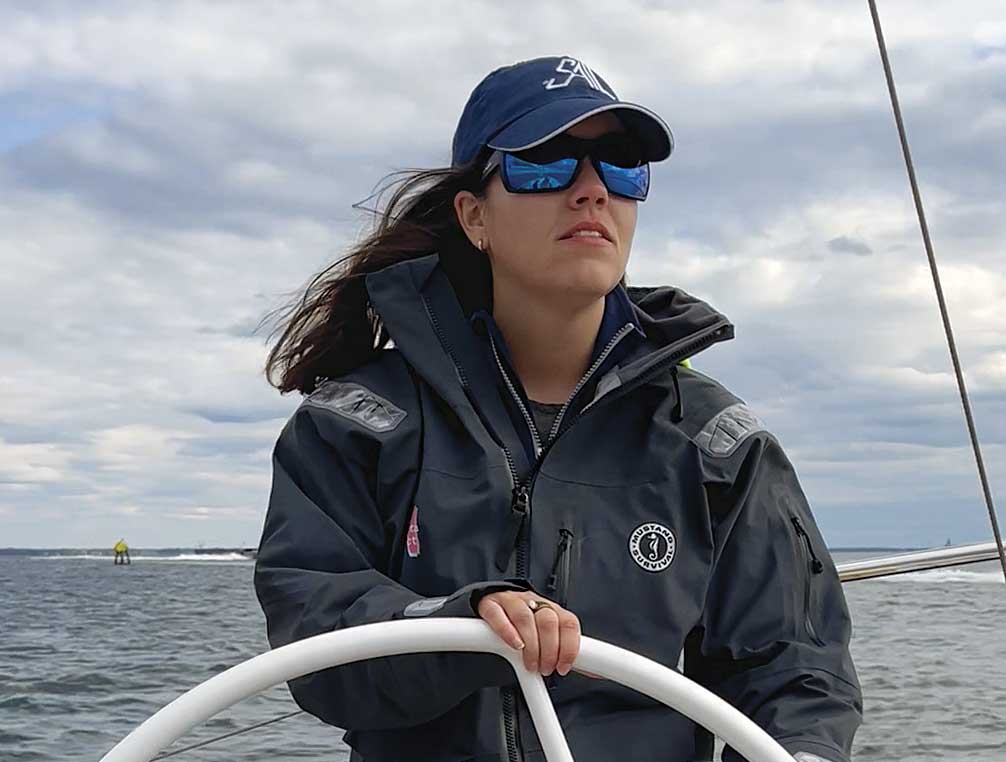
Lydia Mullan SAIL Editor in Chief
Lydia Mullan is the editor-in-chief of SAIL magazine and Multihull Power and Sail. In her eight years with SAIL, she has published over 450 articles. She has twice been named the marine industry’s best adventure writer by Boating Writers International (2023, 2024), as well as being recognized for her articles about seamanship, the environment, and women in boating. Mullan is a lifelong sailor, with a particular passion for offshore racing. She was the race commentator for the 2025 Transpac and 2025 Marblehead-Halifax, a 2024 Magenta Project graduate, and the media manager for Cole Brauer’s viral circumnavigation.
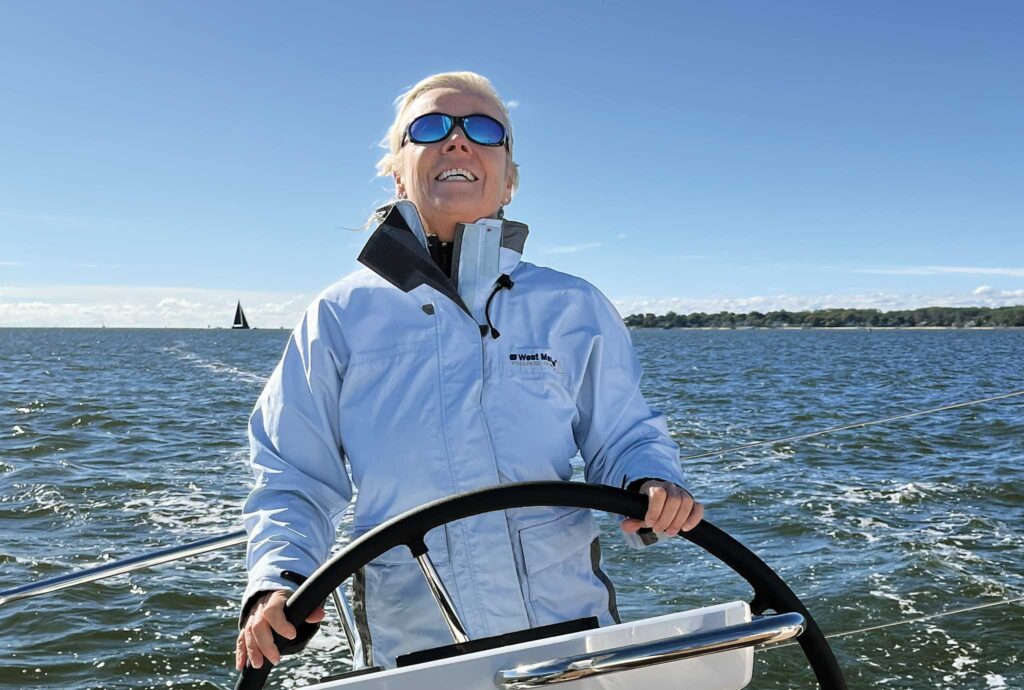
Zuzana Prochazka SAIL Charter Editor
Zuzana is a USCG 100-ton master who logs countless miles on all kinds of boats around the world and never misses an opportunity to raise a sail or crawl into the engine room. She started sailing in California during grad school when she capsized her Lido 14 on the first day—an inauspicious start to a lifelong love of sailing and her career in the industry. She serves as an international presenter on charter, safety, and technical topics, and is the executive director for the board of Boating Writers International.

Adam Cove SAIL Technical Editor
SAIL Technical Editor Adam Cove is a naval architect and marine engineer (University of Michigan) and trained under David Pedrick. He previously gathered experience as a boatbuilder, rigger, and sailmaker, before adding an MBA and becoming CEO of Edson Marine. He currently operates as director of Cove Marine Consulting and is president of Sail America. Adam grew up sailing on the south coast of Cape Cod, captained his high school and college racing teams, and can regularly be found racing around the buoys in New England or heading offshore. He has singlehanded his Luders 33 back and forth to the Caribbean, via the offshore route, and recently completed the 750-nautical-mile Race to Alaska singlehanded in a Marshall 18, setting two course records.
Emeritus Team Members
We call on them to delve into a design or builder’s history, and answer questions when we are stumped.
Wendy Mitman Clarke, former SAIL Editor-in-Chief, logged some 30,000 bluewater miles during four and a half years of fulltime cruising on an Adams 45 with her husband and kids. Her experience also includes offshore racing, dinghies, and everything in between. During her time at the helm of SAIL, the magazine was the most awarded publication in marine journalism two years running.
Charles J. Doane, SAIL Cruising Editor, has been testing boats for the magazine for over 20 years. He is an avid coastal and bluewater cruiser, has crossed the Atlantic seven times, and has crewed in several distance races.
January/February 2026