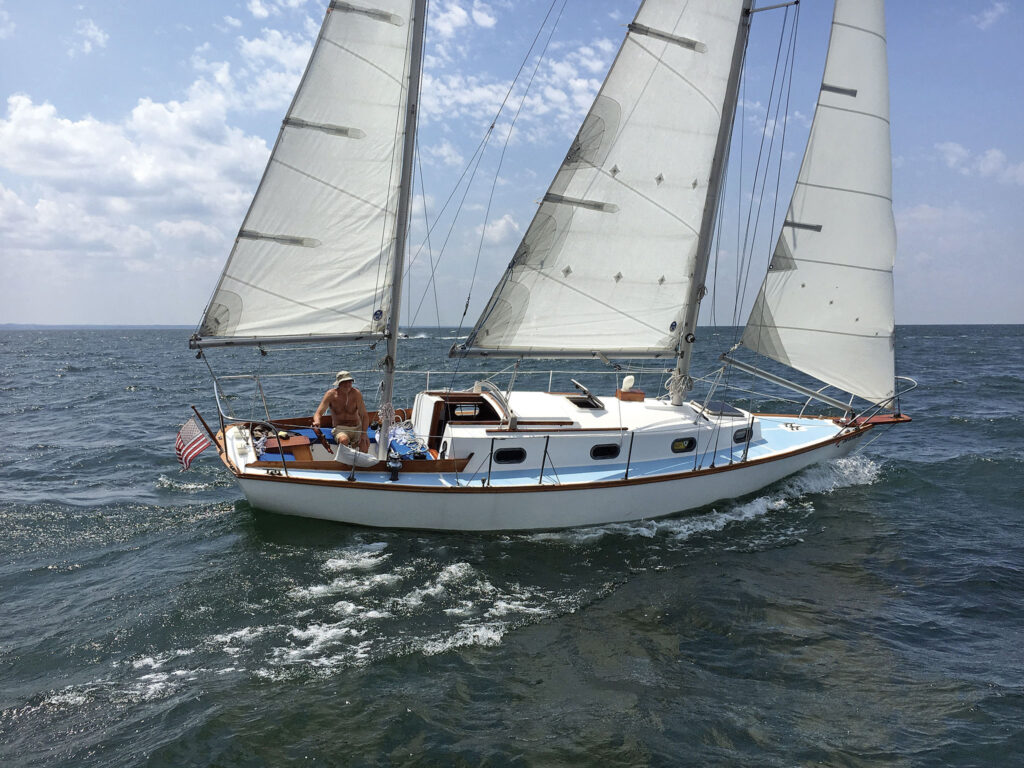
It was the week before Memorial Day and the weather forecast looked perfect for a three-day sail in Valhalla, my 1977 Cape Dory 30 K, on Lake Erie from Lorain, Ohio, to the Lake Erie Islands and back. There was just one possible hitch—a predicted backdoor cold front.
By its very name, the backdoor cold front should have given me pause, since something coming in through the backdoor can be associated with not being quite on the up and up. In weather terms, it refers to “a cold front moving south or southwest along the Atlantic seaboard and Great Lakes,” according to the National Weather Service glossary. “These are especially common during the spring months.” Because they arrive from the east, opposite of typical cold fronts, they’re coming in through the “back door,” hence the name. And, they typically drive cooler Atlantic air across the warmer landmass, a recipe for potential volatility.
I had heard the term backdoor cold front, but I don’t believe I had ever experienced one up close and personal. The local weatherman referred to it as a “dry cold front,” and with it a cloudless transition from warmer southwest breezes to strong northeast winds.
The trick was to ride a predicted east wind at first out to the islands and enjoy two days of rain-free good weather and return on day three with predicted southwest breezes ahead of the front. After a pleasant sojourn to the islands, I made the decision to shove off at sunrise and ride the southwest breeze and hopefully be back in Lorain by 1 p.m., well before the front was expected to arrive in the late afternoon.
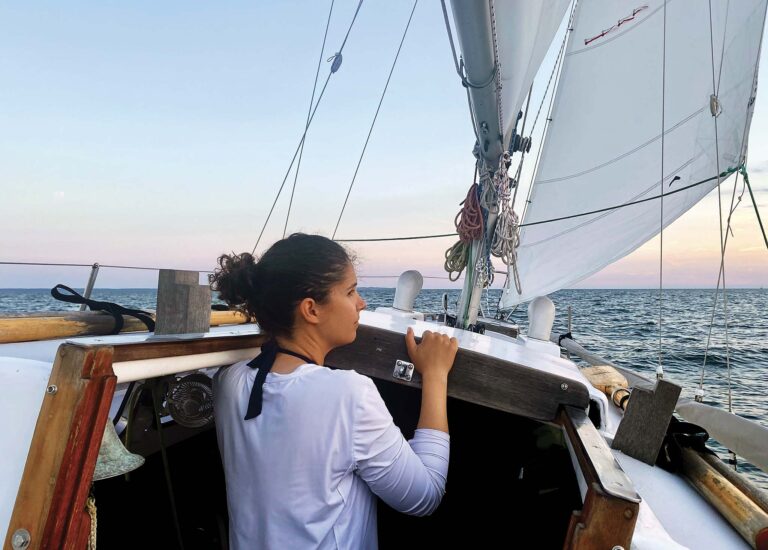
Once underway, I discovered a completely flat lake. It was a cloudless sunrise with beautiful colors of gold, orange, and lavender reflecting off the water. I rounded the southeast corner of Kelley’s Island and picked my way through a group of fishing boats, some drifting, some with their electric trolling motors suspended off their bows. The scene was so peaceful that I motored the first two hours with my engine at idle, making about 2.5 knots. It seemed criminal to crank it up to cruising speed and disrupt the stillness of the morning. In the distance a freighter crossed my bow and slid beneath the golden ball rising above the horizon.
As a matter of course, I tuned into the National Weather Service on the VHF, and an update jarred my early morning reverie. Small craft warnings were posted starting at 2 p.m. with winds out of the northeast at 30 knots and waves building to 9 feet.
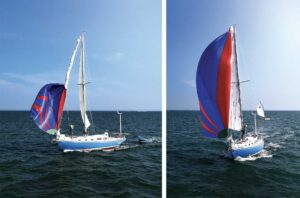
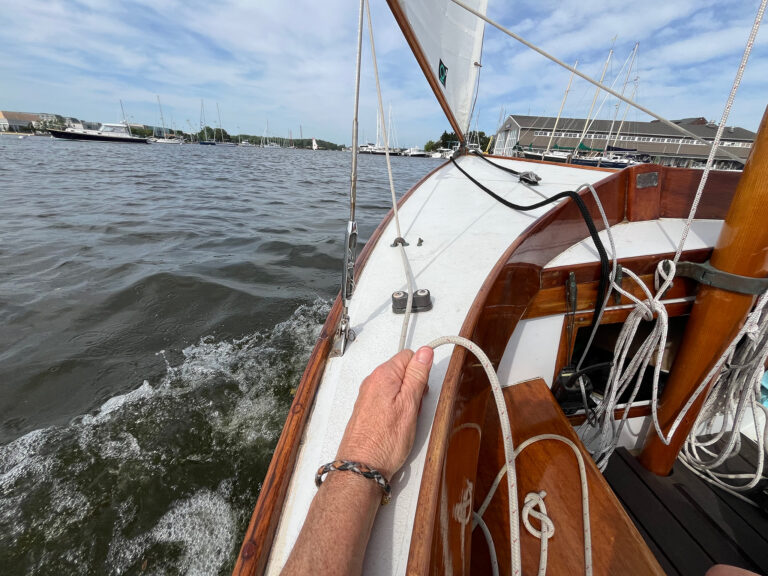
Before I could push the throttle and get Valhalla up to speed, I noticed some ripples on the water, streams of breezes moving across the lake. I secured the engine and set all sail including my mizzen staysail. A small ketch rig is a wonderful boat for people who sail alone. My Cape Dory is such a boat, and for downwind sailing the mizzen staysail is easy to handle without the need to set poles and leave the security of the cockpit. In complete silence the boat began to slide ahead at 3 knots. A standing rule on my boat is that I would rather sail at 3 knots than motor at 4, so I was happy. Within the hour I was making 5 knots with a wonderful southwest breeze and facing 22 miles to Lorain with an ETA of 1 p.m. All was well in the world.
But weather on Lake Erie, especially in May, offers no guarantees. With about 15 miles to go I noticed that the wind was clocking more around to the west. The first sign of this was when the 150 started to hang limp in the shadow of the mainsail. Thank God for the little voice in my head, or maybe my grandfather speaking to me, but what better time to take in some sail. So, with Kelley’s Island now merely a slim gray line on the horizon I dropped the mizzen staysail and then switched from the 150 to the small club-footed working jib.
All this was easily done as the lake was still quite flat. Once all secure and back on course I noticed that the wind had come so far around into the north that I needed to jibe to make Lorain, which was now beginning to appear on the distant horizon. But did I make the right decision? Under reduced sail I was now back to 4 knots and Lorain was still hours away.
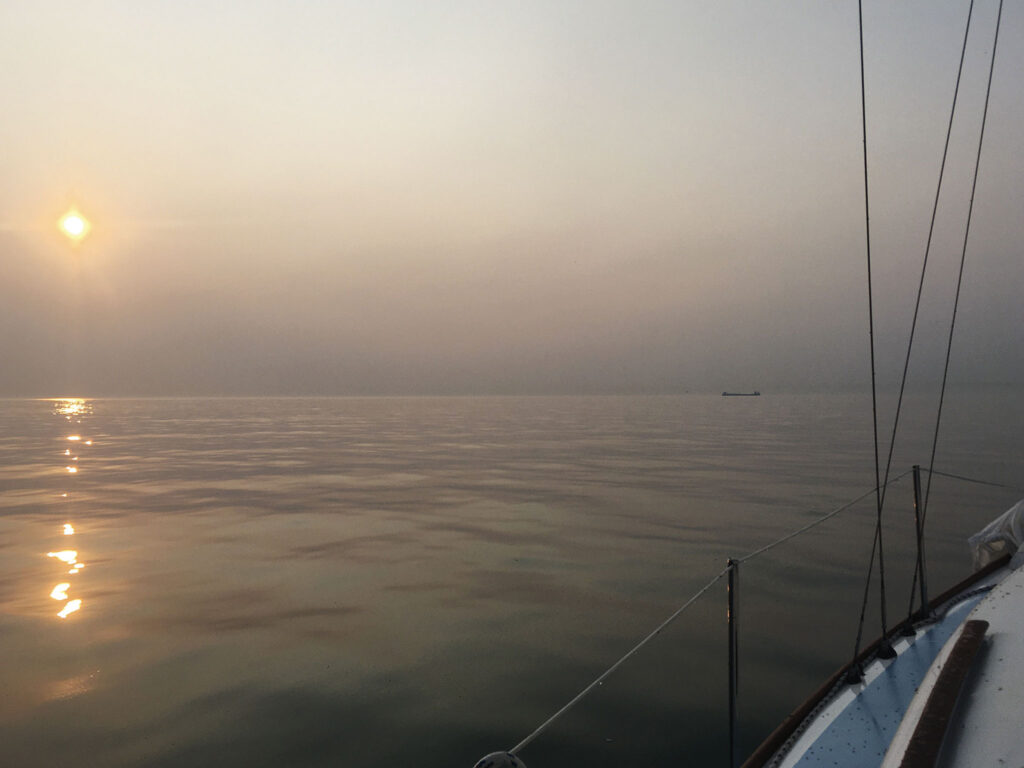
I guess one thing I have learned over a lifetime of sailing is it’s very unlikely that a sailboat will be able to outrun the arrival of any weather (unless it’s something like a foiling ocean racer). And while the sky was still completely clear and the sun was beginning to provide some much appreciated warmth, I had to squelch the impulse to crank up the diesel and push hard for home. I did sense something was happening, and I felt secure in my decision to reduce sail. So I drifted along for another 30 minutes wondering if this was all there was, a wind shift and a cooler 10-knot breeze coming from the north.
And then it happened. Out of the clear blue sky, without warning the wind began to ramp up. I could see to the north the water appeared nearly airborne, skimming across the surface of the still flat lake. It hit Valhalla like a solid wall of wind. For the most part it was still off my port beam, and I kept the boat downwind and hoped for the best. My GPS speed immediately jumped from 5 to 6 knots, and as the gusts continued to increase, 6.5 to 7 and then 7.5. I have seen 8 knots before, running down large waves in a good wind, but not 8 on flat water. It topped out at 8.3 knots. Making well beyond hull speed for sure, the largest wave I could see on the lake was my own wake, now beginning to crest and standing nearly 2 feet high.
I’m sure many sailors have experienced this before, that dry mouth, heart in your throat, shaking at the knees feeling.
Fear.
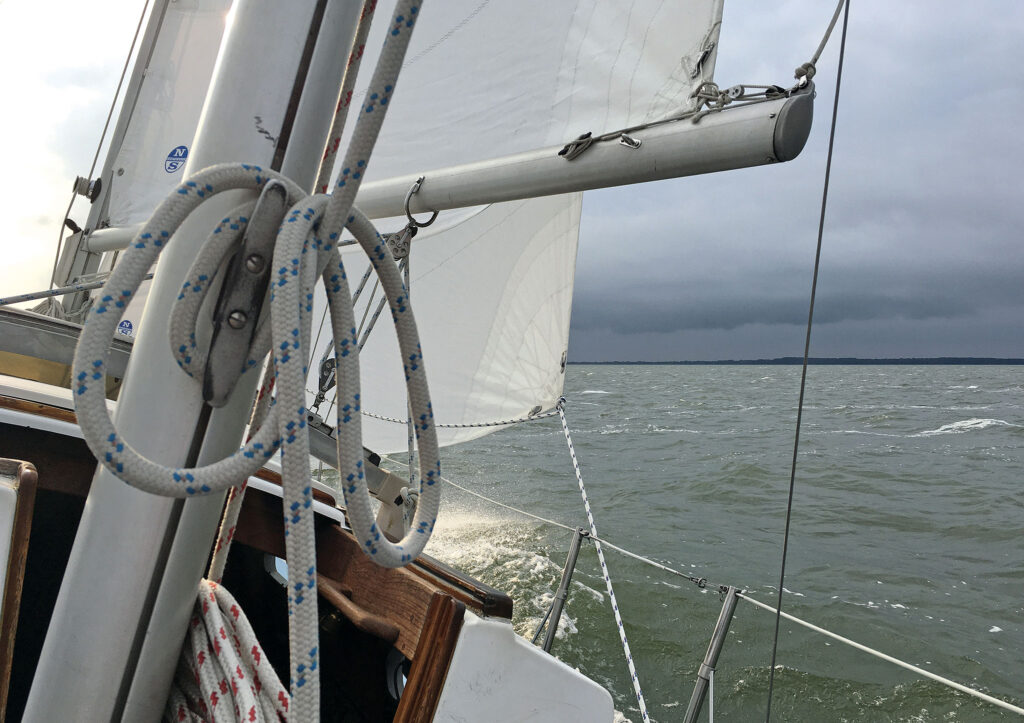
Of course, I knew what I had to do, I had to slow the boat down, I had to drop the mainsail. By the time I realized this, the waves were already beginning to build and were crashing against the windward side. The spray was ripping across the deck and cabintop. The rigging was making that screaming sound in the gusts, that sound that tells me 30, maybe 40 knots. This is where one has to love a solid, full-keel boat, especially a ketch. As I allowed the boat to swing closer to the wind I cranked in the jib and mizzen, and as the main began to flail the two small sails took the brunt of the wind and held the boat solid on course allowing me to scamper to the mast and drop the main.
Needless to say, it came down with some coaxing, but I managed to get it down and tied to the boom. I did a completely deplorable job of lashing the beast while exhausting my entire vocabulary of nasty words. But back in the cockpit and back on course with just working jib and mizzen, I was once again at a reasonable 6 knots. It did not take long for the wind to subside but never below 20 knots. I rode out the last 14 miles without any concerns and thought about my decision to drop the staysail and 150 ahead of the arrival of the front. Had I not, at the very least I would have lost or damaged the staysail and 150, and at worst been knocked down or lost the rig.
At 1 p.m. I sailed Valhalla right into my marina, and with only two small sails to drop I quickly had the boat under power and headed into my dock. A welcome reception from another boater took my bow line and just like that, I was back home, safe and sound.
What I Did Wrong:
• I gambled that I had plenty of time to make the 28-mile sail before what had been a predicted “late afternoon arrival of a cold front.” Though I got a good early start at 6 a.m., I should have powered along at 5 knots in the flat calm and put 10 miles behind me before the arrival of the first west breeze at 8 a.m.
• I never anticipated that such an animal as a backdoor cold front could generate such a sudden and strong wind. I know better now.
• I took the weather forecast as gospel. Even today, with all the technology and tools, timing such events can be a challenge.
What I Did Right:
• Looking at the weather the afternoon before, I sailed over to Seaway Marina on the southeast corner of Kelley’s Island and took a slip for the night. This gave me a 12-mile head start, as the return trip from the Bass Islands is about 40 miles.
• Even though at the time the conditions did not merit a reduction of sail, I wisely took Valhalla to working sails while the lake was still flat. The trade off was to give up a few knots of speed and accept the fact that I may not make harbor before the arrival of the front.
• During the blow I could feel pulses of wind, at times well above 30 knots. As soon as I sensed a reduction, I adjusted my two smaller sails, eased the boat into the wind, and secured the mainsail. Knowing my boat and how it will respond in extreme conditions provided the confidence I needed to drop the main in those conditions.
June 2025