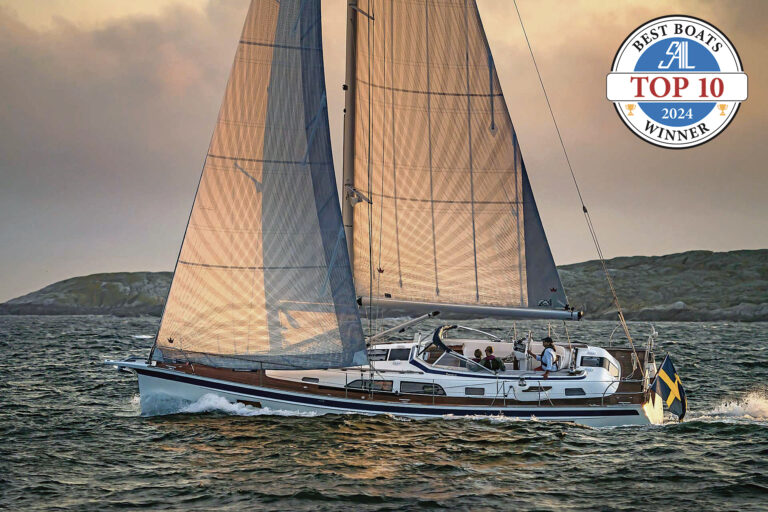
There’s something about a raised deckhouse yacht that puts me in mind of late summer sailing. Temperatures are still clement enough during the day, but there’s a nip in the air at night, and you want to be tucked up inside for your morning coffee. Where better than behind a layer of insulating glass that still lets you survey the anchorage?
With the recent launch of the new Heyman 42 Pocket Pilot House (PPH), deckhouse design has returned to its roots. From the comfortable motor-sailers and trawlers of the past, via the sleeker raised salons of Wauquiez, Amel, and Discovery, the Heyman puts the salon back at cockpit level.
Hardly surprising, then, that its distinctive form stopped me in my tracks as I weaved through the Düsseldorf boat show last January. Here was a boat that piqued the curiosity—something only heightened by the unapologetically individual outlook of its designer, Gabriel Heyman of Gothenburg, Sweden.
“I call it a 2+2 design, like a sports car,” he explained to me. “It is for a couple, but can also be family friendly.” What does that mean? Well, it means that the emphasis is on a single, comfortable forward cabin for the owners, with an additional guest cabin amidships. There’s plenty of entertaining space, a drop-down bathing platform, dinghy davits and the boat is designed for easily handling with a self-tacking jib.
If you’re not familiar with Heyman as a designer, you’re in good company. Although a naval architect by training, he spent much of his career in the medical profession. That didn’t stop him drawing the highly regarded Fantasi 44 in 1995—the same year he won a Yachting World design competition with a 43ft concept called Freya. But only recently did Heyman began to focus on a line of yachts carrying his own name.
And by “recently,” I mean 15 years ago, for that’s when he first sat down to work on his ideal double-handed yacht. He is unabashed by the boat’s long gestation. “We spent eight years on development,” he told me. “We undertook tank testing and ran intense computer simulations, which both led to very profound design alterations.”
One of these involved moving the keel aft by more than 3ft to achieve a better balance between speed and pitching in a sea—something that the CFD modeling had gotten wrong. Heyman is plowing a lonely furrow here, with a long, stubby fin keel, a fine wave-piercing bow with a hint of flare, and a broad beam. A low aspect ratio rig lowers the center of effort making the boat easily driven, stable and fast—all with a shallow ICW draft of just 4ft 10in.
Although designed in Gothenburg, the Heyman 42 is actually built by the experienced laminators at Ridas in Estonia. Heyman specifies high quality vinylester lay-up to eliminate the risk of osmosis, vacuum infused around a Divinycell core for stiffness and lighter weight. This is not a light boat, however. It displaces 12.5 tons—on a par with other deck salon yachts, such as the Moody DS41 (12.3 tons).
Heyman’s unique hull shape makes the boat surprisingly fleet for a deck salon yacht, as becomes clear during a gusty spring test sail off Germany’s Baltic coast in the company of US dealer Joe Brase. With winds up to 20 knots out of a sun-scorched sky, we easily hit hull speed under full main and reacher at around 50 degrees off the apparent wind. At 8.5 knots, though, there’s a fair amount of weather helm, causing us to broach a couple of times.
We decide to shorten sail, furling the big reacher in the lee of the self-tacking jib (a standard feature). Electric in-mast furling from Selden makes it even quicker to put two reefs in the main. Feeling better balanced now, the boat is lither and easier to handle, responding well to the challenge of short tacking back up the channel to the marina. Lacking a centerboard, she comfortably manages 90-degree tacks, but isn’t especially close-winded.
Performance in lighter winds is also decent. We still manage a fast 7.8 knots reaching into 15 knots of true breeze and a respectable 5.2 knots going downwind later in 10kn of wind. In light airs, the boat matches wind speed on a reach—testament to the efficiency of the hull.
Protection in the cockpit is excellent thanks to the relatively high topsides and the sheer depth gained from moving all the accommodation forward of the cockpit—it’s just stowage and technical space below the sole. The beam is carried aft creating space for twin tables in the middle of the cockpit, and there are superb passage seats up on the quarter, overhanging the transom. For the helmsperson, there’s a bench seat behind each pedestal.
Wide side decks lead to the foredeck, where there is a huge sail locker and watertight space for fenders and warps, which also acts as a crash box. Solar panels laid on the leading edge of the coachroof are on articulated panels which can be propped open to serve as backrests when lounging up at the bow. It’s a neat solution.
With flush decking from the cockpit into the raised salon, there is a price to be paid in order to achieve that European A-rating. A large cockpit sump by the companionway diverts water from heading below, while a slit under the opening transom lets it sluice out aft. The drawback is that water can also drain back in when you’re hard pressed, and I found myself with unexpectedly wet feet a couple of times.
Hull number one has just a pair of winches: beautiful stainless-steel Andersen 50s on the coaming with push-button electric controls. The main is furled in the mast, while the headsail and reacher have their own under-deck electric furlers. The jib is a self-tacker whose sheet can just be locked off on a clutch and forgotten about when beating upwind. To my mind, though, an additional pair of winches would be an advantage because of the way the sheets are rigged.
Between the German mainsheet system and lighter Dyneema preventers all led back through the coaming to the helm station, things can get a bit congested around the winches—particularly when jibing. And because the furling buttons are on the port pedestal, singlehanders have to lead the starboard sheet around the starboard winch like a turning block, and across the cockpit to the port winch in order to handle everything at the same time.
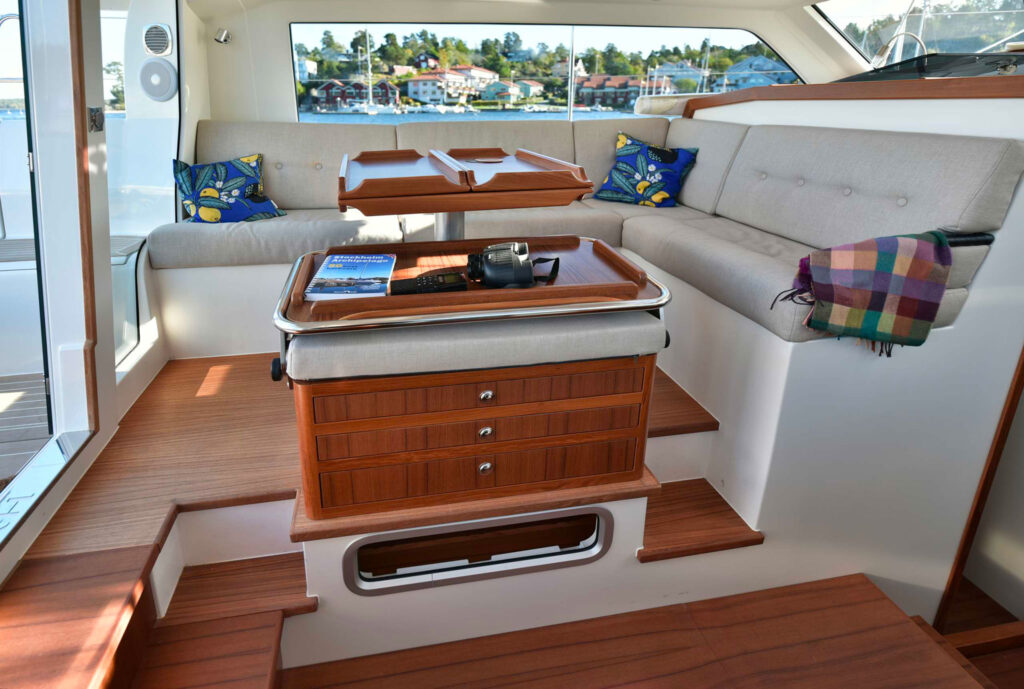
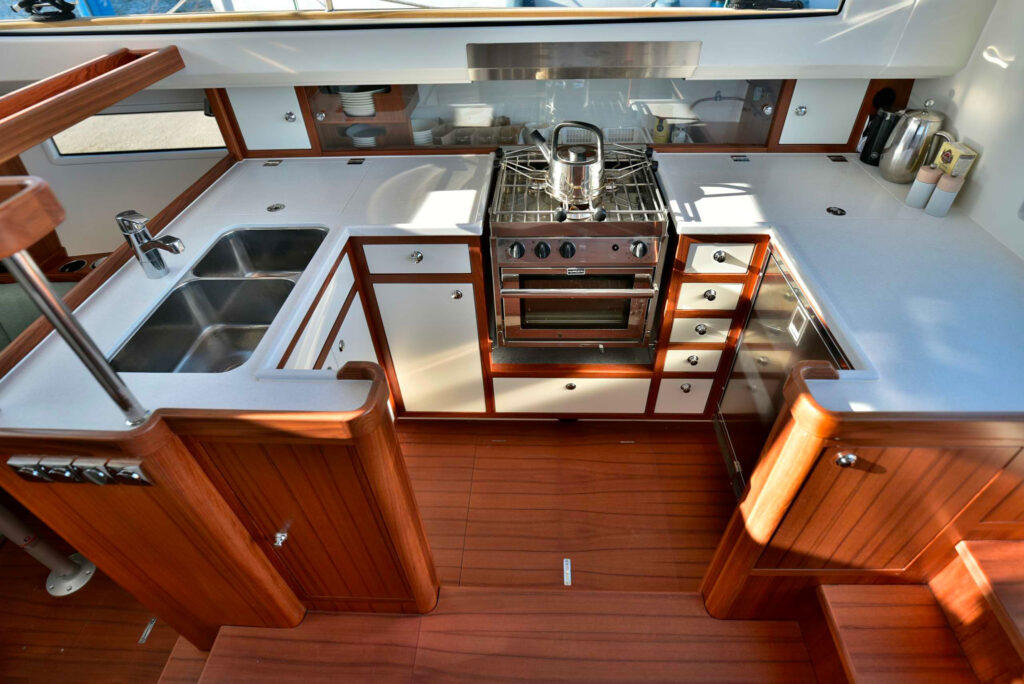
With that aft bulkhead all in glass and big windows all round the deck house, there cannot be a 42-footer with more glazing or better sightlines from the salon table. Not only can you easily communicate between cockpit, galley, and salon, but it makes for bright meals and captures a lot of the sun’s heat, just like a greenhouse. This suits the boat very well for cooler northern waters but keeps the aircon busy further south.
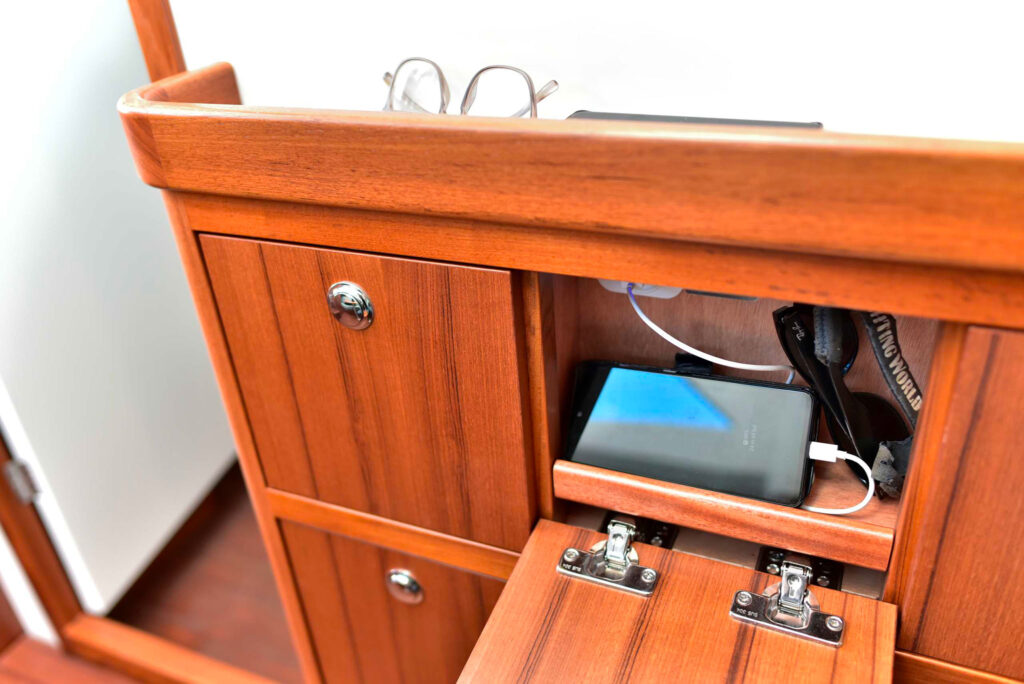
Down again, there’s a nook outside the cabins with a small table and an L-shaped sofa which doubles as an occasional berth with your toes tucked in under the galley. Sitting here, you could watch a TV mounted on the bulkhead opposite, plough through emails, or simply eyeball a new anchorage through the hull light nursing a cup of tea. The orderly minded will also love the bank of six small lockers, each with dedicated charging points—ideal for every crew member to store mobile phones, sunglasses, and other paraphernalia.
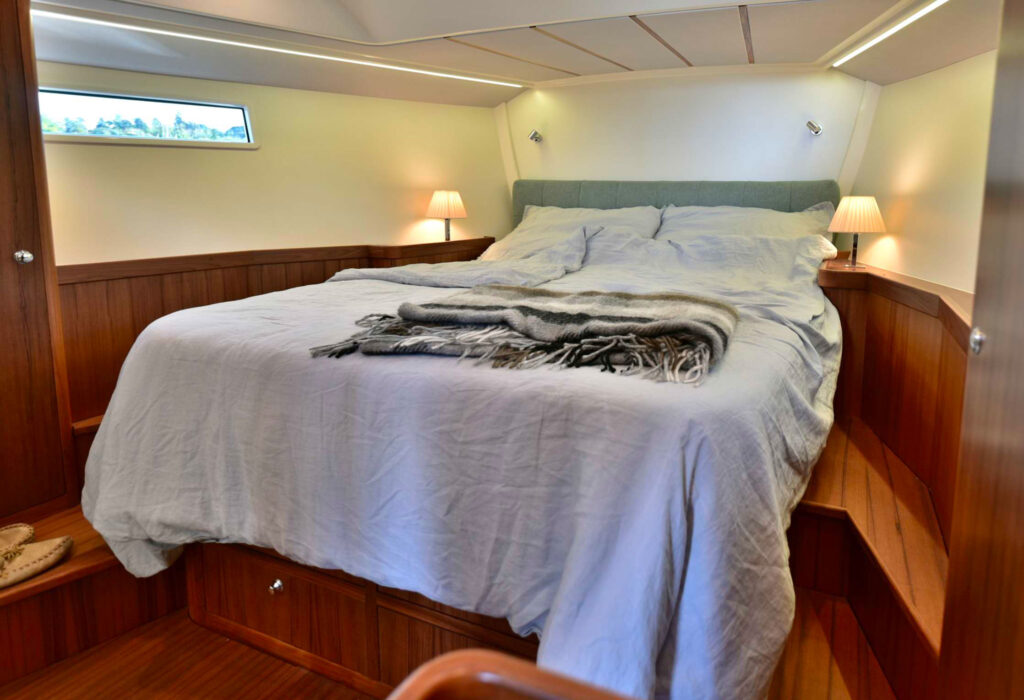
True to the boat’s “sports car” concept, the owner’s cabin is much bigger than the second cabin to port. It has a large, semi-island double bed with a deep mattress, whose comfort I can wholeheartedly endorse after spending a peaceful night aboard. There is a handy shelf running down either side for books, phones, and the like, and large hull lights and skylights. Storage is excellent in two tall wardrobe units with hanging space and plenty of drawers.
The guest or children’s cabin has a long wall-to-wall berth with restricted headroom where it passes under the salon seating above and equally good storage. The two cabins share the same shower and heads, with their own access and the ability to lock the other cabin’s door to avoid any awkward midnight encounters.
Our test boat was fitted with completely independent 110V and 230V mains electrics, but there’s no need for this degree of complication. Heyman recommends a generator to power the optional extra appliances, but the 4kW FischerPanda in the spec list adds an eye-watering $21,000 to the bill.
Propulsion comes from a 57hp Yanmar or 75hp Volvo engine and saildrive with a three-blade folding prop. A powerful Sleipnir bow-thruster is included as standard. The boat hits hull speed under power, and I clocked 6.2 knots at half throttle, albeit with a following wind. As the engine is inaccessible from the interior of the boat, noise levels are extremely low—especially in the salon and the master cabin.
So, the only thing to distract from a good night’s sleep aboard was a loud, intermittent humming noise generated by our boat’s thin Dyneema halyards, and I’ve been told that the problem will be rectified by rig supplier, Selden.
As I walk away from the boat, I can’t help reflecting on how much fun it would be for nosing around the Maine coast or exploring the Pacific northwest. Heyman sees her as a bluewater cruiser and, though I’m sure she would acquit herself well, I can’t help agreeing with Brase when he asks: “do you need such a pretty boat for a circumnavigation?”
It is no surprise to me that two of the five boats sold have American owners. The $795,000 price tag looks high, but it includes a really generous sail-away spec, not a stingy bareboat.
There are certainly cheaper ways of getting offshore, but there may not be a more comfortable way of spending months at a time on the water.
LOA 41’ 6”
LWL 38’ 10”
Beam 14’ 1”
Draft 4’ 10” (9’ 11” board down)
Displacement 25,000 lbs
Engine Yanmar 4JH57 / Volvo Penta D2-75
Sail Area 958/1,400 sq ft (upwind/downwind)
Designer Heyman Yachts
Builder Ridas, Estonia
Price from $795,000 (€683,000) ex-VAT
January/February 2026