Five years ago, discussions started within Groupe Beneteau to commit to sustainable boatbuilding. This was a strategic investment, and they dedicated resources to continually improve their process, including an entire manufacturing plant in Cheviré. By the end of 2025, Beneteau will bring their efforts full circle and produce the first recycled composite sailboat hull.
Manufacturing a recycled boat isn’t possible without recycled materials. While this may sound fundamental, it’s the reason there has been a wait for this moment. Technology does not exist to recycle common epoxy, polyester, or vinylester resins. So, Groupe Beneteau partnered with Arkema, which created a recyclable resin called Elium.
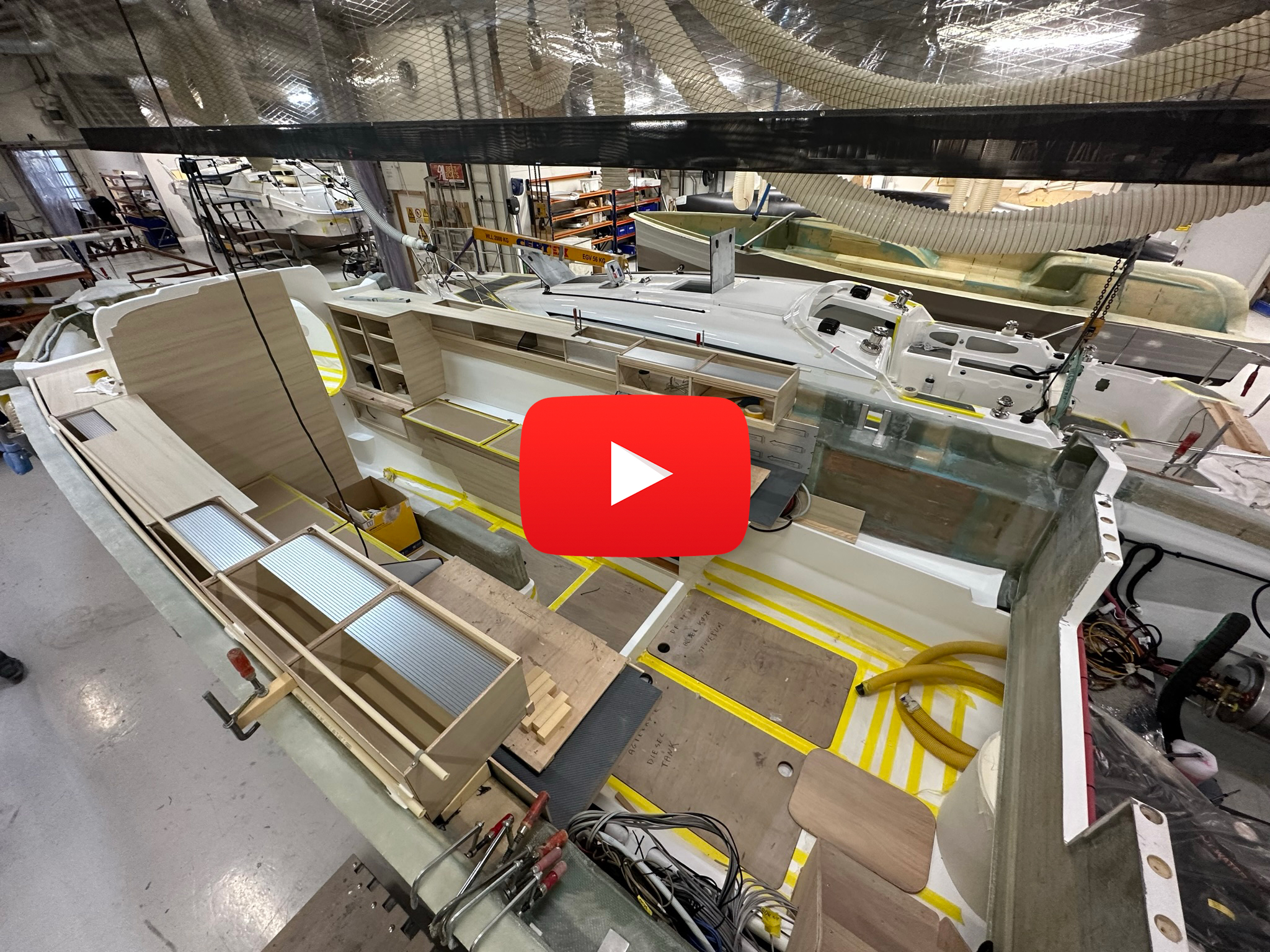
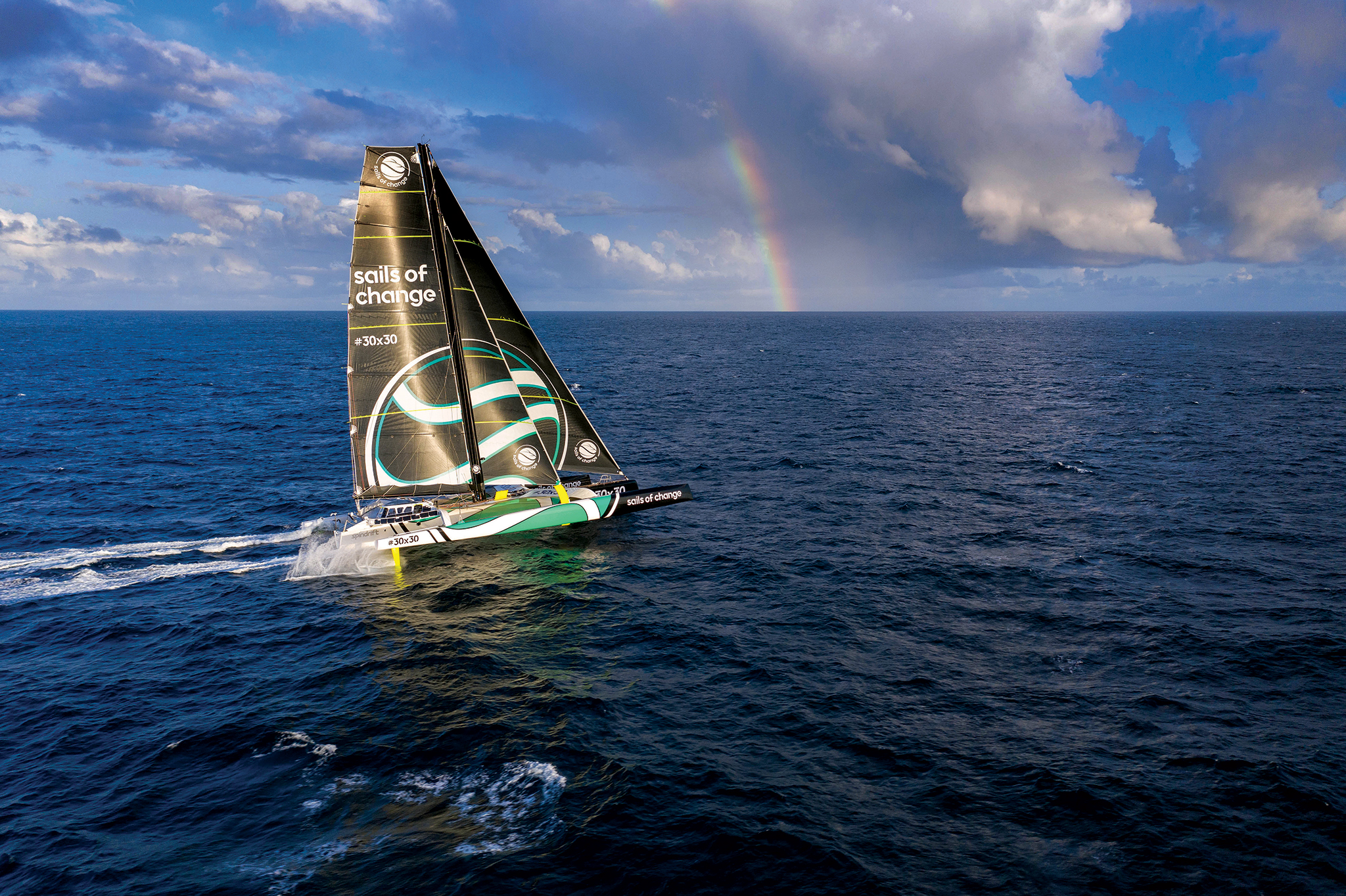
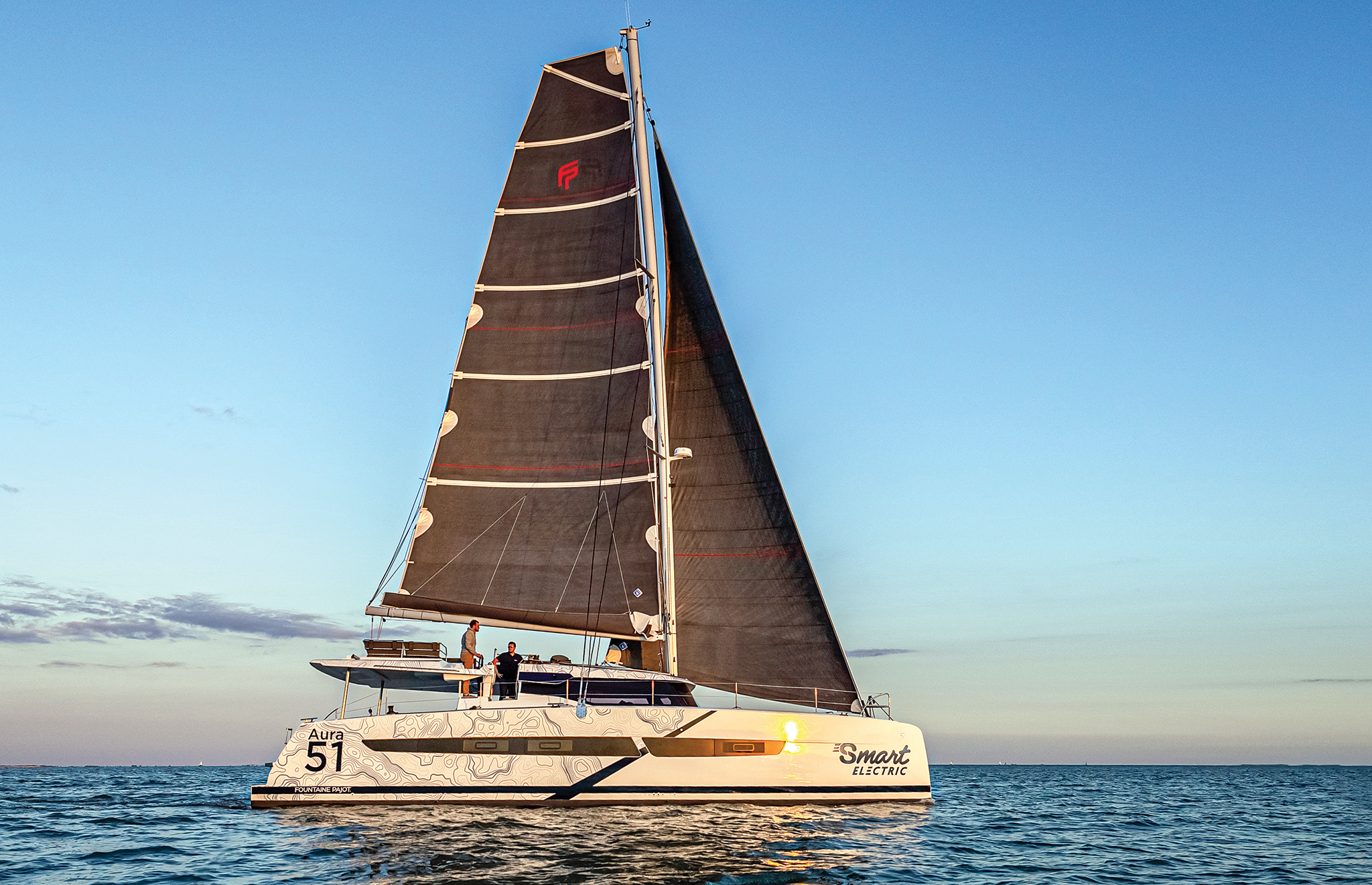
They introduced it into a few builds; 2022 saw the first Elium boat built, a First 44 (that also featured electric propulsion). The following year, the first Sunfast 30 OD was built; 2024 introduced an Elium Oceanis 60. The Cheviré facility has now produced 40 boats from this special resin, including two Mini 6.5s.
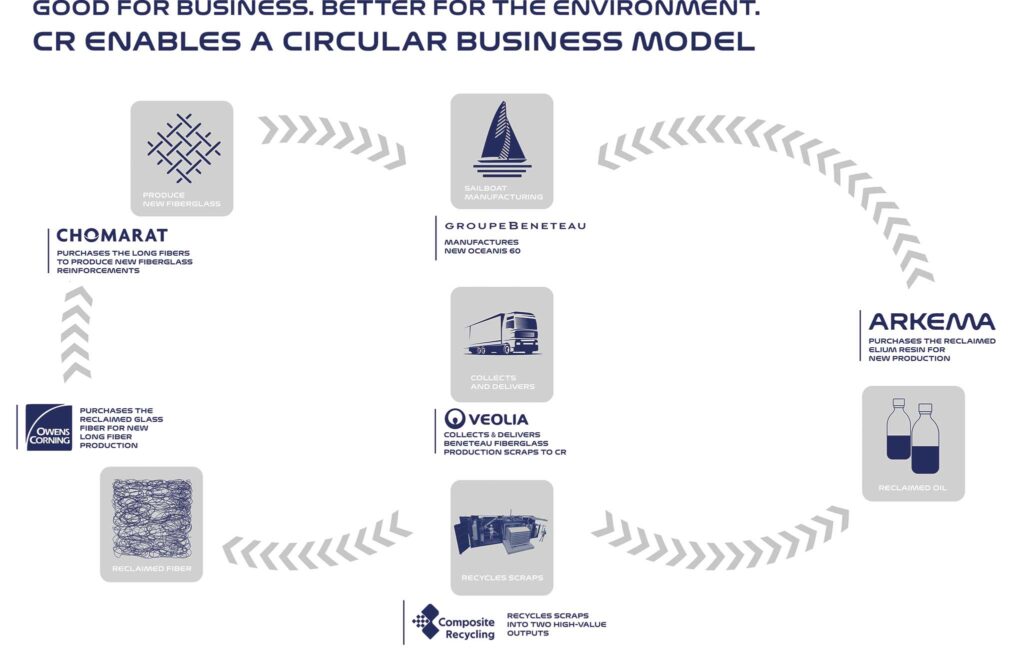
These boats won’t be at the end of their life for some time, but Beneteau does have scrap to recycle from the building process. This is where Composite Recycling, a Swiss partner, enters the scene.
To match the scale of the recreational marine industry, a mobile recycling unit (at a Veolia facility in this case) is used to carry out a technique called thermolysis: sustainable composites are heated at up to 750°F in an oxygen-free environment. The resin separates from the fiberglass, leaving intact glass fibers, thermolysis oil, and captured vapors. The Elium monomer, which is the primary ingredient to make new Elium resin, is captured at high purity, after distillation, and an overall 80% plus resin recovery is achieved.
Photos courtesy of Groupe Beneteau
The glass fibers are handed off to Owens Corning, a U.S.-based company, and processed through their dedicated plant in France to make new fibers out of recycled ones. Chomarat then takes the fibers and creates the reinforcement (fabrics). A near 100% fiber recovery is achieved, although not all fabric weaves are possible. That considered, 65% of the fiber needed to build a new Groupe Beneteau boat can be recovered. The remaining fibers can be used for other products or industries.
Remarkably, the mechanical properties of these materials are the same in a recycled boat; there is no compromise. Additionally, using recycled Elium reduces CO2 emissions by 70% and 10% for the recycled glass fibers (the ingredients also don’t need to be mined, preserving resources).
Older fiberglass boats, if handled correctly, can be roughly 70% recycled, but the composites components are either burned or tossed in the landfill. With this new technology, Groupe Beneteau can achieve a 95-99% recyclability rate on their new generation of builds.
Admittedly, this system isn’t perfect. Boatbuilders first need to implement new materials, such as Elium, to be able to create a closed loop. However, starting this process is a giant leap forward in sustainable boatbuilding and sets the industry up for future success.
Groupe Beneteau will next focus on rolling this technology out in boats 45 feet and up. Sustainable composites have slightly higher manufacturing costs (approximately 5%) over traditional composites, and larger boats are better suited to absorb that cost. This manufacturing change requires time to train employees and refine processes, and while that is happening, Beneteau aims to work for market acceptance.
It will take a commitment from sailors. And with Beneteau willing to share this technology with other builders, there is more assurance that the technology will continue to improve through collaborative and incremental advances.
August/September 2025