How do you store drinking water for a long passage? How about just a day race around the buoys? What about the strategy for a weekend away? Does it all need to be different?
When I bought Ben-Varrey, our Luders 33, I was too concerned about the quality of the tank water to consider drinking from it. I transferred large store-bought single-use bottles onboard for every occasion, even just a night on the mooring. On race boats, we took a similar approach and 24-packs of small single-use bottles were loaded onboard before each start. It was a pain hauling and storing water this way, and the strategy produced excessive amounts of waste, which also needed to be handled. As I started stretching to farther latitudes, I lost my taste for microplastics and leaching additives, and I knew I needed a more resilient solution.
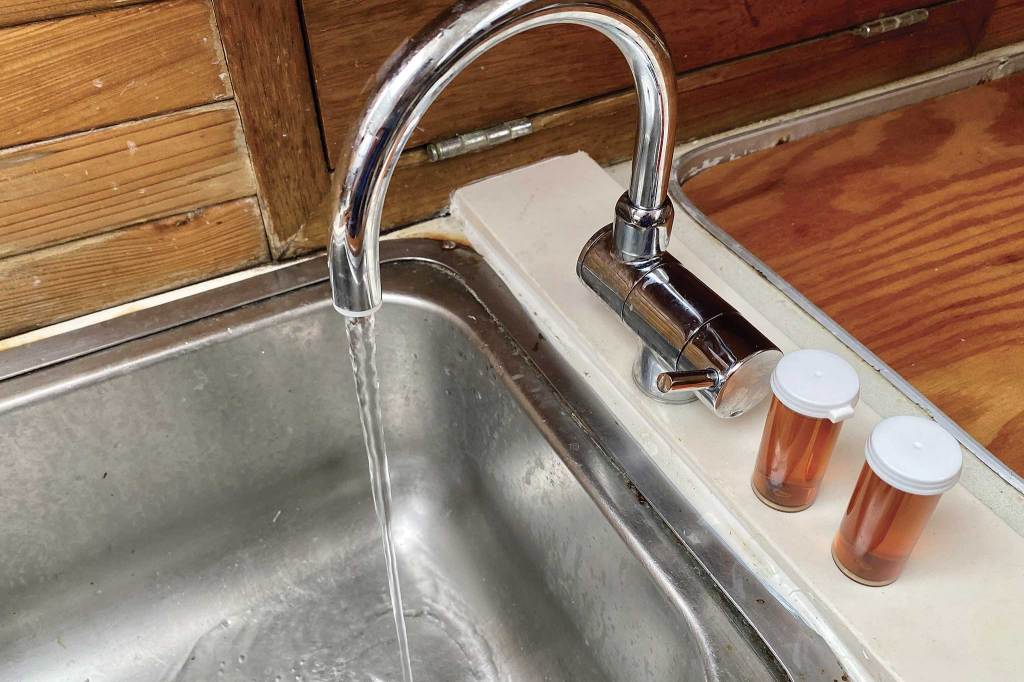
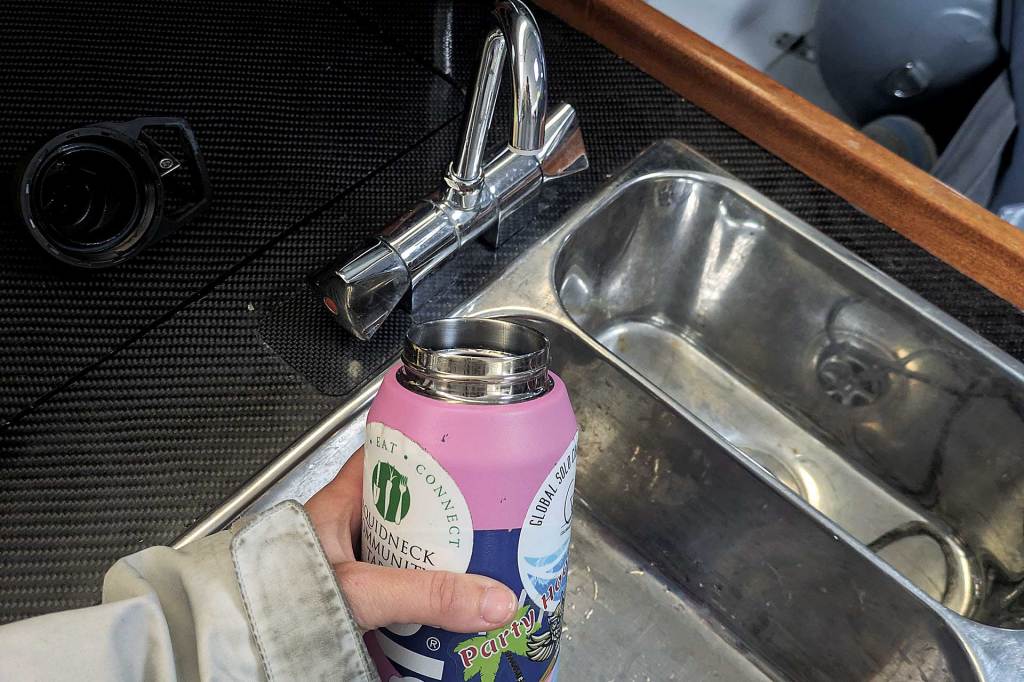
I turned back to the tank I had avoided and developed a robust system for using it to carry my drinking water. Now I just step onboard with a stainless water bottle and fill it up anytime I need with fresh drinking water. The architecture is grounded in simplicity and attention to detail:
Tanks and Plumbing
The foundation of an effective system is the basic infrastructure: tanks and plumbing. Often ignored and rarely cleaned, focusing here is the start of a better system. Algae, mold, mystery slime…all things we don’t want to drink or let clog filters, must be removed.
Access ports allow for the inspection, scrubbing, and power washing of drained tanks. Once that’s complete, flushing the tank with a cleaner ensures no spots were missed. Be cautious of compatibility when cleaning. For instance, bleach and other chlorine-based chemicals are a common go-to for sanitizing, but they attack the chromium in stainless steel. Extended exposure will cause the inside of the tank to corrode. High-Density Polyethylene (HDPE) tanks may be more tolerant of bleach, but any scratches introduced from scrubbing will harbor growth.
The best way to keep a tank clean is high and frequent usage, with fresh new water added to and moving through the system regularly. Additives can also play a role in preventing growth, but—similar to cleaning—ensure compatibility and use as little as possible.
While plastic tanks are common, I prefer to avoid them in favor of stainless due to the ongoing discovery of health risks related to plastics. Some can even add a bad taste. However, if you’re heading in that direction, aim for a material that is as inert as possible, like the Tedlar that is used as the liner of some bladder tanks.
Hoses, fittings, and pumps also need to be cleaned—this can be done at the same time as the tank. Just make sure to remove inline filters during this process. It’s challenging to avoid plastics in the plumbing, so at least be aware of the type of plastic being used and select the most inert options: just because something is FDA-approved and BPA-free doesn’t mean it isn’t leaching chemicals that can’t be filtered out later into the water. Linear low-density polyethylene (LLDPE) tubing is favored within most new builds. It’s similar to PEX (a cross-linked polyethylene) which is used in homes except that it’s more flexible and also tapered in the pressures and temperatures it can handle.
Pre-Filtration
If the water entering the tanks is clean, the tanks are more likely to stay clean. Cleaner water also reduces the need to replace filters further down the system, curbing an exponential growth issue.
Water generated by a watermaker, through reverse osmosis, is bound to be among the purest water taken on. Rainwater, dock water, and even water carried onboard in jerry jugs can all benefit from passing through a filter before hitting the tank.
The more filtration here the better, but the trade off is that flow is impacted as the filtration becomes finer. Getting down to a one micron filter is plenty sufficient at this stage, and we’ve benefited from as large as five micron. This can be handled by inline cartridge filters, hose end filters, or a bag filter. Larger filters with more surface area will help flow rates. Inline cartridge and hose end filters work best for pressurized water such as that from a dock hook up, whereas a bag filter can be setup with an open top to handle the lower pressure from rain collection or water transferred from jugs. Before collecting rainwater from the deck, it’s best to wait for a thorough rinse first and remove any bird guano or other potential contaminants. And regardless of the filter approach, keep this pre-filtration system clean or it may contaminate tank water more than it helps.
Filtration
We’ve established relatively clean water in the tank, but it still isn’t suitable for drinking. To gain that accreditation, more filtration is needed. Those filters should be located after the pressure pump and as close to the drinking source as possible, avoiding issues from water sitting in a long length of plumbing.
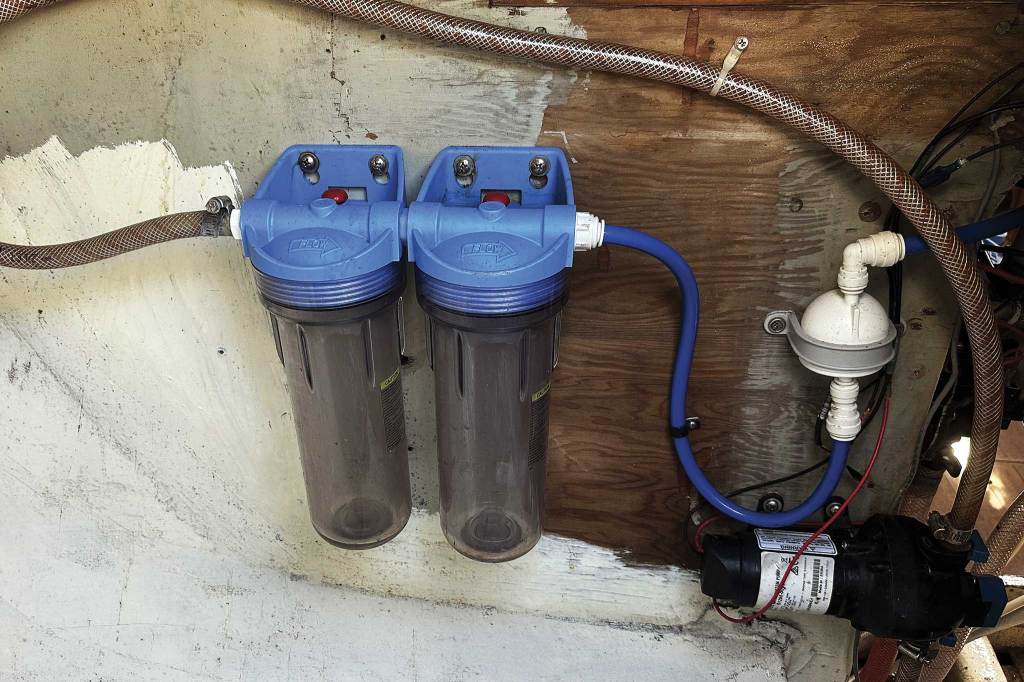
On Ben-Varrey, we’ve installed two filters. The first is a sediment filter, designed to filter out particles up to 5 micron. This catches any debris in the water and will prevent the finer filter from clogging up quickly. The second filter is an activated carbon block measuring a nominal 0.5 micron. That size ensures that not only are chlorine, bad-taste, odor, and particulates eliminated, but it also effectively reduces harmful health-related contaminates like cysts (e.g. giardia), bacteria, lead, and volatile organic compounds.
This prepares the water for the final stage onboard our system: a UV sterilization filter. With other impurities stripped away, a UV-C light damages the cell structure and DNA of microorganisms as they pass through. It renders bacteria, viruses, and protozoa harmless, stopping them from reproducing. It neutralizes 99.99% of microbial contaminants, like E. coli and Giardia.
To keep this system effective, the filters must be swapped out for a given flow volume or timeline. We’re nowhere near the volume capacity, so we change filters every six months. The UV filter also requires annual cleaning from surface buildup. Vinegar works well in our case.
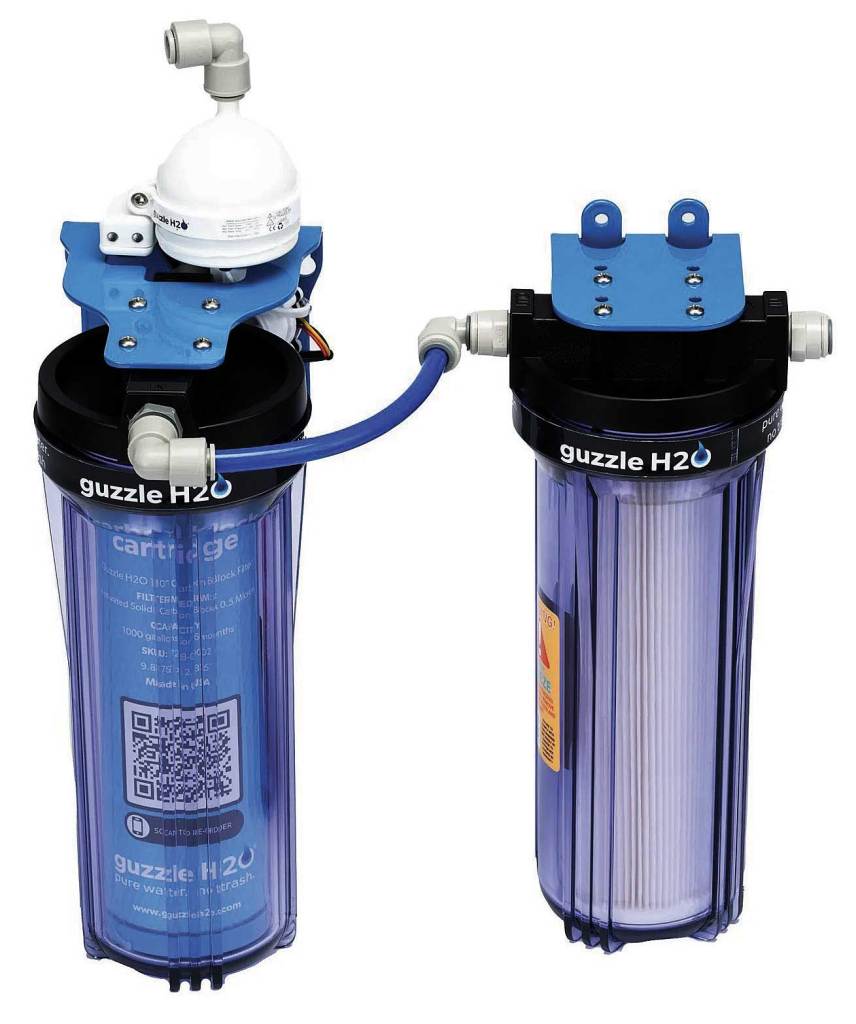
We built our own system from a collection of commercially available products when we couldn’t find what we wanted, but off-the-shelf solutions are also now available. Guzzle H20, for example, carries their Stealth 2×10 Built-In Water Filtration & Purification System, which is very similar to our system.
Winterization
When laying up for the winter, running propylene glycol-based antifreeze through the freshwater system is a traditional approach that prevents damage to the system from freezing. However, it can also leave a bad taste and lingering smell, even after flushing the system multiple times.
To avoid these issues, we blow out our system with compressed air. Make sure to adjust the regulator on the compressor to work at safe pressure levels, and either use an oil-free compressor or introduce a filter in the air line to prevent oils from entering the freshwater system.
We still carry a backup supply of water onboard. It’s entirely independent of our tank and filtration system and ready to drink. We also have two water tanks. If one ever does get contaminated, we have options. Most importantly, our system is simple and accessible: it’s convenient to regularly inspect and service.
Cheers to clean refreshing drinking water onboard. Or, perhaps, more appropriately, here’s to our health: Salud! Sláinte! Santé! Saúde!
This article was originally published in the August/September 2026 issue.