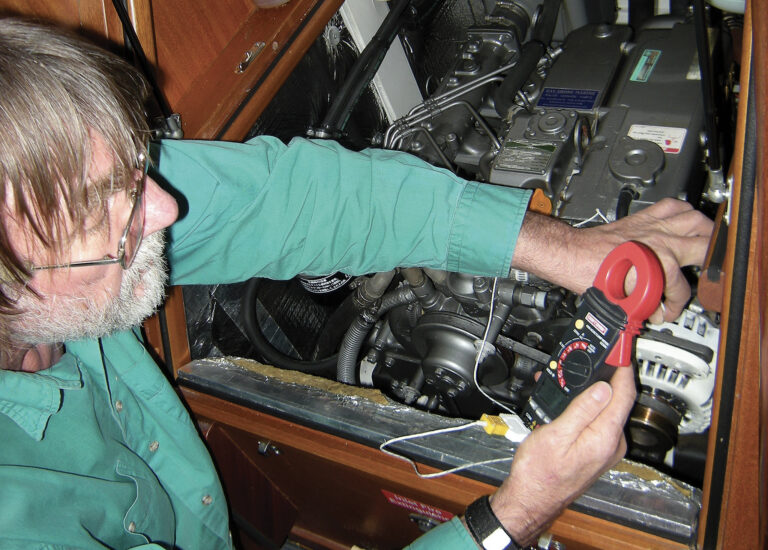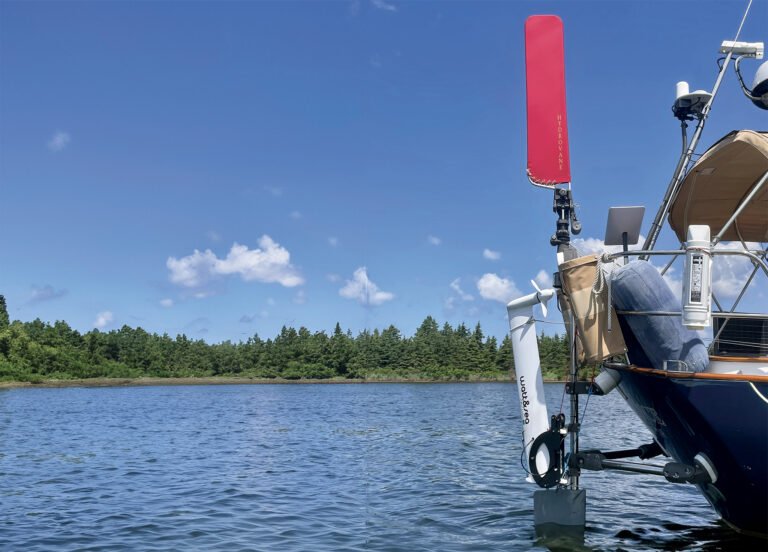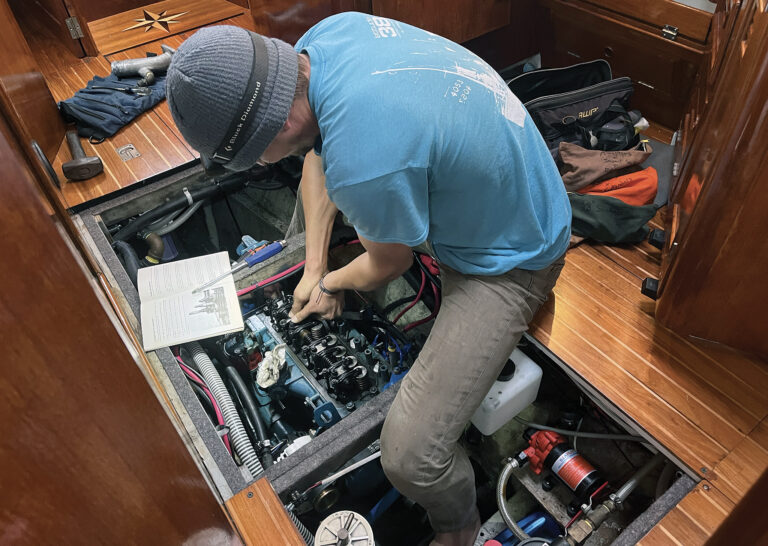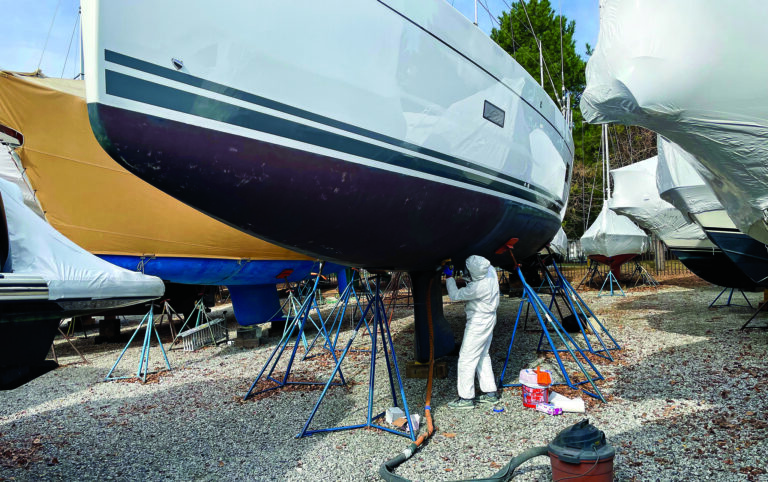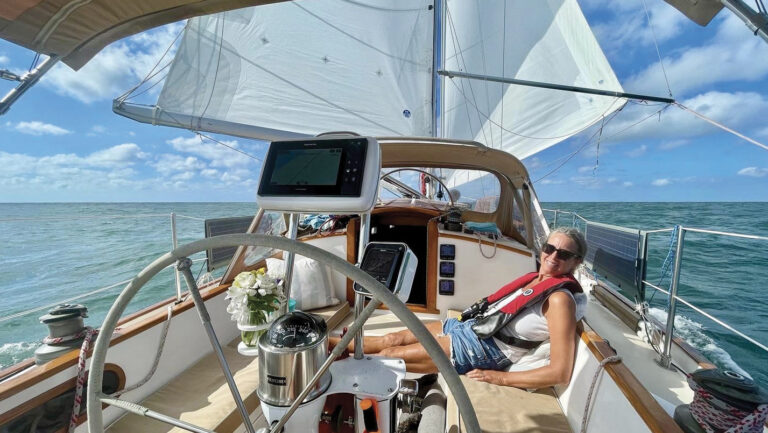
Editor’s Note: This story is excerpted from SAIL Contributing Editor Christopher Birch’s upcoming book The Four Seasons of Boat Maintenance(available for order soon)—a compendium of lessons learned during his 40-year career maintaining other people’s boats as the founder of Birch Marine Inc. in Boston.
A frequently asked question: “Wow—all this boat work is a lot! I know some stuff is mandatory, but I need to find a way to skip the optional stuff. I just can’t spend this much time and money on boat work. Where can I cut back on the worklist?”

Boats do require a surprising amount of work. Even I struggle, at times, to keep up with the needs of my beloved Sundance. The maintenance schedules I recommend are designed to provide care for your boat efficiently, with the minimum amount of time and money. Unfortunately, I can’t provide any shortcuts to further streamline the process and make your life as a boat owner any easier.
Stop and take a look in the mirror, and think about it this way: We humans require a lot of maintenance too. We’re supposed to floss our teeth, get colonoscopies, get mammograms, apply sunscreen, and the list goes on—it’s a lot. With all the time we spend getting cancer screenings and going to the drugstore for dental floss and sunscreen, it’s amazing that we ever manage to get to work or find time to watch TV.
But you never hear a doctor say, “Well, if you get the mammogram and the colonoscopy, you can skip the sunscreen.” No. It’s not like that. You’re supposed to do them all. You’re supposed to tick every box. The same is true for the worklists in this book. I don’t recommend that you skip things or delay things. Imagine a doctor telling a patient, “Well, you’re supposed to get your colonoscopy at 50, but if it sounds uncomfortable and you’re too busy, you could wait until you’re 60, and things will probably work out just fine.” No. That would be an irresponsible thing for the doctor to say. The same holds true in [my] book; I’m professionally compelled to lay out best practices and recommend that you follow them. It’s important to remember that all this maintenance work is for the health of your boat and also for your safety at sea.

It’s true that some items appear to be only cosmetic in nature. Cosmetics are important, and oftentimes, there’s more to the work item than you might guess. Dermatologists encourage us to apply sunscreen. These creams prevent wrinkles and keep us all looking young and attractive. And in some uncommon cases, they can also prevent death! It sounds far-fetched; how could a dab of cream on my nose be the difference between life and death? But if you believe the professionals (and I do), then apparently, it is. The same logic can be applied to the maintenance checklist for your boat. A lot of the work items keep her looking young and attractive, but in many cases, they can be boat-savers too.
I do have an idea that may help ease your burden: If you don’t have the time, skills, or inclination to take on all the work your boat requires, hire someone to do it for you. There are plenty of boatyards and mobile marine professionals who would be happy to help you with some or all of your boat work. You can’t hire someone to have your colonoscopy for you, but you can hire someone to maintain your boat for you.

If outsourcing the work is cost-prohibitive, and you lack the time, skills, or inclination to maintain her yourself, I have another idea for you to think on: We humans all come in roughly the same size with the same set of complexities. It’s hard to simplify our maintenance checklist. Boats, on the other hand, can be simplified and downsized. If your required boat work is too much in terms of time and/or money, then opting for a smaller and simpler boat will reliably solve that problem with ease. Etiquette stipulates that your boat’s length mustn’t exceed your age, but there are no rules saying she can’t be shorter. I know that you will be happier with a smaller boat that looks good and runs well, instead of a larger boat that looks neglected and is always breaking down because you’ve been forced to cut corners on her maintenance.
It’s easy to rationalize skipping regular maintenance and repairs so that time and money can be spent in other ways. Making such a choice would be a false economy. The demands of naval architecture are inflexible, and Mother Nature is a hanging judge. The prudent mariner standard requires you to select a boat that you can and will maintain properly. If the boat budget is an issue, I can confidently state that it is wiser to cut back on boat size than to cut corners on boat maintenance. It’s almost always much, much easier and less expensive to maintain a smaller boat than a larger boat. That generalization holds true all up and down the vast range of available boat sizes.
My book, The Four Seasons of Boat Maintenance, is of greatest value when it helps people avoid classic pitfalls. The most common mistake I saw during my long career in the industry was the person who purchased a larger boat than they were prepared to maintain. This mismatch oftentimes resulted in a boat ownership experience filled with frustration, disappointment, and sometimes disaster. It was always such a shame when this happened. Boats are among the finest creations on Earth, and most bad ownership experiences can be avoided.
Don’t bite off more than you can chew.
SAIL Contributing Editor Christopher Birch is the founder of Birch Marine Inc. in Boston. He and his wife, Alex, are now cruising full-time aboard their 36’ Morris Justine. Follow their voyage at eaglesevensailing.com
This article was originally published in the March 2026 issue.