“In Summer, the song sings itself.” —William Carlos Williams
The idea is to use your boat in the summer instead of working on her. All the time and money invested in the fall, winter, and spring should position you for success in attaining this goal.
Boats are needy though, and you still must dedicate one day a week (or hire someone to spend one day a week) to attend to the routine care of your boat.
For many summers, my wife, Alex, and I worked at our jobs Monday to Friday and then sailed our boat, a 36-foot Morris Justine, on the weekend. We usually managed to schedule in a late summer cruise for a few weeks of vacation as well.
Our pattern of boat use was typical of how a lot of people use their boats, and it was a deeply rewarding way to spend our summer. Our only problem was finding the time to keep up with the regular maintenance demands of the boat. It was stressful to rush through our weekly boat care worklist late on Sunday after returning from a leisurely weekend, and yet the work needed to be done.
Eventually, I solved the problem by adopting the satisfying habit of spending Sunday nights on the boat from June through September. Alex would go home and tend to things there, and it would just be me and Bill the dog onboard those Sunday nights filled with baseball on the radio and stars in the sky. On Monday, we’d wake with the sun and enjoy the quiet, cool morning taking care of our boat. Then, around 4 p.m. on Monday afternoon, I’d roll into work. I put in my hours at other times during the year, and since I was always self-employed, I never got into too much trouble. For me, this schedule was just so much better than trying to bring the boat into the crowded dock from her mooring on a busy, hot Sunday with everyone else. I also loved my peaceful summer Sunday nights spent aboard with Bill.
Of course, there are a lot of possible cleaning schedules that could achieve the same objective. There are also a lot of different boat use schedules to accommodate. The idea is to develop a routine for boat care that works best for you. If you can’t find the time to commit to this work, then hire someone to do it instead.
The routine summer work list looks like this:
1. Top off the water tank(s).
It’s a simple enough concept; topping off water tanks on a regular schedule helps to ensure that you won’t run out of the precious stuff when you are next out sailing. To keep the water in the tanks fresh, maintain a 0.5-micron carbon block filter between the tanks and taps. It may also be necessary to treat the tanks with Aqua Mega Tabs purification tablets on a regular schedule per the tablet manufacturer’s instructions.
If your boat has multiple tanks and you feel like you carry more water than you need, or if you want to keep the boat light for racing, you can cut capacity by draining and valving off one or more water tanks. When deciding which tanks to drain, consider which ones negatively affect boat trim the most on your boat and drain those.
Time Estimate: 10 minutes.
Supplies and Tools: Aqua Mega Tabs purification tablets.
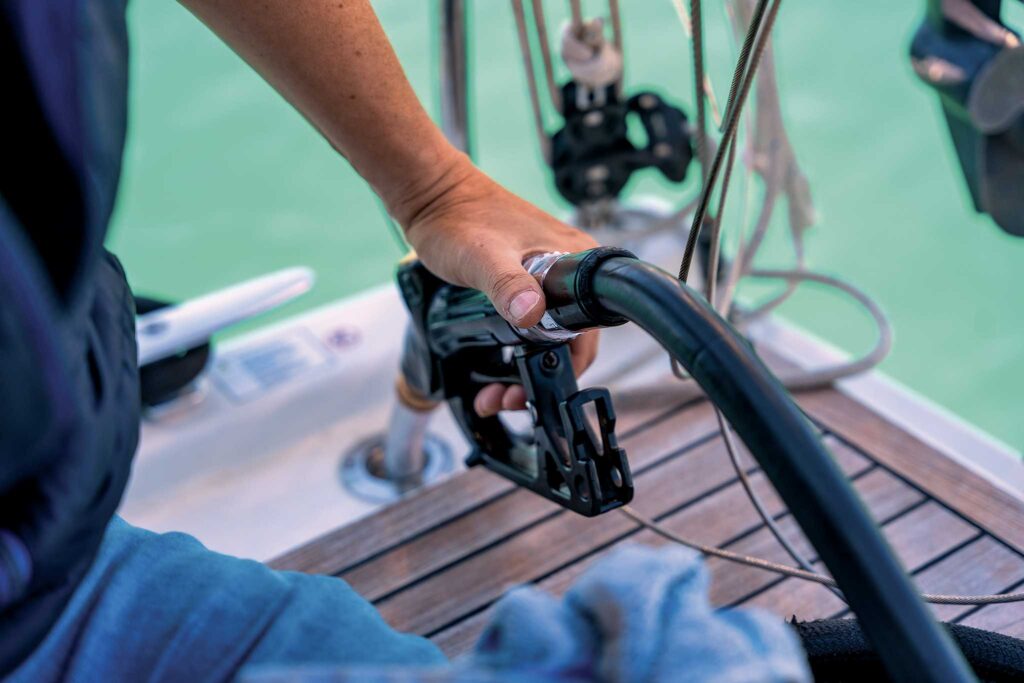
2. Top off the fuel tank(s).
Running out of fuel in the middle of your next cruise is just as bad, if not worse, than running out of freshwater. It’s also worth noting that air space in fuel tanks leads to condensation, which presents as unwanted water in the fuel. Boat engines do not run well when water is present in the fuel. The solution is to eliminate the condensation by eliminating the air space in the tank. You achieve this by keeping fuel tanks as full as possible at all times. When fuel tanks drop below 3/4 full, it’s smart to make a trip to the fuel dock and top off the tank(s).
Instead of trying to jam this project into the start of, or on the return from, your next sailing outing, the smart captain will complete this work on the maintenance day when there won’t be guests aboard and the line at the fuel dock will inevitably be shorter.
Time Estimate: Two hours.
Supplies and Tools: Fuel.
3. Pump out the toilet holding tank(s).
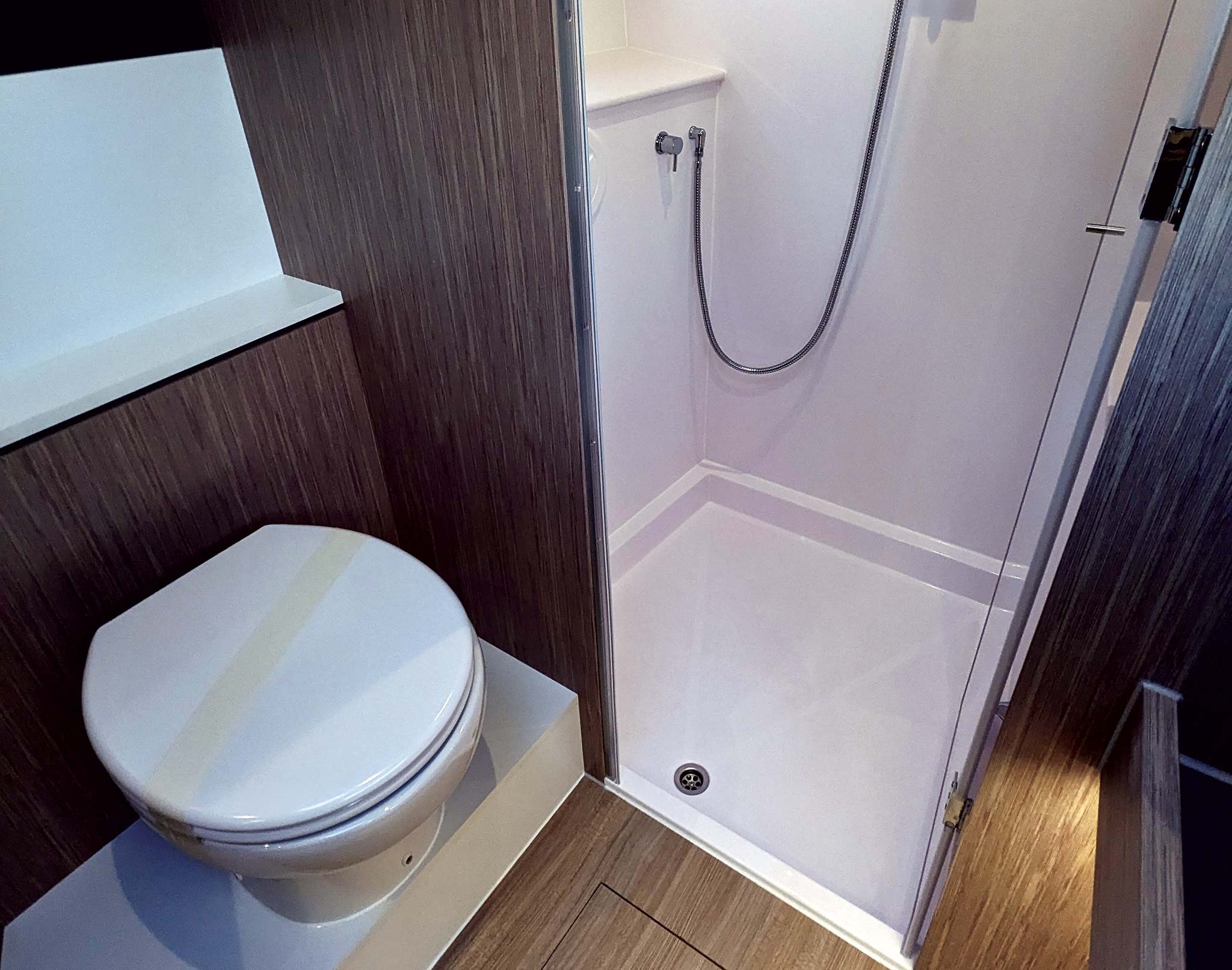
Perhaps the worst thing that could happen in the middle of your weekend cruise would be losing the ability to flush your toilet. Starting out with an empty toilet holding tank allows for maximum capacity on the next trip.
You might have pump-out capabilities right in your marina slip. If not, a mobile pump-out service may be available to come to your boat and pump the tank. If neither option is available, the nearest pump-out facility is probably going to be located at your local fuel dock. If that’s your best option, take advantage of your ability to multitask while you are there for fuel.
Time Estimate: 10 minutes.
Supplies and Tools: None.
4. Wash and dry the boat’s exterior.
Salt, dirt, food crumbs, and dog hair accumulate on deck when you use your boat. Bird droppings, grime, and dust also accumulate even when you aren’t using it. It’s smart to break out the soap once a week and give your boat a bath to keep all problems under control.
My favorite washing product is a green boat soap called OrPine Wash & Wax. Add a dollop of the stuff to a 5-gallon pail half-full of freshwater. Use a soft deck brush attached to a long telescoping boat pole. Abundant freshwater from a hose will also be required. If your boat lives at the dock, access to freshwater shouldn’t be a problem; if your boat lives on a mooring, you’ll need to move her to a temporary work slip for washing.
Start by wetting down the entire boat with the hose. Then, working in sections, scrub and rinse the boat starting from the highest point and working down. All boat soaps are multipurpose soaps and are suitable for cleaning everything on the exterior of your boat, including your teak, stainless, nonskid, and canvas. If you have a dinghy, go ahead and give that a wash too while you’re at it. If you have cockpit cushions, relocate them to the dock. Scrub and rinse them there and then set them on edge to dry. If the wind’s up, keep an eye on them to make sure they don’t blow away.
The side of the boat facing away from the dock is what I refer to as “the dark side of the moon.” Getting there will be your biggest challenge. One strategy is to flip the boat around in her slip to orbit the dark side around to within reach. An alternate approach would be to wash the dark side of the moon from a dinghy. A bit of gymnastics is required for this method, as you’re forced to wash with one hand while hanging on with the other. All the while, the dinghy fights against you like an out-of-control lunar lander trying to pivot to the worst possible position for work. A third approach exists for the truly lazy astronaut: You could alternate weeks, bringing the boat in starboard side to the dock one week and port side to the dock the next week. (I’m ashamed to admit that I have succumbed to this temptation more than once over the years.)
As an aside, if your boat lives in a slip all season, instead of on a mooring, it’s good practice to rotate her position in the slip regularly to even out UV wear.
To help manage expectations, it’s important to understand the limitations of the weekly cleaning work. A regular boat washing routine is not a viable alternative to wax. No amount of scrubbing with any boat soap will remove stubborn stains or revive a dull finish. The deep cleaning in the spring and fall with rust stain remover, waterline stain remover, compound, and wax is what gets the boat clean. When that work is done well and on schedule, the summer wash routine is an easy and effective way to maintain cleanliness. Unless, of course, the stars are crossed, and you have problems with birds or Uncle Larry.
Birds like to exact their revenge on us for our poor stewardship of the planet by using our unoccupied boats as a latrine. You may want to gently encourage these birds to land elsewhere by equipping your boat with some sort of anti-bird device. If the birds still manage to breach your defenses, extra work will be required during the weekly wash. If you feel like you’re living in a Hitchcock movie nightmare while scrubbing, commit yourself more fully to bird prevention. Once birds get comfortable on your boat, they will return with greater regularity, in larger numbers, and with more vengeance. Fortunately, there is some good news amid the feathers: I’m happy to report that this is a rare place in yachting where UV radiation is helpful. If you struggle to fully scrub away a bird dropping, you might be pleasantly surprised to see that same spot washes clean easily after sitting in the sun for a week. Give the sun a shot at solving the final remnant of a bird problem before ramping up to more aggressive soaps that will be hard on your wax finish.
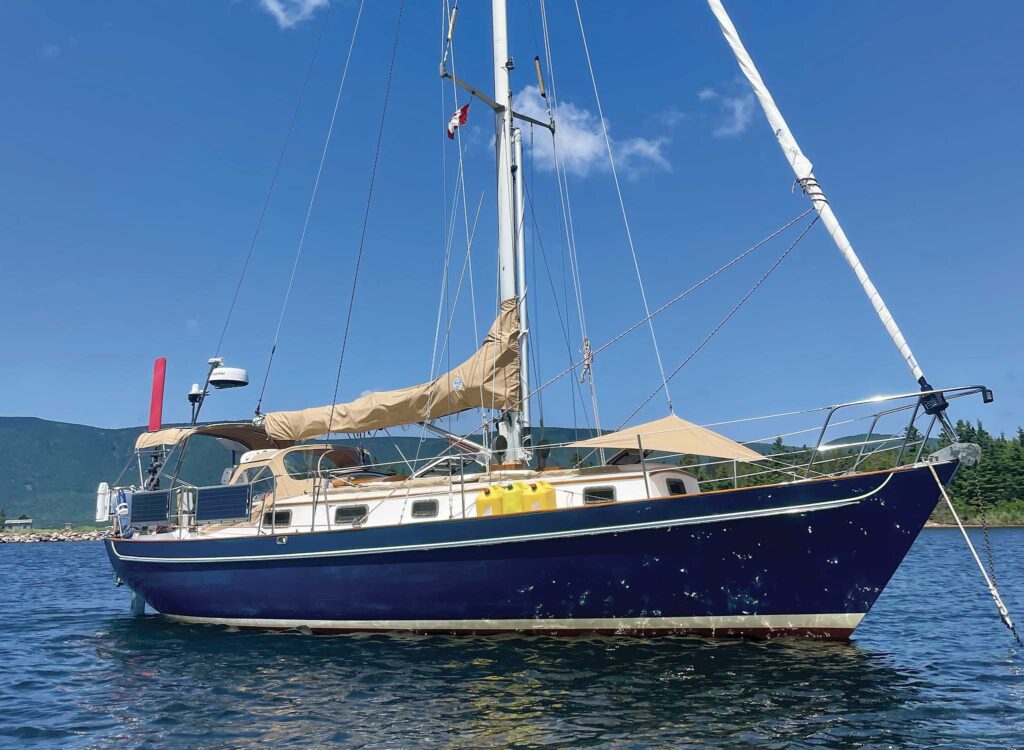
Unfortunately, no amount of UV radiation is going to solve the problem of Uncle Larry and his beloved black-soled running shoes. For every hour he is aboard in those nightmare sneakers, you will spend 10 hours cleaning up after him. And it’s not the mild spritz with a hose type of cleanup; it’s the down-on-hands-and-knees with rubbing compound scouring with all your might type of clean up. Hundreds of 3-inch-long black streaks all over the deck. Each one a 20-minute battle in a war that you did not need to fight. You must not let Larry, or anyone else, aboard unless they are willing to go barefoot or wear white-soled sneakers or boat shoes. No exceptions!
Once your washing work is complete, wipe the boat dry using a chamois to eliminate all the water spots and reveal that perfect shine. I recommend a chamois product called The Absorber. If the boat has dried in places before you can get there with the chamois, re-spritz those areas with the hose so the chamois can dig in and do its magic. Work in sections, just like when washing, from the top down. Don’t forget the dark side of the moon.
Year-in-review schedule for exterior washing and waxing: Rinse after every use, wash and wipe once a week, and a deep clean followed with wax every spring and fall.
Time Estimate: 5 hours. (One experienced worker, 40-foot boat.) Maybe a bit less if you are a bad astronaut. Definitely a lot more if Larry has been aboard with those running shoes.
Supplies and Tools: OrPine Wash and Wax boat soap; telescoping boat pole; soft bristle brush head; bucket; freshwater from a dock hose; Absorber chamois.
Notes of Caution: Beware of the black-soled shoe. Soapy decks are especially slippery. Move slowly and carefully around the boat, especially if you are barefoot.
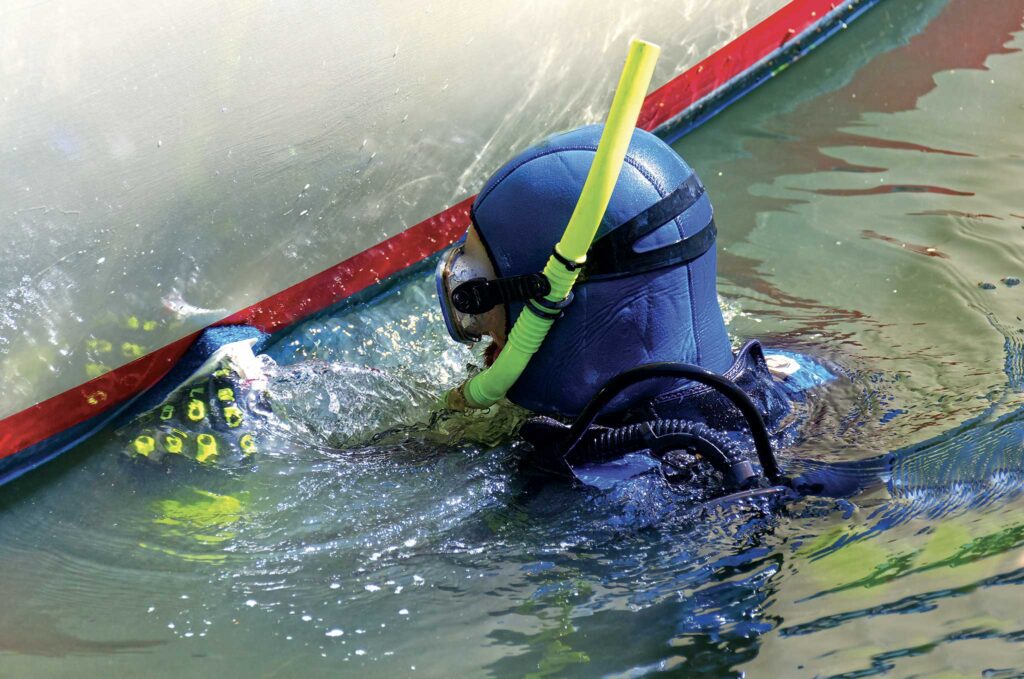
5. Scrub the waterline.
Scum and marine growth will accumulate at the waterline of your boat when she sits still in the water. For this stuff, you may need a stiffer brush. Most telescoping poles allow for a change of brush head. You want a soft brush for washing the boat from the waterline up, but you may need a stiff brush for the waterline itself. If you scrub the waterline once a week, it should clean up quickly and easily. If you fall behind schedule, the waterline will quickly become unsightly and hard to clean. This ring-around-the-boat will also affect boat speed while underway.
The dark side of the moon problem crops up again here. Resolve the issue the same way, and at the same time, as you did in No. 4 above.
Time Estimate: .5 hours. (One experienced worker, 40-foot boat.)
Supplies and Tools: Telescoping boat pole; stiff bristle brush head for above.
Notes of Caution: Be careful not to scrub away all your bottom paint at the waterline. This concern is especially acute if you have ablative paint on the bottom.
6. Clean the boat’s interior.
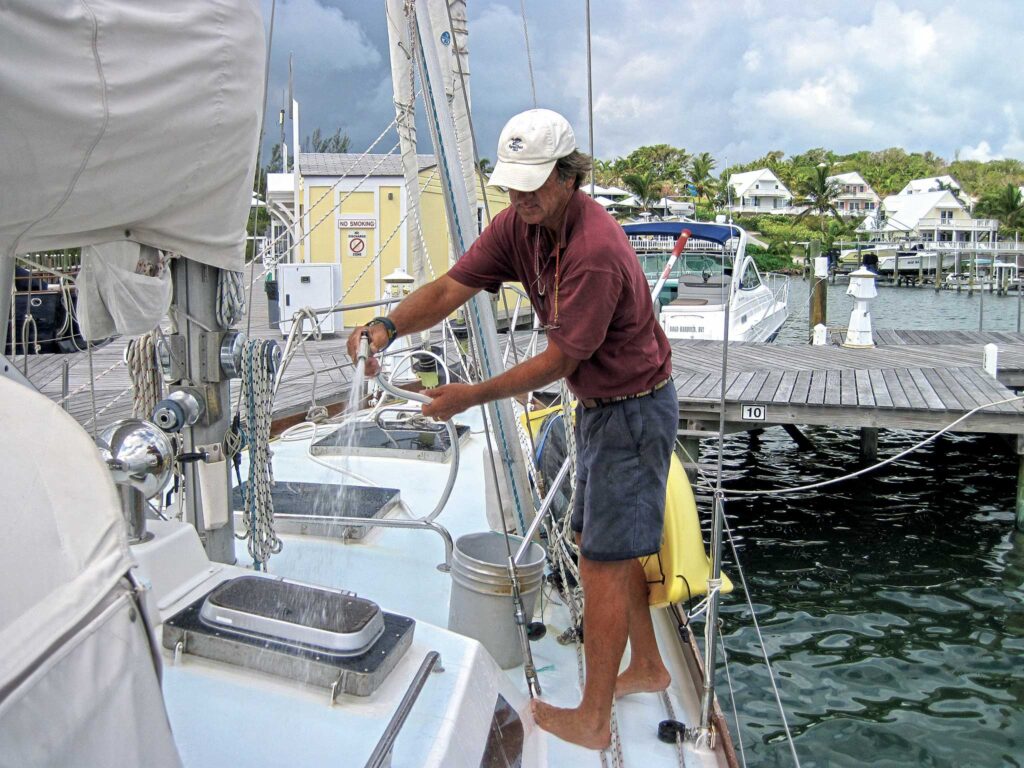
When you think about it, you don’t really need to brush your teeth—ever. But in practice, we do all find time to regularly brush our teeth because failing to do so would be both bad for our teeth and disgusting. The same holds true for cleaning your boat’s interior: Failing to do so would be both bad for your boat and disgusting.
Keeping up with interior cleaning on a routine schedule will minimize mold and mildew, making your boat more enjoyable for both crew and guests. There are no great secrets here; cleaning the inside of a boat is a lot like cleaning the inside of a house or an apartment. A small vacuum comes in handy (not the filthy shop vac you used for bottom sanding!). If AC power isn’t available where you’re working, a DC-powered vac that you can plug into a cigarette-style outlet onboard would be a good investment.
The Windex multisurface, ammonia-based spray product will handle most of your cleaning needs, including the cabin sole. For tougher stains, cleaning in and around the toilet, and stubborn spots of mold and mildew, ramp-up your cleaning power to the Clorox bleach-based spray product.
Year-in-review schedule for interior cleaning: A cursory vacuum plus surface clean including galley, cabin sole, headliner, and toilet, once a week. A detailed deep clean of cabin interior including all storage lockers, and the contents thereof, plus the anchor locker, bilge, engine space, and cockpit lockers, every spring and fall.
Time Estimate: 2 hours. (One experienced worker, 40-foot boat.)
Supplies and Tools: Hand-held vacuum cleaner; Windex multi-surface, ammonia-based spray cleaner; Clorox Bleach-based spray cleaner; paper towels.
7. Create a supplies-needed list.
Now is a good time to take inventory. Sometimes a checklist is also a shopping list. Picking up a few essentials for the boat will help ensure your next outing goes more smoothly. You’ll want to customize a checklist for your boat and your tastes, but here’s a decent starting point:
• Non-perishable foods and drinks.
• Consumable supplies for the boat (boat soap, engine oil, lamp oil, etc.).
• Consumable supplies for the galley (dish soap, trash bags, cooking oil, etc.).
• Paper products (toilet paper, paper towels, etc.).
• Personal toiletries.
• Supplies for any ongoing or upcoming boat projects.
• Other.
Time Estimate: 10 minutes
Supplies and Tools: You tell me!
This story is excerpted from SAIL Contributing Editor Christopher Birch’s upcoming book The Four Seasons of Boat Maintenance (available for order soon)—a compendium of lessons learned during his 40-year career maintaining other people’s boats as the founder and owner of Birch Marine Inc. in Boston. He and his wife, Alex, are now cruising full-time aboard their 36-foot Morris Justine. Follow their voyage at www.EagleSevenSailing.com.