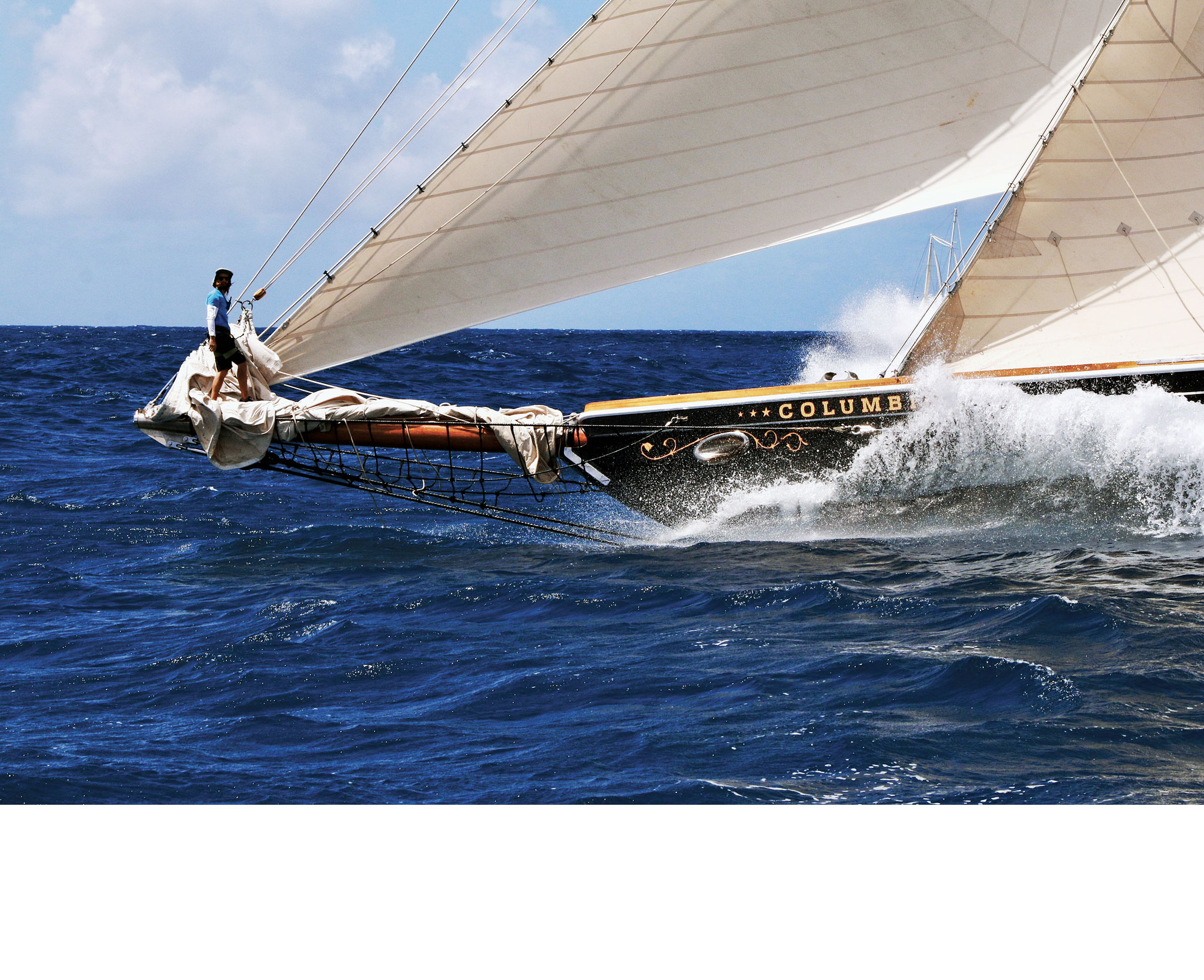
Time slows down as I carefully position the tip of my spike against the trigger of the Tylaska. No wonder this has traditionally been a boys’ sport, the thought flashes through my mind. Perched at the tip of a long piece of wood that proudly leads the charge of the powered-up schooner, delicately inserting the spike into the shackle’s opening…the sense of suspended power in my fingertips is incredible, and all of the accompanying images are distinctly male. I glance back up, read the words on my crew boss’ lips—“Three, two, one, SPIKE!”—and deftly insert and jerk.
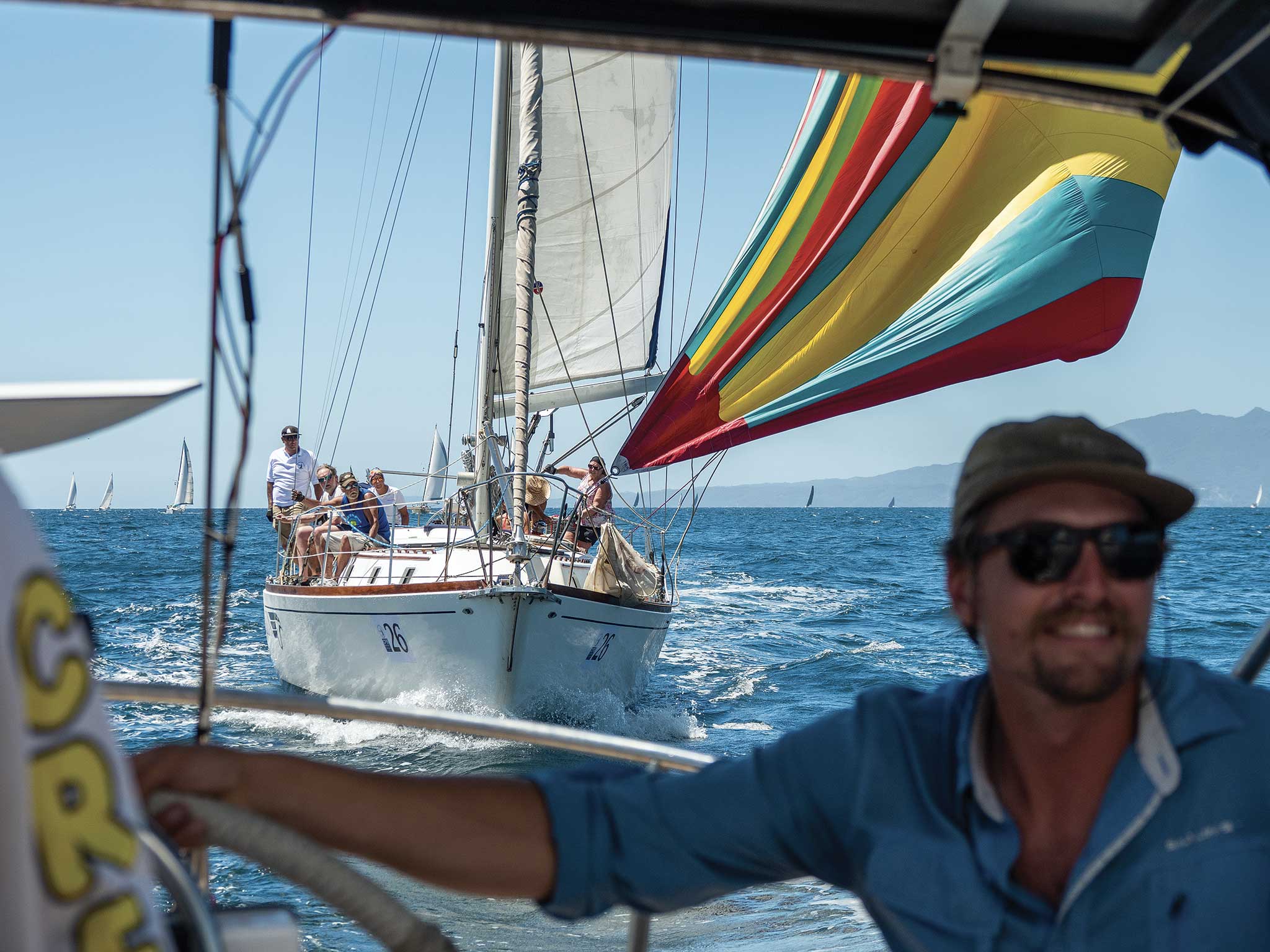
The reaction is explosive as the 4,500-square-foot A3 spinnaker rips away through the air. My job in the spinnaker douse done, I stow my spike into my harness loop and watch the battle now raging on the mid-deck as my fellow crewmates fight to land the enormous kite I have just unleashed. It is heroic—the fight and poetry of Hemingway’s Old Man and the Sea captured in a modern army in matching shirts struggling to tame the wind-powered fabric beast. The scene is modern, but the classic story of humans against the elements is no less moving.
Satisfied that I’ve properly tidied my domain of the bow, and after a quick glance up to check the trim on the jibs, I resolutely turn my back on the action and cast my eyes forward and outward once again, looking out for oncoming starboard tack boats.
• • •
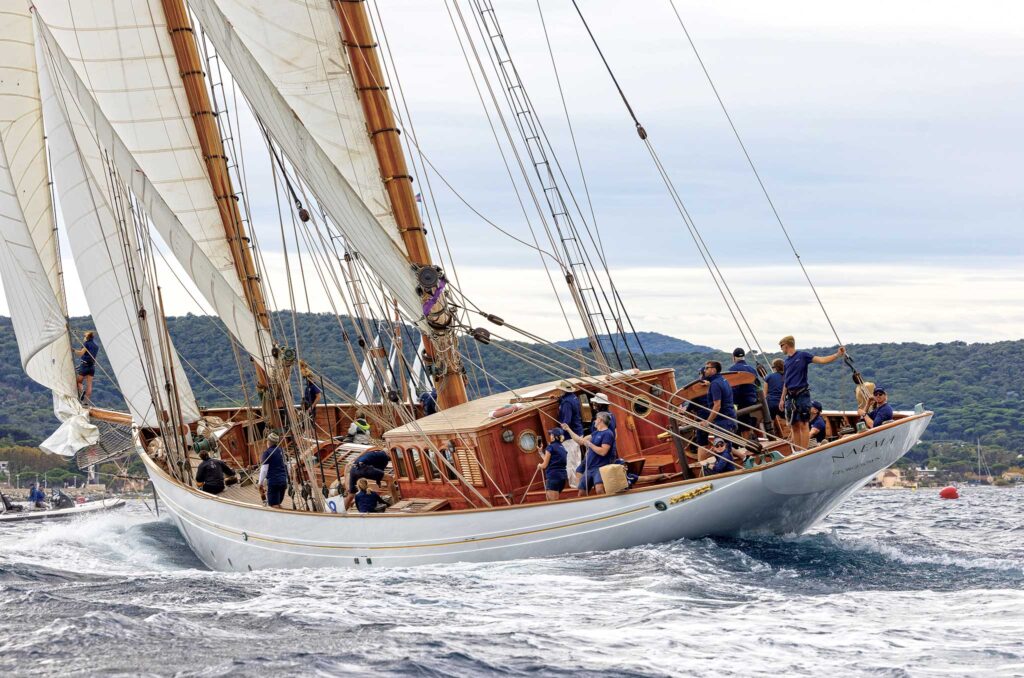
Les Voiles de Saint-Tropez is a week of racing that takes place along France’s Cote d’Azur, in the bay outside of the historic fishing port-turned-destination village of Saint-Tropez. Moderns and classics of all sizes come together to race side by side, right at the shift in the seasons that brings summer’s light sea breeze and fall’s howling mistral flip-flopping day to day. The boats are stunning, the racing is fierce, and the backdrop is exquisite.
That is the event pitch.
The sailor’s pitch is that it is a varied week of racing on stunning boats, in a fantastic and walkable village, with an international assembly of boat crews who are dead set on celebrating the end of summer in fashion. Sail Hard Play Hard is the theme of the week.
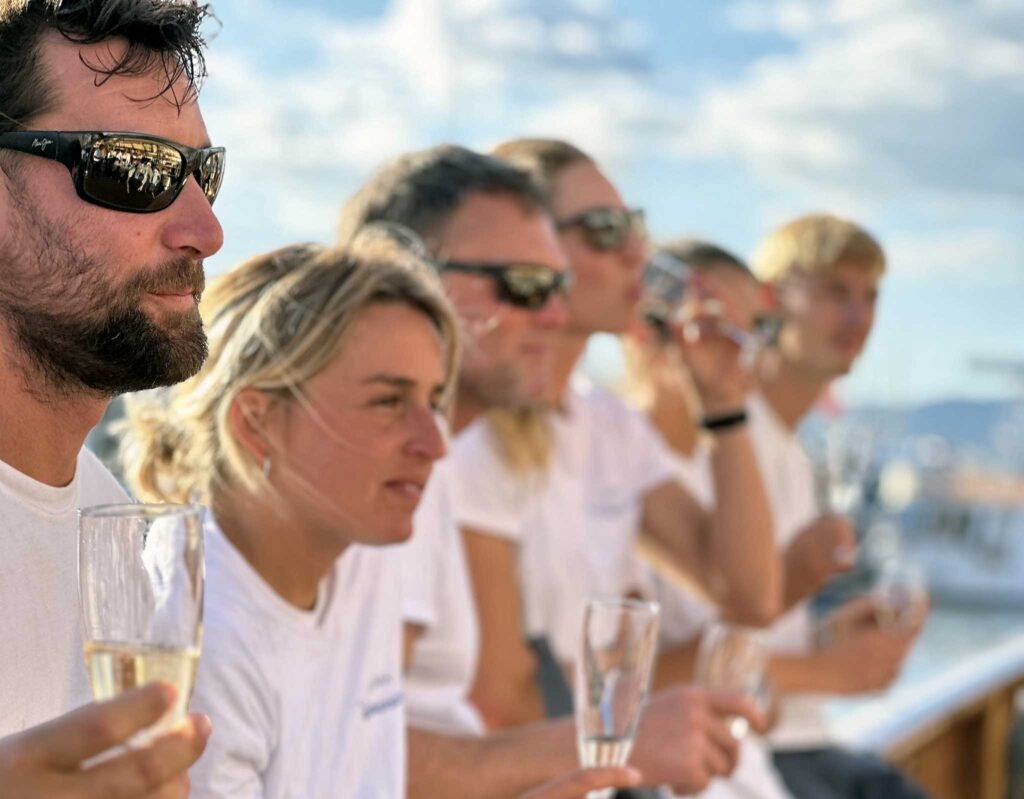
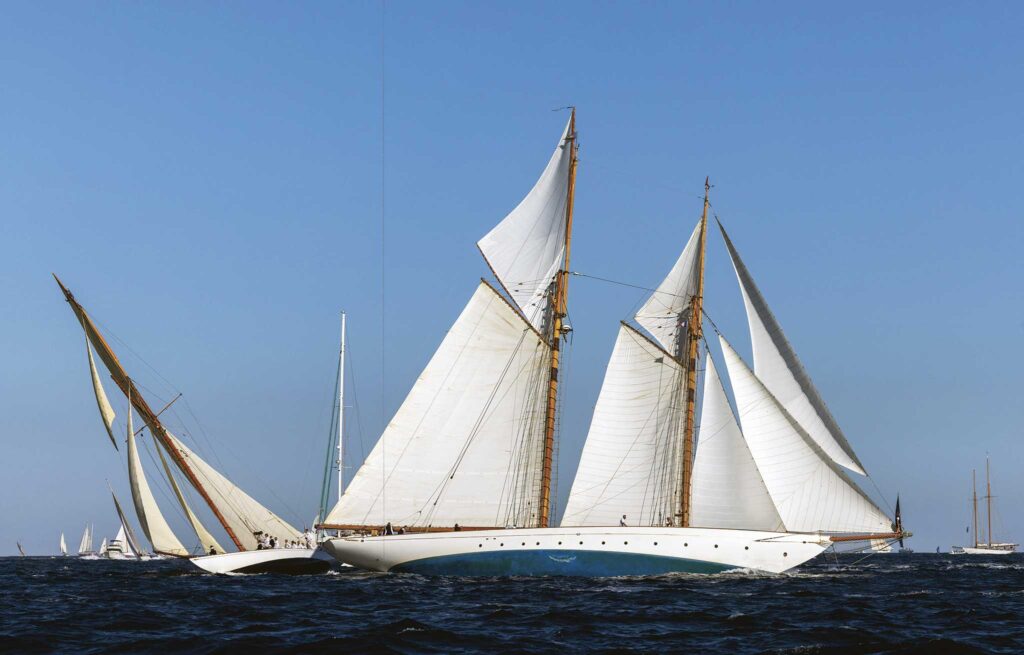
My pitch: I have been racing with Schooner Naema since 2021, when I was the full-time deckhand. Since then, I have returned every year as race crew. Our team is a collection of sailors from around the world, many of whom I count among my close friends yet who I only see this one week a year. We come together and transform Naema, a lovingly maintained classic cruising yacht, into a racer capable of flying eight sails at once, including a jackyard topsail, kites, and a variety of “tweensails” including a fisherman and gollywobbler—sails that sound made up unless you’re a niche classic schooner sailor.
In addition to the lovely boat and fantastic crew, Les Voiles is typically a week of growth for me, honing my skills as I sail under some of the truly knowledgeable sailors who build out the backbone of our team. The last two years I raced as mid-bow, forming the support side of the bow team as I worked and learned under Ado Stone, who has historically raced as Naema’s hotshot and exceedingly competent bow guy.
This year I ran point. It was my first regatta running bow; nothing like starting small on a 140-foot boat in a world-famous regatta.
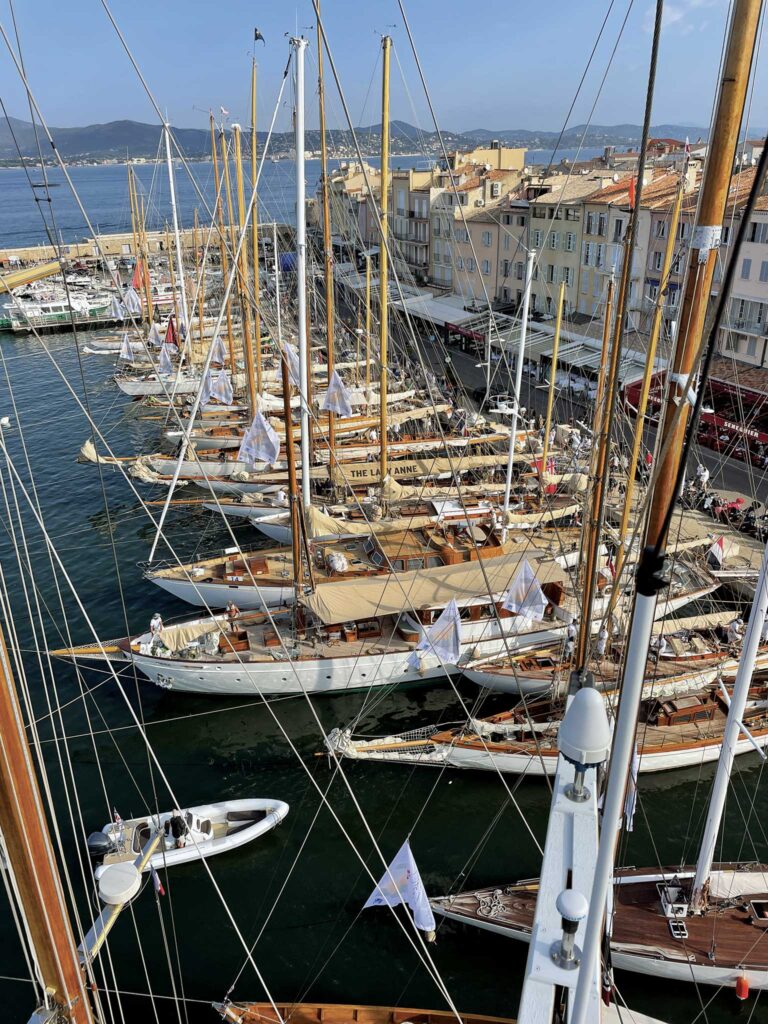
As the race program stands now, Naema is not a competitive boat. We generally only race once or twice a year, often with a single practice day. We also seem to always rate terribly, though maybe every boat feels this way. As the breeze tried and failed to fill on the Monday before racing—our practice day—and we motor-tacked slowly up the bay so the trimmers could at least get reps passing the slack jibs back and forth, my hopes that we would get to practice a spinnaker set faded with the windless afternoon. Well, no time like the first day of racing to hook the thing up for the first time, I thought with a sigh as we finally headed in. Right as we entered the harbor, the sea breeze, late and delighted with its contrariness, rewarded the last dogged boats with sails still up, pressing them over and sending them scampering forward to the screaming delight of tourists watching from the many overloaded tour boats.
• • •
Lesson from day one: “Learn to use your watch and keep your eyes forward!” –Shanan Wolfe
Day one. The sea breeze, late again, missed the start and left our class—the biggest, heaviest boats—floundering over the line. I had set my (borrowed) watch for the five-minute starting sequence, and when I checked it one minute later was horrified to realize I had set it for a five-hour countdown. Unrelated to my timing snafu (probably) we had an awkward, late start that left us crossing late and on port. For the next 30 minutes we watched Schooner Elena, our main competition, make slow tracks on us towards the mouth of the bay, both boats barely retaining steerage. It was decently dismal.
“Wind line!” Our crew boss had spotted it first, the expected sea breeze filling in from behind. Watching it race towards us and anticipating a possible kite hoist, myself and Louis, my mid-bow, hooked the A2 up. The breeze hit with a vengeance, and we went from 2 knots to close to 10, the boat leaning into a happy rumble. Poised for a kite hoist call that never came (shyer angle/bigger wind than expected) we watched in satisfaction as we flew east down the course past Elena, the last to get the breeze after the wind shift.
Precarious jibe around a mark, and then sailing low for the leeward mark. Again, no call for a kite; with the jackyard up the boat was already overpowered in the heavier than anticipated breeze. I got distracted by the inboard lead of a jib-top sheet until our crew boss yelled at me to keep eyes forward. Going downwind, the sails obscured sight lines to leeward for the afterguard, and my eyes forward were critical while on port tack, especially considering the 140 feet of boat between us. Crouching on the bow, I radioed with our tactician as we wove through the fleet, chastising myself for forgetting my job. My priorities had changed with my race position; what was happening behind me on the boat wasn’t my chief concern anymore.
The rest of the race was uneventful, with the exception of Elena breaking a spreader, ending the regatta for them. On this first day, with crew (including me) still learning/remembering our positions and in significantly heavier wind than expected, we sailed conservatively. We didn’t place well but we were ready to sail the rest of the week.
• • •
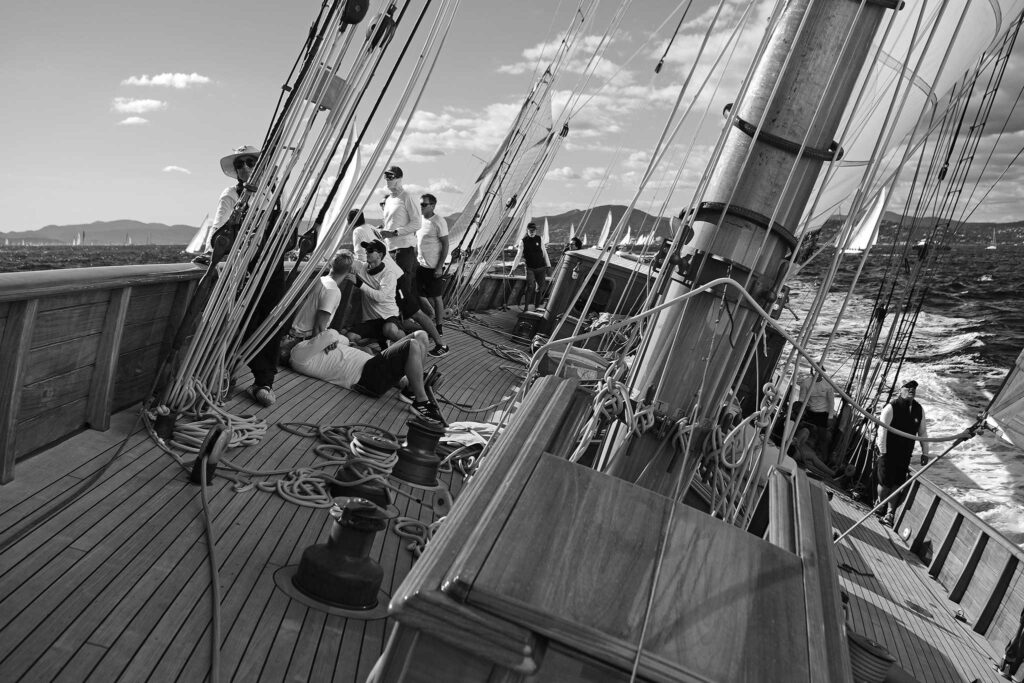
Big boat racing is still a male-dominated sport. Pro race teams are made up men to women in a ratio of easily 20/1, and it is normal for there to be no women on a team at all without incentives.
The exception to this seems to be classics. The classic scene is split closer to 70/30, and in my experience a woman’s competence as a sailor is less likely to be dismissed out of hand by dint of sex. Despite this acceptance, too rarely are women seen in the high-responsibility and hotshot positions. How often do we see a woman driving the boat, calling tactics, or wearing a harness on the bow or aloft, classic, or otherwise?
In 2024 on Naema, nearly half of the race crew were women. Whether the culture was already there, or whether I have helped foster it, I am not sure. Possibly both. But when I was the deckhand in 2021 preparing for my first Saint-Tropez and the mate told me I didn’t need to wear my harness, I blatantly ignored him. I am adept at scrambling aloft and onto the bowsprit and suspected that unless I pushed for it, this ability might never be employed. Whether I was acting from narcissistic self-importance or fighting unconscious sexism is impossible to know; the reality is I have rarely gotten ahead in this industry or sport by sitting back and trusting that my turn will come.
That small act of pushy rebellion likely helped bump me from a deck-bound “girl job” and ultimately land me, this year, in one of the biggest “guy jobs” of all—running the pointy end of the boat.
As a female sailor there is an incredibly fine balance between putting yourself forward and pushing for recognition while not portraying yourself as cocky and overconfident, and being able to ask questions and not be dismissed out of hand for not knowing things. I have been lucky to surround myself with sailing mentors who acknowledge and use the skills I do have, while continuing to teach me and help me grow as a sailor.
• • •
Lesson from day two: “The back of the boat will try to f*** you. Be ready for anything.” -Ado Stone.
Day two. Big breeze still expected. A reachy/downwind start to a leeward mark, a small sausage, and then a big upwind beat to finish. The plan was to cross the line into a kite set, but on final the call from the back of the boat switched and we scrambled to set the jib top instead. Once over the line that call quickly changed again—the back of the boat wanted the kite after all—and Louis and I discovered that our hasty JT set had locked out the kite halyard.
Had I been anticipating this move, I would have brought the halyard forward and pinned it to the end of the bowsprit outside the jibs, but I was caught off guard and flustered, and now the halyard was inside of the JT sheet, which, at the forward shrouds, sits nearly at the spreader. Our start included our class—seven big schooners—as well as the class below ours, including two of the 15s—beautiful, gaff-rigged, Fife-built cutters nearly 115 years old.
As Louis grabbed the kite halyard and started trying to clear it, one of the 15s, Tuiga, got under us and started trying to push us up. A very hectic minute ensued as our tactician fired questions at me over the radio about overlap, I flapped my hands angrily at Tuiga (they weren’t even in our class!), and I also kept an eye on Louis trying to clear the halyard. Eventually Tuiga scooted ahead, I told the tactician to drive his own race, and, running back, grabbed the halyard from Louis, clipped it to my harness, and ran up the shrouds with it, weaving a complicated over-under web aloft that eventually landed me back on deck with the halyard clear. We plugged it in and finally, finally, the damn kite got set.
Talking about it later over a dockside beer with Ado Stone, he clapped me on the shoulder and cheerfully reminded me that, “The back of the boat will try to f*** you. Be ready for anything.” I nodded, finished my beer, and angrily told myself that the dumb mistakes were done.
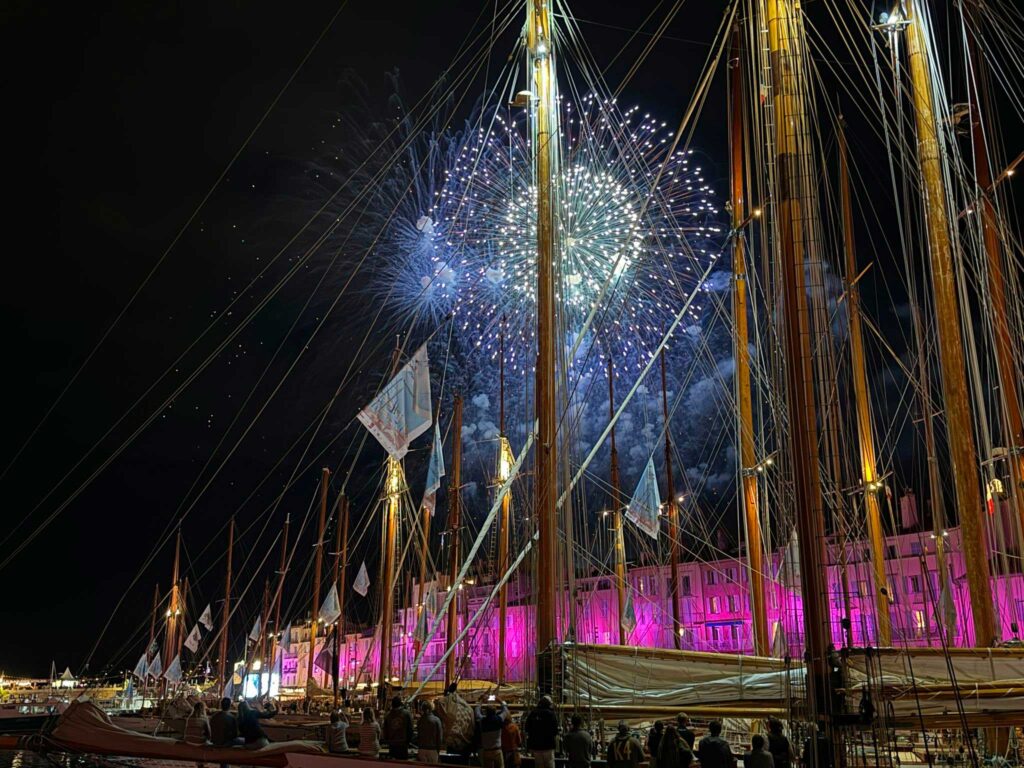
The Thursday of Saint-Tropez is always a lay day for boats to conduct challenges, participate in the Centenary Regatta, or “rest” (an activity that often involves a crew lunch at Club Sac en Sac, the bar made famous by Brigitte Bardot). We often coordinate with the other big schooners and go for an afternoon sail, as we did this year, managing a close flyby of the port with our kite set. As a destination village, Saint-Tropez is a place to see and be seen, to be talked about, ogled, and admired—for boats and humans alike. The beautiful classics (and a few moderns) squeezed into the small port preen at night under the cameras and gazes of the hundreds of tourists there to gawk at the pretty boats, and a close flyby of the port under full sail is practically a mandatory Give the People What They Want maneuver.
Friday, day three of racing, dawned cold, lumpy and windless. It didn’t get better. We bobbed around for hours in the slop until finally the hopeful race committee lowered the AP flag. As we moved into sequence, the boats in the start ahead of us floated on the line. The gun went off and we joined them. A flotilla of beautiful classic boats, every sail possible set to catch the non-existent breeze, eyeing each other in consternation as our sails flapped and drooped. Thirty seconds passed; 45 seconds…and the race committee called the race. We grumbled about the waste of a day and went in.
• • •
Schooner sailing is delightful because no matter how well executed the maneuver, there is always a hint of chaos. There are so many sails, never enough winches, and nearly always at least five things happening at once, with multiple bodies exerting maximum effort.
For example, to tack Naema is a series of steps involving not just sails crossing the boat but also going up and down. When we get the call to ready for a tack, the MTS (see sidebar of terms below) is struck all the way down to deck; the foretopsail has to be bunted, while at the back of the boat the runners are prepped. We go helm up, the runner teams grinding their new runner on tight as the three headsails get passed, the jib trimmers frantically swapping jib sheets and topsail tacklines on their winches. The foremast team re-sets the foretopsail while the midship plugs in the MTS on the new windward side. And, finally, the MTS is re-hoisted. That is a simple tack.
After a few days of racing, we all settle back into the routine of the chaos, knowing the individual dance steps of our area and able to coordinate them efficiently. As on any boat, it is an addicting feeling when a team starts to come together and the boat responds, and we sense that we are not racing ourselves anymore but are actually competitive and racing other boats on the course.
• • •
Saturday, last day of racing. “I certainly hope the sailing is better than yesterday! It can’t get much worse.” –Owner of Naema.
For the Naema team, Saturday was a great day of racing. The sea breeze behaved, popping up when it was supposed to and blowing the magic 12-15 knots. The course was a schooner’s dream—reachy, with minimal windward/leeward legs. We were focused, the stoke was sky high, and the general feel was that we could do no wrong.
We nailed the start, and Louis and I nailed the kite sneak into full hoist as we crossed the line, our A3 filling and keeping us out and in front of the pack. One of those suspended-organized-chaos moments ensued, but one that stretched on for breathless minutes as Naema took to her heels powered by an onslaught of activity. We crossed the start line, got the kite set, dropped headsails; the mid-deck got the gollywobbler set as Louis and I, seeing that our angle was quickly becoming too shy to hold the kite, ran the windward kite sheet around to use as our “storm drop” sheet; the mid-deck dropped the gollywobbler, we re-set the jib and staysail, and then came my glorious moment of sitting on the end of the bowsprit, spike in hand, feeling the boat charging along as we sailed fast and hot, the crew poised behind me on the mid-deck and the rest of the fleet spread out behind us. A beautiful moment, a snapshot of a moment, and then three, two, one spike!—and the kite exploded away, and I tidied the bowsprit in that short-lived silence.
Naema, who never keeps up with the spry, higher-pointing 15s, vied with them for the lead the whole race, the 15 Mariska finally getting her nose ahead of us as she took a tighter turn around a mark. She increased that lead in the final beat, finishing in front of us, but the final, capping moment of what was for us a brilliant race came right before we tacked onto lay for the finish. Tuiga, who had so indecorously pushed us up on day two of racing, was blasting towards the finish—on port tack. Getting to scream STARBOARD at them and then crossing the line first was, while completely inconsequential in terms of our race—as they were in a different class—inordinately satisfying, and our tactician and I shared an especially smug handshake post race.
After corrected time for that race, we placed fourth.
Coming down from the event that Saturday night amid the festivities and goodbyes, and in the recovery days that followed, I took the time to process. To some extent I was unsurprised I had made mistakes at the beginning of the week, much as I would have fervently preferred not to. It is hard to do a new thing flawlessly; the very concept of practice acknowledges this. I was therefore not so much upset at myself that I had made those initial mistakes as I was glad that I had been able to learn from them and end the event on a great day, feeling proud of a job well done.
The feeling of doing a thing well, however, is addicting, and the main emotion I walked away with was acute disappointment that it was over. Four days of racing, especially when cheated of one of them, barely scratched the itch. Tasting that last day the sweet satisfaction of finally being proud of the job I had done and deserving of my flashy hotshot position, I ended the week with a fierce desire for more; more days out on the water at the front of a racing boat, to continue to learn and grow towards being the most competent bow girl I can be.
In his book Born to Win John Bertrand writes: “Honor and pride and the timeless human desire to pursue excellence for the sake of pure excellence are, believe me, the most powerful masters of all.” For me, the pursuit of excellence is just as sweet as he claims.
It goes without saying that a huge thank you to Naema and the whole team are in order, and that Les Voiles de Saint-Tropez 2025 cannot come soon enough.
List of Terms
Jackyard Topsail: The jackyard is a spar hoisted from deck, which extends the dimensions of the jackyard topsail beyond the main topmast and main gaff.
Fisherman: A four-cornered reaching tweensail that fills in the gap aloft between the mainmast and the foremast.
Gollywobbler: A four-cornered lightweight downwind tweensail that fills the gap between main mast and foremast but extends all the way to deck.
MTS: A triangular upwind tweensail that fills the gap aloft between the main and foremast.
Jib Top (JT): The outermost jib, hoisted to the top of the foretopmast and with an extending tack line.
May 2025