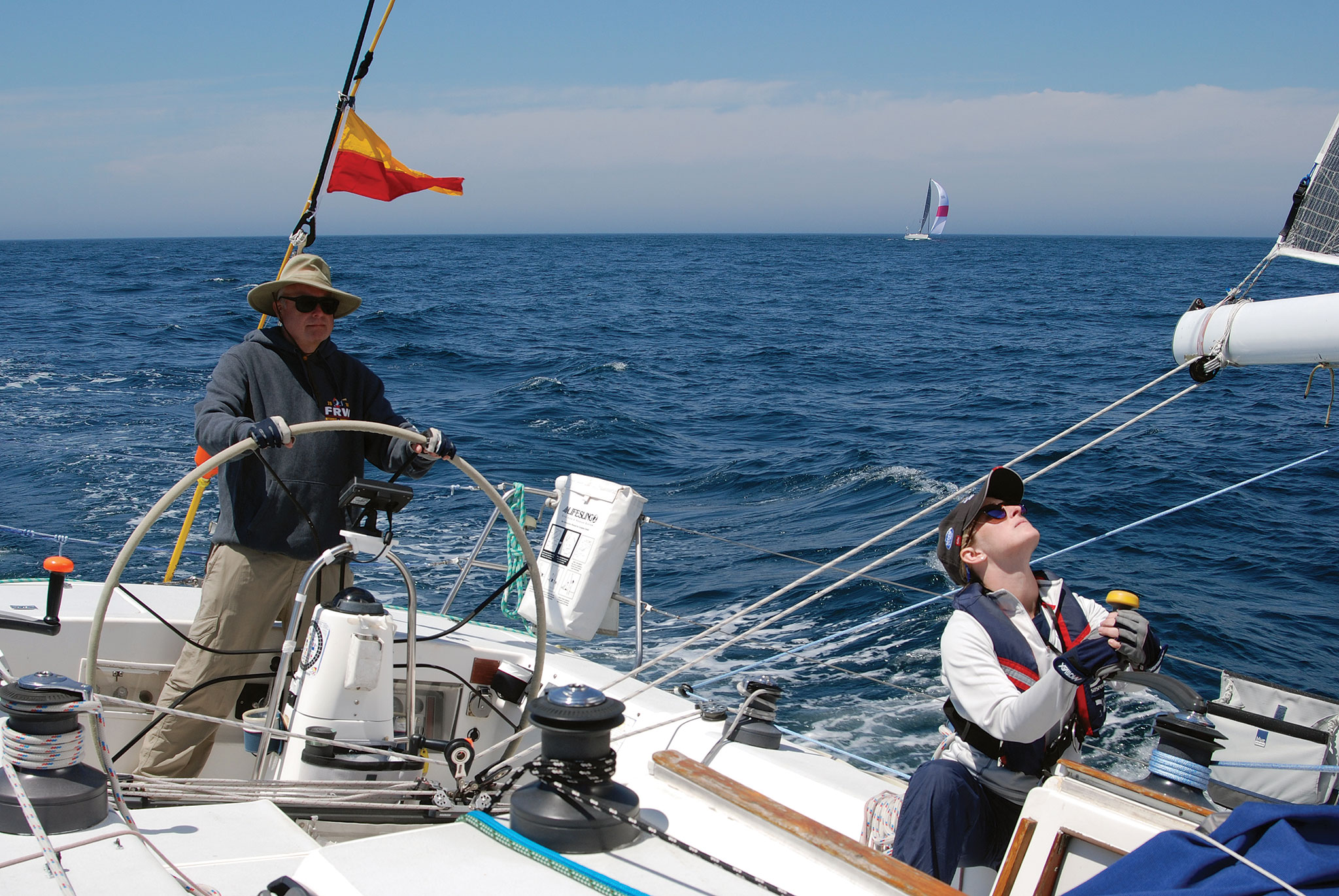
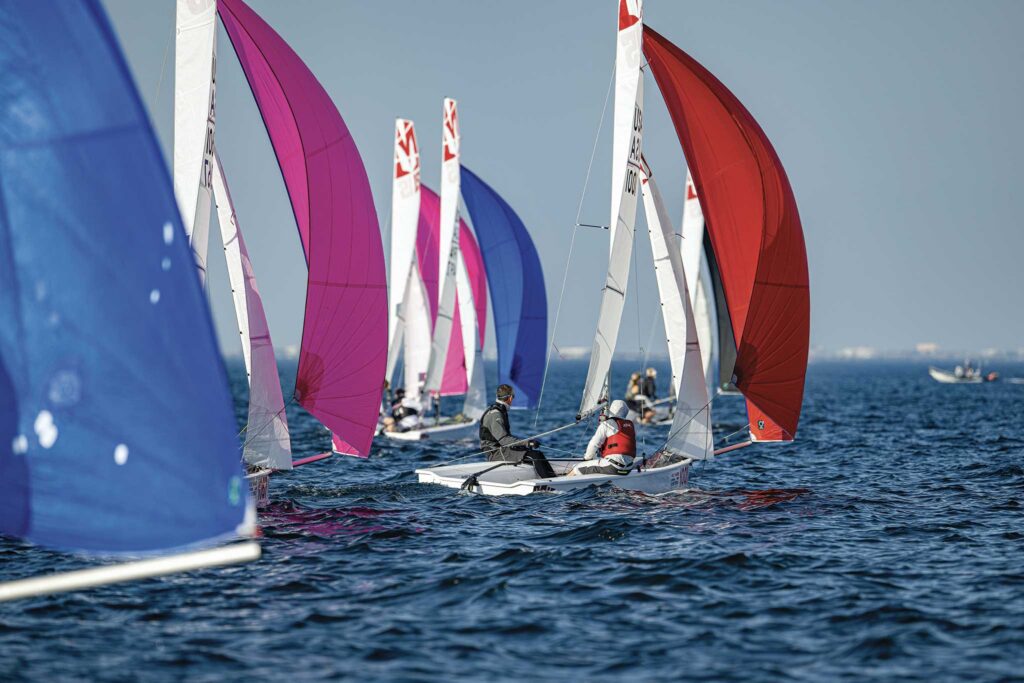
This is a small-craft advisory of a different sort. Be advised, for when the red triangle pennant is stiff on the yardarm, there’s a good chance Melges 15 sailors young and old will, with a pep in their step, rig up and go for it.
Bill Goggins included. “What I love is how the boat behaves when it’s windy,” says Harken Inc. CEO and father of three sailing teenagers. “You’re not sailing around on eggshells and when you get hit with a puff downwind, it just tracks and wants to accelerate instead of rounding up.” His boys, he adds, would tell you, “this boat is sick.”
“They actually want to go out when it’s windy,” he adds, “which turns big-breeze days into ‘let’s go out and play days.’”
And, by the way, he adds the boat is equally fun when coasting, for those not seeking thrill.
The Melges 15, designed by Reichel/Pugh, who also hatched the matchless Melges 24, is another one-design sensation from the hallowed cornfields that cradle Melges Performance Sailboats in Zenda, Wisconsin. The 15-foot lightweight dinghy introduced in 2020 isn’t just another flashy craft tossed into an overcrowded dinghy market. There are plenty of other good options, but this one has somehow ignited a resurgence in American small-boat sailing.
With more than 1,200 boats already built, healthy localized fleets have sprouted on all U.S. coasts, salt and fresh, as well as in Europe. Wintertime all-ages regattas in Florida at the bespoke Melges Watersports Center now easily surpass 100 boats, a phenomenon the likes of which the sport has not seen since the heydays of the Sunfish or Laser classes. Yes, the boat itself is a wonder of performance and enjoyment, but those who sail it say there’s a magic to the experience and the eclectic community of those that sail it—from groms to teenagers to seriously competitive “mega-masters.”
Clay Johnson, who first sailed a demo Melges 15 in 2022 and now sells them from his dealership, Colie Sails, in Point Pleasant, New Jersey, says the appeal of the boat is how completely it cuts across age and experience. “The 15, anybody can sail. I mean, anybody from 10 years old to 75 years old, 80 years old. We’re seeing it all on the racecourse, and they’re having fun doing it.”
When manufacturers introduce a new model, there’s always a spin on filling some gap in the market, and Melges did the same when it presented the boat to Sailing World magazine’s judging team in 2022 before they selected it as its Boat of the Year. Come to find out, Melges wasn’t hyping. The class’s explosion has revealed a demand that few fully recognized at the time. Even Johnson admits he might not have believed that such a boat would become so essential—yet he now accepts it as the modern refinement of what doublehanded sailing always wanted to be.
Johnson, a one-time Laser Olympic campaigner and top collegiate sailor, remembers vividly his first Melges 15 experience at a regatta hosted by New Jersey’s Little Egg Harbor Yacht Club, home of Melges 15 Fleet No. 1. Little Egg, Johnson says, embraced the boat’s potential and bought six boats from Melges, sight unseen.
“I mean, yes, if you had told me six years ago that something like this would exist, I’d probably have my doubts,” he says. “This one is a 21st-century version of the best possibilities out there at the time. It is durable, accessible, reasonably priced, and Melges really cultivated it well.”
Goggins was another early adopter. As the first Melges 15 fleet co-captain at Wisconsin’s Pewaukee Yacht Club, he witnessed the fleet grow from two boats to 25 in three years. Other clubs have also embraced the Melges 15 as practical to own and maintain. It can be used for learn-to-sail programs, yet it’s also fully capable of high-level racing, making local one-design fleet-building easier. Unlike other traditional youth boats, which tend to confine participation to juniors, this boat comfortably supports adult-child teams, couples, and families. The current price point, which is roughly $16,750 rigged and about $20,000 with add-ons, is manageable for club fleets and shared ownership. Its durability (robust build, aluminum blades) and compact storage footprint (fits in containers, on trailers or racks, and can be stored upside down) make it logistically attractive for seasonal clubs and sailing centers. Critically, it’s backed by strong builder support from Melges, which Johnson describes as quick to fix issues and committed to the long-term health of the class. This is key, he speaks from experience, for institutional buyers who need reliability, parts and responsive service.
For Goggins, the family craft has become more than just another transactional boat purchase. It’s been a “family journey.” The boat is an object, he says philosophically. It is “a shared project” and a platform that has worked for every combination of his young family.
“I can sail with my kids, my kids can sail together, and I can sail with my wife,” he says. And the class scene that has blossomed before his eyes is one that he describes as “inclusive and joyful, not elitist or hyperspecialized.”
“It’s just a really good vibe of a blended combination of people that are in it for the joy of the sport, and it’s inclusive in that there are so many different types of body types and age groups and gender doesn’t matter.”
At the regattas he now attends with his sons Jack, 18, and Peter, 15, he adds, “you’ve got all these college kids, and right next to them are two older women, or a husband and wife in their 60s or even 70s. You’ve got these junior kids trading off with their dad who is crewing for them. It’s just a totally different vibe.”
Cate Terhune, who recently purchased Melges Performance Sailboats with her husband, Allan, admits they took ownership of one of the most important sailing brands and have enjoyed riding this runaway train with the Melges 15. “I think a boat like this was really long overdue,” she says. “You have a lot of kids in America that grow up sailing, and they’re sailing Lasers, and they’re sailing 420s and they get into college and they’re doing FJs. But you exit college, and unless you’re on that Olympic path, you really exit into an unknown in sailing.”
Speaking from her own experiences racing at the highest levels of the J/70 class over the past few years, she’s witnessing her peers and countless professional sailors rediscovering enjoyment in the class because of its inclusive culture. Both Terhune and Goggins highlight the likes of Seattle’s Jonathan and Libby McKee, Olympians and world champions of many one-design classes, who showed up at the most recent Winter Series event and finished second overall. McKee blended among the hundreds of sailors on the racecourse, but stood out ashore, sharing wisdom and tips through a megaphone.
Terhune’s limited Melges 15 outings have reminded her to embrace the whole point of the sport. “It’s really easy to get caught up in the seriousness of sailing, but at the end of the day, we’re all doing it because it’s fun, and we need to remind ourselves of that. And I think, like when you’re sailing on a boat that inherently makes you giggle, that’s a good reminder that we’re here to have fun.”
The tiny Zenda boat shop, she says, is currently turning out three to four Melges 15s per week with a small but highly active team. But they have an eye toward expanding production beyond the cornfields in order to keep up with global demand. The small-craft advisory stands—there’s a breeze a-blowin’ so rig up.
This article was originally published in the June 2026 issue.