You’re surfing the Facebook Marketplace boat classifieds, and one ad catches your attention: “Sunfish Sailboat for sale. 1985 AMF/Alcort in great condition with all the parts ready to sail. No trailer. Pick-up only. Solid boat. Will need two strong people to load it on your truck or trailer. $500 cash.”
At first glance, it looks like just what you need to teach the kids to sail. You are about to contact the seller, rush to the ATM for cash, but that little “wait a minute…” light in the back of your brain clicks on, and it dawns on you that you don’t know the first thing about buying a 41-year-old Sunfish. If this is you, read on.
A little background. Although “iconic” has become one of the most over used words in the English language, the Sunfish sailboat may be the most truly iconic sailboat ever built. According to Gail M. Muliett, lifetime Sunfish Class aficionado, after WWII Alexander Bryan and Cortlandt Heyniger, the “Al” and “Cort” of Alcort Inc., produced the Sailfish sailboat, essentially a hollow plywood surfboard with a lateen sail. Legend has it that Bryan’s pregnant wife complained that the Sailfish’s flat deck made it uncomfortable, so one of Alcort’s employees redesigned the boat with a wider hull and a small cockpit, and the Sunfish was born. Alcort offered the plywood Sunfish as a factory built, ready-to-sail boat or an easy to assemble kit for amateur home builders. Sales of these wood Sunfish were brisk, but in the late 1950s Alcort made the decision to transition from wood to fiberglass construction. Now for a few hundred dollars, any aspiring yachtsman could purchase a low maintenance, sporty dinghy that could be easily car-topped or trailed to any body of water large enough to have a name. Sales soared. There is some dispute about the number of fiberglass Sunfish built to date, but most agree that the number is somewhere north of 700,000. This makes the humble Sunfish arguably the most popular one-design sailboat ever produced.
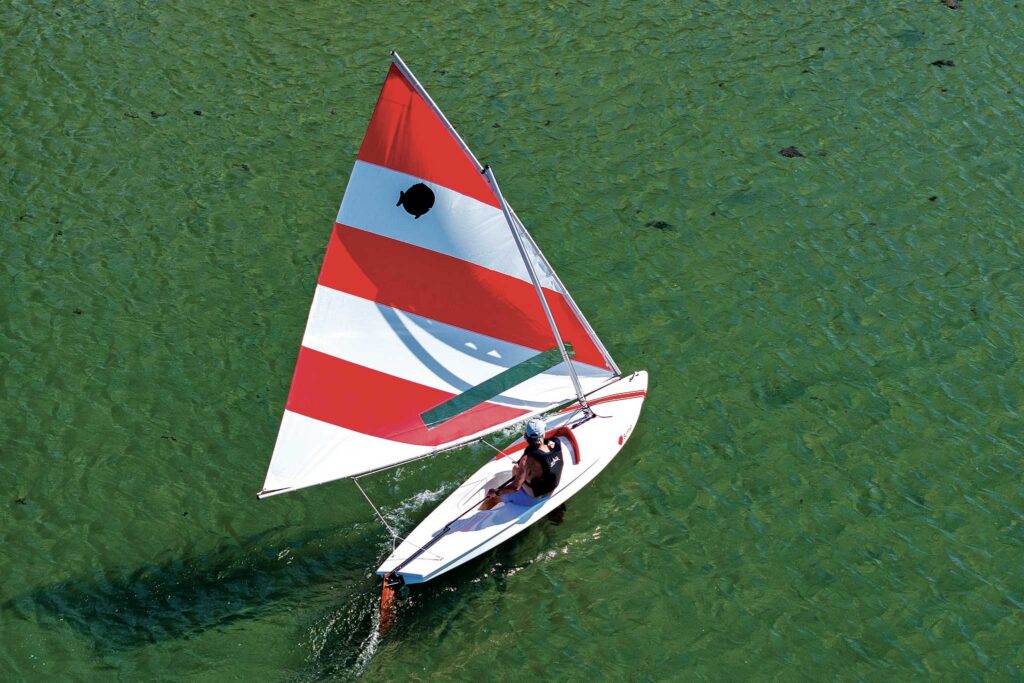
In 1969, the Alcort boys merged their company with emerging sports conglomerate American Machine and Foundry (AMF), and the Sunfish and several other small boat designs were built by the new company, AMF/Alcort. The company has been sold and resold several times since, and in an odd twist, has diverged into two different production lines. Sailing Michigan’s SERO Sailing makes the official Sunfish with the (sorry…) iconic Sunfish sail logo. However, International Sunfish Class Association (ISCA) regattas and National Sunfish Class Association regattas (qualifier events for the World Championship), require the class legal alternative ISCA dinghy, made by Zim Sailing in Rhode Island. Depending on equipment options, these boats now retail from about $5,700 to $6,300, still an affordable option for families to get on the water.
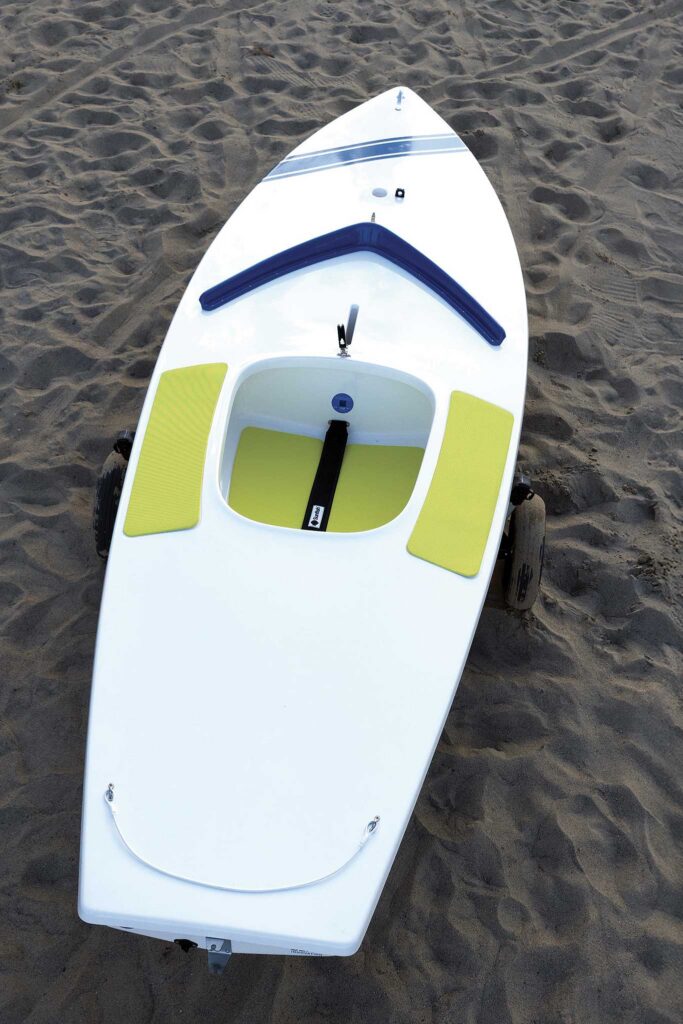
Sunfish owners fall into at least two categories: racers and recreational day sailors. The hard-core racers seem perfectly willing to spring $6,000 for a new boat, and to be honest, $6,000 is not a bad price to pay for access to hundreds of well-run regattas with world class competition. Recreational sailors will occasionally buy a new boat but will probably plan to keep it for several decades and maybe even pass it on to children or grandchildren. However, for both categories, there is a robust market for used boats.
I bought my first new Sunfish in the spring of 1972 when I finished up a five-year hitch in the Air Force. I paid $600 for it, took it on a vacation to the Florida Keys then sold it to a friend before starting graduate school. My second Sunfish was a $25 damaged boat that I repaired and sailed off the beach for a decade and then sold for a nice profit when I decided to give Sunfish racing a try with a newer, more competitive boat. It was not long before I was buying and re-selling used Sunfish as an enjoyable hobby/side hustle. While I don’t make a lot of money for my efforts, the work is fun, the boats are fairly easy to sell, and I enjoy the idea of getting older boats back on the water and introducing a lot of first-time buyers to the world of small boat sailing and racing.
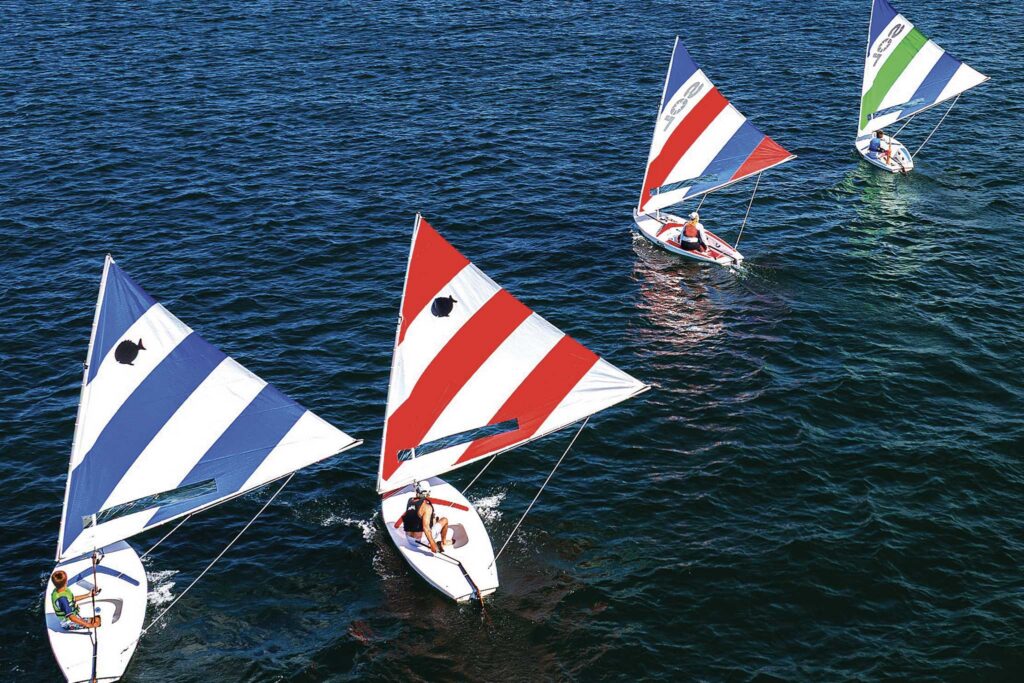
So how do you buy a good used Sunfish? Look on any yacht club bulletin board, Craigslist, and Facebook Marketplace, and you will find plenty of Sunfish for sale with prices ranging from free to $5,500+ depending on age, condition and equipment included. Over the years, I came up with an unofficial grading system to categorize used Sunfish:
- -“New” or close to new. This would include new Sunfish that were built for World Championship regatta charters, raced for a few days then sold post-regatta for a discount off the regular retail price. Also, almost new boats occasionally come on the market from individuals who buy a new boat, sail it a few times then decide to sell it. (Priced as high as $5,000+)
- -Older but in nearly new condition. Late model, low hours, complete with all parts, with no damage or repairs, and ready to sail as found. (Priced $2,800 to $4,000)
- -Used, race grade. Stiff, light, synthetic blades, race sail, race grade mainsheet, outhaul, and Cunningham lines, mainsheet ratchet block, hiking strap. Some minor scratches and dings, but no soft spots, structural damage, or significant repairs. (Priced up to $4,000)
- -Good condition, recreational grade. May have some minor damage with repairs, but not waterlogged and generally complete and sailable as is. (Priced up to $2,800)
- -Fair condition/“Beach banger” grade. May have some damage or repairs. May be heavier than new boat weight. May be missing some parts or in need of a new sail. (Priced $400-$800)
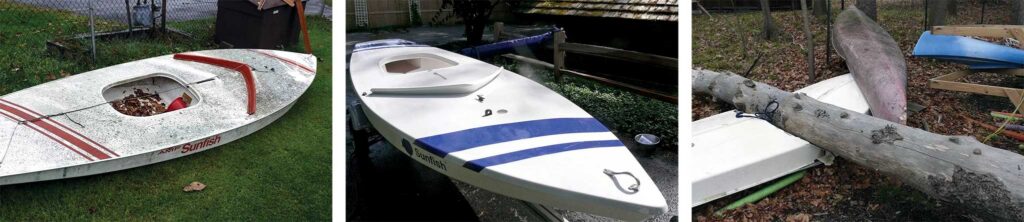
- -Poor condition. Significant damage/repairs. Waterlogged. Missing or damaged parts. Not sailable as-is. (Priced $100 to $200)
- -Landfill grade. Very poor condition. Severe damage. Waterlogged. Missing some or all parts. A “parts” boat at best. (Priced free or close to it)
A trailer, dolly, race gear, bottom, deck or spar covers, synthetic blades or other accessories will increase the value. Add about $350 to $450 for a roadworthy trailer with paperwork and $250 to $300 for a beach dolly in good repair.
Older hulls generally sell for less than newer hulls. In 1972 the class upgraded the rudder design, and the post-1972 rudders with side mount kick-up springs are vastly superior to the pre-1972 design with clunky bronze hardware. Also, some builders have better reputations than others. Ask veteran Sunfish racers for their opinions and heed their advice, especially if you plan to race. Newer hulls with the round-over Laser style deck edge are desirable and tend to leak less than the older design with a sharp edge joint covered with aluminum trim.
Decide how the boat will be sailed. Are you looking for a competitive race boat or a “beach banger” that you plan to leave on the beach all season, or something in between? What is your tolerance for dings, cracks, or scratches? Once you determine what you are looking for, search local yacht clubs, dealers, Craigslist, Facebook Marketplace, local Pennysavers, and other publications with classified boat advertisements. Narrow your search, contact the owners and set up times to see the boats in person. Cash is king. Have ample cash in hand, but don’t tell the seller how much you have.
How to survey a used boat: First, try to find out how old the hull is. Boats built on or after 1972 are required to have an alpha/numeric Hull Identification Number (HIN) engraved on the upper right-hand side of the transom just under the hull/deck joint. Google “Hull Identification Number” to find out how to decode this number. An example: “AMF64563M781” translates to an AMF hull built in 1981. Hulls without HINs are older than 1972, but it is harder to determine an exact year built.
Second, do a gross examination of the hull and all the components and note general condition. Do your best doctor imitation and palpate the entire deck and underbody with your hands. Ideally you want the deck and underbody to be free of soft spots, an indication of hard bumps where the fiberglass skin has separated from the interior foam. If you plan to race, even a few soft spots, particularly on the underbody, are a deal breaker—it’s less important for a day sailor. Are the spars straight, free of serious corrosion and have all of the plastic end caps? Are the daggerboard and rudder/tiller assembly in decent shape and free of cracks or clumsy repairs? Is the cockpit bailer functional or in need of being replaced? Is the sail good enough for your needs or will it need to be replaced? A very nice, new aftermarket sail with window (but no Sunfish logo) goes for under $150, but a class legal race sail will set you back about $450.
Third, what does the bare hull weigh? Until very recently, all Sunfish hulls had blocks of foam glassed into the interior of the hull for structural and emergency flotation reasons. If the hull leaked, the foam absorbed water resulting in a heavy, waterlogged hull. 1970s or older hulls had a new boat weight of about 130 to 135lbs. Newer hulls now weigh in at about 125lbs. For sailing performance and ease of handling ashore, light is always better than heavy, so if at all possible, weigh any boat you are thinking about buying. Bring an accurate bathroom scale with you. Place the scale on a hard surface, balance the hull on its edge amidships on the scale with light finger pressure and take a few readings. You won’t get a perfect weight, but it will be close. If you plan to race, you will want the hull to be as close to new boat weight as possible. If you plan to daysail, 15 or 20lbs over new boat weight is not necessarily a deal breaker. Heavy hulls can be dried out with inspection ports and fans, but you still have to find and repair leaks to prevent weight gain in the future.
Fourth, do a mast hole leak test. Due to the stresses the unstayed mast places on the mast hole, cracks in the mast hole are a common source of leaks into the interior of the hull. Do a visual flashlight inspection to look for obvious cracks or holes, but then do a simple leak test by filling the hole up with water to deck level then watching to see if the level drops.
Other considerations: If repairs are needed, do you have the skills, tools, and interest to make the repairs yourself, or will you need to hire somebody to do the work? Marine repairs don’t come cheap, so if you can’t do the work yourself, try to buy a boat that does not require extensive repairs. Similarly, if the boat is missing parts, keep your offer lower to offset the cost of replacement parts. A new daggerboard, rudder/tiller assembly, sail, or spars can cost hundreds of dollars and sourcing parts is not always easy. A boat with all parts included is almost always a better buy than a boat missing essential equipment.
- -Cosmetic condition. A very dirty boat can usually work to the buyer’s advantage as it will usually sell for considerably less than a cleaner boat. Sunfish left out in the elements often get filthy to the point of having mold or lichens growing on the surface. However, after a few hours of washing with soap and water, some regular laundry bleach, CLR brand stain remover for minor stains and Fiberglass Stain Remover (FSR) brand for more serious stains, an ugly hull can often be made to look almost like new again.
- -Paperwork. If the boat or trailer is titled and/or registered in the state where it is sold, be sure to have the seller sign over the title and/or the registration to you. Also, find out (in advance) what paperwork your home state may require to register or title your “new” Sunfish. At the very minimum, you will need a signed, rudimentary Bill of Sale with a description of the boat including the Hull Identification Number (HIN), the name of the seller and the buyer, the sale price and the date sold. Prepare a separate Bill of Sale for a trailer including the Vehicle Identification Number (VIN) as your state Department of Motor Vehicles may require it when you register the trailer in your name.
- -Negotiation. Don’t agree to a price in advance, and don’t be shy about offering less than the seller’s asking price, especially if the boat is older, dirty, missing parts, or needs repairs. Many sellers will set a high asking price and are often willing to take less for a quick, cash deal. That said, be willing to pay a fair price for a decent package. Also, don’t be afraid to walk away from a deal you are not comfortable with. Market value is what a buyer is willing to pay and what a seller is willing to take, nothing more and nothing less.
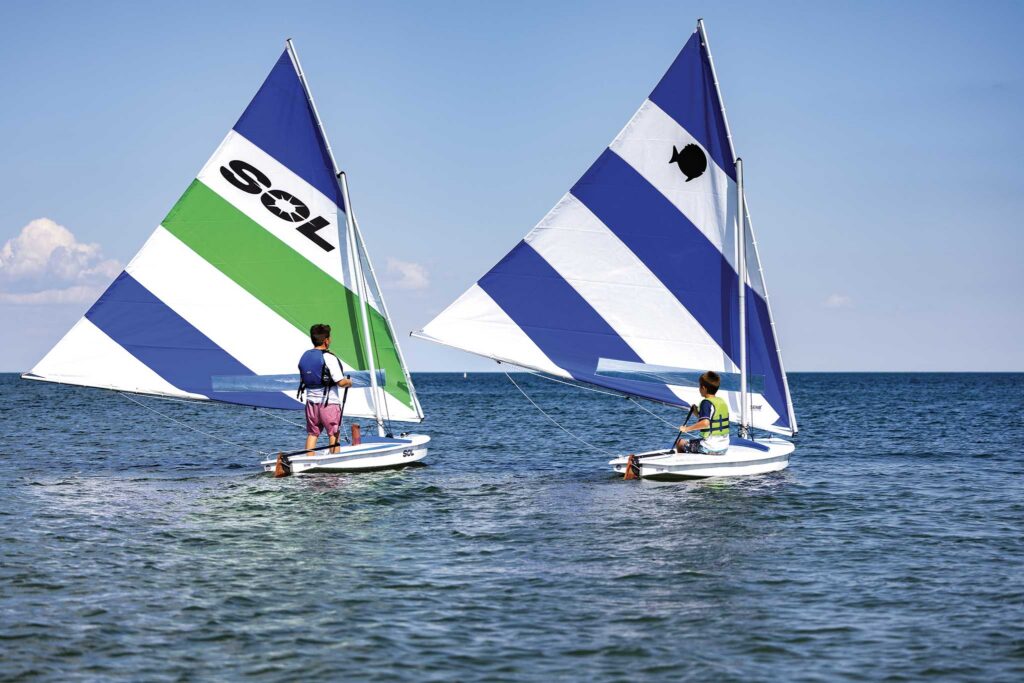
The Sunfish is a great design, a perfect first boat and an ideal trainer for kids and novices of all ages. Used boats sometimes go for bargain prices, like my best score, a 2005 Vanguard that had never been sailed and was sold for $900 by a seller who found it in the garage of a lake cottage he had purchased and just wanted it gone so he could park his car inside. Deals like this exist if you look hard enough.
Good luck and good pickin’!
This article was originally published in the June 2026 issue.