Photo courtesy of Balance Catamarans
I was ferried by tender to hull #1 of the Balance 502 named Tiger Lily. I’ve found this way of approaching a new boat makes the best visual impact. She looked at ease sitting on the wavelets off Miami but also like a force to be reckoned with. She was fresh off an Atlantic crossing on her own bottom, a passage that didn’t seem to have left a mark. I scrambled aboard to meet my friend Phil Berman, the founder of Balance Catamarans, for a much-anticipated sea trial.
Co-designed by Berman and Du Toit Yacht Design, the Balance 502 adopts the sleek family aesthetic with long knife-like hulls, reversed bows, a low profile, and a two-foot eight-inch bridge deck clearance. She replaces the Balance 482 and includes dozens of little improvements that make her a worthy successor.
The construction is a hand-laminated vacuum-bagged e-glass epoxy fabrication with a closed cell foam sandwich and what Balance calls their Carbon Core structure. That means the cabin soles, bulkheads, primary beams, daggerboards, trunks and rudders are all built of carbon. This makes the design lightweight and relatively quiet. And yes, she’s also easy on the eyes.
Any added length is a blessing on a cat, and the two extra feet of LOA added buoyancy to minimize hobby horsing. Additionally, there are new transom closures. On the 482, loose boards were used to close up the wide transoms for safety offshore. On the 502, sections of the cockpit sole over the engine rooms hinge up to form doors on both sides, revealing acrylic hatches below so that nobody falls through to the machinery spaces. It’s a streamlined solution with no more loose bits that need to find a home once at anchor. Another improved detail is the placement of the five solar panels on the bimini. Although Balance insists on using free-standing glass panels for efficiency and longevity, the new panels have been recessed into the hardtop for a sleeker profile while still retaining an air cavity below for proper ventilation.
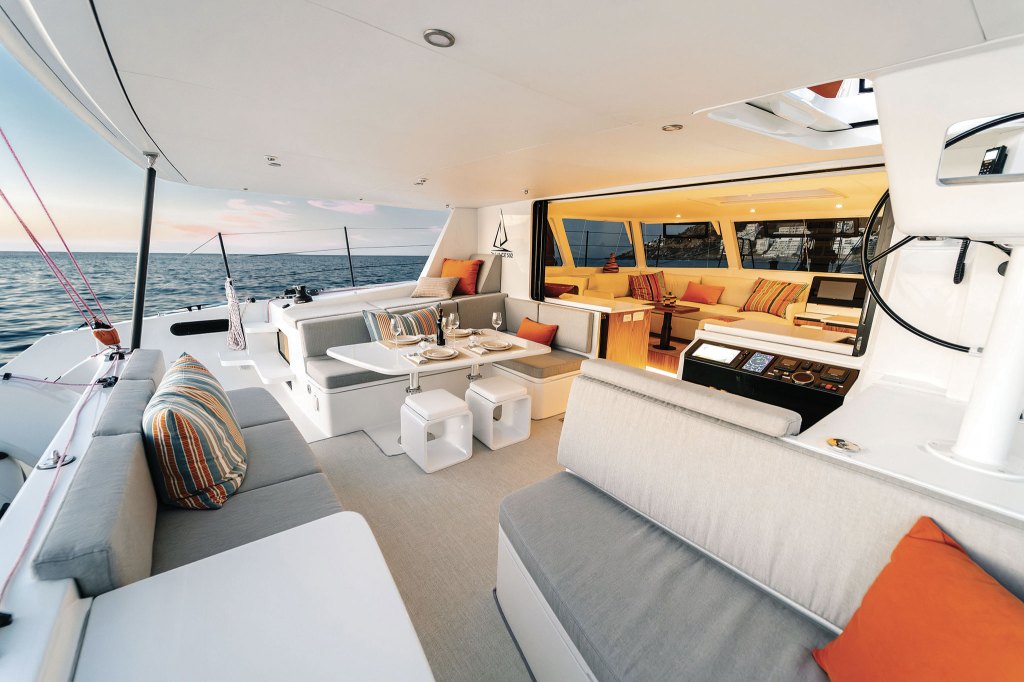
The daggerboards are controlled via lines led to clutches and winches at the steps to the decks on either side. It’s a simple and intuitive system with quick access from the lower helm in the cockpit in case you need to raise those boards in a hurry. The cockpit itself is delightful with a grill integrated into the transom on starboard, and a transom seat that was raised for better sightlines through the salon windows. An inviting daybed is on port next to the dinette. For me, any off-watch time would be spent there.
Balance’s trademark VersaHelm is a fixture on all models and the 502 is no exception. The wheel pivots 90° between the upper and lower helm stations. The lower helm seat was allotted more room in the redesign for better comfort, and the enlarged salon windows provide improved visibility forward when driving from this position which is also protected from the elements.
Line handling is done at the upper helm with three winches and arrays of line clutches. Two B&G displays deliver information, one mounted at an angle on the coachroof and an instrument screen by the wheel. Another screen is at the lower helm as are the two Yanmar engine displays. What takes a bit of getting used to is the placement of the engine throttles. To split the difference between the two helm locations, Balance put the single set of throttles up high but still reachable from the lower station. However, this leaves them to the left of the wheel at the upper helm which made it awkward for a right-hander like me. But, since I tend to lock the wheel when maneuvering solely with the engines in tight quarters, I’d hinge the wheel down to get it out of the way and drive the way I’m used to.
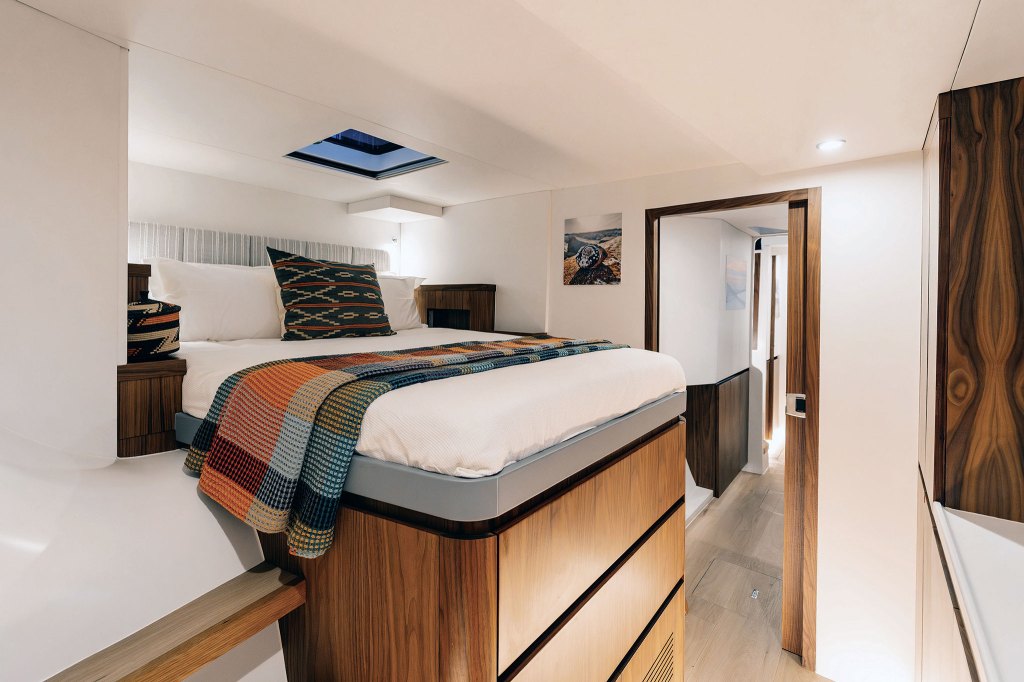
Tiger Lily’s layout is fairly standard with three cabins and two heads. The master suite consumes the entire starboard hull with an athwartships bed forward and a mindbogglingly big head aft that includes a shower stall with six feet five inches of headroom. The storage in this owner’s cabin seems endless. There’s even a walk-in closet with shelving in the bow and a vanity desk amidships. I wondered where they hid the daggerboard trunks that normally eat up a lot of room.
To port is a cabin with another transverse bed that’s identical to the owner’s and a double cabin aft that splits into two beds with a dividing board. It can also be transformed into an office. A shared head occupies the midsection and the use of sliding doors has saved room in the passageways. The port side is also home to the sophisticated electrical panels and some systems like the watermaker.
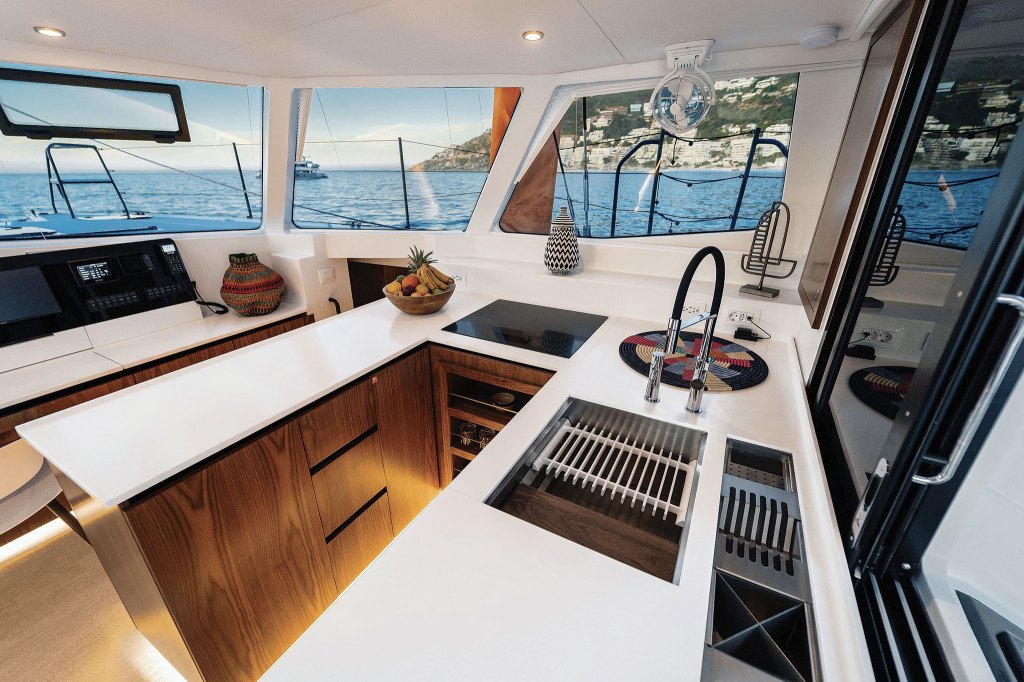
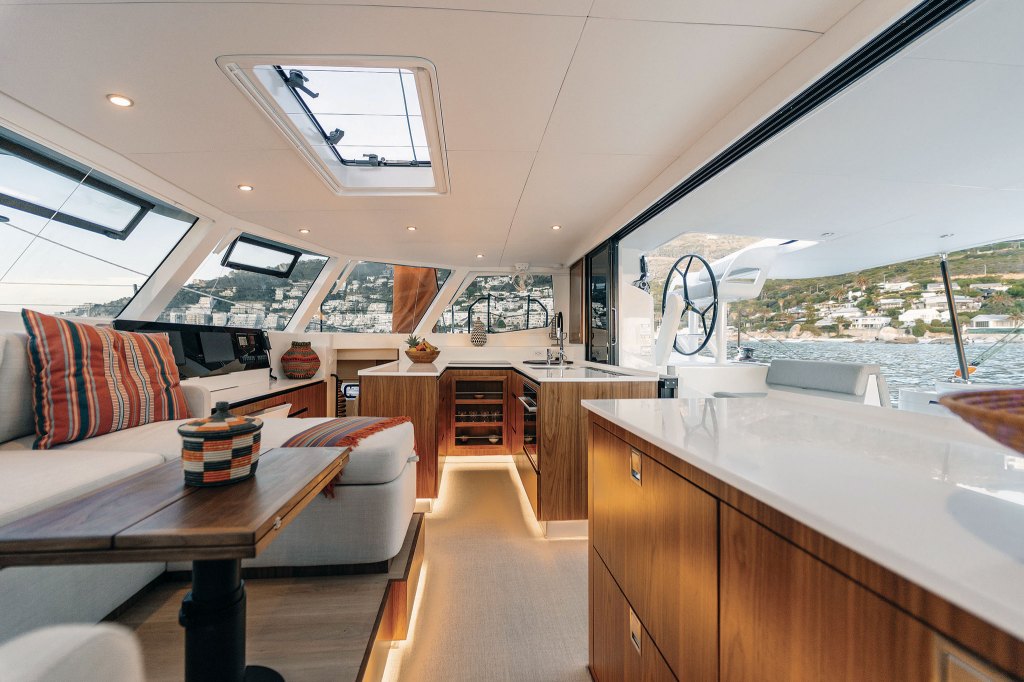
On the main deck, the salon is in the port forward corner ahead of and facing an array of four refrigeration units. The deep galley is to starboard and directly ahead of the lower helm so the chef and the helmsman can converse easily with the doors open. For two people on a crossing, this proximity can be meaningful. There’s only one galley sink, but an integrated drying rack along the countertop alleviates the need for another.
Just ahead of the galley is the nav desk with more screens and a free-standing chair. It’s a tidy affair with many items like charging ports tucked discreetly behind a drop-down panel. Balance is increasingly espousing an Italian flair with hidden functionality like this desk, and the cabinetry and fridges are enveloped in wood veneers giving the interior a cohesive and upmarket vibe.
Balance builds ocean-crossers designed for short-handed crews of owner operators so the boats must be easy to sail. The 502 carries 1,539 square feet of upwind sail area and can switch quickly between a 423-square-foot self-tacking jib attached to a curved track on the foredeck, and the 2,345-square-foot asymmetric spinnaker on the long bowsprit. Switching up sails is easy peasy.
Our test day served up mild conditions with true winds of 8-15 knots and a small chop. In 9.1 knots true, we sailed 6.9 knots of boat speed at 80° apparent wind angle (AWA). That’s a whopping 75% of wind speed. When we cracked off to 120° AWA, we made good 9.2 knots although the wind had piped up to 14 knots by then. The helm was fingertip light and our tacks were crisp. The polar diagrams suggest that she’ll sail at wind speed given 20 knots at 110° on flat water which left me wishing for more wind.
Note: I sailed the Carbon Cross version which came first but since then, the 502s are called Carbon Core and are 2,200 pounds lighter. They offer potentially slightly better performance but I can’t say I was disappointed with Tiger Lily.
Balance offers hybrid propulsion having re-named Integrel’s E-Drive system to “VersaDrive” which inserts 15kW electric motors between the 45-hp diesels and the saildrives for short bursts of all-electric propulsion or advanced charging depending on how you set each side. The large 36kWh 48-volt lithium battery bank is charged quickly—up to 15kW per side. That means you can skip adding a generator and even do away with propane for cooking and grilling. Add up to 3,000 watts of solar on the bimini and the company reports a fuel savings of up to 25% while leaving a cleaner wake.
Under pure electric power, the 502 can motor for two hours at six knots, which is ideal for quick exits from the marina or a run to the fuel dock. “With the enormous Mastervolt bank, you can run air conditioning all night using only 50% of the batteries,” says Berman. “There’s no genset making noise all night.”
As for hydro-regeneration, Balance feels there’s little meaningful power generated by props free spinning while under sail, especially below a boat speed of 10 knots. “The juice ain’t worth the squeeze,” adds Berman.
Balance builds luxury performance multihulls with loads of thoughtful and practical details and that doesn’t come cheap. A well-outfitted Balance 502 is around $2.2 million, but that’s in the ballpark for this size and class of multihull. Because Balance is a semi-custom builder, there are loads of opportunities for customization like the color schemes. Just like the flower, Tiger Lily was decked out in smart black and orange accents.
I recently sailed the Balance 580 which is an impressive machine, but she’s also a behemoth that to me, felt like Papa Bear’s Chair. By contrast, the Balance 502 just seems to fit. This luxurious and roomy bluewater passagemaker will make the most timid sailors feel at ease and a crew of two won’t need to stretch to manage her, even in a blow. She definitely gets this Goldilocks’ seal of approval.
LOA 50’ 0”
Beam 25’ 11”
Draft 3’ 10” & 7’ 7” (boards down)
Upwind Sail Area 1,539 sq ft
Displacement (light) 28,660 lbs
Water/Fuel 103 gallons/106 gallons
Engines 2x 45hp Yanmar
Naval Architect Du Toit Yacht Design
This article was originally published in the October 2026 issue.