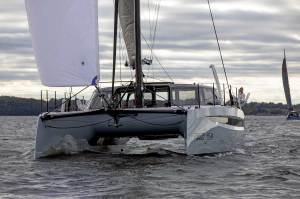
While everyone in the multihull market seems to be zigging, Aquila Catamarans has decided to zag. Renowned for their comfortable and spacious powercats, Aquila has entered the sailing market with their first 50-foot model. “All of us at Aquila used to be sailors,” says Nick Harvey, Aquila Group’s chief revenue officer. “We’re just returning to our roots.”
It’s a curious and counterintuitive move as many sailboat builders eye the power market rather than the other way around. However, according to Aquila, new sailing multihulls outnumber powercats with a ratio of 2:1. Although powercats are growing at a faster rate, their established base is less than half of their sailing brethren. Aquila sees this as a strategic growth initiative to eventually become “the number one catamaran company in the world.” Harvey expects that within four to five years, Aquila will have a balanced offering with an even number of power and sail models produced. As we walked through hull #1, his enthusiasm was catching and I could hardly count the number of times he exclaimed, “This is where the magic happens!”
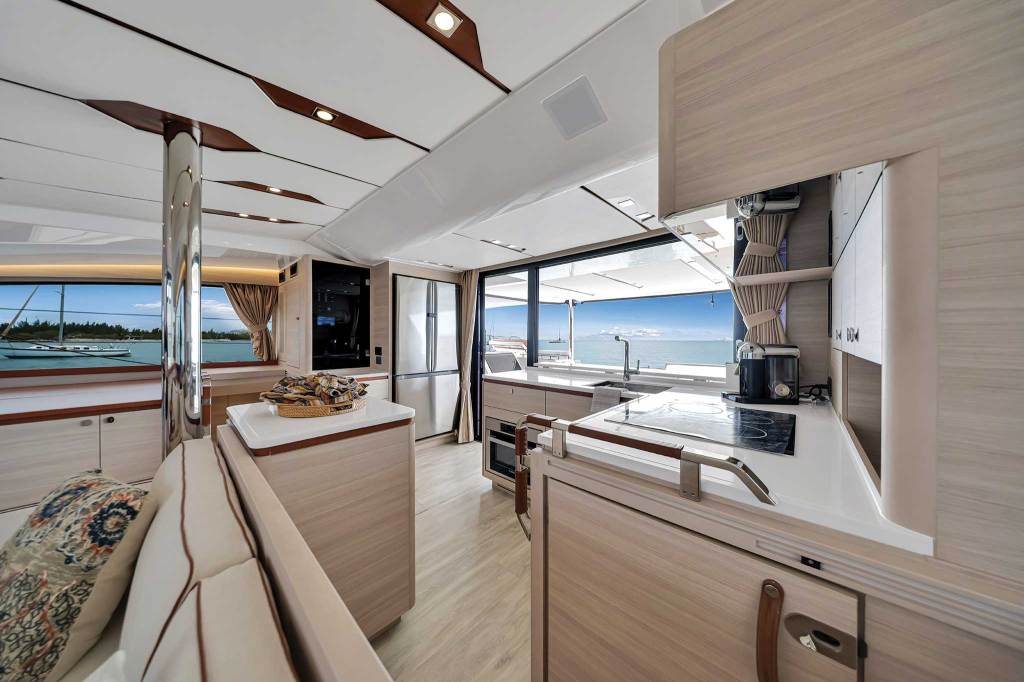
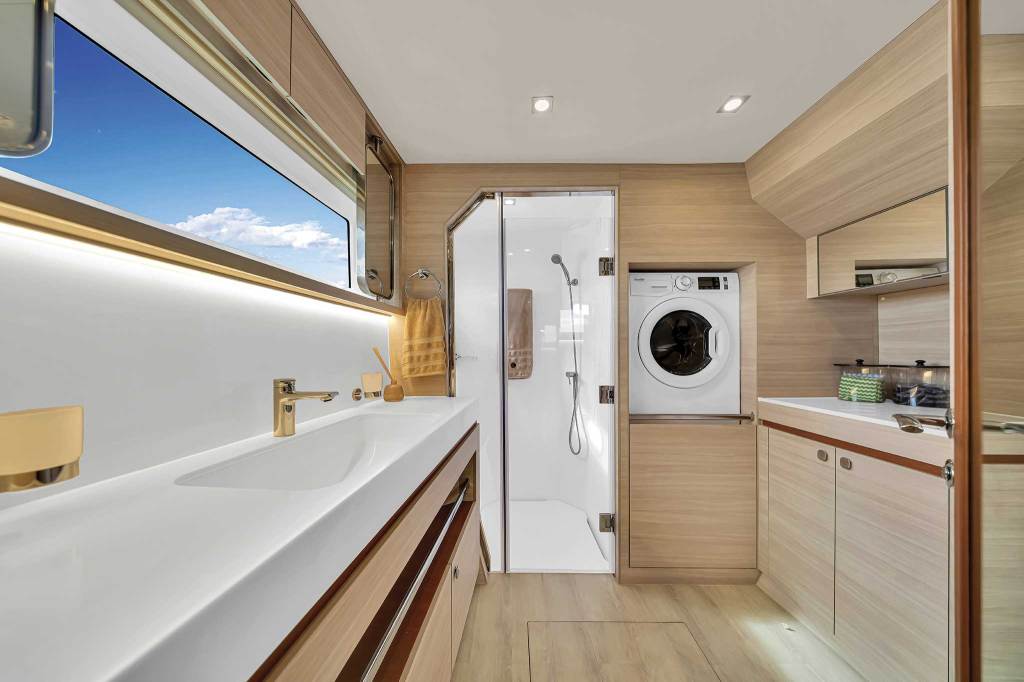
Although the LOA is only 49 feet 1 inch, the Aquila 50 feels big, like clown car big. It’s hard to take in all that has been packed onboard. Up to six spacious ensuite cabins with their own entrances can be specified, and because there are no interior hallways, the designers saved precious square footage in the accommodations. The salon and galley rival open floor plans in posh homes and there’s a dizzying amount of stowage space everywhere. To prove the point, Harvey grabbed my full-sized carry on roller bag and dropped it into a deep drawer in the master suite. There was room for two.
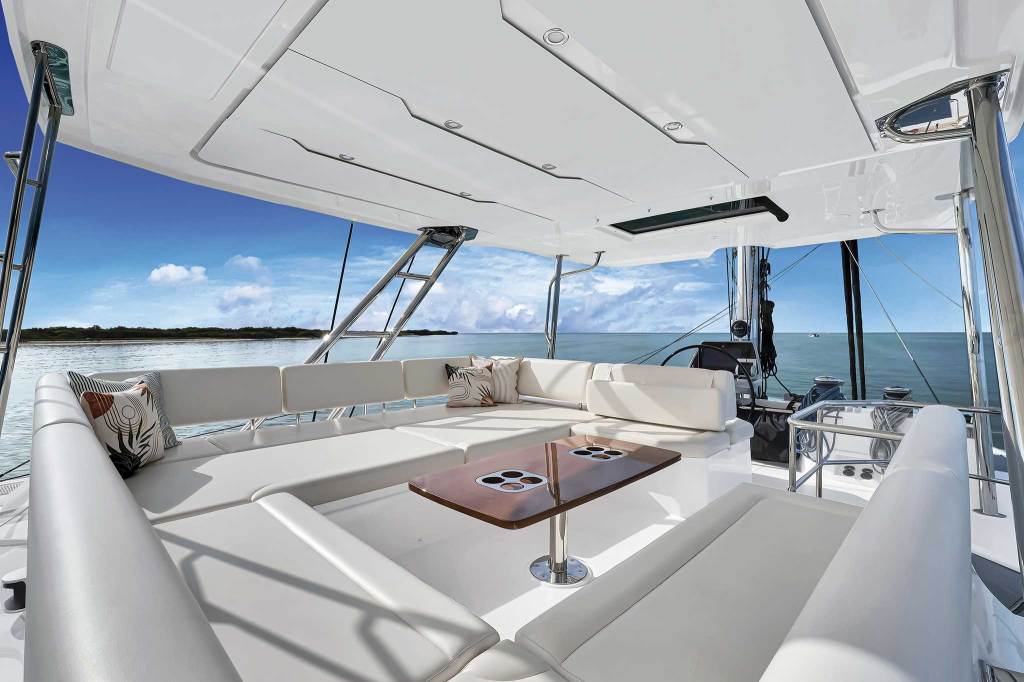
The salon flows easily from the forward door all the way back to the galley that features Aquila’s signature bar and stool combination that connects the interior with the aft cockpit. Two full dinettes are aboard, one inside in the salon and one outside in the cockpit. Each will seat six to eight so owners or charter groups will have plenty of elbow room. Aft, Harvey points out the lack of a hydraulic swim platform noting that these can be notoriously failure-prone since all the working parts are so often submerged in saltwater. Instead, the deck extends back to carry the tender which is lifted via Aquila’s trademark dinghy crane embedded into the flybridge structure above. It’s a single-line solution that’s easy to use and adds much less weight and complexity than the alternative.
The overall design mimics what Aquila has been doing with their powercats for years. The foredeck is solid GRP rather than a textile trampoline so there’s generous space for lounge seating as well as multiple sunbeds. This hard deck brings the gullwing underbody farther forward. Although I expected that to pound into head seas, I didn’t hear or feel anything during our sail on open water outside of Government Cut off Miami.
Stairs are integrated into both sloping sides of the superstructure so moving from the helm on the flybridge to the foredeck is quick and easy. And speaking of the flybridge, it could be an entire boat in itself with a massive rectangular dinette part of which doubles as the helm bench seat. I’m not a fan of centerline helms since the skipper can’t sight down either side when docking, and on a sailboat, there’s the added complication of the mast being right in the driver’s sightlines. That said, everything here is at your fingertips from the 16-inch Raymarine display to the engine throttles and the winches on either side. A bird’s-eye view camera at the masthead would help spatial awareness immensely.
The model is tall, especially with the optional hardtop that is crucial to the comfort of the expansive flybridge. This top has hefty supports that serve as ladders to climb up and check on the solar panels or manage the mainsail in the bag. Feeling sporty, I decided to test it. It was a challenge even at the steady dock, but Harvey assured me that the pitch of the ladders would be eased on subsequent hulls, and another handhold would be added up top where I ran out of options to steady my transit.
Watertight bulkheads fore and aft and sacrificial keels boost safety in case of collision. A variable speed bow thruster on the port bow manages the effect of the ample windage when maneuvering this towering design in tight quarters.
Like her unique layout, the Aquila 50’s performance warrants a mention. Standard propulsion includes twin diesels paired with Saildrives. There’s a choice of 50 to 80-hp engines and either Volvo Penta or Yanmar brands. With a displacement of 51,000 pounds (loaded), the boat will benefit from an engine size upgrade to push into head seas. However, hull #1 had a trick up her sleeve in the form of the Torqeedo Hybrid Ocean Drive system with twin 50kW electric motors paired with a 40kW generator and two 80kWh lithium battery banks. With this optional arrangement, the range under electric power alone is 30 nautical miles at 6.5 knots and 13 miles at 8.2 knots. A dedicated screen monitors the system and the genset starts automatically to make the system user friendly and foolproof.
Charging is done via the generator, a 4kW array of Solbian solar panels on the hardtop, shore power, or hydro-regeneration with the propellers free-spinning while under sail. Meaningful regen doesn’t start until the boat reaches nine knots of speed. “We used no shore power for five days at the show dock,” says Harvey. “It was all genset and solar.”
Aquila has gone to great lengths to bring the space and
amenities of on-land living to their new cruiser. Photo courtesy of Aquila Catamarans
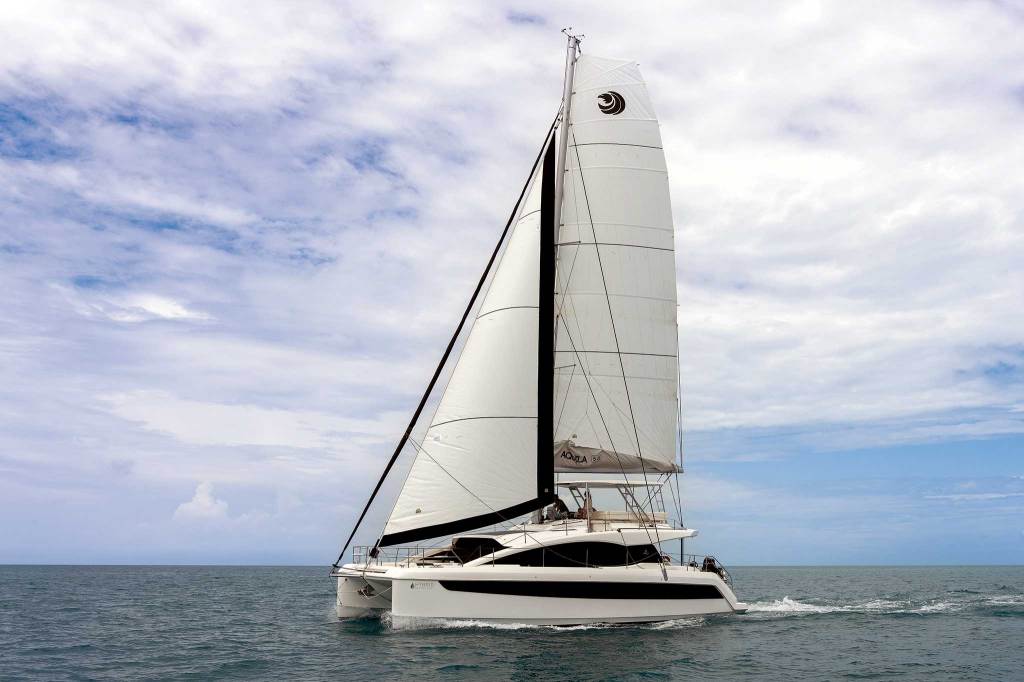
Under sail with the genoa and square top mainsail, our top speed was 7.1 knots in 14 knots of true wind on a beam reach, and when we cracked off, the speed dipped to 5.2 knots at 140° apparent wind angle (AWA). Pointing up to 50° AWA, we pinched and lost speed quickly. When the Code 0 rolled out, I was happy to see the speed jump up to 10.4 knots at 100° AWA but the wind had also stiffened to 17 knots true.
A note on the rig—it’s massive. At 82 feet, the double-spreader Z Spars mast creates a height/LOA ratio of 1.63, which is far above the standard range of 1.25 to 1.35 for most cruisers and especially for multihulls. That’s a lot of weight aloft so this rig will need to be managed carefully in a blow.
At the world debut in Florida, Harvey struck a coup by doing the unthinkable. He invited the heads of competing catamaran builders for an exclusive visit aboard his first model. “Now if they want to discuss the boat with others,” says Harvey. “They’ll know what they’re talking about.”
It was a bit of showmanship with a healthy dose of chutzpah, and it showed that Harvey isn’t afraid of his competitors, most of whom were his colleagues in the past. He welcomed scrutiny and feedback, and that’s an uncommon but admirable approach. I think it left the others speechless both due to his tactics and the boat itself, which proved popular with show goers as well. “We sold two 50s and two 45s at the show,” says Harvey. “And the 45 is still only on paper!”
Aquila expects to splash the upcoming 45-footer at the Annapolis Sailboat Show in October 2026 and then deliver a 65-footer in 2027. The diesel version base price of the Aquila 50 is $1.1 million, and the Torqeedo Hybrid Drive system adds another $300,000. Trimmed out with all kinds of goodies, our boat was north of $1.5 million. That’s not nuthin’ for a multihull cruiser in this segment, but then, she lives large and is spectacularly innovative and that’s not nuthin’ either. Maybe this really is where the magic happens.
- LOA 49’ 1”
- Beam 25’ 9”
- Draft 4’ 8”
- Air Draft 82’ 6”
- Displacement 45,232 lbs
- Upwind Sail 1,679 sq ft
- Fuel 222 gal
- Water 232 gal
- Engine 2x 50 diesel w/ Saildrive or 50kW Torqeedo hybrid system
- Design J&J Design
- Builder Aquila Catamarans
This article was originally published in the August/September 2026 issue.