My weapon of choice, when it comes to dinghies, is a set of oars. I’ve even used a pair on small sailboats, like on Wildcat racing up to Alaska. I like the exercise and the reliability. When it comes to Thursday night summer racing though, my brother and I take a different approach with our 15-foot Marshall Sandpiper.
If the wind is solid, we can sail most of the way to the start line outside of Padanaram Harbor in South Dartmouth, Massachusetts, but we still have to maneuver through a narrow corridor formed by the swing bridge. The current can rip, and so it helps to have some extra propulsion, especially when caught leaving work too late when we end up powering from the inner harbor to just shy of the starting line.
Bigger commonly is seen as better. Ground tackle. Bilge pumps. Winches. Sails. And even outboards. Optimizing for racing forces us to reconsider all those decisions. We’d rather not carry extra weight on the racecourse and so we landed on the compact electric outboard approach. We also picked up some fringe benefits—ones that transcend the line between racing and cruising. They may even be compelling enough on their own to validate the concept.
When discussing small electric outboards, I suggest the equivalent of 3 hp or less—that’s a cap of approximately 1000 watts in the electric world. It’s enough to move a dinghy or small sailboat, not at extravagant speed, just something practical. And the battery handles the round trip nicely, still leaving us a generous reserve, even at high throttle.
Unlike my days powering a J/24 to the Newport start line with a small gas outboard, I can now have an easy conversation with its electric counterpart pushing us along. We no longer breathe toxic exhaust or deal with the smell. There’s no need to carefully handle fuel or clean up the inevitable spills either: it’s a clean operation that never leaves my hands smeared with grease. Pull-starting disappears and maintenance is minimal. Put bluntly, and perhaps quoting one of my former engineering professors: it’s a more eloquent solution.
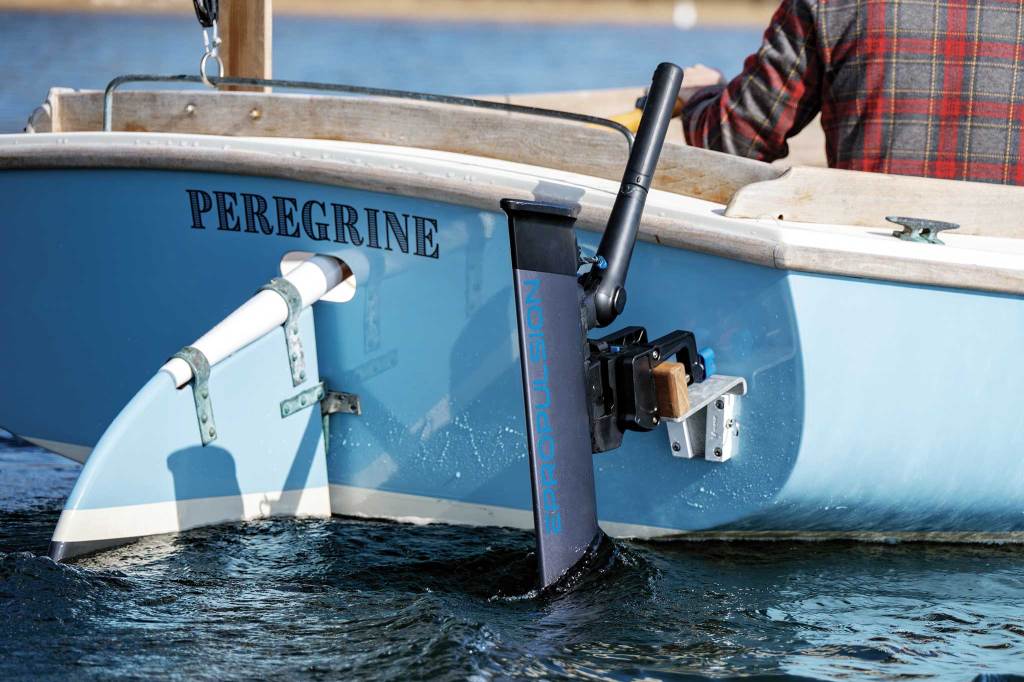
Where the compact side comes in, and it is a critical part of this equation, is handling. Small electric outboards tend to be lightweight. Some are exceptionally lightweight. And the goal was to get as light as possible and still fulfill our powering needs. Lightweight means easier to install, remove, carry, and store.
To establish a baseline for standard shaft length outboards, consider a 2.5 hp or 3.5 hp Tohatsu, which both come in at 41 pounds dry (or roughly 44 pounds with fuel and oil). A slightly more powerful 4 hp Suzuki weights 55 pounds dry (about 58.5 pounds with fuel and oil). Even a 2.3 hp Honda comes in at 29.5 pounds dry (near 32 pounds with fuel and oil).
In contrast, the small electric outboards we put to the test weighed as little as 14.7 pounds, and even the heavier options break down into components that are more manageable than the gas equivalent.
Everything has its trade offs, and with electric outboards it’s the time they take to recharge. As long as we had the range, that could be ignored for our Thursday night racing application, but in other instances such as dinghies for cruisers who have to charge onboard or carry spare batteries, this may become a hurdle. In the off season, it’s worth keeping an eye on the charge levels too—each manufacturer suggests maintaining certain battery levels to avoid performance-degrading damage, which introduces a complication factor.
Specs:
- Weight: 14.7 lbs; 17.4 lbs with bracket
- Operation: 45min at full throttle
- Charge: 4-5 hours (AC); 6-8 hours (DC)
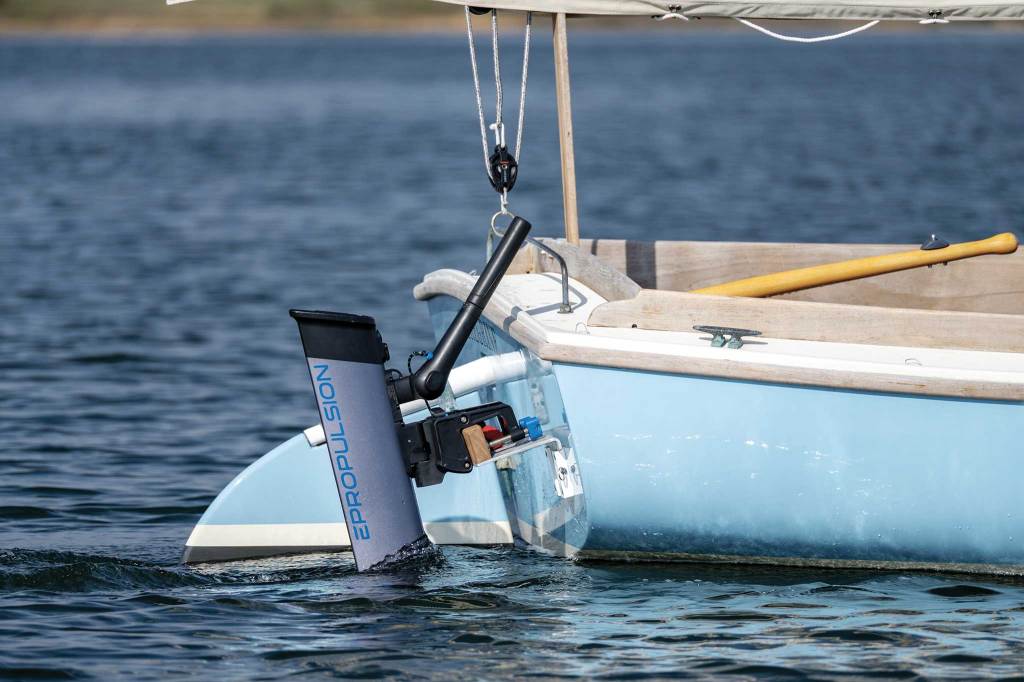
ePropulsion eLite
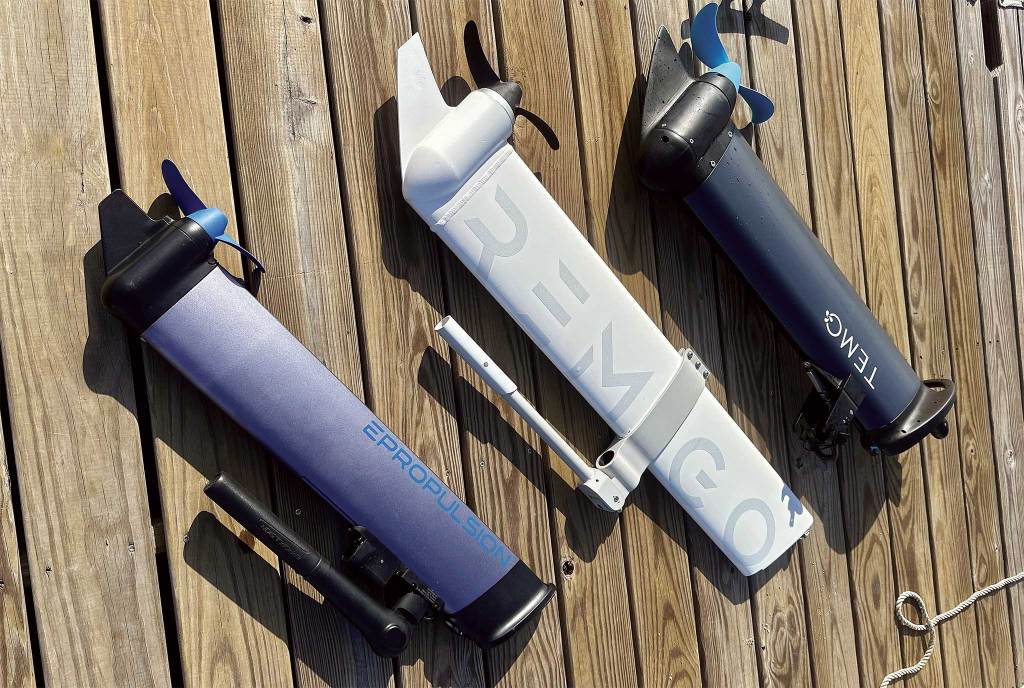
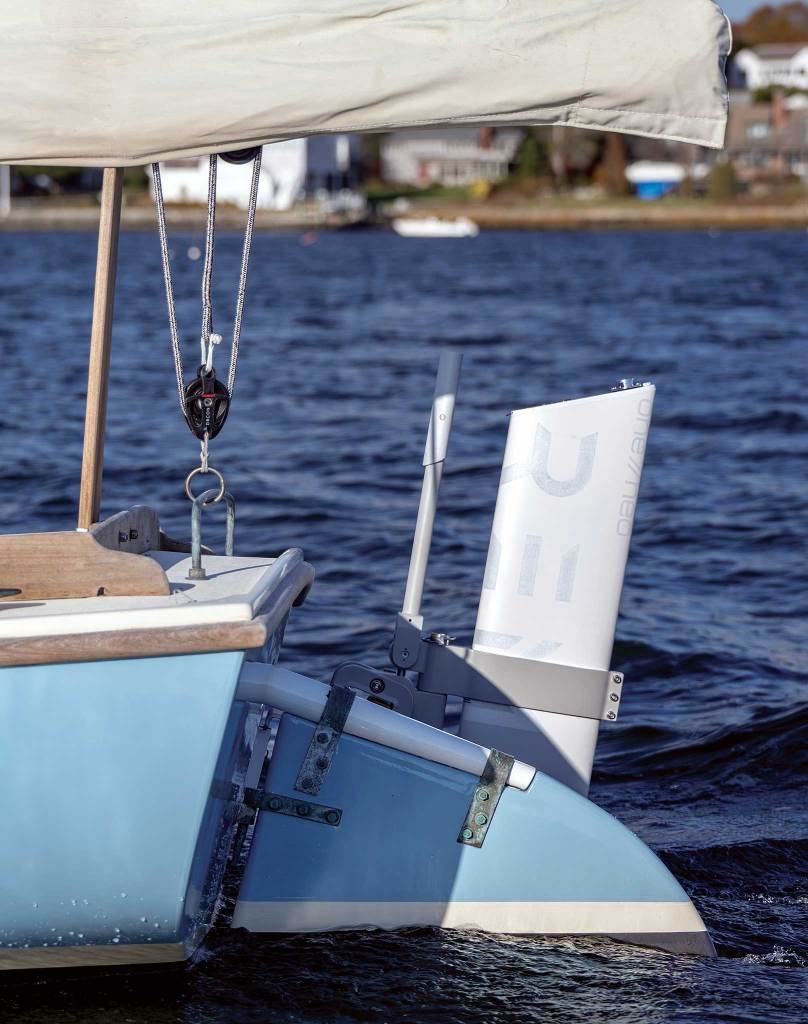
At 14.7 pounds the eLite is the most compact option we tested (17.4 pounds with bracket). It features 500w of power (with 28 pounds of static thrust), and 750w in sport mode, with an integrated 378Wh lithium battery. At the 500w full throttle, expect 45 minutes of operation. Back that off a touch and the run time exponentially improves.
This outboard can lock to center, like the other models we tested, so steering can be entirely through the rudder for a small sailboat. In close quarters, the lock can be quickly disengaged, allowing the eLite to turn again for more maneuverability. The tiller is extendable, with throttle and shift being adjusted through a familiar twist grip. That same tiller folds downward when the outboard is removed to form a carrying handle.
A foil-shaped extrusion forms the body of the outboard, just like each of the other designs tested, minimizing drag and improving turning characteristics underway. The depth of the propeller is also adjustable, meaning that the same unit can be used across different boats.
Tilt functionality, a battery level display, and a magnetic kill switch round off the prerequisite design features, but its beauty is also in its simplicity. It’s exactly what it needs to be and nothing more.
Charging off of AC power takes four to five hours for a full charge and the optional DC charger takes six to eight hours.
Specs:
- Weight: 28.5 lbs; 34 lbs with bracket
- Operation: 60min at full throttle
- Charge: 3 hours (AC fast); 6 hours (AC standard); 10-12 (DC)
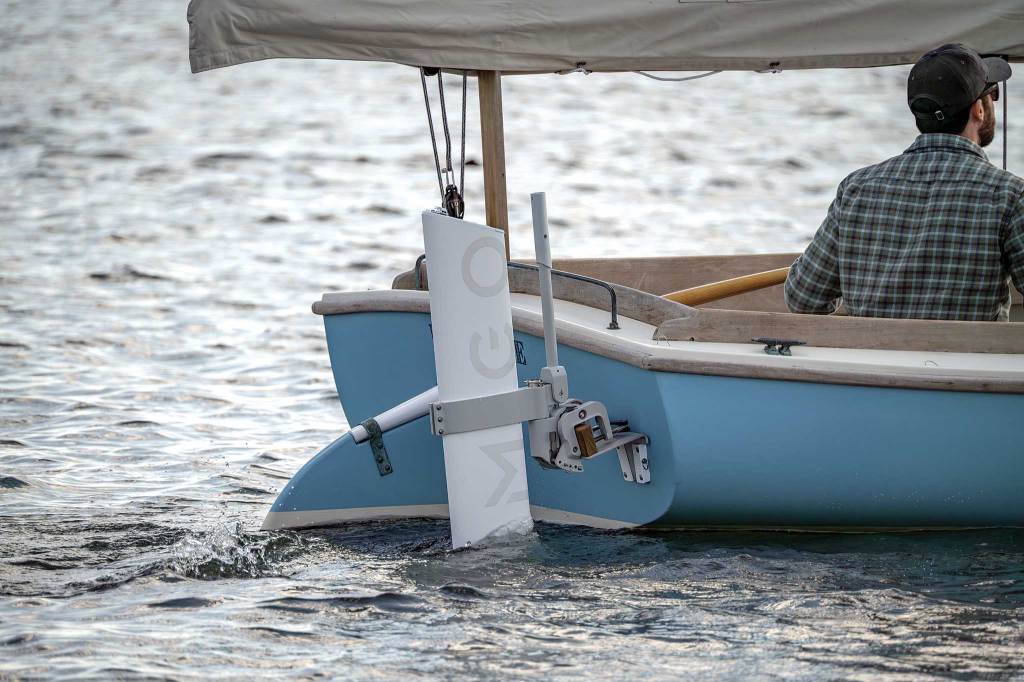
Remigo One Neo
This 1000w electric outboard, in standard mode, extends up to 1500w with its brushless dc motor in boost mode. That’s 66 pounds and 79 pounds of static thrust, respectively. The Remigo One Neo also features a unique throttle system through a two-button interface on top of the outboard. Press the forward button to incrementally increase forward speed and the back button to decrease speed and eventually step into reverse after passing through neutral. Pressing both buttons places the unit in neutral.
An optional wireless remote features the same interface and allows for very comfortable operation, including a nice edge when grabbing a mooring singlehanded. The remote also snaps into the end of the tiller.
The 1085wh integrated lithium battery will last about one hour at full throttle in standard mode. It takes about three hours for a full charge with the fast AC charger, six hours with a standard AC charge, and 10-12 hours with the DC charger.
The Remigo One Neo weighs in at 28.5 pounds and hits approximately 34 pounds with the bracket. Like the other units tested, the outboard is detachable from the bracket and would most frequently be removed that way. The depth of the propeller is also adjustable.
Specs:
- Weight: 35lbs
- Operation: 50min at full throttle
- Charge: 5.5 hours (AC); 12 hours (DC)
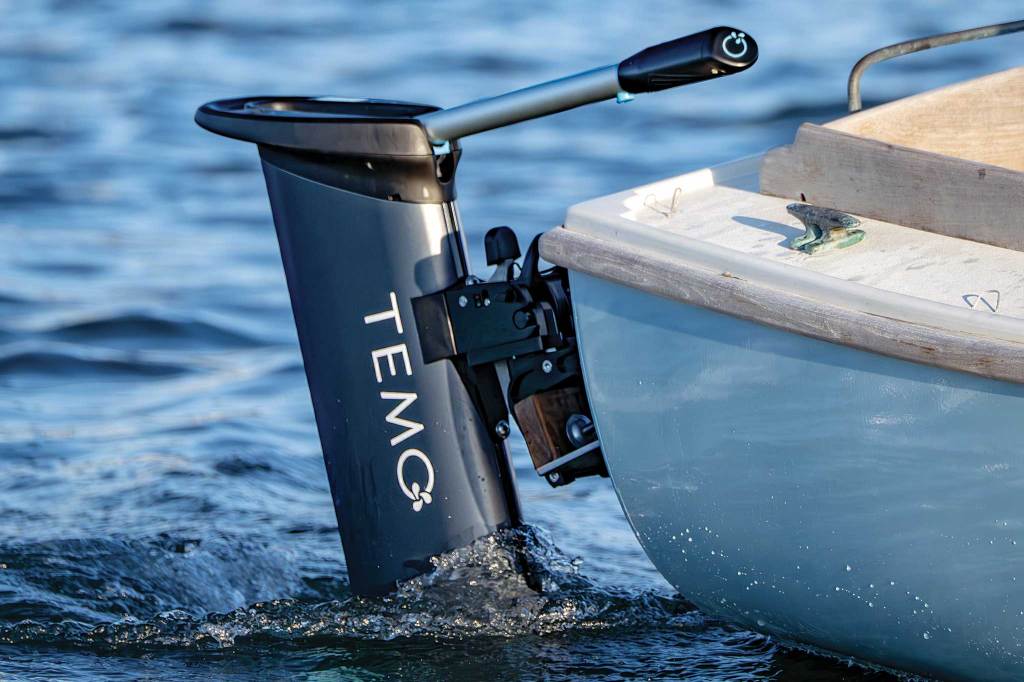
Temo 1000
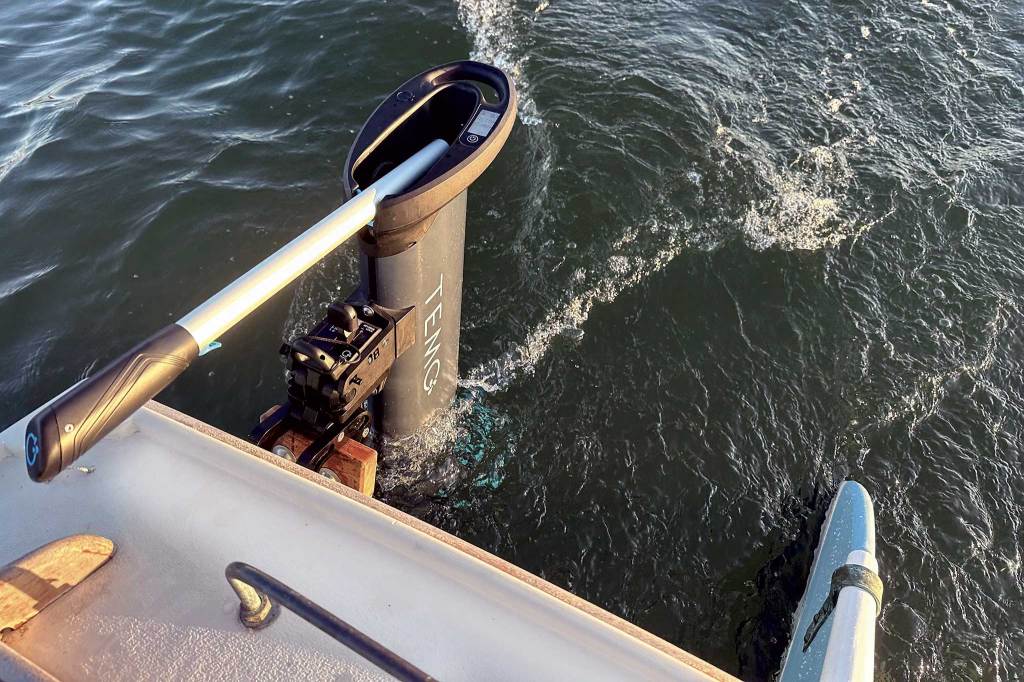
An 1100w motor produces 59 pounds of static thrust for the Temo 1000. With a 940Wh lithium battery, that’s about 50 min at full speed. We had more than enough power and so it was hard to even come close to depleting the bank. If we had, this unit features an interchangeable battery system.
The batteries drop right into the top of the outboard unit and feature a cable-free connection: they just lock in and are ready to be used. The batteries themselves are even waterproof (IP67) and are cooled by water that is allowed to flow into the battery compartment (away from the connectors). Even though the batteries are light enough to easily move at 13 pounds, tilting up the outboard makes for convenient swaps. The combined unit with a battery comes in at 35 pounds, but the ease of separation keeps handling weights low. The batteries can be charged with AC or 12V DC systems, with full recharge times ranging from 5.5 to 12 hours.
On top of standard trim, turning, and adjustable depth capabilities, the motor mount can also rotate 360° in the plane of the transom. This aids in an even simpler install, especially in rougher weather, and allows for the outboard to be completely rotated to be stored inside the boat (a clean and safe approach for crowded dinghy docks).
The tiller is fully retractable and can slide inside the outboard unit, preventing it from catching lines while getting sailing or getting damaged when stored or being transported. The Temo 1000 is also constructed of sub-assemblies, so when it comes to future repairs, individual parts can be swapped out without the need to replace the entire outboard.
Further Reading
The Torqeedo Travel XS S wasn’t available to test, but fits the target power range of our other successful options. It is a 700w outboard with a 648 Wh lithium battery and 54 minutes of runtime estimated at full throttle. It’s heavier than the other units, weighing 25.6 pounds for the motor and 15 pounds for the battery, for a combined weight just over 40 pounds, but those components can be separated for installation and transport. A floating battery removes some risk during installation.
Another model was just released as I’m writing this is the EP Carry Gen2. It provides 220w of power with a boost mode to 280w. The motor weights in at only 14 pounds. and the external 288wh LFP battery is 6.4 pounds. The run time is estimated to be one hour at the full throttle, but the EP Carry Gen2 also allows sailors to provide their own 12V, 24V or 36V LFP battery for even more flexibility and extended range. A security lock is still included to help prevent theft at the dinghy dock. The DC charger takes five hours to fully recharge the battery.
The Verdict
Each of these compact electric outboards presents plenty of advantages, but the best choice will depend on the boat and operational goals. With our 15 foot Marshall Sandpiper, we took the lightest route with the ePropulsion eLite, which shines in its compact and simple nature, but compromises on range and power: it’s perfect for weeknight racing (or keeping it modest on a cruising dinghy).
The Remigo One Neo has an impressive amount of torque with its large 12 inch diameter propeller, and the boost mode truly provides a solution if conditions change unexpectedly. The remote control is a favorite feature that none of the others offered, and while the two-button control was strange at first, I enjoyed challenging the status quo after a short time operating it. Still, it would take some practice to nail a tough docking situation as it is not as quick to adjust as a twist grip.
Hailing from France, the Temo 1000 operates intuitively and is a carefully designed unit. From the removable batteries to the capability of the outboard to rotate into the boat, it’s clear that easy handling was a priority, which matters when you’re in rougher weather or if you’re losing some mobility as you age. It’s also hard not to appreciate the modularity of this unit. Eventually parts will wear out on any of these outboards, especially the batteries, and to be able to keep the same unit in operation after swapping out a part is a financial win and how more equipment should be built.
Trying them out side by side really puts the marketing to the test, and while the Torqeedo Travel XS S and the EP Carry Gen2 didn’t make it out on the water for this, they appear to be solid options and deserve consideration. Even if the Travel XS S is a bit heavier for its power and capacity, separating the battery from the outboard makes it wieldy. The EP Carry Gen2 is designed and built by cruisers for cruisers, and it shows with their open-source battery approach and availability of maintenance components; it seems promising for cruising remote regions and long-term enjoyment.
Even after all this testing, I still prefer a pair of oars, but for the right circumstances, and especially when it comes to outboards, going compact and electric is the smart play. The quiet operation betters our time on the water, and keeping it simple and lightweight means more of us can continue to partake in that experience.
This article was originally published in the August/September 2026 issue.