If you remember back to the October issue, I left my XR 41 review open ended. Not in the sense of whether it was a high-quality build or if the design had impressive sailing performance—that was all there and then some. X-Yachts built an impressive boat. I left it unfinished because X-Yachts had set an even higher standard for themselves, and I consequently raised my expectations: they wanted to win ORC Worlds in their debut appearance. Given the amount they invested in this design, particularly from an emotional standpoint, I anxiously awaited the outcome.
One month after I submitted that review for print, the results were in. Not only did an XR 41 win Class B ORC Worlds, XR 41’s also took second and fourth place: a definitive answer to the capability of this design. There’s no doubt that the winning crew aboard Formula X are great sailors—I had the pleasure of joining the captain and bowman for a 140-mile delivery, and it was immediately evident. Equipment partners were also strategically selected, training was purposeful and iterative: the accomplishment was a culmination of many highly focused efforts.

But having three boats in the top five isn’t just a matter of good prep. The X-Yachts design team, both in-house and their partners, worked relentlessly to optimize the XR 41 for ORC B and position it at the fastest end of the fleet, particularly upwind, to be able to maintain a clear lane off the starting line. From foils to subtleties in the hull form to the sail plan, iterations were analyzed against the rating rule to develop what they believed to be an optimal solution.
However, the celebrations dimmed in early November, three months after the ORC victory. The Offshore Rating Congress (ORC) held their annual meeting, and the meeting minutes disclose that during ORC Worlds “the Chief Measurer and some ORC Congress members asked the ITC (International Technical Committee) to evaluate [a] discrepancy between the upwind VMG and other points of sail” for the XR 41, relative to the X-41. The meeting notes continue and unfold a theory that the XR 41 is faster than its rating due to the design’s parameters falling outside of the residuary resistance model and not being calculated appropriately (if you care to get more technical, read on here in the meeting notes: orc.org/agm-2025).
Let me use my naval architecture degree to help translate that. The ORC rating rule uses a VPP (velocity prediction program) as its mathematical model for ratings. Imagine it as a virtual test tank. A set of design measurements are the input, and the output is a prediction of real-life performance. This technology isn’t perfect even at the highest levels of yacht design—ORC seemingly acknowledges that by a commitment to update the VPP on an annual basis. A rating rule like this also needs to maintain a level of accessibility, and so there will always be a tradeoff between practicality and the accuracy offered by the latest technology: the input data set and modeling are simplified.
The ORC VPP software is available to purchase and download. This allows designers and builders to get expected ratings for their designs before even building a boat. Ratings can then be compared against far more sophisticated and accurate VPPs—often proprietary and extensively nurtured with real-life and computational fluid dynamics (CFD) data. By iterating, designs can be optimized to rate slower than they actually perform, exploring weaknesses in the rule. That is, at least, what the best yacht designers accomplish. More conservatively, a design can be validated to match the rating.
In this particular case, the allegation is that the ORC VPP model was extended beyond its accurate range when computing wave-making and pressure drag for heavier boats sailing fast relative to their length.
Based on these concerns, the XR 41 was hit with a penalty—or rebalancing depending on who you ask—equivalent to ten seconds per mile by the ORC for the 2026 season. Opinions in the sailing community quickly surfaced that this was a politically imposed performance-based adjustment unrelated to measured values or calculated outputs, countering ORC fundamentals. The Technical Committee believed the XR 41 still would have won the Worlds with this correction.
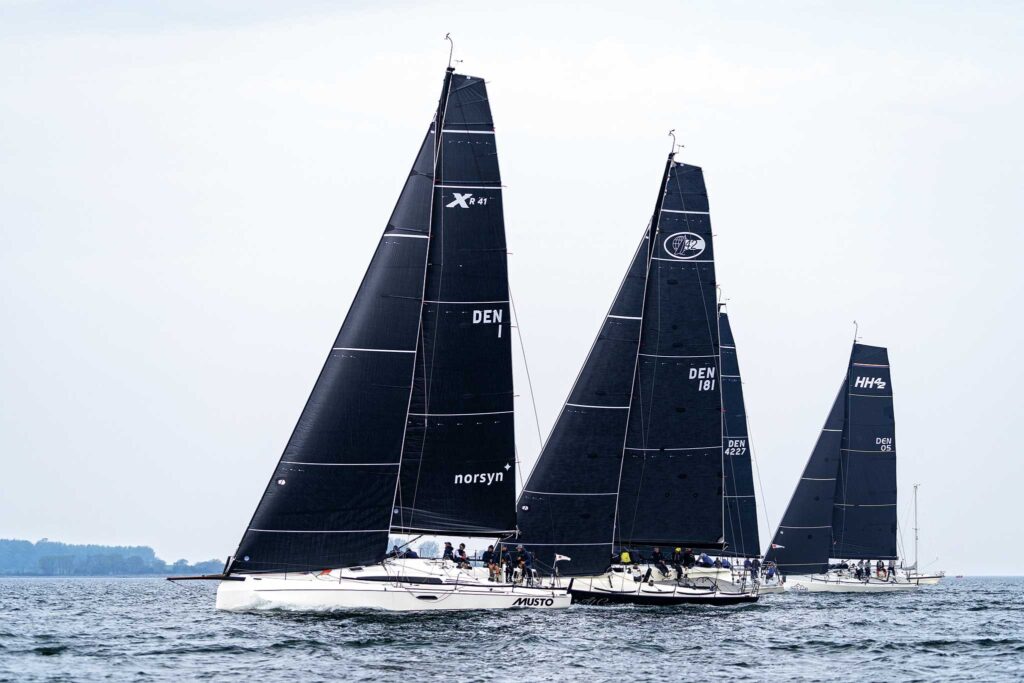
Fortunately for the integrity of the rating rule and in fairness to the XR 41, X-Yachts and ORC agreed to work together to answer these technical questions, releasing in a joint statement that “both ORC and X-Yachts reaffirm a fundamental principle: the VPP must remain a scientific model—and science is not negotiable. Any modification to the 2026 VPP must therefore be based on validated data and transparent methodology—not on isolated regatta outcomes or stakeholder interests.” This approach should ensure the XR 41 remains competitive and is poised to retain the ORC title in 2026.
Stepping aside from any politics at play, this is nothing new: every rating rule to date has had areas of frailty. Would it be too obvious to recall the groundbreaking winged keel on Australia II in the 1983 America’s Cup? The legality was challenged after competition but found to be valid. While there is no question that the XR 41 complied fully with the rules, the inquiry in this case is whether the rule has kept up with the boats.
Newer VPP-style rules (ORC, IRC, ORR) vary from traditional measurement rules (CCA, IOR) in that they aim to accommodate a wider range of boats, rather than steer designs in a particular direction for favorable ratings. The ORC defines their rating mission as equalizing all boats, whereas the CCA rule funneled designers towards comfortable and seaworthy cruiser/racers. These older and more restrictive rules let earlier designs become obsolete. While they likely faded away as a result of that, it also sparked innovation.
In achieving the ideal VPP rule, are we punishing innovation? If all boats are equalized, what is the motivation for designers and builders to develop a faster boat? What is our motivation to buy a new boat? (Can we at least ensure the rules create pretty boats?)
Rating rules will never be perfect. They are slower to evolve than the cutting edge and so even with a philosophy of creating an even playing field, designers and builders will continue to push the limits through advances in materials and a better understanding of fluid dynamics. It will force rating systems to evolve or be replaced, with each generation of rules continuing to absorb lessons from the last.
It is in our competitive nature to look for an edge. Even in one-design racing, boat preparation is up to each crew and makes a difference on the racecourse. The fact that we can optimize, means that there will always be an edge for those that are persistent.
New designs, like the XR 41, can offer much more than a competitive rating. There is the evolution of knowledge carried into new builds that touches the intangibles of a rating rule. A more efficient cockpit means smoother tacks and gybes. Comfortable and secure bunks pay dividends in offshore racing. Ergonomic positions for the helmsman reduce fatigue and increase focus. Ratings don’t account for every aspect of a boat—so while we can get lost in the technical details, it’s important we don’t lose sight of the big picture.
This article was originally published in the March 2026 issue.