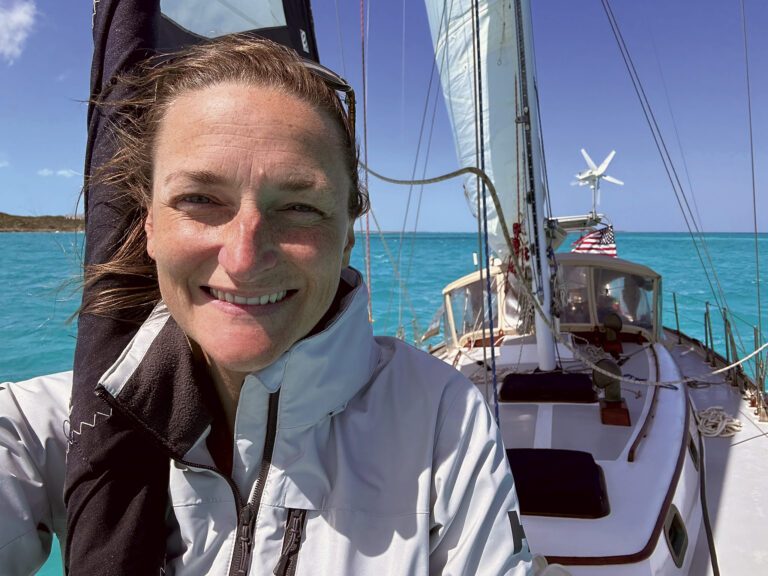
I was sitting on the bow, looking at the twinkling lights of Cefalù, Sicily, and wiping away tears. We had saved and planned for years, and now we were finally living our dream aboard our catamaran, Coronado. Our argument earlier that day was one of many that had been happening all too frequently since moving aboard four months earlier. The view was magical, but I was frustrated, discouraged, and searching for flights home.
After almost twenty-five years of marriage, my husband John and I were equally committed to our new life. I thought we had prepared well for cruising, training in everything from diesel engine repair to handling medical emergencies. I was mentally prepared for bad weather and tough passages. What I did not expect was all the emotional storms raging inside the boat.
Thankfully, I did not fly home. As I opened up to other cruisers, I learned that a rough adjustment period is normal. Arguments are common. People often joke, “We haven’t thrown each other overboard yet!”
How can there be so much angst after working so hard to be out here? Every partnership has its own dynamics, but there are common threads. Four years and over 20,000 nautical miles later, we learned that many of our challenges had less to do with our relationship and more to do with the environment we were now living in.

Constant Low-Level Stress
No amount of sailing experience thoroughly prepares you for cruising full-time, especially in the first year. We never thought we would sail away into the sunset and leave our problems behind. We knew it would be challenging at times, but we could not have anticipated the constant low-level hum of stress that comes with this lifestyle. It’s subtle, always running in the background, and it took us a while to recognize its impact.
There is always a slight sense of needing to be ready for the unexpected, and it puts your body in a quiet, steady state of alert. Is the anchor set well enough? Did the wind just shift directions? Is the water pump cycling more than usual? Is that bit of bilge water fresh or salt? Are the solar panels keeping up? At any hour, one unfamiliar noise can send your heart rate up.
The person managing the weather often carries a heavy share of this stress. On shore, the weather is something you notice and work around. On a boat, it determines when you move, where you anchor, how well you sleep, and what decisions you need to make next. Conditions can change quickly, and plans that made sense in the morning may feel risky by afternoon. Even on calm days, that mental vigilance can’t ever fully turn off.
All of this makes it easy to feel just a little bit on edge, even when nothing is wrong. Small worries stack on top of bigger ones until we would find ourselves bickering about things that don’t matter at all. It quickly led to bigger arguments, especially when living in such close quarters.
What Helped: Awareness and Time Off
For us, the first shift came from naming it. Simply acknowledging the constant background stress made it easier to work with instead of being swept up in it. We started prioritizing taking intentional breaks by occasionally going for walks alone on land. Even a little bit of space can be helpful when you are suddenly together 24 hours a day, seven days a week.
We also take breaks from the boat. We had heard seasoned cruisers talk about this, but we didn’t understand its value until we lived it. Getting off the boat entirely offers a real reset. Sleeping on land, even briefly, gives your mind and body a chance to exhale fully.
We now make a point of stepping away once or twice a year to visit family. Even short breaks help us return to the boat more appreciative, more grounded, and better able to handle the hum beneath the surface. If leaving the boat is not an option, an occasional stay in a marina can ease some of the stress of sleeping on anchor in bad weather or worrying about water and power.

Arguments Under Pressure
On land, it was rare for both of us to be overwhelmed at the same time. If one of us was dealing with a stressful situation, the other could usually stay calm and steady. Cruising changed that completely. When problems arise now, they often hit both of us at the same time.
Most advice says to take a break or call a time-out in those situations, and talk when you are calmer. That is not an option when you are moving through a tight channel or reefing sails in rising wind. Without the ability to pause, stress escalates quickly and is often compounded by another powerful factor: fear.
Critical situations out here can have immediate and serious consequences. Our nervous systems know it, even when our minds are trying to stay calm. There is a fear of getting hurt. Fear of breaking the boat. Fear of making a mistake that can’t be undone. It is instinctual and hard to manage, especially in the beginning. Emotions spike and logic steps aside. Voices rise, not because anyone wants to fight, but because both nervous systems have been pushed unwillingly into survival mode.
What Helped: Pre-Planning and Debrief Sessions
We learned to anticipate that emotions may be complicated to manage in these moments. When we can, we talk ahead of time and identify what might be tricky. We also accept that some stressful situations arrive without warning and must be handled immediately. Our shared goal is simple: stay as calm and respectful as possible. If one of us loses regulation, the other will try to stay steady rather than react. It is hard in the moment, but practice helps. Each time one of us can remain even a little grounded, the entire situation is better.
We also give ourselves grace. Stress and fear make people snippy. The priority in the moment is to get through the task safely. Later, we debrief. We apologize for any yelling, acknowledge what the other person did well, and talk about how to handle similar situations more smoothly next time.
This is also an area where time and experience help. With each situation we successfully managed, the fear lessened. Over time, our confidence grew, and we learned we could handle the challenges.

Communication Differences: When “Marriage Savers” Aren’t Enough
All relationships rely on clear communication, but on a boat, it becomes essential. Many cruisers swear by “marriage savers,” electronic headsets that allow you to talk without shouting across the deck. And they are incredibly useful. Being able to speak calmly from anywhere on the boat removes a lot of friction.
But for John and me, headsets didn’t solve the real issue. Our challenge went deeper than volume or clarity. It was about how we process information.
I am an external processor. Talking out loud helps me think, so at the helm, I naturally narrate my actions as I go. “Port forward, back to neutral.” “Speed looks good.” For me, speaking is part of focusing.
John is the opposite. He is an internal processor. He thinks best in silence. In stressful or time-sensitive moments, he needs space inside his own mind to run through his steps. Words feel intrusive. They break his concentration.
This meant that in situations like docking or picking up a mooring ball, we often missed each other entirely. I felt anxious because he was quiet and I didn’t know what he was doing. He felt overwhelmed because my running commentary made it harder for him to stay focused. Neither of us was wrong. We just had mismatched styles. But before we understood that, it created real tension and more than a few heated moments.
What Helped: Streamlined Communication
Once we understood our differences, we started focusing on talking purposefully. The biggest shift was learning to keep language short and neutral. Think less casual conversation, more critical information. Instead of narrating every move, I shifted to brief, clear cues that John could take in without feeling overloaded.
Simple phrases like “Lobster pot to port,” or “Three meters to dock” gave John exactly what he needed without breaking his concentration. One-word acknowledgments like “Copy” kept us connected without adding unnecessary chatter.
Friends suggested using the clock system for directional references, and it was a game-changer. Saying “Speedboat at two o’clock” removed any ambiguity and made our communication crisp.
Another helpful shift was agreeing in advance on whose voice would lead during a maneuver. If John is driving, I stay quiet unless something is essential. If I am in charge, he focuses on giving simple descriptions. I ask short, direct questions when I need clarity. This change eliminated a surprising amount of tension and helped us work together as a calmer, more coordinated team.
Looking back, John and I can see that the hard days early on were not a sign that we were failing. They were simply part of the adjustment and learning to operate as a team in a completely new environment.
Cruising demanded that we grow as individuals and as partners, sometimes faster than we expected, sometimes in the middle of situations where we had no choice but to rise to the occasion. We still argue sometimes, but we also laugh more, trust more, and understand each other in ways that only this life could have taught us. The beauty, freedom, and adventure cruising offers have made the effort more than worth it.
This article was originally published in the March 2026 issue.