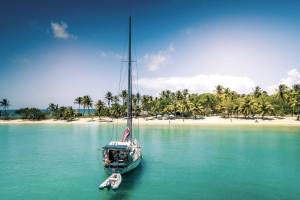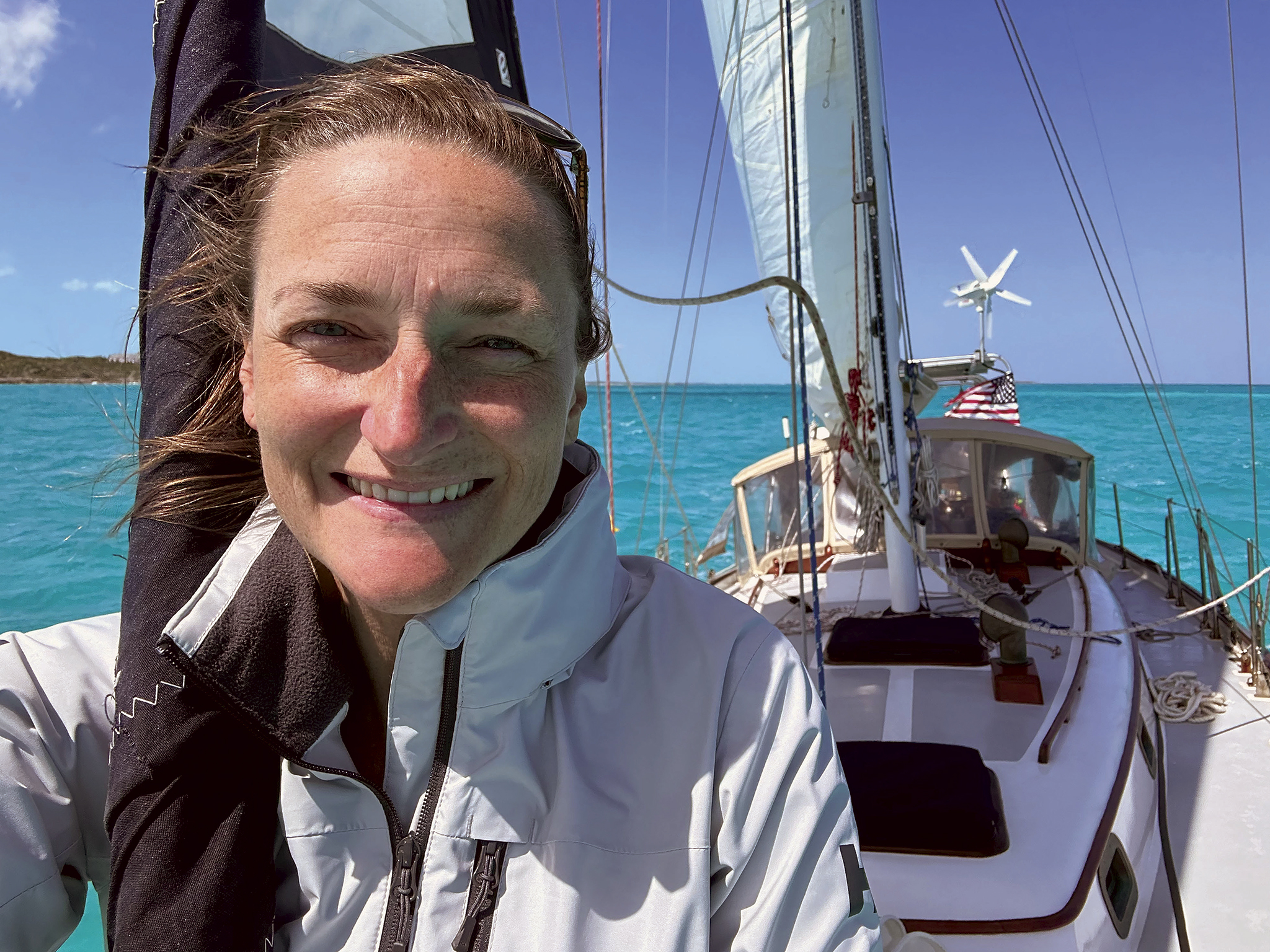
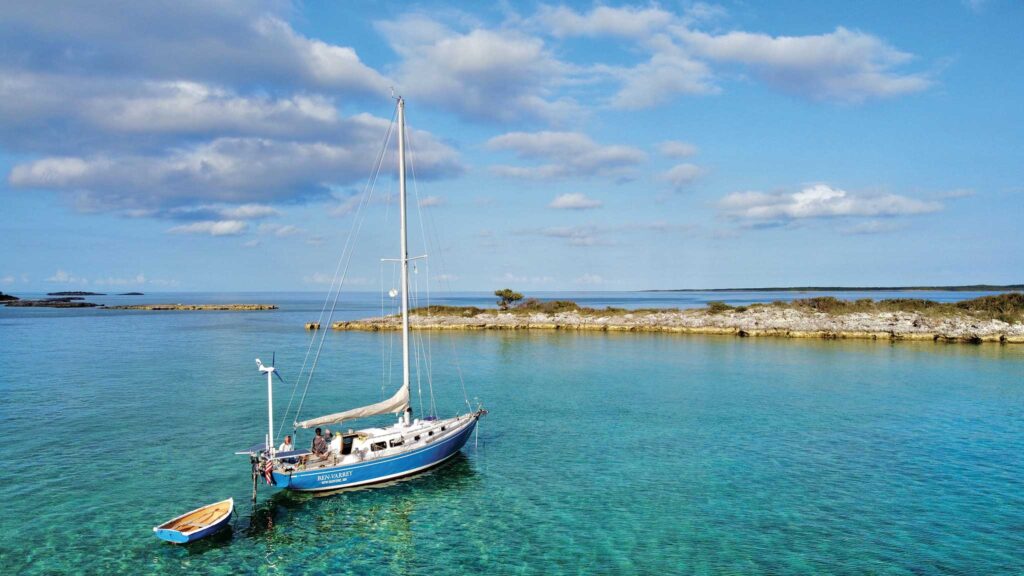
The anchor hit the water’s surface with a familiar splash and the chain rumbled over the roller, quickly at first and then slowed down to a pace that matched our slow drift. The crystal clear and shallow waters of the Exumas put all this hardware on display as we prepared to spend the night in the protected cove of Southwest Allan’s Cay.
Two nurse sharks and a stingray passed beside Ben-Varrey’s keel as the mainsail leisurely danced down the mast and draped itself over the boom. A couple dozen iguanas scurried around the beach to the south. A faint pattern of ocean rollers crashing on the outer coral shore provided some background noise, but otherwise this paradise was quiet and void of civilization.
It had been somewhere in the vicinity of 130 days since Ben-Varrey had touched a dock and before that it was tough to remember—perhaps, clearing customs in Cruz Bay? Every night was spent either underway or at anchor since then, and that would also be the case for the foreseeable future. I suppose there were a couple nights on moorings to help protect the recovering seabed of some national parks; that was a worthy cause.
I had slowly refit Ben-Varrey, our Luders 33, and refined our cruising approach to reflect this off-the-grid cruising lifestyle. It’s certainly more cost-effective underway and adds to the adventure, but what it really equates to is freedom: the ability to decide what to do and when to do it, given the endorsement of mother nature.
This approach is far from free though. It either comes at the cost of onboard comforts or through the bruises, scrapes, and sore muscles of extensive boat work. While you could hire a yard to tackle all of these projects, that also comes at a cost: a financial one, and it would be well-worth compensating them further to explain the workings of every system, or risk countering one of the very basic principles of cruising off the grid: self-sufficiency, and within that the need to know your boat inside and out.
Here are the fundamentals of how we remain unplugged and untethered.
No Fuel Docks
Ben-Varrey was engineless for three years—that was after I pulled out a perfectly fine diesel engine with the goal of simplification and a cleaner smelling boat. A sculling oar adorned the starboard stanchions and the boot stripe stood slightly higher above the ocean. I had never been more connected with a boat—I learned Ben-Varrey’s subtleties and how to keep her moving in the lightest of conditions. Most other sailors thought I was crazy. Maybe I was (maybe I still am), but I was delighted with the experiment and experience.
This concept evolved with the desire to enter channels that were too tight to short tack and to add redundancy for staying clear of unforgiving coastlines and the growing level of unpredictable traffic.
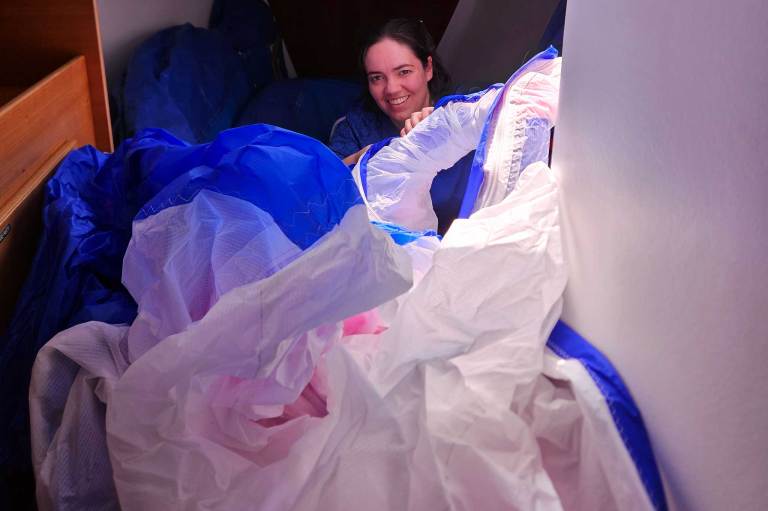
My wife, Alison, and I also installed an electric inboard and returned a propeller to the empty aperture. The fuel tank then became a bank of batteries. The steaming range was not as far, but these batteries could be charged again and again. Instead of fuel, we invested in sails. Heavy and light air options, but we really focused on our light air inventory: a new asymmetrical spinnaker, drifter, and 135% genoa, plus a fresh main that offered a much better upwind shape.
Ben-Varrey hasn’t taken on diesel in ten years and fuel docks are no longer a point of interest or detour in our cruising plans, greatly expanding the range of possibilities. Over the last two years, we’ve expanded the battery bank, but we still focus on sailing everywhere we go.
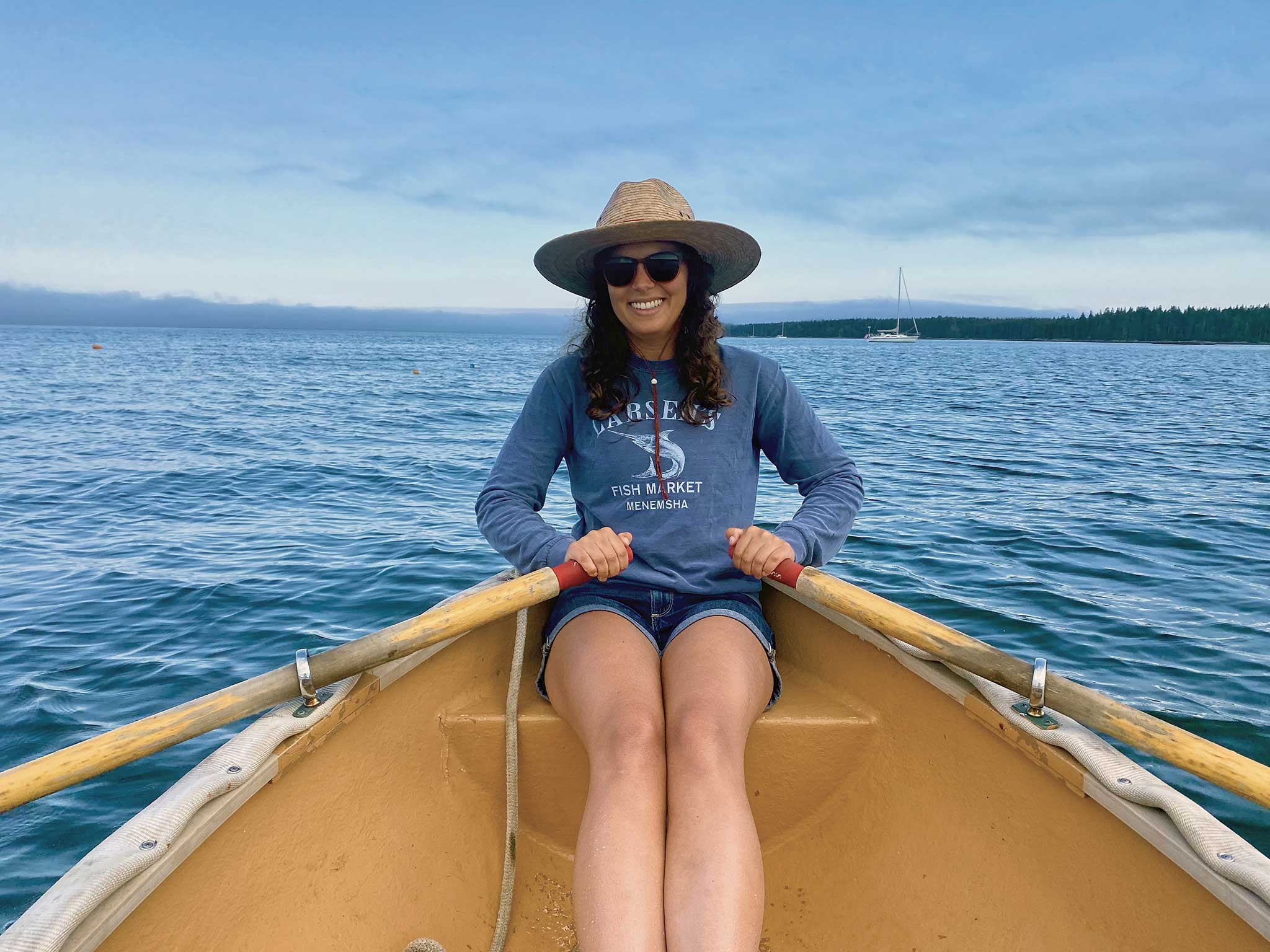
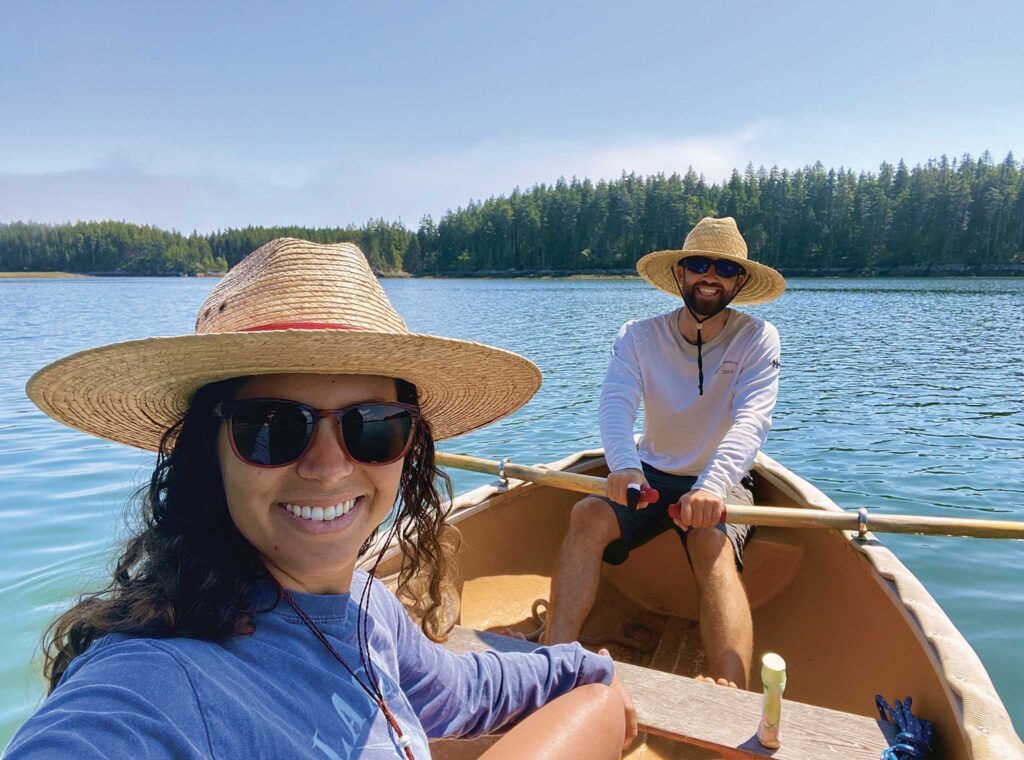
The same concept applies to our dinghy, Tanner. It’s a Puffin fiberglass dinghy and is set up strictly for rowing. We can explore as far as we’re willing to row, which has topped five miles some days, and we get the bonus of some exercise along the way.
Even with a diesel engine, it’s possible to lean towards sailing more and motoring less. It’s all about tradeoffs. Burning more fuel now may mean arriving at your destination sooner; filling a larger fuel tank gives up sailing boat speed in light air.
Sustainable Power
The less power we consume, the less we need to generate. Our focus started here. It’s a debate on necessary comforts but also on the efficiency of those onboard systems. LED lights, for example, helped drop consumption on our house bank, but so did smarter settings on our autopilot (or better yet, using our windvane autopilot).
The batteries that power our electric engine and house loads eventually need to be recharged, and while pulling into a slip every night may be an option in some areas, so many stunning locations don’t have this resource, including even most of our favorite spots in New England. Fortunately, renewable generation options are abundant.
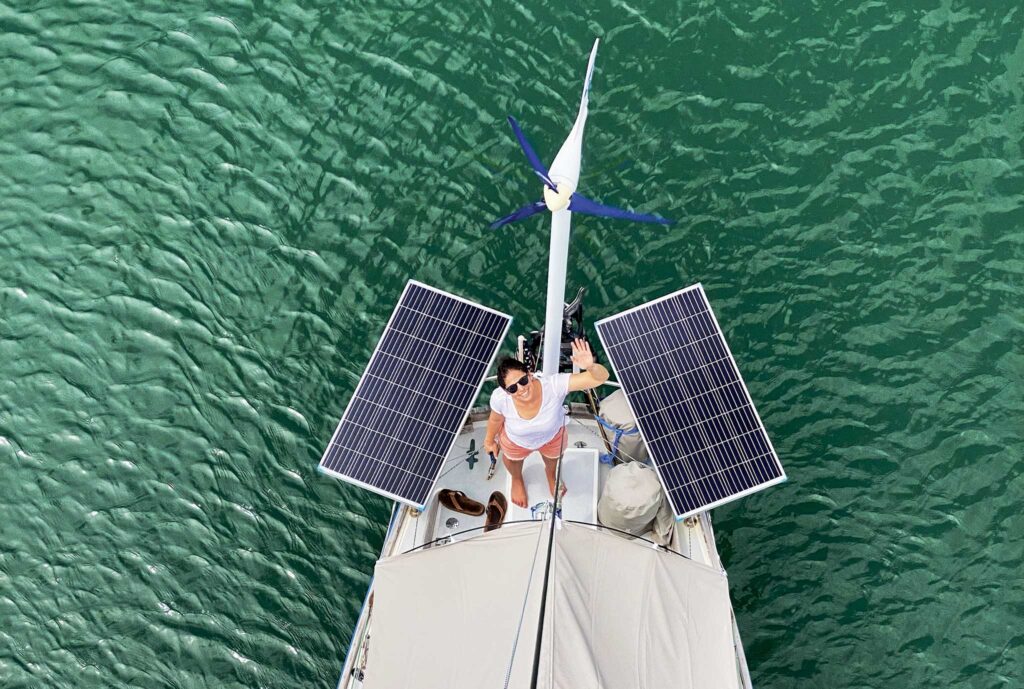
Solar has been our primary energy source, supplemented with wind power. Across a range of climates and conditions, our panels have consistently outperformed our wind generator (350 watts of solar versus a 400-watt wind generator). There are exceptions: I was once sailing for three days wing and wing due south, late in the season from higher latitudes, and the solar panels were only ever given a glimpse of sun. The wind generator supplied all the power that was needed in the heavy breeze. Wind generators also shine in the trade winds and areas with good thermals and will always be a welcome part of our power portfolio, especially as we explore new areas (and since ours is so quiet).
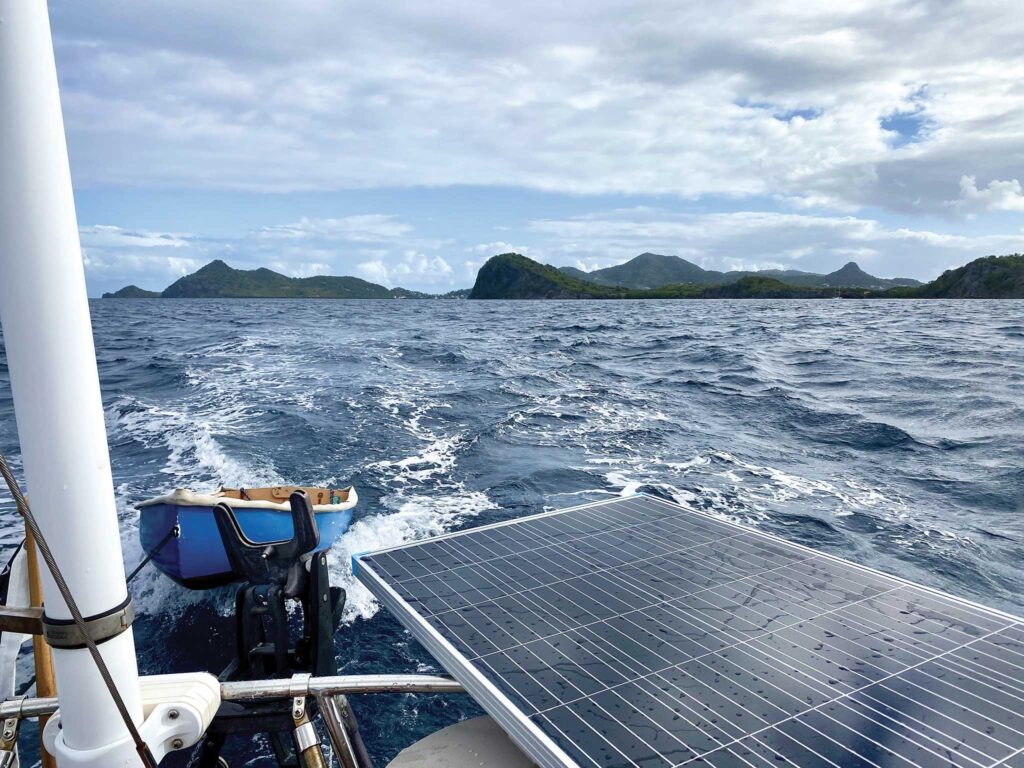
Diversifying power sources adds flexibility and means charging can happen regularly and any time of day. If a boat has a high enough average speed, hydrogeneration is a great addition for satisfying needs underway. In the instance above where my solar panels weren’t helping, I wished I had flexible panels that I could secure anywhere—those are now on board with long cables and their own charge controller. So, even diversifying within a type of system can be helpful.
Ultimately, power consumption and generation need to be in balance. Bigger renewable systems can help replenish batteries faster and larger battery banks can extend run times when generation conditions aren’t ideal. Still, we need to stay in tune with nature and remain aware of the conditions—once in a while, this requires changes to our habits.
Secure Anchoring
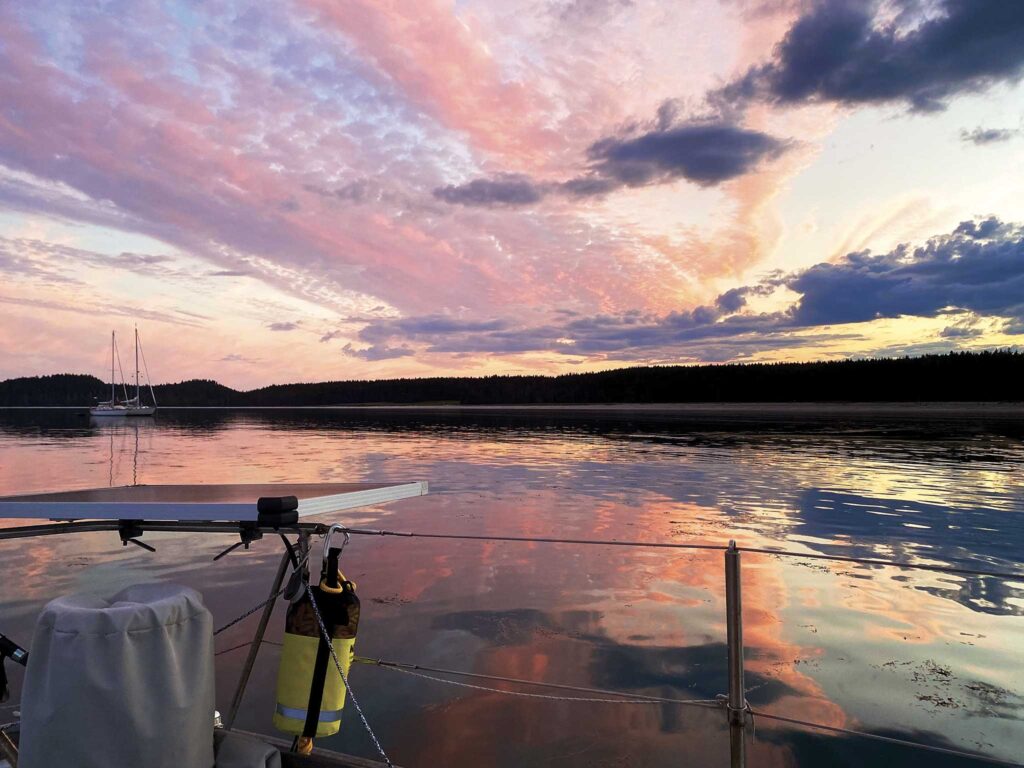
Cruising off the grid means being very comfortable with anchoring, and that’s only going to happen with practice. Grabbing a mooring or a slip is easier, but we make a point to avoid it. We go as far as to sail on and off anchor every time. When something doesn’t go right and the weather is turning foul in an unfamiliar harbor, we have a well-practiced set of skills to support our problem-solving…or the knowledge to help avoid the mishap altogether.
Having the right equipment, regularly inspected and maintained, allows us to leave Ben-Varrey with confidence and go hiking or snorkeling, and sleep soundly through the night. But we are always keeping track of the changing weather and other boats in the anchorage. Great equipment works best in collaboration with great planning—so this doesn’t go without the need to pay attention to the bottom contour and material too. Even with that, there’s always some level of worry—that never goes away entirely.
We cruise with an oversized shovel style anchor (check out the Mantus M1 as an example) as our primary anchor and another as our backup. Alison and I keep a couple other styles onboard but have never had to break into that collection since upgrading Ben-Varrey’s primary anchor. The shovel style works well in a broad range of bottom conditions and sea states and is remarkably efficient for its weight.
Chain is heavy to carry, but also resilient against rough bottoms and unbeatable in keeping the anchor set and helping it reset. Ben-Varrey carries 275’ of high-test galvanized chain, which offers a respectable compromise on weight, while maintaining a high breaking load. If we were ever to need rode beyond our chain, a rope rode is already secured to extend it. Our additional rodes are helpful in creative anchoring situations, and secured within quick reach onboard.
Self-sufficiency
In many parts of the cruising world resources are limited, especially in the middle of an ocean. And even if that isn’t the case, the quest of heading ashore in search of parts or assistance can make for some interesting stories, but it’s generally a time-consuming and trying experience. And while it’s not entirely avoidable, a good knowledge base with the right tools, spare parts, and materials, can help solve most issues at sea or anchor. (See the October 2025 issue for a full list of the spares Contributing Editor Chris Birch carries while cruising.) Many repairs won’t be perfect, but they will be adequate to keep moving along safely—the pursuit of perfection could mean never leaving port again.
The preparation of material goods is slightly more straightforward—they are a reflection of the boat being sailed. We focus on the essential systems first and what is needed to perform regular maintenance, then move to the more likely repairs. Functions such as floating, directional control, and propulsion (mast, rigging, and sails) come to the top of our list, along with anything that supports human life onboard during a passage. Repair materials don’t have to be specific—they can be universal, such as fiberglass cloth and resin, which could be used in many structural locations, or electrical tape, which also has abundant uses. This process also helps to build a damage control kit that can be quickly accessed to solve immediate problems.
It takes time to gain knowledge; remaining curious is a trait that benefits all of us. I have shelves full of books and a garage full of projects, and have been to formal and informal classes that range from splicing double-braid to advanced hydrodynamics. But, perhaps, most importantly, I know there is so much more to learn and am excited to pursue that. There are lessons to be learned racing on other boats and information to be gathered from talking with others at the dinghy dock. Even as I’m writing this article, I’m recollecting experiences I can reprocess.
Water
Ben-Varrey has a primary water tank that rests partly within her full keel. Offshore, we shift to also filling an aft bladder tank. And spare water is always stored under the settees. This redundancy and filtering every drop through a carbon block and UV system keeps us healthy and hydrated.
These tanks and bottles, if overlooked, could run dry if we cruise long enough. Ports often have water available at marinas or town docks, but what happens when that isn’t a convenient option? What if the water quality is questionable and may quickly clog our filters? We see two primary options: rain collection and watermakers.
Rain collection can be beautifully simple, as long as it rains. If it doesn’t, it’s great to have a backup plan or just a primary reliable source. We designed and built our own watermaker for Ben-Varrey, but there are plenty commercially available. We also carry five-gallon water containers onboard which can be helpful for gathering water from clean sources ashore or during provisioning runs.
Food
While catching our own food is a great way to supplement our needs, sometimes it just doesn’t work out. We’ve never been willing to count on it and consider anything caught or foraged a treat. Instead, we focus on building up a long-lasting supply. This is the area that ultimately ties us back to shore.
Our base level is non-perishable items and dry goods, like canned fruits and vegetables, canned meat, rice, pasta, dried spices, and freeze-dried rations. Everything else is fresh and must be chosen and used carefully. Oranges last much longer than bananas (not actually bad luck on a boat—we’ve tested this thoroughly), so the bananas get eaten first. We also don’t want more than we can eat before it goes bad. Some foods can be frozen to extend their shelf life, others prefer only refrigeration, and the balance may want plenty of ventilation or just a cool dark place.
We hope to cook with electricity one day, and maybe supplement it with a solar oven, but for now, we admittedly use propane (it’s a challenge to overcome the energy density). A 20-pound tank lasts us at least a couple months. We carry an extra bottle, which provides us with plenty of time away from refill facilities.
Communications
If for safety alone, it’s worth having a link to shore-based assistance: from medical advice to weather updates, the latest offerings of satellite communication can provide quick access to information. We also love staying in touch with friends and family, researching new areas to explore, and being able to work remotely.
Mindset
The freedom achieved from cruising off the grid requires flexibility—plans don’t always come together as anticipated and unexpected opportunities arise that lead to incredible experiences. We keep an open mind and expect problems to arise. When everything goes smoothly, we’ve exceeded our expectations and when there are challenges, it’s all about keeping a positive attitude. Sometimes, we just need to pause for a moment, remember where we are and what we’re doing, and it puts everything back into perspective.
Perhaps, the hardest part of cruising off the grid is weighing anchor, and leaving behind beautiful places, friendly smiles, and charming wildlife. But just over the horizon are more possibilities, filled with adventure and cruising independence.
November/December 2025