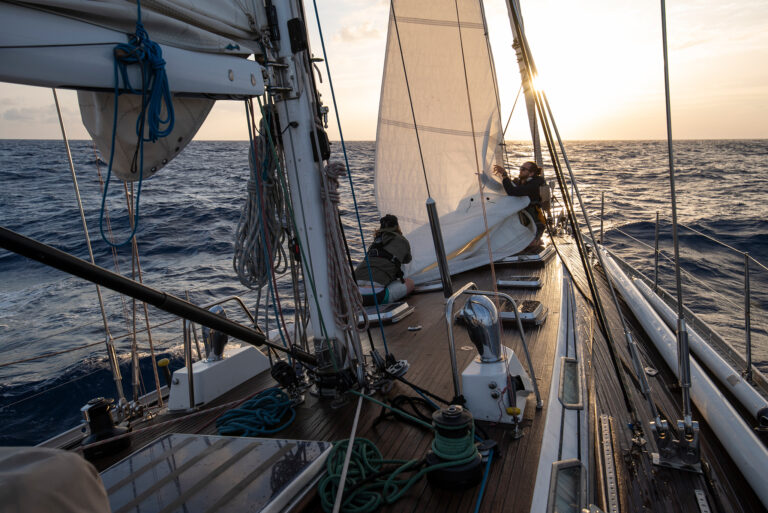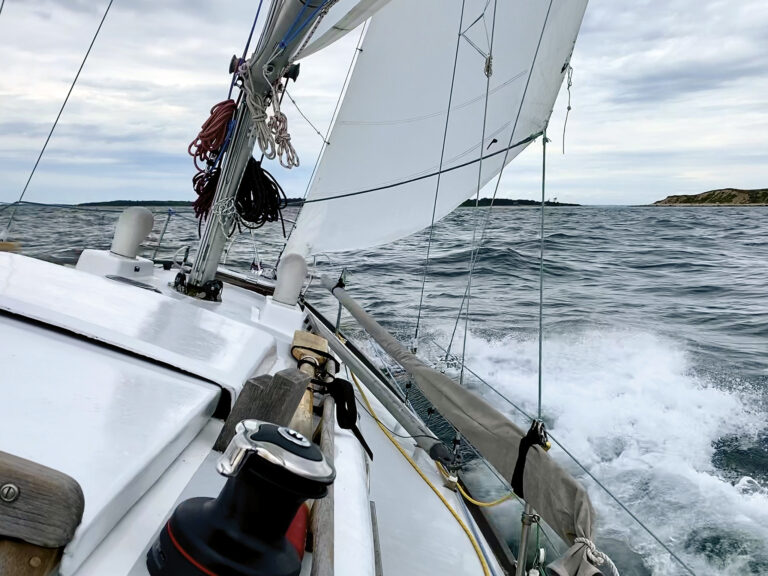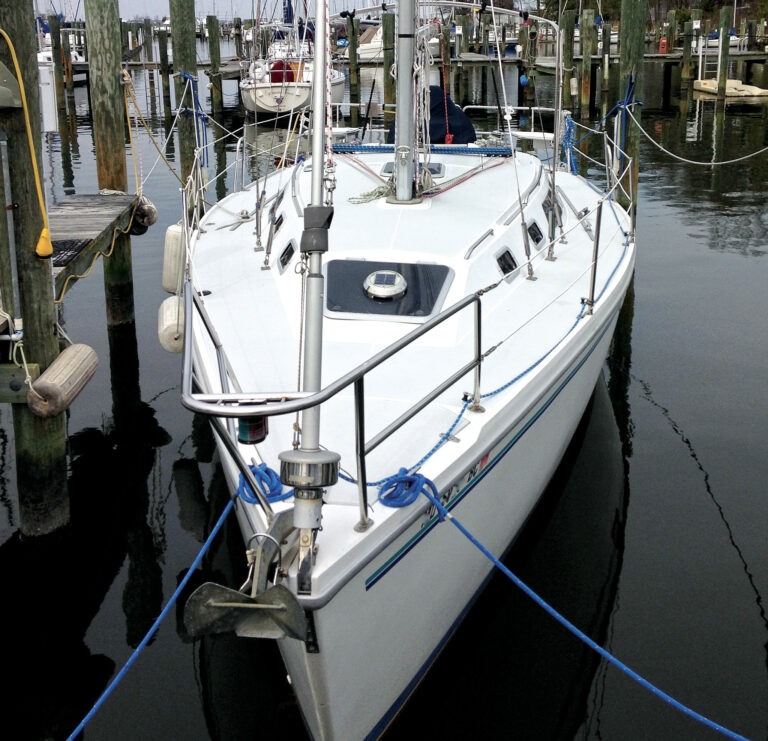
I wrote recently about my ongoing project to redesign the mast and sailplan on our family boat, a 1971 OE 36 called Spica. I’ve agonized over whether to put new money into an old boat (the estimate on the new rig and sails is more than we paid for the boat), and even whether I love the boat enough to keep it long-term. News flash—I’m still not sure about either.
Indecision and uncertainty aside, I’ve spent a lot of time thinking about and tinkering with plans, going so far as to arrive at a final design and quote from the spar builder and sailmaker (in fact, by the time this goes to print, I may have even pulled the trigger). I feel confident now that whether we do it or not, I know what I want in the right rig for cruising.
First, it’s gotta be taller. When you’re buying a new rig, you only get one shot to get it right, and like Moitessier said when he was outfitting Joshua, you can always reef your sails, but you can never raise your mast. His were telephone poles—literally—but the point remains. Go bigger. As I wrote before, the OE 36 is well documented as having been under-rigged. Even the designer himself, Olle Enderlein, admits it, saying the boat’s primary audience was family cruisers, so he prioritized ease of handling over performance.
To accomplish a taller sailplan, we not only increased the mast height but also decreased the gooseneck height, where the boom attaches. I felt the boom was too high for a small boat. Flaking the mainsail was unnecessarily awkward, and we had plenty of clearance over the dodger and above people’s heads when standing on the cockpit sole. So we brought the gooseneck position down by about 18 inches. Without doing anything else at all, this would have increased the mainsail area by increasing the “P” measurement—aka the mainsail luff. We also increased the masthead height by about six feet. A lot, but still relatively conservative compared to the 10-foot increase that one of the early builders put on his own boat. We lengthened the boom by about 18 inches as well and kept a very modest 17/18ths fractional rig, with the forestay attaching about two feet down from the masthead (much more than this and you’d need runners to tension the headstay on a straight-spreader rig).
With the design worked out, it’s the details that really matter in rig specification. When I sent my laundry list of items to the spar builder, they replied that “this is probably the best specification we have ever gotten from a client!” So what did I include?
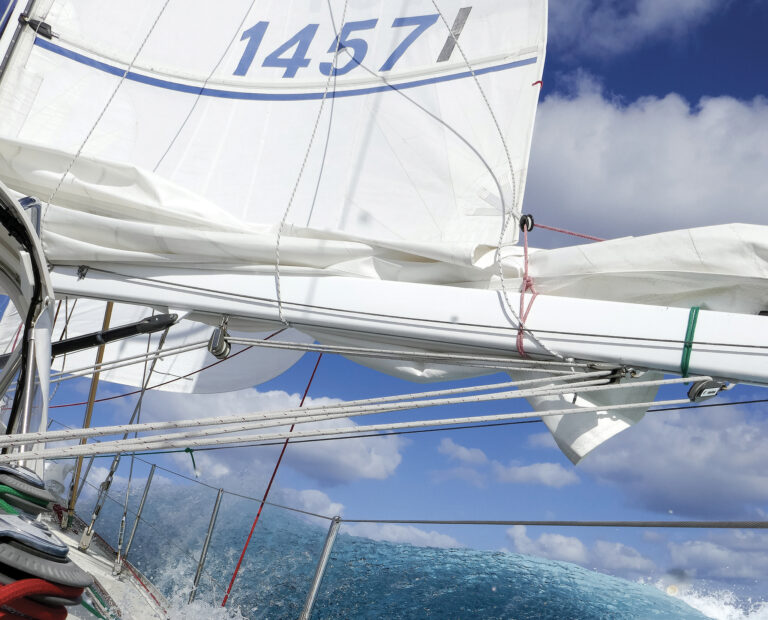
Little things—like placement of the halyard exits on the mast. On the current rig, they’re way too low, so when you send someone to the mast to sweat the halyard, you’re short-arming it with no leverage. We spec’d them at the correct height so a six-foot person can reach overhead and heave away. Rope clutches at each halyard exit, properly spaced and oriented because all mast lines stay at the mast base and nothing runs aft on Spica. We spec’d four sheaves in each end of the boom—three for reefs and one for the outhaul. An aft-facing winch base just under the gooseneck, where the reefing winch will live. I’m firmly against single-line reefing because of the friction it induces, and since no lines run aft, you need a way to tension the reef lines at the mast.
Old-school exterior mast tangs with through-bolts for the standing rigging instead of T-bolts or similar (they’re much stronger, though they add some weight and cost). A low-friction but ballbearing-free Antal mast track for the mainsail sliders—the same system we use on Isbjørn and which has seen us through almost 70,000 miles of low-maintenance mainsail handling. And crucially, a system that, thanks to its low friction, allows reefing the mainsail off the wind. Two mainsail halyard sheaves, one doubling as a topping lift/spare main halyard. Sheave-box exits for spinnaker halyards, jib halyards, pole topper, and staysail and solent jib halyards (you can never have too many halyards).
I spec’d a mast-mounted spinnaker pole, less for flying the kite and more for poling out headsails on long downwind runs. On a 36-footer, the pole is light enough to handle if stowed on deck, but you’ve got to mount a short track anyway—so mounting a longer track that allows the pole to stow vertically on the mast is a marginal cost and makes for far easier pole handling while keeping the decks clear. A no-brainer, and much easier to do at the factory than once the mast is installed.
Perhaps most important was the addition of mast fittings for both a solent stay and an inner forestay. The boat already has the deck fitting to accommodate either, and I wanted the option for both with the idea that we’ll one day take Spica ocean cruising. Again, much easier to specify and install at the factory than after the fact.
And lastly, wiring runs and fittings specifically for the excellent OGM LED nav lights from Weems & Plath, which we’ve used on all the boats in the 59º North fleet since inception in 2015. Little stuff like this can get very frustrating at the install stage if you haven’t thought it through at the design stage.
I’ll be hard-pressed not to order this dream rig now that I’ve spec’d it all out. And anyway, if I don’t do it, what will I write about next issue?
March 2026