While checking in on my parent’s boat at the yard, I saw this unusual keel. What’s the purpose of it?
— Maddie Doherty, via sailmail@sailmagazine.com
SAIL says: Good eye! It’s a tandem keel, designed to improve lift without increasing draft, while also bettering directional stability. Popularized by designer Warwick Collins, the concept is that two narrower keel fins have better lift coefficients than one bigger one, due to the higher aspect ratios. Designed properly, the loss of lateral area is more than compensated by this higher lift coefficient, all while reducing wetted surface area. A tandem keel design can hypothetically support the same weight of keel bulb with less drag when compared to a more traditional design. They also carry structural advantages longitudinally and in torsion.
From our anecdotal experience, they sail beautifully. This one looks like a Bavaria design, but manufacturers like Etap and Pegasus have also made consumer versions of the tandem keel as well.
“We did not choose the tandem keel to be different,” says Pegasus co-founder Miha Breskvar. “Our goal was to increase directional stability, reduce autopilot workload, improve control in marinas and under side winds, and, at the same time, preserve Pegasus 50’s speed potential. Advanced CFD analysis and comparative testing showed that it can provide greater lateral resistance and stability with lower drag than a conventional keel of similar area.”
It should be noted that the improvements in upwind performance come at the cost of the price point, both up front and for maintenance or repairs. Additionally, design nuance will affect the actual benefits on each model, and since they’re not common, we don’t have a statistically significant number of designs to assess how much these theoretical benefits pay off on a whole.
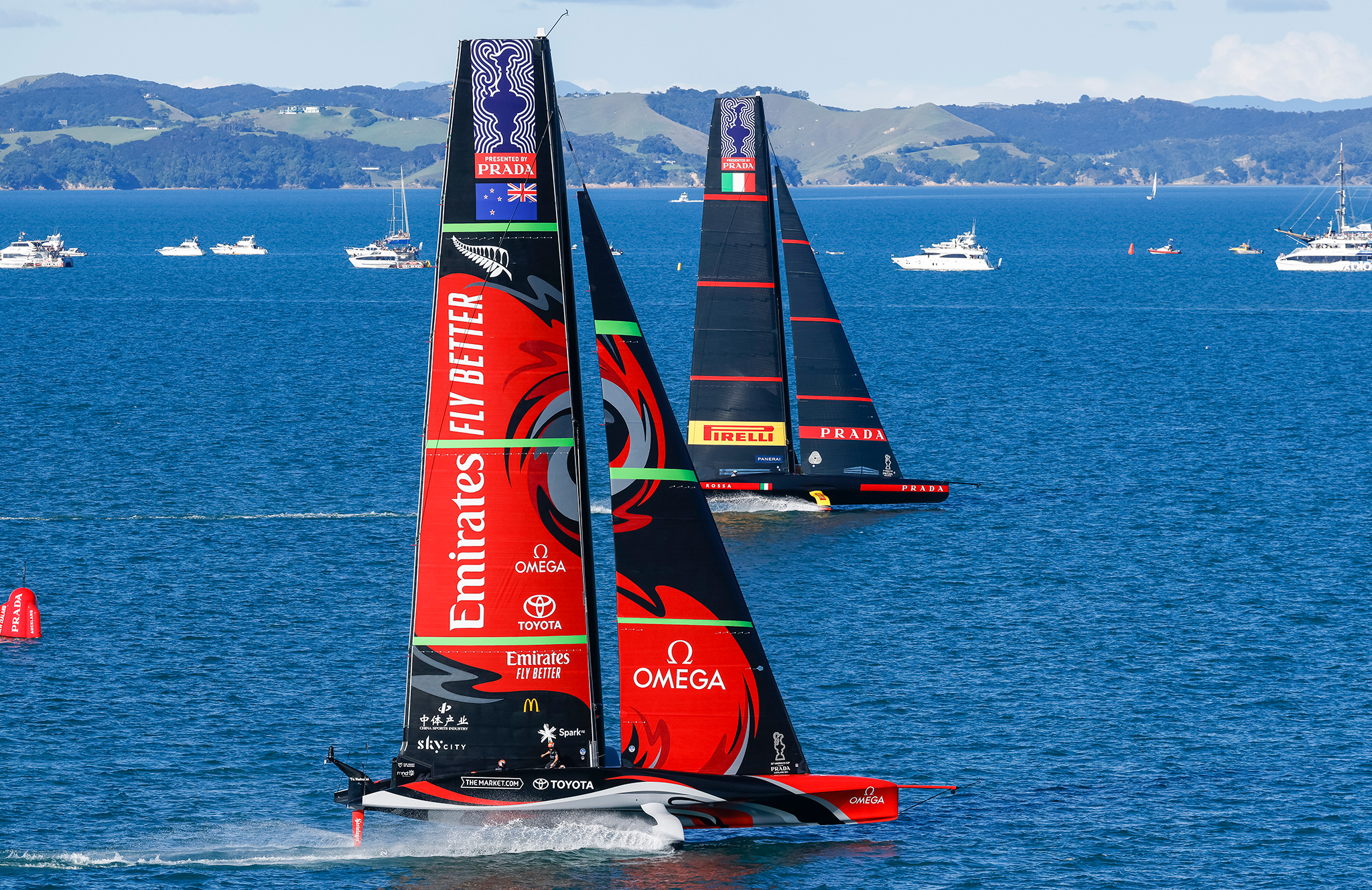
The most famous example of a tandem keel was seen during New Zealand’s 1992 America’s Cup campaign. They weren’t the only team to attempt a tandem keel that year, but the extreme nature of the Bruce Farr-designed “Little Red Skiff” was an extraordinary innovation (you’ll notice NZ-20 had much longer and narrower fins than on the cruiser you spotted, giving it a keel design that looks almost like a handle). The boat had no rudder and was steered instead by flaps on the trailing end of the keel fins. Unfortunately, due to a protest they didn’t have the chance to face off against the American defender, but the proof of concept for this radical design lives on.
Send your questions to sailmail@sailmagazine.com to be featured in the magazine.
This article was originally published in the October 2026 issue.