I arrived at Sam’s New Year’s Eve party around 11:30 and tried the bell. No answer. I texted. No answer. After 10 minutes, it was starting to look like I was going to ring in the new year on the sidewalk with the city rats. It was fitting; 2024 had been a bit of a rough year for me.
After we lost Alliance in the Newport-Bermuda race, it took a few months for me to start to feel normal again. When your job, your friends, and your hobby are all sucked into one single traumatic event, it’s hard to come back from that. The truth is, I was quietly having doubts about where to go from there. I wasn’t sure whether I could keep writing about sailing, whether I could go offshore again.
I told the story of the sinking for the October 2024 issue of this magazine, how I’d been driving just before 3am when a massive bang and the scent of burning fiberglass filled the boat. In the dark, about 200 miles from shore, we’d hit what we believe was a submerged shipping container. Within a few hours, the boat was gone. In some ways it was cathartic to have the story out there. The outpouring of support from the SAIL community was incredible, and that autumn I’d helped Alliance’s owners deliver their new boat, a gleaming Sabre 426, home to Newport. The incident inquiries were done and the insurance paid out. It all seemed resolved, but the shipwreck still cast a shadow over me. So, I was more than ready to be done with 2024.
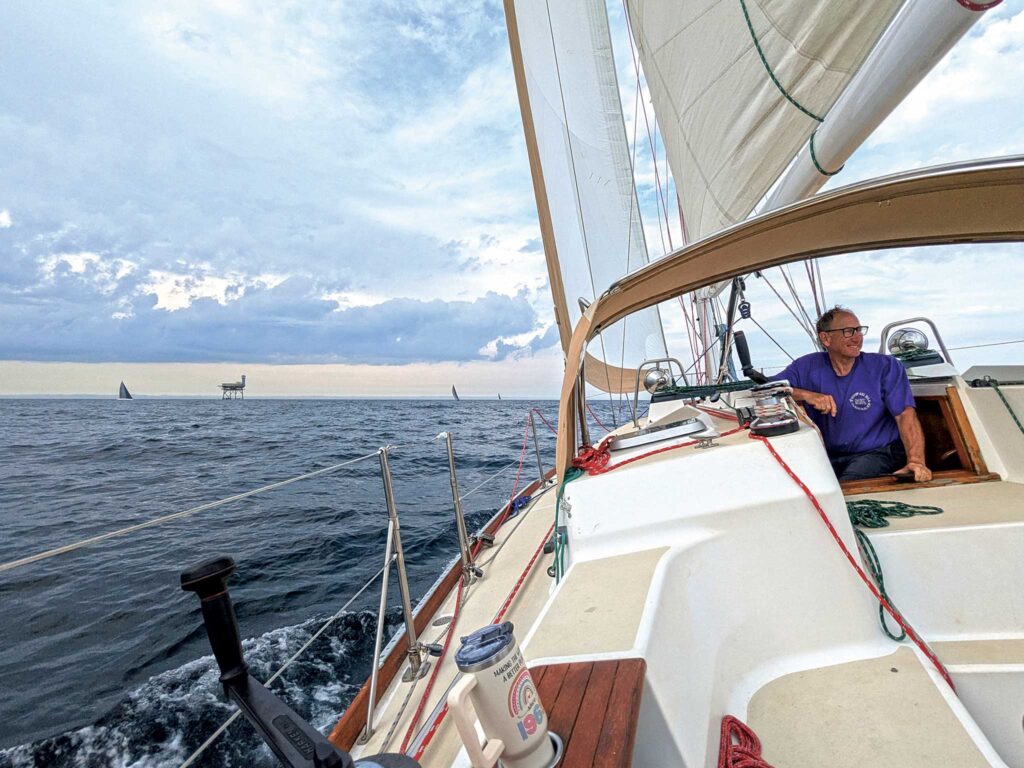
Sam, who’d also been a part of Alliance’s crew, appeared to let me in in the nick of time, cheerfully tipsy and wrapping me in a quick hug. I said my hellos, and found myself introduced to Rich and Monica, parents of a friend of a friend. Rich had Sam’s copy of that fateful October issue in hand, thumb bookmarking my shipwreck story.
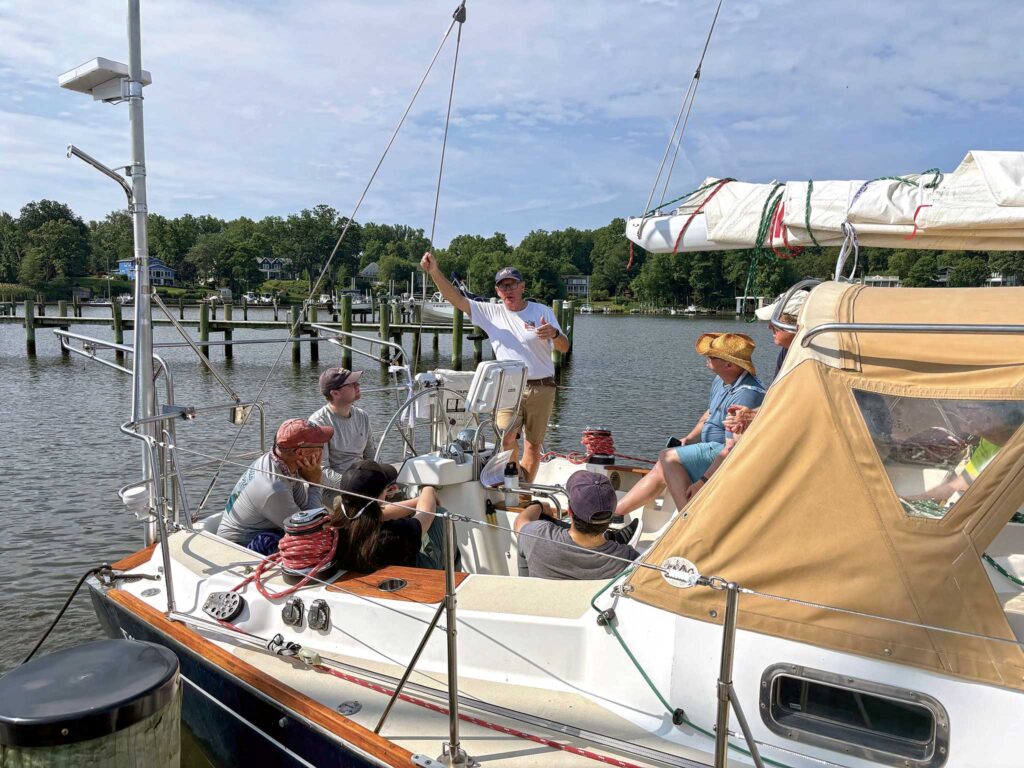
“Your article about Alliance was great,” he said. “If you don’t already have plans, would you consider doing the Annapolis-Newport race with us?”
“You did read the whole thing, right?” I asked wryly. “It doesn’t end well.”
Even though I had some doubts about going offshore again, I also was growing increasingly worried that even if I did want to, another team wouldn’t have me. The frequency with which I was being introduced as “the girl from that boat that sank,” didn’t inspire confidence. It’s not a great line for your resume. But Rich considered responding to an emergency at sea as valuable experience, and as luck would have it, his crew could use someone with offshore know-how. I was (metaphorically) on board by 12:30. Happy New Year indeed.
• • •
The winter months ticked by. Eddie from the Alliance crew signed on. We did crew calls, reviewed the SIs, headed down to Annapolis to do an overnight training sail. I obsessively studied. Rich worked endlessly on the boat, even procuring a sewing machine to stitch the boat’s very first spinnaker himself.
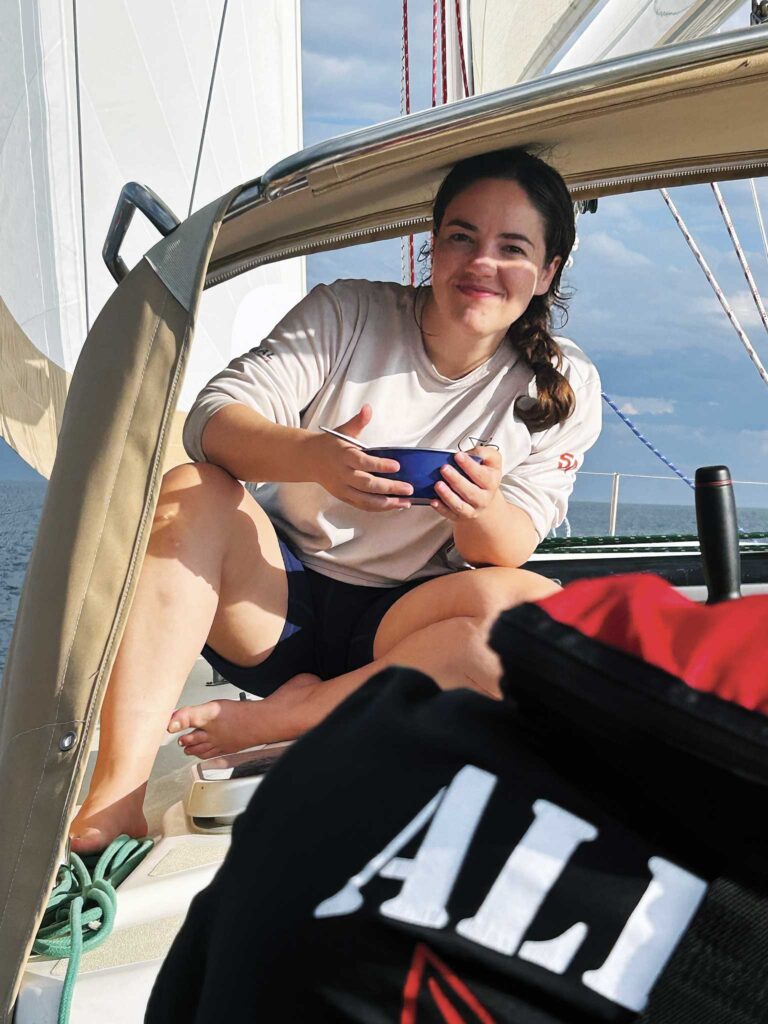
The boat turned out to be a Tartan 4100 named Tally Ho, lovingly maintained but—as Tartan’s tend to be—not designed with racing in mind. There was a bit of initial awkwardness as Rich tried to set expectations for us perhaps not being the most competitive boat in the fleet. Truth be told, that couldn’t have suited Eddie and I better. Being as it was both of our first race back after the wreck, we were more than happy for a gentler pace. Plus, we’d gotten absolutely walloped by the Annapolis-Newport in 2023 (see the October 2023 issue), so a boat that was both comfortable and solid as a tank was exactly right for us.
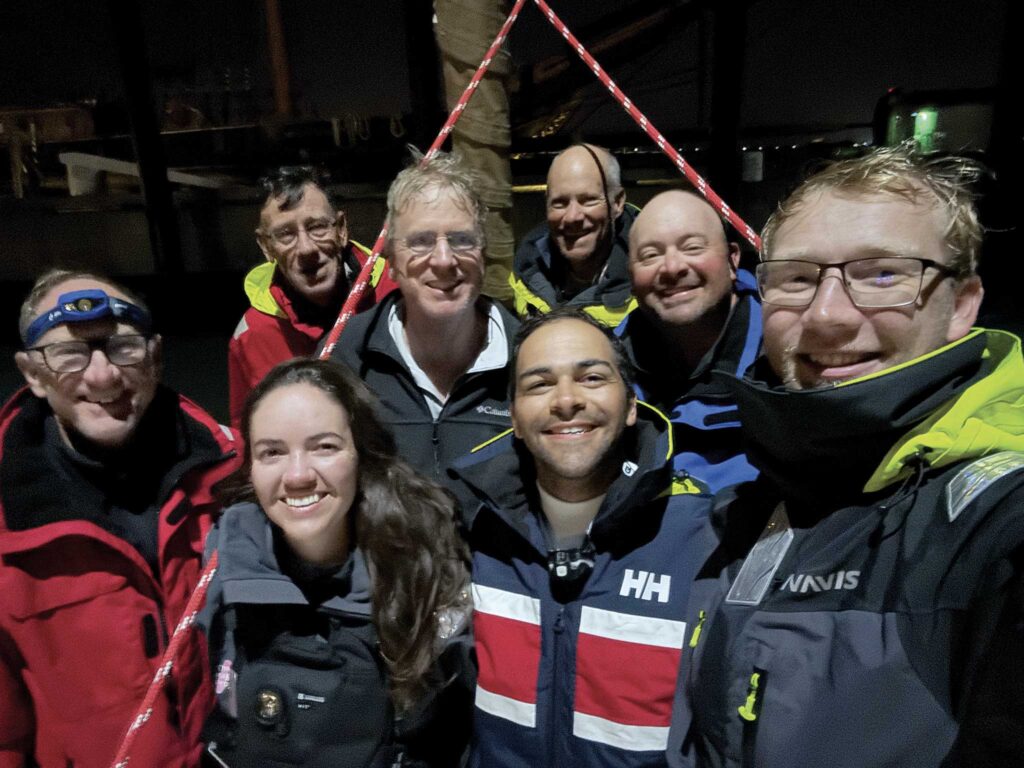
Tally Ho had mostly stayed close to home in recent years, but Rich and his son John were dreaming of the Newport-Bermuda, so they needed to get some miles under the keel. The rest of the crew consisted of John’s cousin Mike, friend Nolan, and Rich’s school friends Dan and Brian. It was a real family and friends program (plus me and Eddie), which made for a happy, cohesive group.
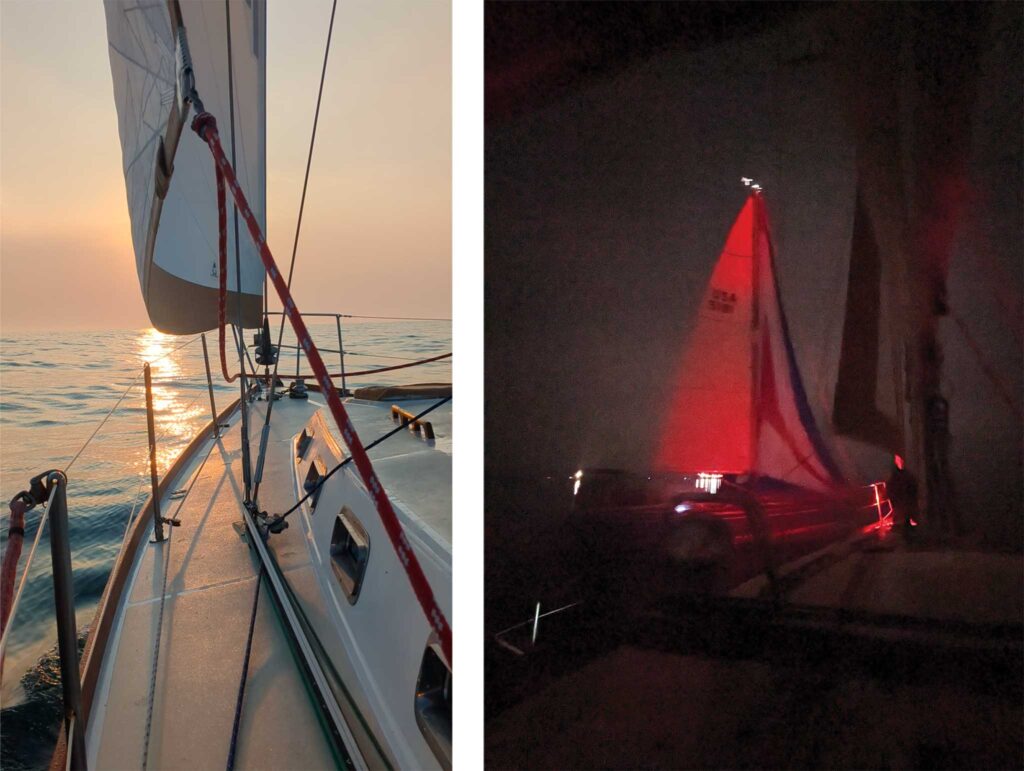
I was tasked with sorting out a watch bill with staggered watches that moved in four-hour shifts over night and six-hour shifts during the day. John is an engineer at Space X, and even he was scratching his head. Ultimately, though, we ended up with John and I as watchmates across from Rich and Eddie. That way, there was always at least one person familiar with the boat and one person with offshore racing experience on deck. The other four we split up with an eye to experience and social cohesion.
We began assembling in Annapolis a few days before the race, tackling the last few remaining projects: Taping shrouds, troubleshooting rigging kinks, endless weather speculation…I love those last 48 hours before the start of a race maybe as much as the race itself. There’s a special anticipation of a long summer afternoon just before you head out to sea. In the mess of feelings about going offshore again, I’d forgotten about that.
Race day dawned warm and clear. We weren’t expecting to have much wind, and it seemed like this race was going to be a game of finding and staying in the breeze. Little did we know how impossible a job that would be.
We started with a jag out east to chase a wind line that initially looked like a winner. It was…not. By nightfall, we were lagging, occasionally crossing paths at the back of the fleet with Bellatrix, a Swan 38. We just needed was to make it to Cedar Point before the wind change, and we’d be in the right breeze to catch the tide.
We did not make it to Cedar point before the wind change.
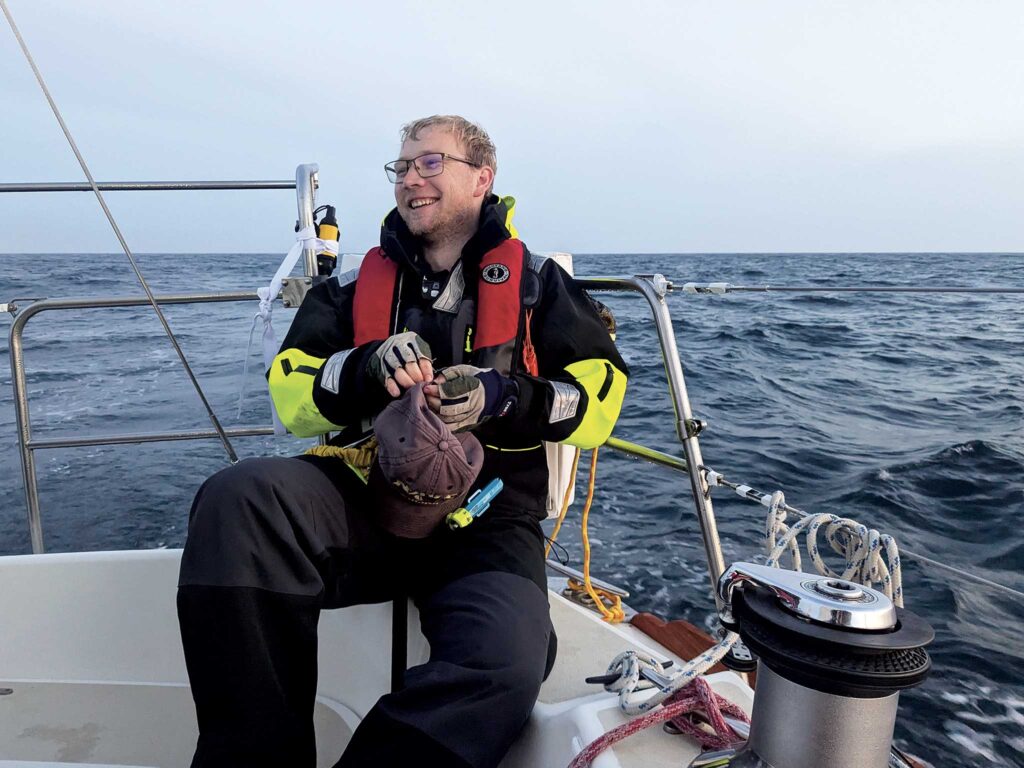
John and I spent a long six hours fighting for a single knot of boat speed, occasionally struggling just to stay pointed in the right direction since there was so little water flowing over the rudder. I’ll admit to having been relieved to turn it over at 10:00pm and let the mirror-smooth water be Eddie and Rich’s problem for a little while.
Shouting woke me a few hours later, and I leapt from the settee, hoping rather than expecting to be useful since the boat still didn’t have a degree of heel. Life jacket in one hand, I stuck my head out of the companionway. Bellatrix was to port, a boat length away and over taking us while crew from both boats prepared to fend off. Steering was impossible for Tally Ho with our non-existent boat speed, but surely they had a little flow over the rudder, right? They were passing us after all.
But no. In fact, they had no steering at all because they were, you guessed it, anchored. The tide had turned, and after a baffling, disoriented moment, the on deck crew realized we were drifting north, back up the bay towards the start line.
“When we threw out the hook, I really did not think we’d be moving up the scoreboard tonight!” one of their sailors called out to us, and I burst out laughing.
“Well, it’s technically positive VMG towards Newport,” I offered and got obligatory eye rolls from the crew on watch. But our own anchor was already well on its way to deployed and there was really nothing for me to do, so I headed back to bed, still chuckling at the absurdity of being overtaken by a boat at anchor.
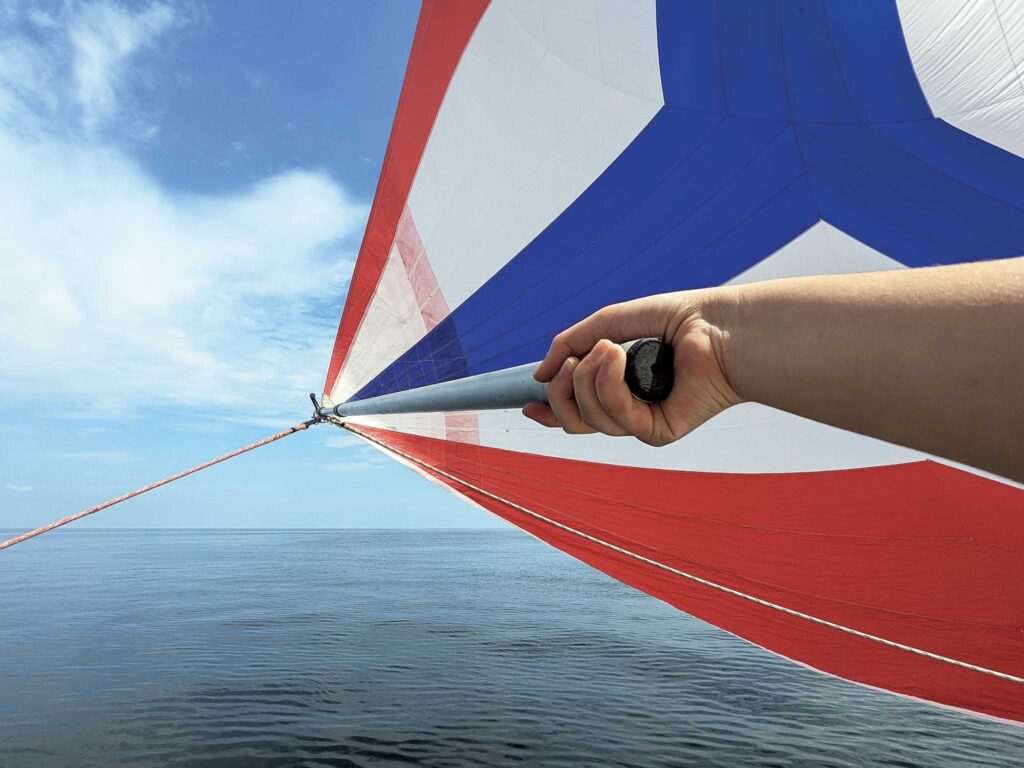
The next afternoon was long and hot. I amused myself for a while by using the boathook to poke the spinnaker away from the shrouds, occasionally getting it to fill for a few triumphant seconds. It was neither useful nor particularly entertaining, and I soon found myself back in the cockpit, reapplying sunscreen and recoiling everything I could reach.
My rule on watch is that I don’t check the time until I absolutely cannot help it anymore. There’s a half life to impatience, and if I check after an hour, the next check will be half an hour later, then fifteen minutes, then seven minutes, until I’m just staring at the clock waiting for each second to pass. The longer I can hold out for the first check, the better off I am. But a six hour watch in the blazing sun with not a breath of wind is never going to feel short, no matter how disciplined you are.
“Who has a favorite book?” I finally asked, arms locked around my knees to stay as small as possible, hiding in the lone sliver of shade on the sidedeck.
“Oh, I do,” John said.
“Please, no,” Mike groaned, already sensing where this was going.
“I want to hear exactly how it goes,” I said. “Don’t leave anything out, I want it as close as you can get to the original.”
And to my absolute delight (and the great feigned irritation of our crewmates) I was treated to a two hour long, astoundingly accurate rendition of Andy Weir’s Project Hail Mary feat. John Mount. Given John’s SpaceX background, I may have even gotten more planetary physics than the original version. (Then again, it’s Andy Weir so maybe not…) And despite the heat and the fact that we hadn’t seen more than four knots of boat speed in 24 hours, it was one of the most pleasant afternoons I’d ever passed at sea.
That night, we had the 10-2:00am shift, and for the final two hours John kept looking out and saying “we’re almost to the channel.” We handed off the helm at 2:00am, still almost to the channel. When we came back up at 6:00am, Eddie gave us the update.
“So there’s the channel, that’s the buoy—”
“The same channel marker!?” John’s incredulous laugh was a touch hysterical.
In all, it took us 49 hours to get out of the Chesapeake Bay. For context, the same distance had taken us 19 hours in 2023. But far from dispirited, we’d gone so far through frustration that we’d come out the other side to jovial, fully committed to the comedy of errors this race was turning out to be. Once you’ve been passed by a boat on the hook, it’s hard to have an ego about whatever happens next.
After two long, sweaty days, I took the most satisfying bucket shower of my life and went down for a nap. We rounded the tower at twilight the third day and reconverged with both our fleet and the second start fleet, making for a long march of boats drudging up the coast like ants in a line. We observed, first on the AIS then on the horizon, as a tug approached cautiously, watched the parade go by for 20 minutes without a break, and then turn back to port, seemingly unwilling to deal with the drama.
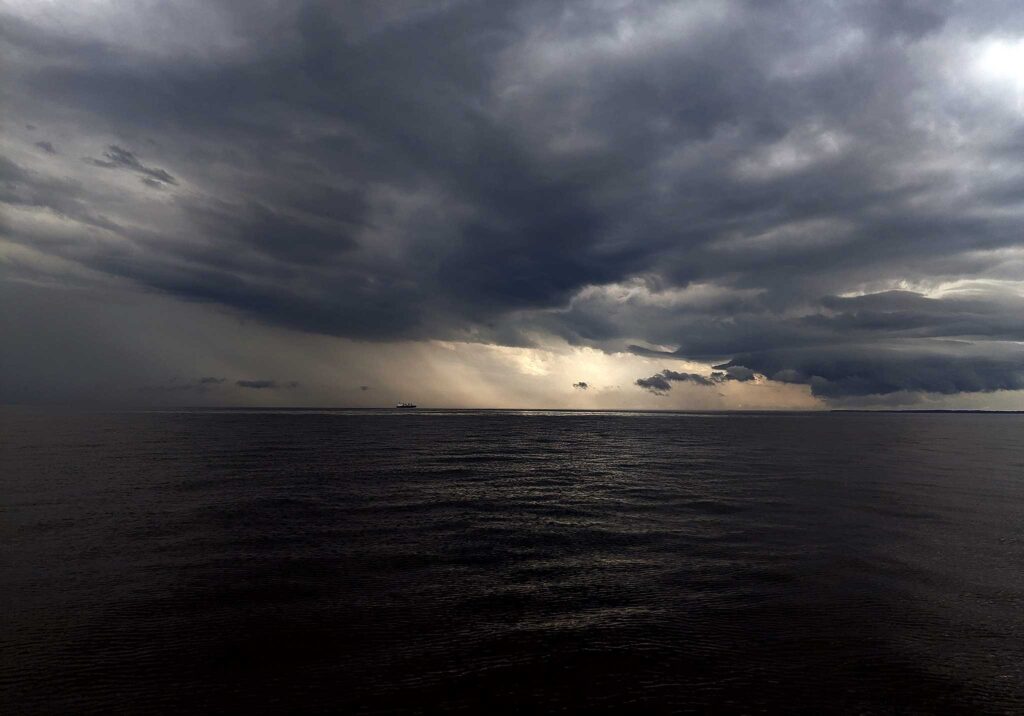
We finally saw a bit of wind that night, and with it an electrical storm in two parts, one east of us and one hovering over the shore to the west. The fleet threaded the needle neatly, though Brian, who’d been on a boat when it’d been struck by lightning before, suggested the helmsman wear gloves just in case. We tried not to think too hard about flesh melting to metal.
Still, it was probably the best four hours of sailing we had the whole trip, with a spritely breeze and spotlight moon so clear that while John drove, Nolan and I cast shadow puppets on the companionway from our perch on the high side.
By the next morning, it was all gone again. Tally Ho would’ve been fine with a moderate amount of wind, but she simply didn’t have the SA/D ratio move when things got this light. And to make matters worse, we’d realized that we weren’t getting accurate wind speed or direction readings, which certainly wasn’t making us faster. We were still racing, but I’d reached a state of zen about the whole thing, acknowledging that some things were simply beyond our ability to control. And given the hand we were dealt, I couldn’t have been happier to be with a crew with a good sense of humor. The worse it got, the funnier it got.
I had forgotten that punchy cheer that comes from that unique cocktail of sleep deprivation and misadventure. I’d forgotten I loved that part too.
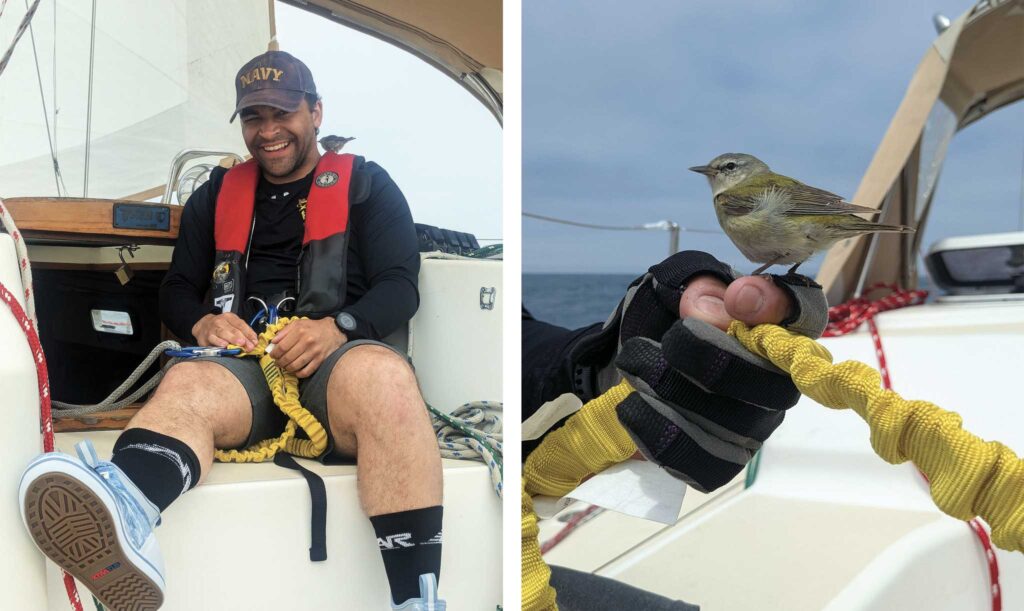
That afternoon a little yellow bird struggled to catch the boat, wet and exhausted. I coaxed him into the cockpit with my last orange slice and (after eating a truly astounding amount considering the size of his little body) he fluffed up to dry. A short nap later, and he was hopping about the boat, very happy to sit on our fingers and hair. He was curious and friendly, and he knew we meant him no harm. Eddie identified him as a Tennessee warbler, and we named him Tally.
Tally earned his keep, singlemindedly tackling the small flock of flies and moths that had been circling the boat since the Chesapeake. A pod of dolphins surrounded us, jumping and flitting around the boat. I went for a closer look and Tally accompanied me, landing on my shoulder to gaze with me into the sea. We loved him dearly.
I was sorry to see him go that evening, filled with a sort of aching sadness at the thought of that precious little body fighting the wind and the spray to get back home. None of us said it, but we all knew that this far from shore, his chances couldn’t have been good.
The next day, I gazed out at the seabirds circling, still feeling melancholy over our little friend. Our new neighbors were incongruously close together on the wide open ocean, agitated and circling. I knew that behavior.
“There’s something in the water here,” I said. “Maybe a whale.”
We waited tensely, not moving fast enough to really worry about a whale strike and eager for whatever was coming. Sure enough, we were suddenly visited by the largest pod of dolphins I’d ever seen, leaping and swerving around the boat. They moved so quickly I couldn’t count them, zipping around in teams of two or four. To their delight—and ours—the breeze had swelled just enough for a little bow wake, and they stayed to play for a long while.
At night, I talked John through steering by the stars since there was nothing else for dead reckoning. He was getting good, our waypoint accuracy graph leveling out to almost flat. He kept his chin up, eyeline away from the instruments in to keep his night vision, while I watched the readouts to make sure we were still on course.
“John, you’re a bit high.”
“Sorry, coming down.”
A minute later. “You’re high again.”
And a few minutes after another correction. “John, come down a bit.”
He squinted skyward. “Oh…no….”
“What?”
He groaned. “It’s a Starlink satellite. I picked a star to follow, but it’s a satelight.” He steered back to course, and we ribbed him about being duped by his own tech.
Dawn broke over another mirror-glass morning, orange and lovely. Rich came on deck, squinting into the sun and tweaking lines. We’d heard that other boats would be finishing later that day, but we were still a long way out.
“Listen,” he said to me. “Everyone else can move their flights home, but I know you have a meeting tomorrow that you need to be at. We’d have to start motoring now for you to make it. Should I turn the engine on?”
What a question.
I was meant to catch a flight to Atlanta in less than 24 hours, but it didn’t take any thought, really. After days of slogging and slatting, I wasn’t going to be the reason we threw in the towel. What’s a meeting when you’re watching a sunrise with nothing but ocean all around?
We saw Long Island late that afternoon, a greyish line smeared on the horizon.
That night, we were swallowed up by pinpricks of light swirling around as we passed between Block Island and the mainland, with anchor lights and traffic bobbing all around us. After days and days of nothing, it was jarring and breathtaking, like floating in space with stars all around. The summer heat had broken, and we were so, so close to home.
Naturally, the wind died one final time just as we passed Beavertail Light, and we were 30 minutes from the finish for an hour and a half. With the whole crew on deck, we waited. And waited. And waited.
We’d been driven just about mad by the sound of slatting sails when Eddie did a quick Google. We were staring down a finish time of five days and 15 hours. It would’ve taken us five days and 14 hours to walk.
We crossed the line in the small hours of the morning—worn out, caked in sweat and dirt, and feeling about three years older than we’d started out—whooping in victory as a corresponding cheer went up from a small, hardy group of loved ones on shore. Crewmates from my first Annapolis-Newport (turned friends, turned rescueres in the Newport-Bermuda) had come out to see us in, calling out to us and texting fuzzy night photos of Tally Ho at the end of her long journey. It was an exhausted blur of cheer and relief as we put the boat back in order and finally flipped the engine on.
“This was probably one of the coolest things I’ll ever do in my life,” Mike said as we tied off in a slip, and it struck a chord in me. He’d never been offshore before that week, and it brought back a memory—the feeling of that very first time I’d lost sight of land. One more thing I’d forgotten, an experience I take for granted now. And in a race that most sailors would consider a bit of a dud, a race where we’d had precious few hours of good sailing, Mike was right: There wasn’t anything I would’ve rather been doing.
As of yet, I’ve been unable to find a record of a slower Annapolis-Newport Race finish. (What can I say? Another summer, another unflattering line on my sailing resume.) But the truth is, it’s one of my most fondly remembered adventures. It reminded me of everything I love about being at sea, everything that had been eclipsed by the trauma of the shipwreck. Yes, we had some bad luck, we’d been challenged, but we’d also laughed the entire way.
November/December 2025