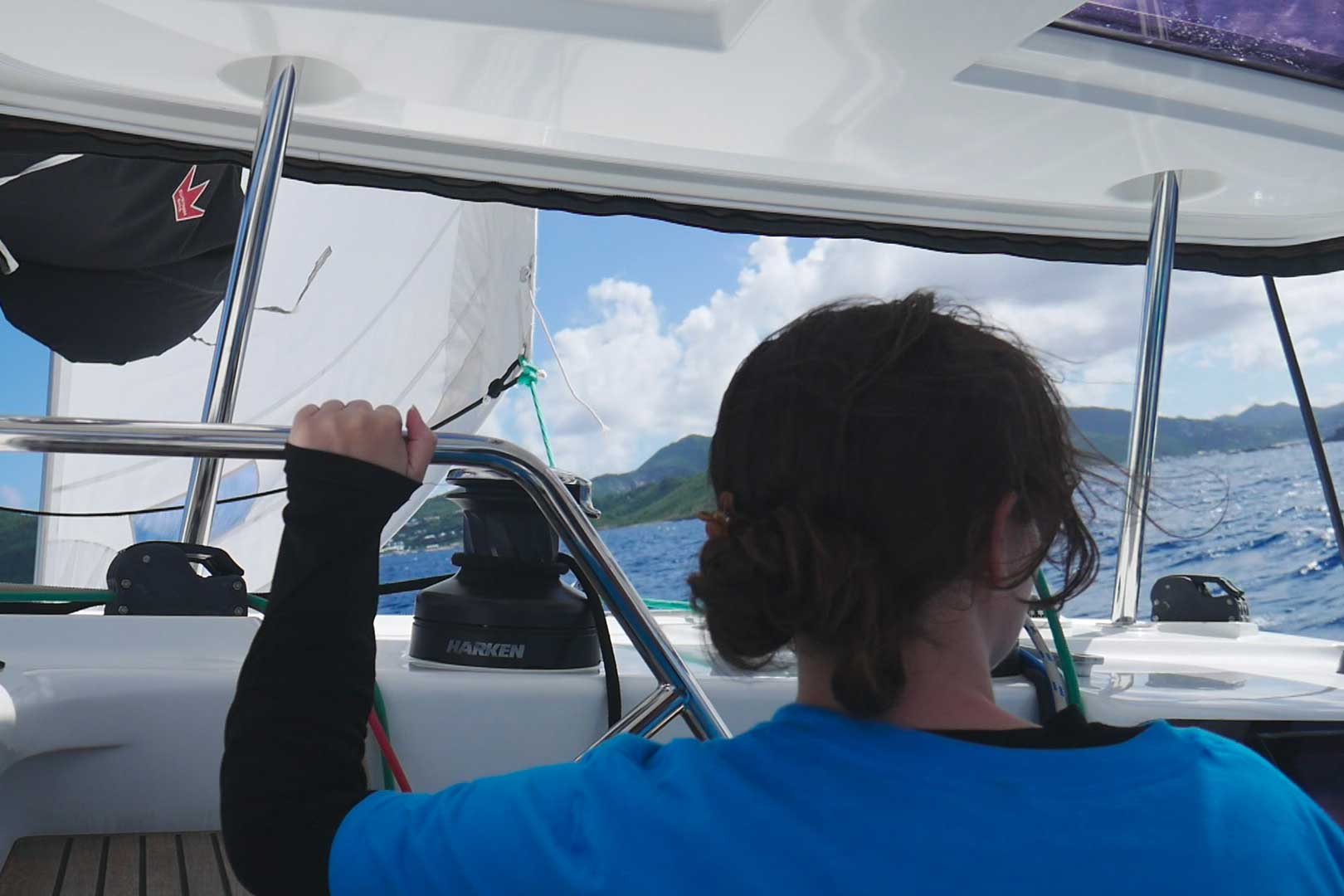
It had been a fine day on the water, sailing to Lough Hyne, on Ireland’s southwest coast, for lunch and back. We were approaching Glandore Harbour last August, and I was under Laughing Gull’s hardtop, furling the mainsail down into the boom. I was using one hand to press the button that activates the power winch, which was smoothly winding in the furling line, and the other to control the tension on the halyard as the sail came down the mast track. The sail was about two-thirds down when I thought I heard a faint shout above the wind noise and chatter of the crew in the cockpit. Then another shout, more urgent. I immediately released the power winch button and stuck my head above the hardtop to see what was going on. “Tamsin has her arm caught in the mainsail,” James yelled. “Release it.”
“How is that possible?” I wondered as I raced to throw open the clutch on the furling line, and strip the line off the winch. James was able to start unrolling the sail, and freed Tamsin’s arm. I had asked her to go forward to keep an eye on whether the mainsail was rolling neatly. Without thinking, she had reached out to guide the sail as you might to help the flake on a traditional mainsail, and it had pulled her left hand, and then forearm, into the roll it was making inside the boom. Now she came aft, hugging her limp arm to her body, in obvious shock and pain. Paddy, a doctor who thankfully was aboard, took Tamsin below and strapped the arm up to immobilize it. We got her ashore quickly with the help of a sailing school crash boat and Paddy raced her up to Cork University Hospital. The damage: a bad fracture just above her wrist, which required surgery, a plate, and lots of pins. The doctors, expecting something akin to a simple skateboard fracture, were amazed during surgery by the extent of the trauma that had been done to Tamsin’s surrounding tendons and ligaments. Of course, they had never seen an arm furled tightly into a mainsail by a power winch before.
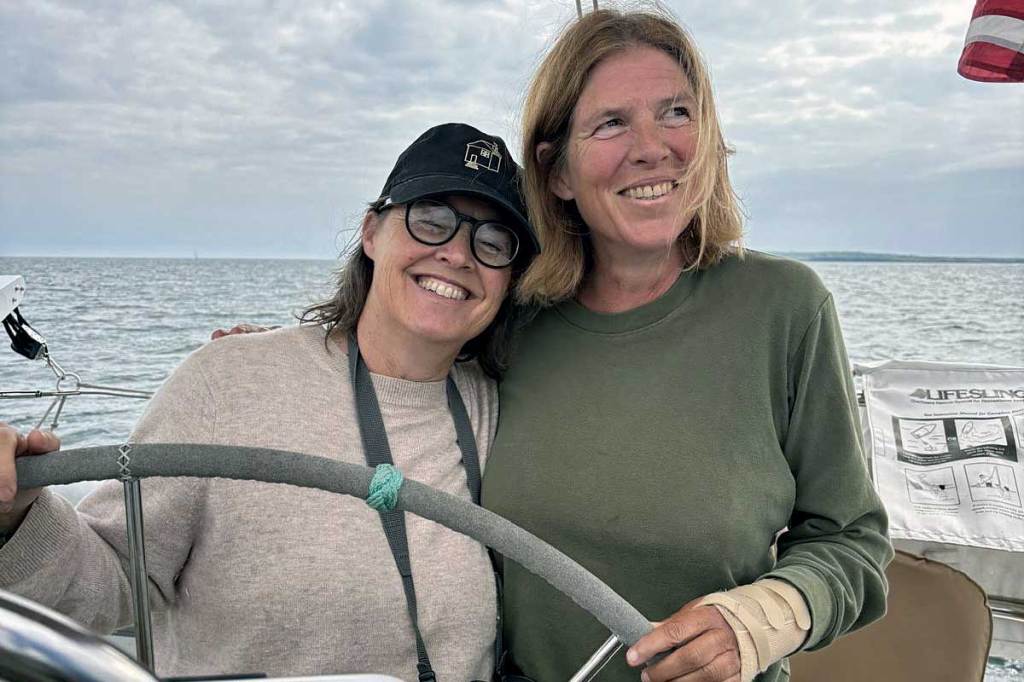
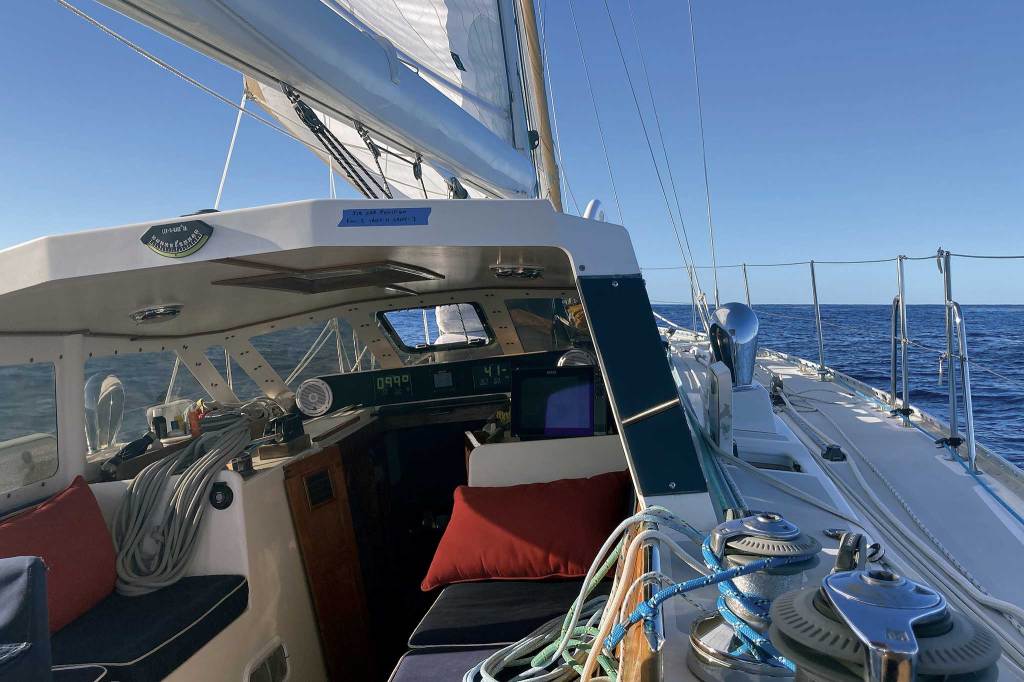
Laughing Gull is a 1996 Able Apogee 50, and the first sailboat I have cruised extensively that has a powered windlass and powered winches (the halyard/furling winch for the boom-furling main, and two powered primary winches for the genoa at the aft end of the cockpit). From the start I treated them with a wariness that bordered on fear, instinctively sensing the damage that powered winches can do to people, sails and gear. I routinely used the electric windlass and the halyard winch because it would be hard to work a 50-foot sailboat without them, especially solo. But as a general practice I left the powered genoa primaries turned off, to reduce the chance of an accident, especially when things got chaotic in the cockpit during a squall or other moment of stress and urgency.
Over the course of three years, and thousands of miles of ocean sailing up and down the United States’ east coast, to the Bahamas and Caribbean, and then a transatlantic to Ireland, I had managed to avoid any mishap or injury with the winches. But now there had been a serious incident that forced me to think more deeply about the use of power winches. I gave myself shivers thinking about what would have happened to Tamsin’s elbow, and then shoulder, if I hadn’t heard the shout in time and the winch had tried to pull more of her body into the boom. A skipper’s primary responsibility is to keep the crew safe, and I had failed in that responsibility, with potentially disastrous consequences.
Powered winches are increasingly common aboard cruising sailboats for a number of good reasons. They allow the same crew to sail and manage a larger boat, which translates into faster, more comfortable passages, and roomier life aboard. They make furling mainsails more viable, helping eliminate the hassle of slab reefing, or dousing and flaking, a large expanse of unruly sailcloth. They make lifting a dinghy onto the foredeck a push-button operation.
On Laughing Gull, raising, reefing, and furling the mainsail would be an ordeal without a powered winch, especially when I am solo. And as i get older, the ability to start using the powered genoa primary winches will allow me to keep sailing longer than if I had to rely on aging musclepower alone. In short, powered winches are very convenient, make it easier to handle big loads, and deliver real benefits.

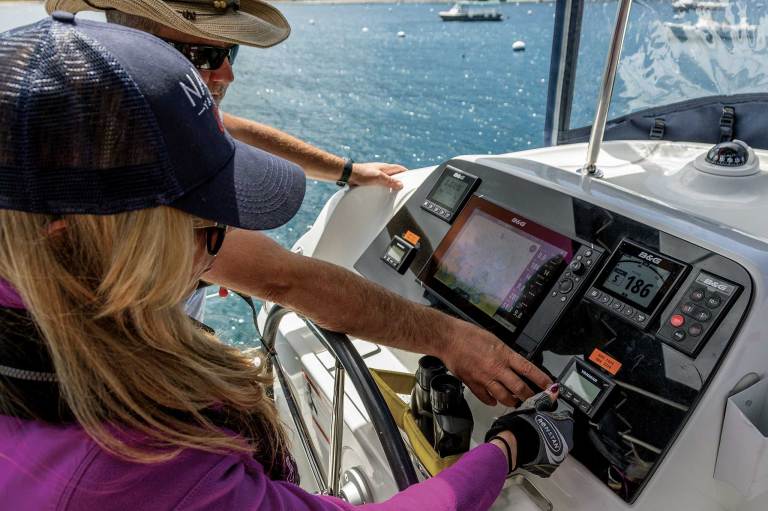
With power there is inevitably risk, though. The full danger was made tragically clear by an incident in England that coincidentally happened just days after Tamsin’s injury. There, an experienced 74-year-old skipper called Lyall Babington inadvertently activated a power winch as he was removing a line from it. The line pulled his hand and then arm into the winch, and his crew was unable to quickly deactivate the winch, despite repeatedly pressing and releasing the control button (which appears to be the same pressure switch covered by rubber I have on Laughing Gull). By the time the crew got the winch to stop turning, Babington’s upper torso had been pulled hard into the winch pedestal. He suffered major trauma to his chest and head and could not be revived by the emergency responders who arrived at the scene and disentangled him 30 minutes later.
The preliminary investigative report of this accident is sobering and made me realize I needed better practices and measures to minimize the chances of any future powered winch disasters on Laughing Gull.
In his analysis of Babington’s death, John Harries, of the Attainable Adventure Cruising website, advocated strongly for the most logical measure: a prominently located kill switch that can quickly cut the electrical power to a powered winch or all the powered winches. A Big Red Button would address the dangers of a faulty or unreliable activation switch, which was a key factor in Babington’s death. According to the investigative report, the button was known to be intermittently faulty. That delivers another important lesson: stay on top of maintenance of any system that can do such great harm if it fails.
Chris Stanmore-Major, an experienced round-the-world sailor and racer, in a YouTube video, also analyzed what happened to Babington. Stanmore-Major zeroed in on the absence of a kill switch, as well, and pointed out that a Big Red Button is standard alongside any industrial machinery these days.
Kill switches are more common on large, modern superyachts, where push buttons and joysticks are used to control just about every system and mega-load. But I have never seen one on any sailboat comparable to Laughing Gull that has electric winches. Babington’s death and the accident on Laughing Gull reveal a gap in standards for powered winch systems at the smaller end of the cruising industry. Even the smallest powered winch, on a relatively small boat, can kill, maim, and do grievous damage.
Harries says that kill switches should be a required standard for electric winches. Whether they do or not, common sense and risk management make a pretty strong case for a kill switch. The breakers for the electric winches and windlass on Laughing Gull are easy to access below, at the foot of the companionway. But even if everyone on board knows where they are, in an emergency the extra five seconds it might take to get to them from the deck could mean the difference between a minor or survivable accident and a life-altering incident.
I hadn’t previously worried much about the possibility of a faulty switch. My winch fears had focused more on inadvertent damage to gear or human extremities due to inattention or mishap. But Stanmore-Major noted that the rubber coverings on the activation buttons can deteriorate and crack, causing the spring-loaded switches inside to stick or behave unpredictably due to water ingress. Whether this was the cause of the intermittent malfunctioning on Babington’s boat is unclear. Still, I will start paying much closer attention to whether all the pressure-activated switches on Laughing Gull are intact and functioning reliably, especially the toe-activated buttons for the windlass on the exposed foredeck. I will also consider where and how a Big Red Button for all powered winches on Laughing Gull might be installed in the cockpit.
Even if the winch switches are working properly, the lesson of Tamsin’s broken arm is that absolutely reliable communication—ideally a person who is a dedicated relay—between the deck and the power winch under the hardtop is critical if there are people around the mast or boom while the sail is being furled. A comms relay for the windlass would also make sense in case of switch failure, and if the kill switch is located in the cockpit. On sailboats, stuff happens. And you had better have the procedures in place to respond as quickly as possible when needed.
I half-joke with Tamsin (now that she is healed, we can kind of joke about it) that I should affix warnings to the mast and boom that read: “Never, ever, ever, under ANY circumstances put your hand in the sail or touch the sail when it is being furled!”
Tamsin of course felt dumb that she had done exactly that. But she was likely–and unconsciously–just trying to be extra diligent because she knew I was concerned about how neatly the sail would roll up after I had made a mess of the hoist earlier in the day. And this is a key point I have learned over the years of sailing Laughing Gull with lots of different crew of varying experience: you can never really know what unexpected or inadvertent action someone might take. Human nature and intention is unpredictable.
To try to minimize the possibility of unwelcome surprises I have developed two mantras I share with new crew. The first is: “If you are not sure about something, anything, please STOP. And ASK.”
The second is: “Don’t take initiative beyond what you have been asked to do unless you are 1000% sure what you are about to do is the right thing to do.”
In the end, you can’t control everything, which is both the challenge and allure of life on a sailboat. So on a sailboat it is good to be afraid of the right things—the things that can kill you, injure you, damage your boat, or end your voyage. When you are, you prioritize and focus your risk mitigation and communication on the right things. What happened to Tamsin, and most tragically to Lyall Babington, has moved powered winches much, much higher on my list of things to be scared of—and I will act accordingly. I am pretty sure they should also be higher on the list of any sailors who use them.
Tim Zimmermann is a lifelong sailor, and writes the Substack Sailing Into The Anthropocene.
This article was originally published in the August/September 2026 issue.