All Photos courtesy of Jeanneau
The forecast held. There wasn’t much hope for anything else, especially when glancing at the radar, but shedding all optimism never feels right. I was glad I brought my foulies—fortunately, I always pack gear pessimistically. The occasional raindrops turned into steady patter on the deck within moments of leaving the dock. It was summer in Newport, and we were onboard the brand new Jeanneau Sun Odyssey 455. Perhaps, nothing more needs to be said than it was all smiles and laughs from there on out.
This was hull #6, the first 455 to arrive in the United States, and it had just been launched. The hull and deck are entirely new designs.
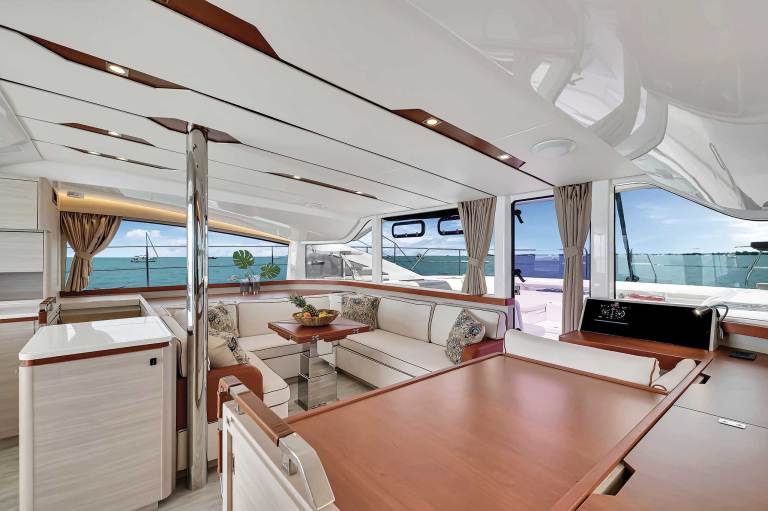
Strategically, we stepped below deck for a tour of the interior and were glad to slide the hatch closed as the rain picked up even more. It hit immediately: the 455 is remarkably spacious—the interior volume outpaces its length compared to earlier Jeanneau models. The 14-foot 8-ingh beam is a large contributor, but so isn’t the fuller section shape: more width is carried lower, and how far the full beam is carried forward. It offers a fresh look at how a much larger interior can fit into a 46-foot 9-inch overall hull length.
The floorboards are screwed down in this model, with key systems access provided through purposefully placed access panels. This approach eliminated creaking noises while we were onboard and still offers full access for maintenance: a well-balanced tradeoff.
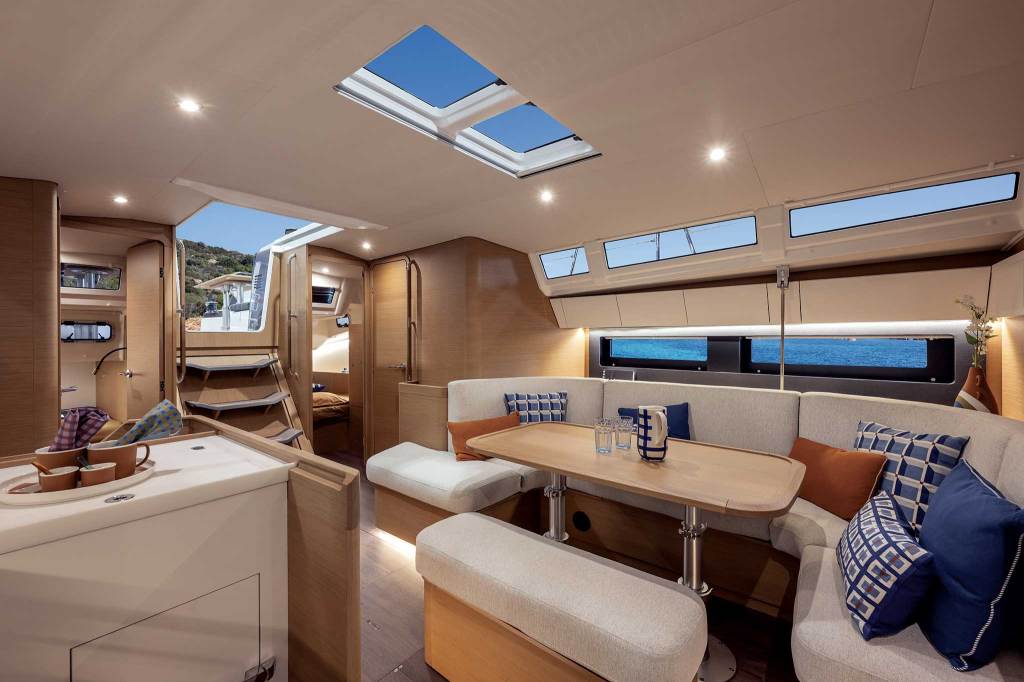
Along with the rest of the cabin, the galley remains bright, even with the deep upper cabinets nestled nicely between the deadlights in the hull and those in the cabin top. The galley arrangement places the fridge opposite the sink, on the ends of the C-shaped counter, with the two-burner gas cooktop and oven outboard. This forms that work triangle that is sought after in home kitchens, but perhaps more notably, it means that use of the counter space next to the sink won’t cover access to the fridge. And even if the top of the fridge is used for counter space, there’s a secondary side loading door (also helpful when something unpoetically falls to the bottom and would otherwise be considered lost until everything above was eaten first).
Household details continue with dedicated spice and cutlery drawers. Beyond the level of organization, this approach also helps to keep the boat quieter in a seaway, eliminating rattles and clangs. Quick access to sponges and scrub brushes can be had through a thin drawer on the face of the sink.
Accent lighting, located under the lower edge of galley joinery and throughout the rest of the cabin, brightens up the cabin sole. A safer environment for evening hours onboard, undoubtedly, but it also encourages keeping a cleaner vessel. Those dots connected when I discovered the integrated dustpan: lift up the access panel just forward of the companionway stairs and a recessed plastic tray is ready to accept anything swept in its direction. Pop it out to empty it or gain access to the bilge.
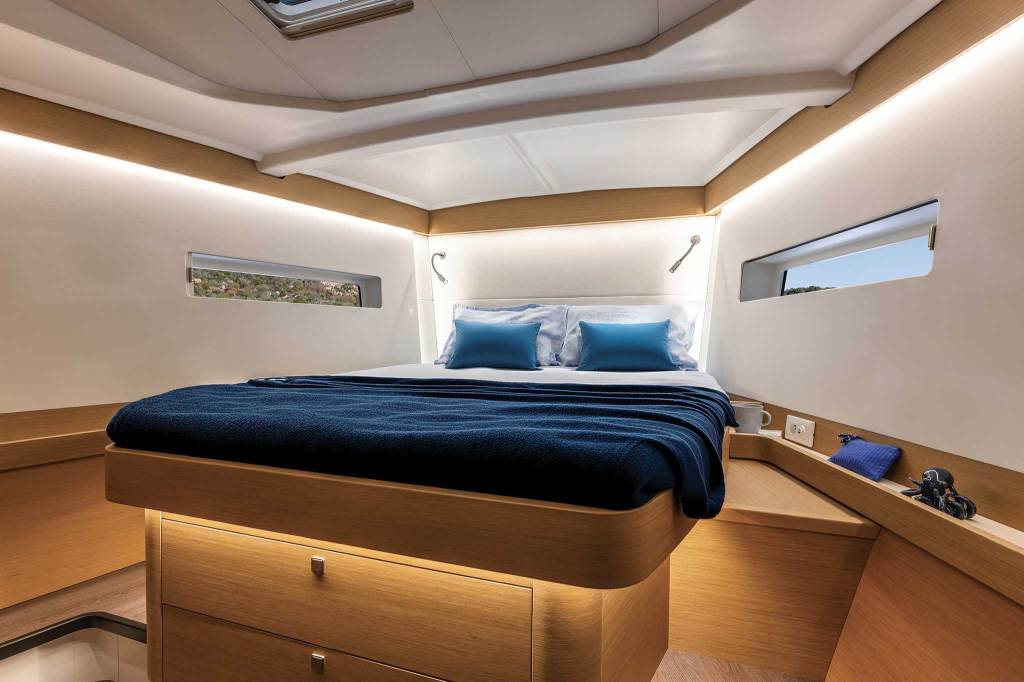
interior feel warm and cozy.
The entire salon is convertible to a lounge (or double berth) by dropping the table, or with the optional dual tables, just one can be dropped for a more flexible space. The settees include storage underneath, as does the moveable bench. Across the way, the u-shaped seat at the nav station converts to a chaise lounge, drop down head rest (from the upper cabinet) and footrest included. It may be the most comfortable spot onboard and expands the casual entertaining space.
Forward, a generous owner’s cabin is filled with more details: a tip out laundry bin, deep drawers, a tall hanging locker, twin hatches for ventilation, and carefully located power outlets. An ensuite head features a separated shower stall and plenty of natural light. The charter versions of this boat (four cabin/four head or five cabin/three head) split this forward space between two cabins and their respective ensuite heads. This speaks to the volume of this space in the three cabin/two head configuration.
In all configurations two more cabins are located aft, on either side of the companionway. The three cabin/two head layout places a large head to port, with a separate shower stall, and a bonus room to starboard. This ventilated bonus room can serve as a workshop, pantry, hanging locker, a laundry room, or any combination of these purposes.
I would be remiss not to call out the improvement in below deck handholds over earlier models. Some are subtle, like countertop fiddles and others are leather-wrapped stainless bars, but they’re all well thought out and natural places to grab when traversing the cabin. A coastal or offshore passage is the best way to prove this out and find where more could be added (particularly in heads): tailored to each owner, of course, but the existing arrangement is a good baseline.
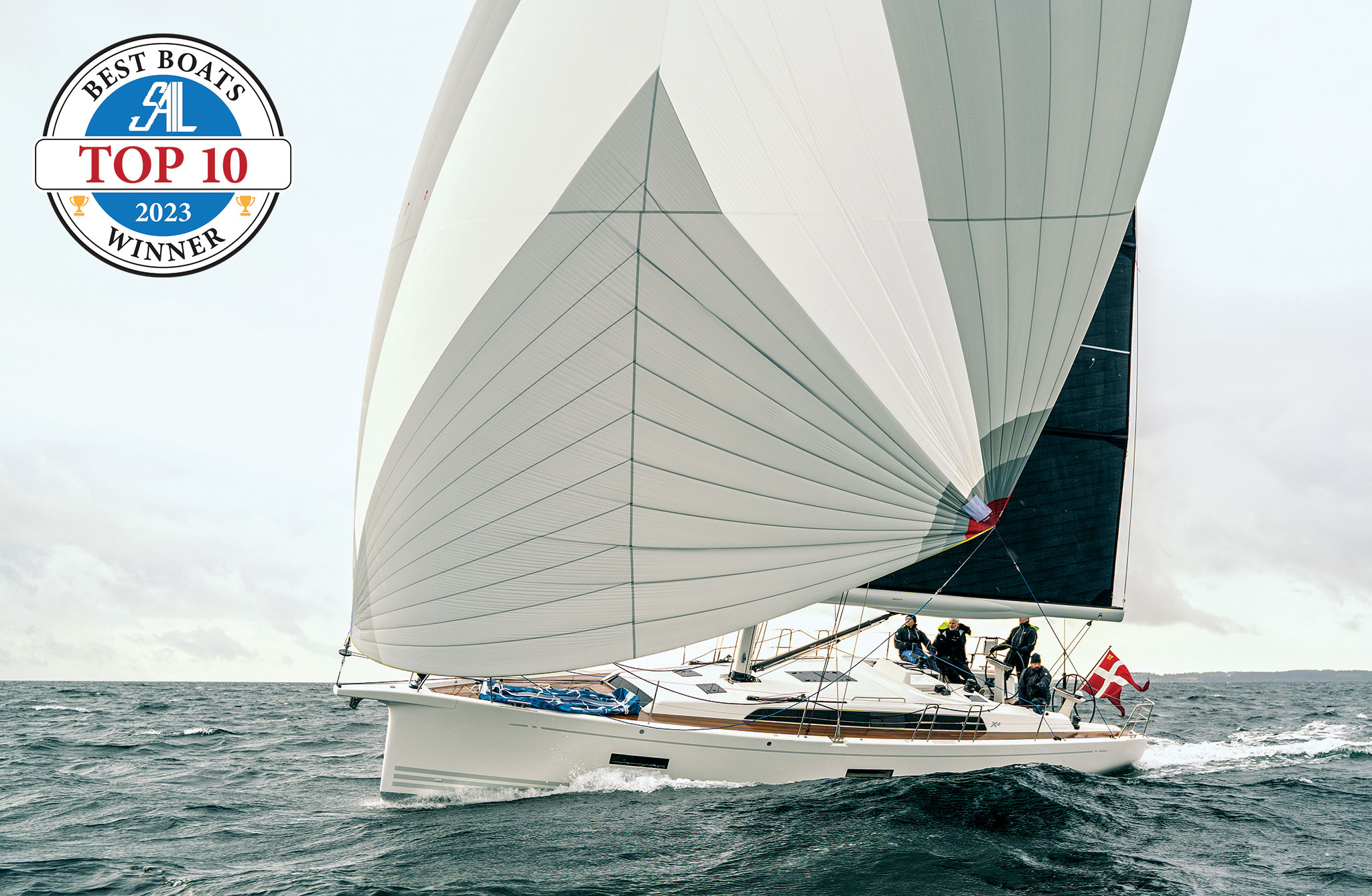
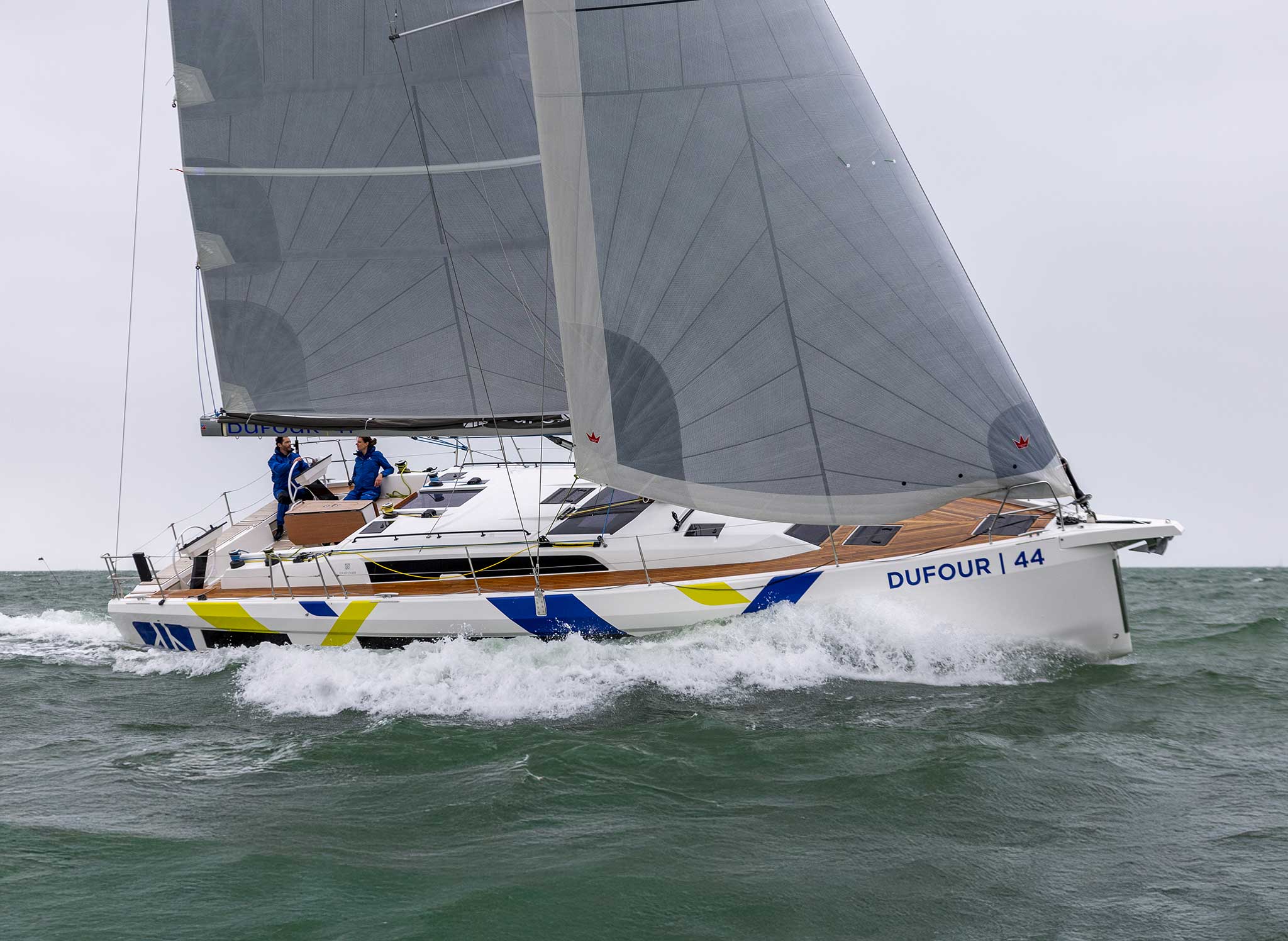
As we cleared the mooring field and poked our nose even with Fort Adams, the optional 80 horsepower turbo Yanmar Saildrive slowed, and the bow swung to the north. I slid into my bibs and zipped my jacket as I climbed up the companionway. The rain was no lighter, but there’s no such thing as bad weather, just bad clothing, right? The breeze was a beautiful 12-15 knots as the main unfurled and we fell off to port. The headsail was next to come out and was efficiently trimmed from a set of Harken winches forward and inboard of the helms (the main was also conveniently controlled here).
Floating genoa leads simplify deck hardware and keeps the system approachable for entry level sailors by only having a single tweaker that controls the height of the low friction ring. The mainsail adjustments follow a similar theme: instead of a traveler, Jeanneau installed a fixed bridle (raising the height of the deck-supported block of the mainsheet system and securing it by port and starboard lines that are terminated outboard on the cabintop, forming a triangle when the sheet is tensioned). This is the same trick I rigged up on dinghies years ago and still do: compared to a fixed block lower down, a bridle allows tighter sheeting angles while still being able to twist off the main sail.
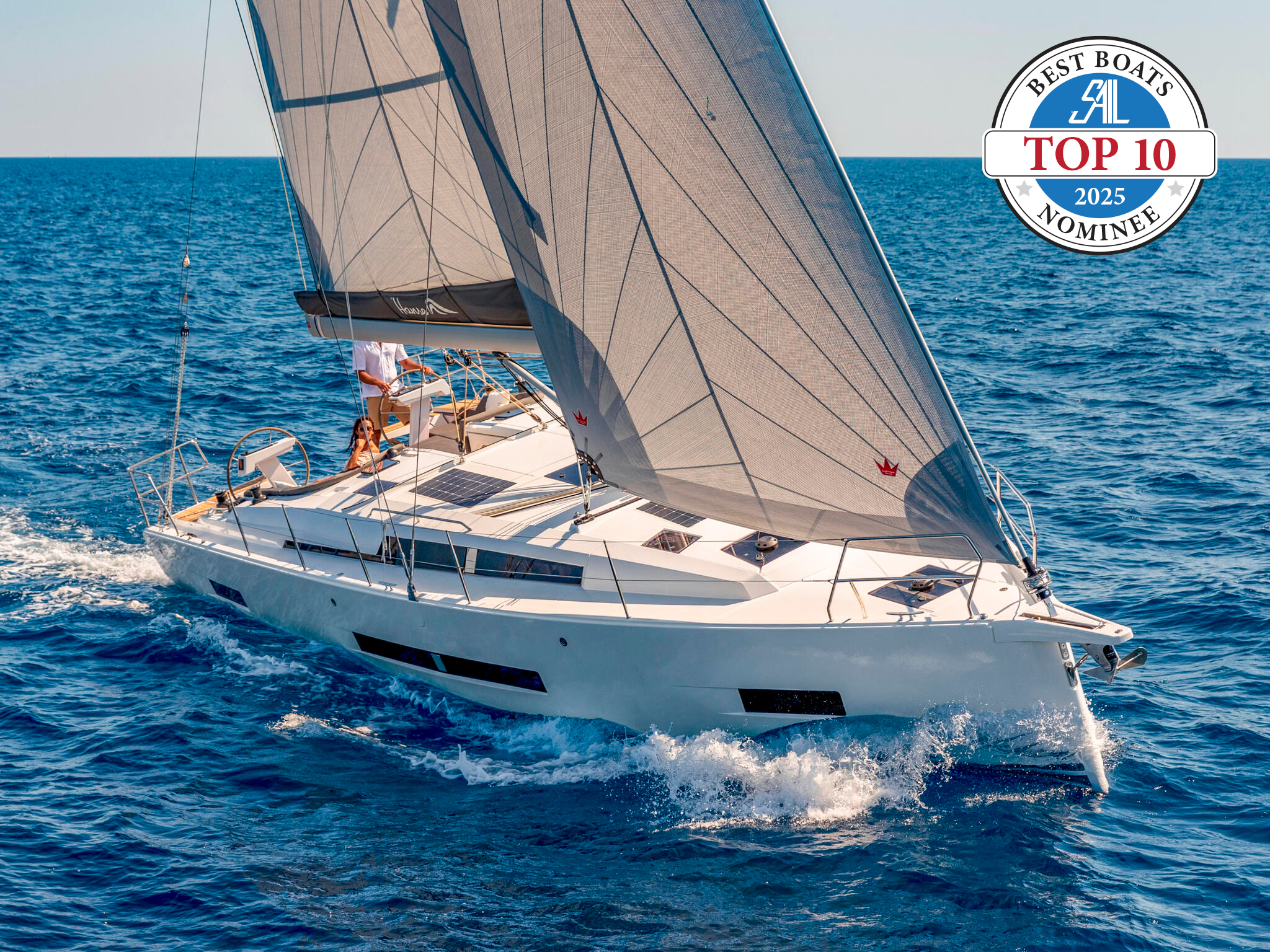
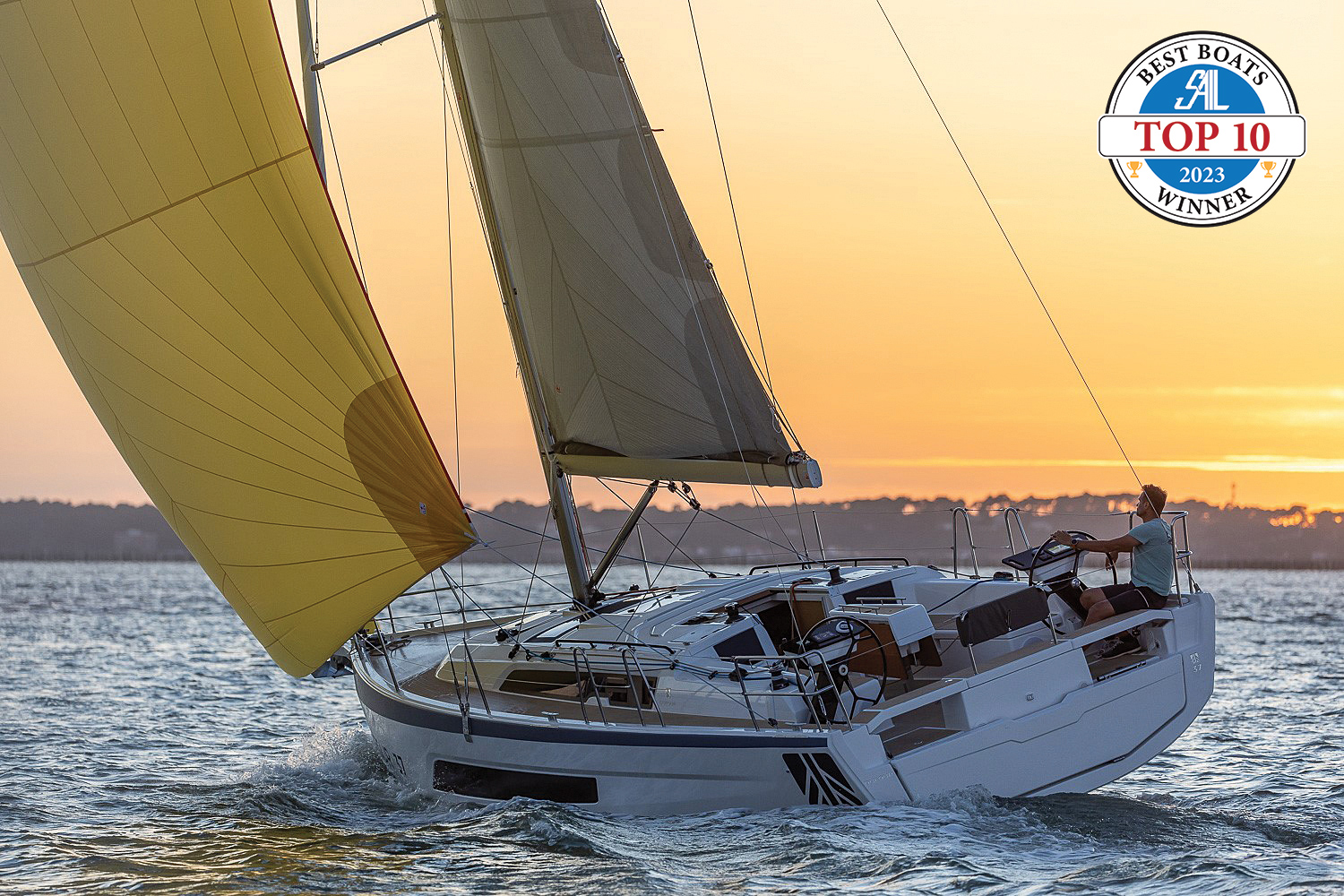
The Jeanneau Sun Odyssey 455 sailed to weather cleanly, mostly powered by the genoa (almost a jib as the overlap is minimal, making for quick tacks). The optional in-mast furling main is a much smaller sail than either the standard semi-battened main or the performance fully-battened main: 496 square feet versus 581 and 591, respectively. The shape of the larger sails should be better as well. I wish I had the opportunity to dial in either of those larger mains—call me a traditionalist, or maybe it was my competitive side.
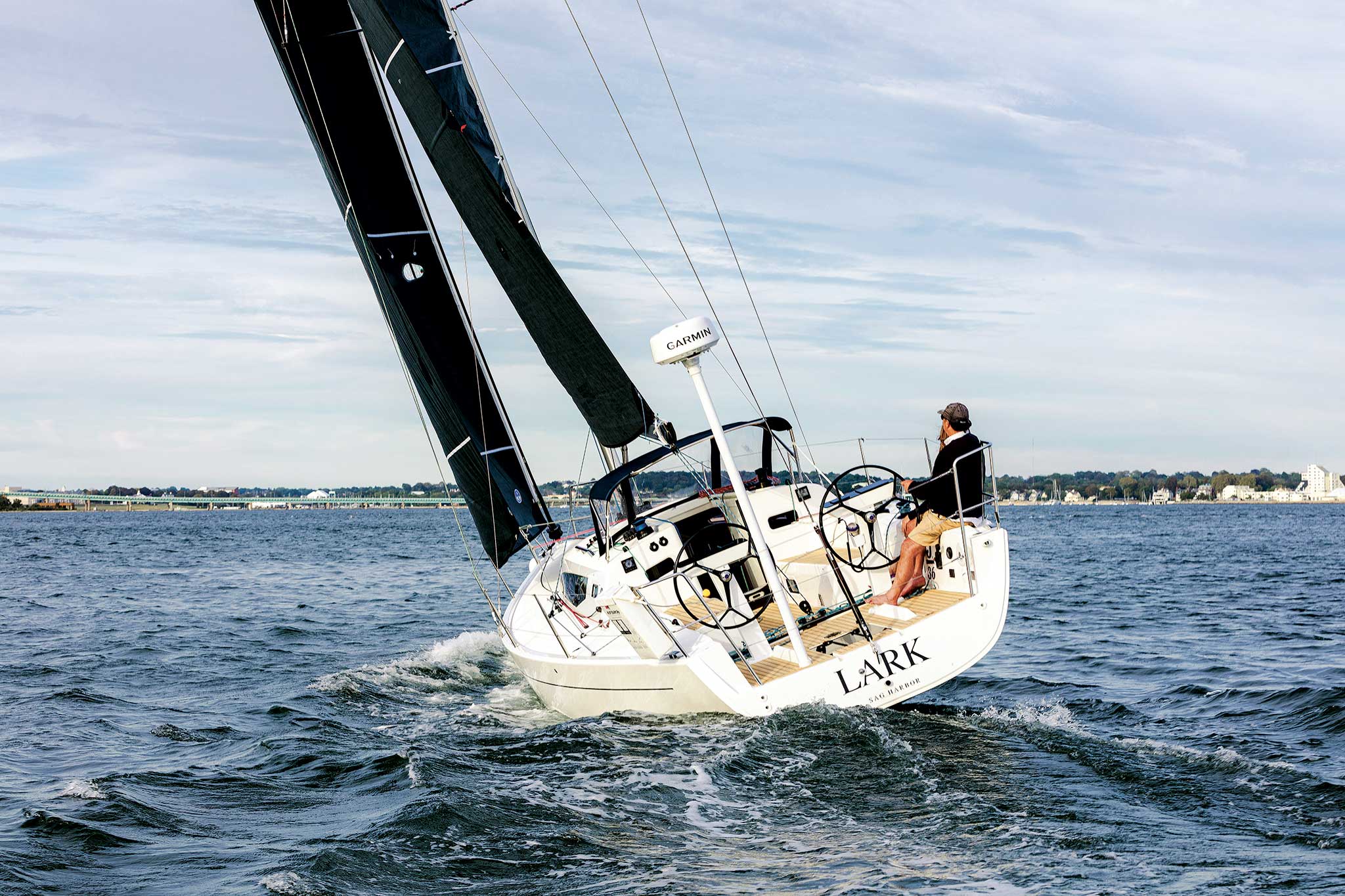
The helms controlling the twin rudders are entirely neutral, so steering for hours at a time has no muscle fatigue factor, even in the puffy weather we faced. The tradeoff is a sense of feel that always helps to dial in performance, but that may contradict the mission of this boat. If performance data is of interest, there is no shortage with the optional Raymarine Axiom+ plotters at the fingertips of the helmsman.
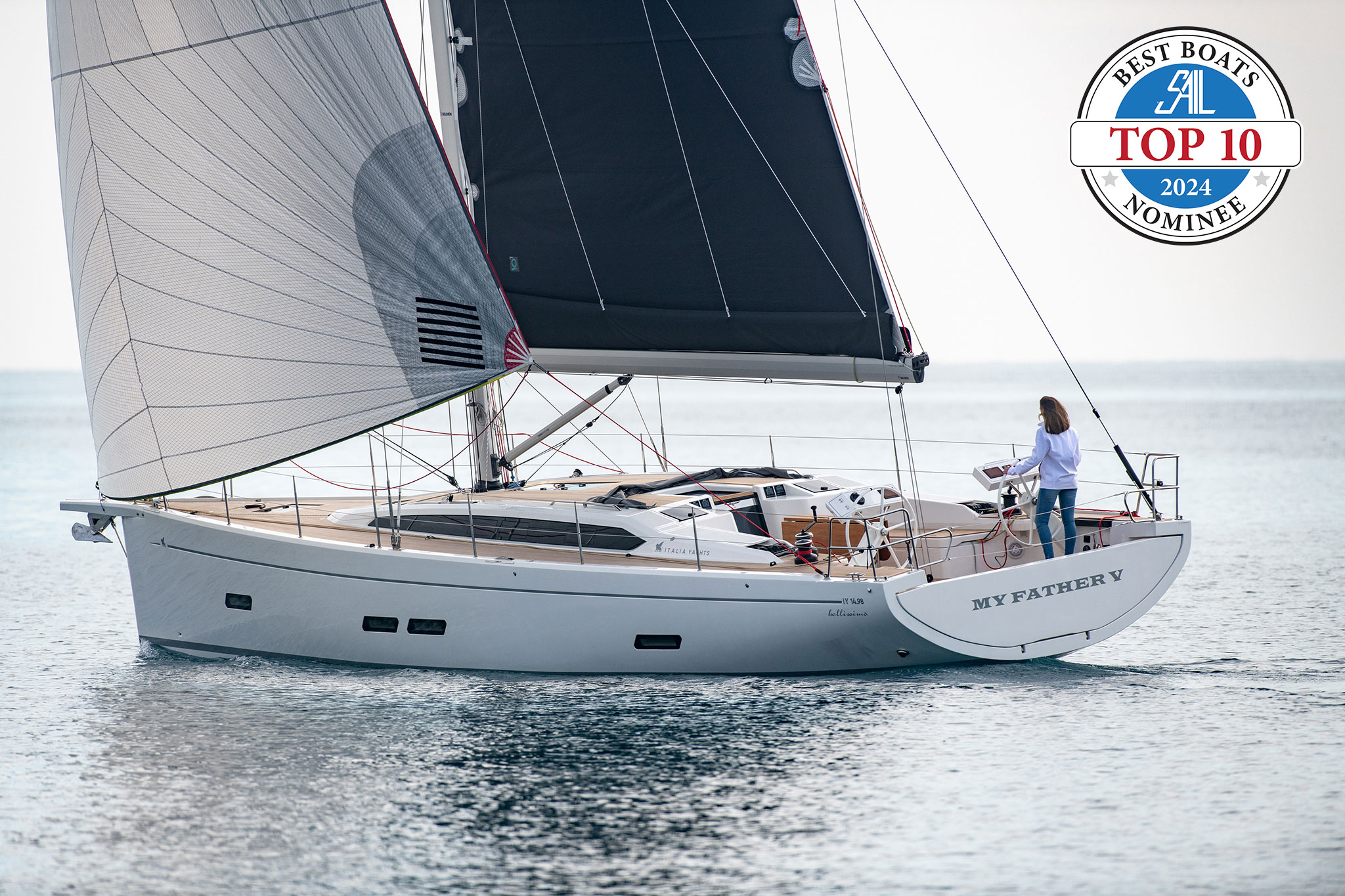
Reaching was enjoyable, even with just the main and genoa. We touched nine knots with little effort. And all the while, a stroll from the helm to the bow was smooth. The 455 uses the same walk-up design as recent models. There is no climbing over coamings or dodging hardware. The double-spreader aluminum rig is designed to carry the V1 shrouds outboard and the D1’s inboard of the side deck. The quick translation: there’s no ducking or swinging around the side stays, just extra handholds.
A sail locker is accessible from the foredeck and sports a wide hatch for straightforward light air sail stowage and retrieval of socked and furled spinnakers. Just forward resides the anchor locker and windlass. The integrated bowsprit forms a nice home for the anchor, but it’s also standing by to accept an optional Code 0 or asymmetrical spinnaker.
If seeking additional storage, turn back to the cockpit. Just aft of the companionway is a life raft locker. And aft of that is either an optional genset or more storage. Symmetrical lockers are also under the port and starboard cockpit seats. Further storage exists under the helmsman seats, except when the option is exercised to make the starboard side a cockpit fridge. There is also a lazarette but be mindful of the steering equipment and other systems when stowing gear in there. Arches and davits are optional for dinghy storage, with boarding made comfortable by the large swim platform.
Just as we were pulling into the dock, made seamless by the Sleipner bow thruster, the rain began to let up. By the time we had stepped off, it was only a drizzle. We nearly had Narragansett Bay to ourselves, a hard feat on a July day, and I wouldn’t have preferred it any other way. The smiles and laughs continued, even as we walked back down the dock—that’s part of the magic that comes with sailing, and if we can’t at least partly judge a boat by that, we’re missing an important part of the picture.
LOA 48’5”
Beam 14’8”
Draft 7’9” (standard) 5’9” (shoal)
Ballast 5,933 lbs
Displacement 24,864 lbs (light)
Sail Area 1,109 sq ft (standard) 1,128 sq ft (performance)
Power 57 HP Yanmar diesel
This article was originally published in the November 2026 issue.