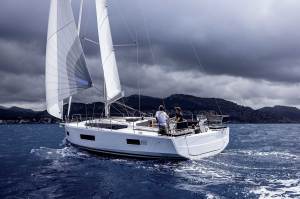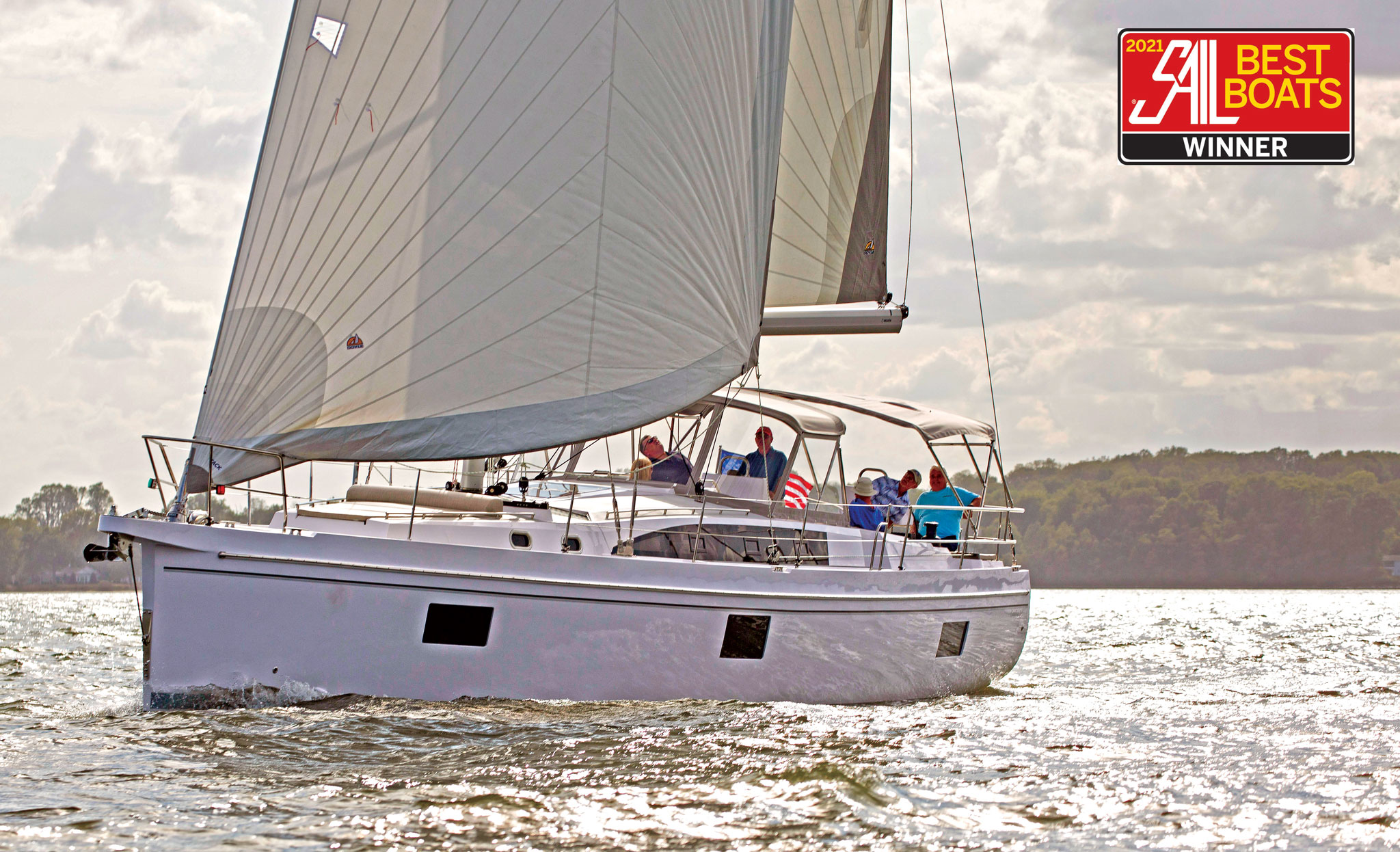
How do you top a design that reigned for nearly a decade and launched 500 hulls? That was Beneteau’s quandary as they contemplated building a successor to the Oceanis 51.1 that initially splashed in 2016. As the French builder rolls out their 8th generation of the iconic cruising line, they’ve hit the mark with the Oceanis 52. After an initial review of the brochure, I wasn’t convinced there was much to her, but once I stepped aboard and hoisted sails, I changed my tune.
We untied the dock lines quickly, barely giving me a chance to look around. The 110-hp turbo Yanmar pushed us out of the marina and into Chesapeake Bay at 7.7 knots and 2300 rpm and I briefly brought her to wide-open-throttle at 8.9 knots at 3150 rpm. That top number is speedy but it doesn’t do much for consumption which could be tricky with only 53 gallons of fuel onboard. Beneteau chose to pair the diesel with a saildrive rather than a straight shaft, a choice I’m not sure I’d have made on a boat of this size, but she moved along smartly and turned in her own length.
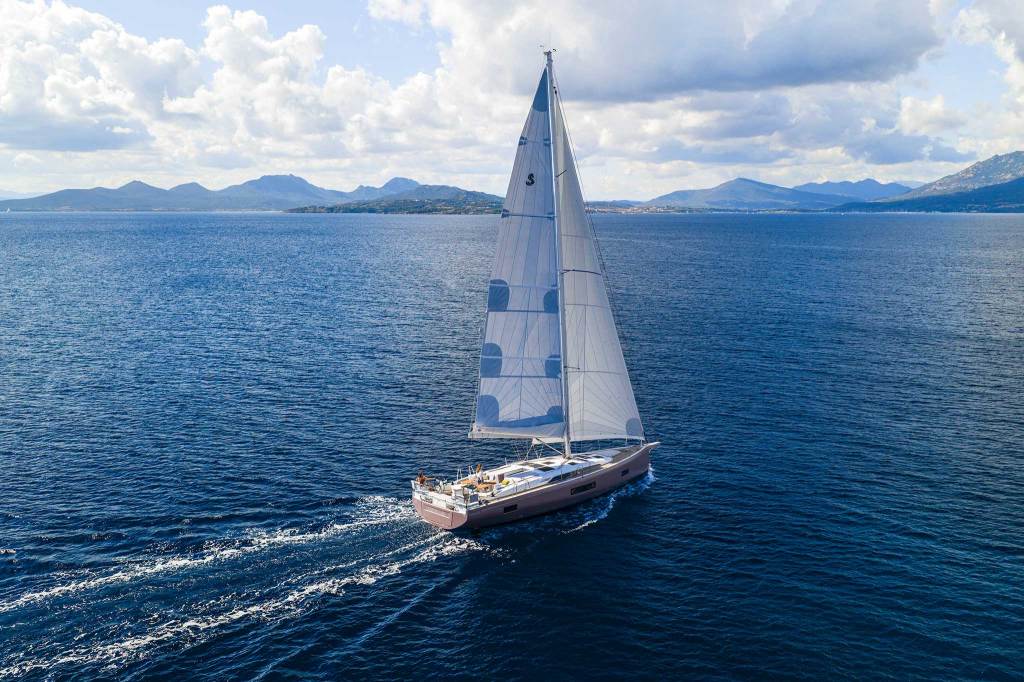
Our test day was a mixed bag of variable conditions but the Oceanis 52 managed it all with a cool confidence. With 1,453 square feet of upwind sail area, she accelerated quickly in small gusts but then settle onto her chine and stabilized as the breeze built. The deck-stepped mast carries a choice of a self-tacking jib or an overlapping genoa, and the addition of the 1,539-square-foot Code 0 is a must to add power to the sail plan. To balance out all this canvas, there’s a choice of a deep 7 foot 9 inch T-shaped keel or a shoal version at just 6 feet 4 inches, which is what we had on the skinny waters of the Bay.
The Oceanis 52 is slippery. We made good 7.4 knots of speed over ground in 11.4 knots of true wind at 60 degrees apparent wind angle (AWA). That’s 65% of wind speed which is respectable. We even nudged up to 35% AWA and she still glided along nicely. The helm was responsive and precise so I had to take care not to oversteer in the tacks because that would have been an inexcusable operator error. Anyone wishing to club race or make fast passages should check out the First Line package with a taller mast and upgraded sails.
A real improvement over her predecessor was made in line handling due to the new layout of the cockpit. The primary and secondary winches are now separated allowing for crew to work without crowding the helm. The primaries are aft by the wheels and within reach of the driver who can grind or just push buttons when the winches are electric. The secondary winches are well forward, ahead of a set of deck steps that I’ll address later. Crew can lean over these winches and put their bodyweight into grinding. If there is no crew, the helmsman controls the electric secondaries via buttons on the starboard pedestal.
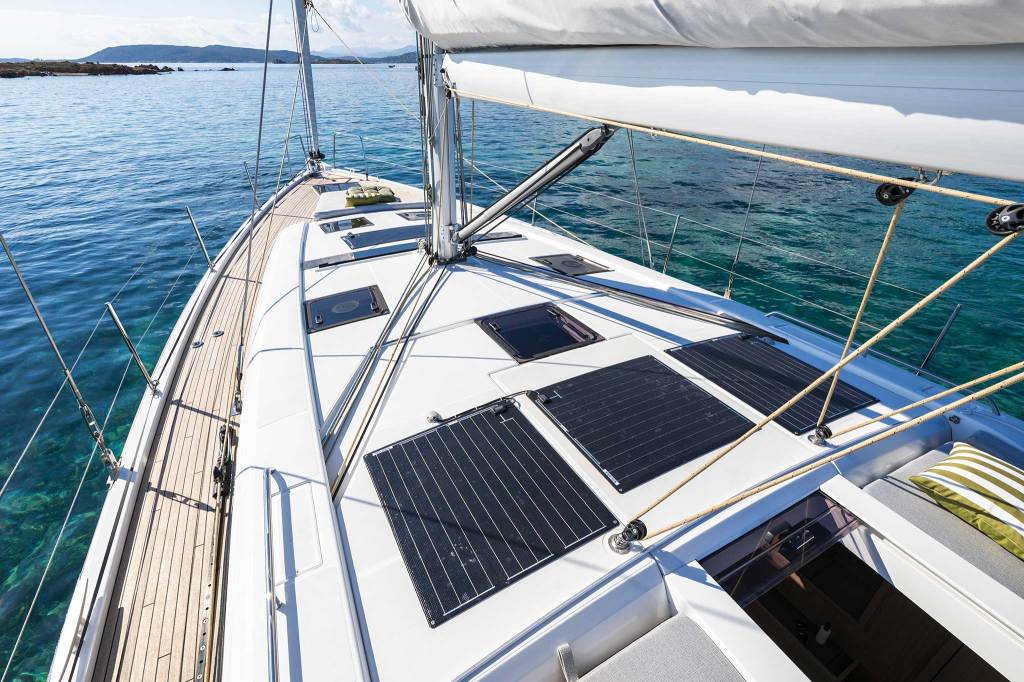
The lower shrouds were moved inboard to widen the side decks and the track for the self-tacking jib is tucked in neatly just ahead of the mast. An integrated composite bowsprit keeps the anchor from dinging the stem and holds the Code 0 padeye. In true Beneteau fashion, the mainsheet is double-ended and attached to the integrated arch over the companionway eliminating the traveler.
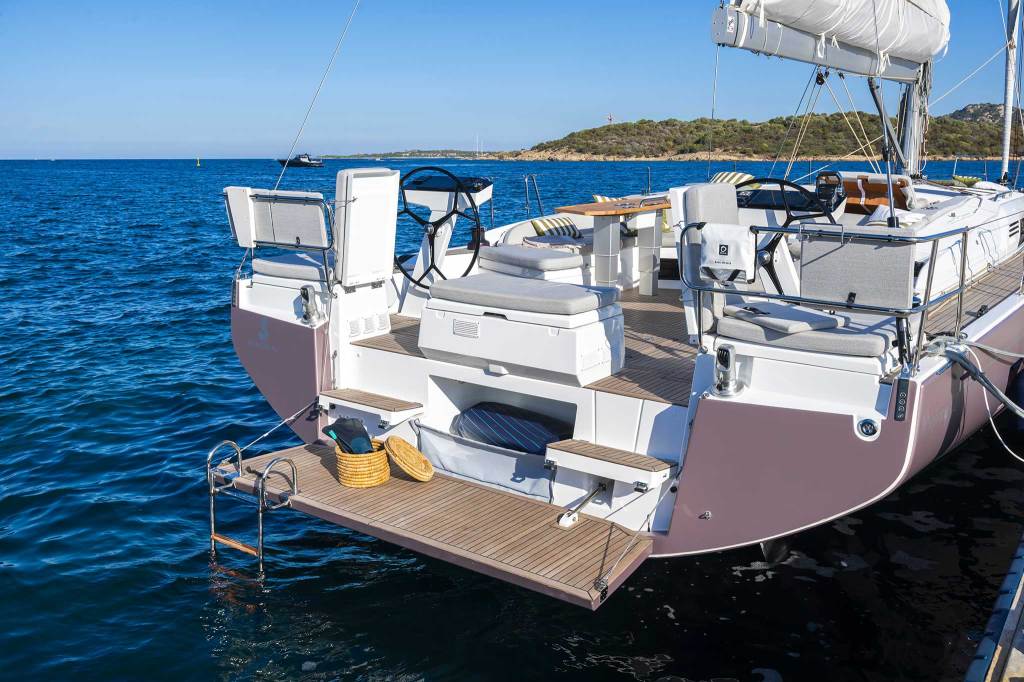
A Roberto Biscontini design, the Oceanis 52 benefited from owner and dealer input resulting in a massive cockpit that has to be experienced to be appreciated. Beneteau calls it their “diamond cockpit” which is reflective of its shape and it’s 30% more spacious than the one on the 51.1 The diamond is formed by two angular settees, each with a hi/lo table that can be used for dining or lounging when lowered. At the ends of the benches are steps on either side that lead from the cockpit to the side decks. Not only is there no more climbing over the cockpit combing, these steps also provide space for crew to work the winches as described earlier without disturbing anyone in the social section of the cockpit.
The entire aft end of this new Oceanis was elevated in the re-vamp and now has the feel of a superyacht in just 52 feet. The design of the two angled binnacles adds a stylish flare with large dashboards supporting a 12-inch Raymarine MFD, windlass control, winch buttons and the engine throttles up high where they’re most useful. The electric drop transom holds an optional grill and a small drawer fridge and has nicely integrated steps on either side to ascend to the cockpit. Even the space under the dodger was put to use with cushioned lounges that will be fought over by everyone in the family.
One truly odd element is the placement of the fuel fill on the cockpit sole by the starboard wheel. That’s optimistic given that drips and spills happen.
Below, the Oceanis 52 is bursting with thoughtful details packed into an upscale interior. My attention was immediately drawn to the aft-facing navigation desk in the port forward corner backed by a large mirror that brightens the salon. Inboard of this desk and just ahead of the compression post is a tall open cabinet that doubles as a library up top and a bar below. It looks like something you’d find in a house more than on a boat and it immediately makes you feel at home.
To starboard and aft of the dinette, there’s a discreet cabinet that holds the DC panel and the digital switching screen as well as the battery switches and breakers. These are all well-organized and supremely accessible as are the tank manifolds below the cabin sole near the U-shaped galley. No more tearing up the furniture to switch water tanks. Our boat featured a standup refrigerator and freezer, a gimballed three-burner stove, a microwave, a split sink and an optional washer/dryer below the counter. There’s not much more you’d need on an extended cruise and it’s all within arm’s length.
The arrangements on the Oceanis 52 are versatile with three to five cabins available. In the three-cabin owner’s layout, the posh master suite is forward with a split head and twin overhead hatches for lots of light and ventilation. For charter, this area is fitted with two cabins and twin wet heads. Two staterooms and one large head are aft in the standard layout but a pullman cabin can be added so the boat accommodates up to 10. In this charter version, the galley is stretched along the port side replacing the useful nav desk and that lovely bookcase.
The finishes have been upgraded since the preceding .1 series. The choices of upholstery have been enhanced and the textured wood finish on the headboard in the master draws the eye. Copious indirect lighting bathes the interior in a soft white glow and natural light pours in through the many hatches and hull ports. It’s an inviting environment that’s easy to get used to.
Experience is the Key
For the full effect, the Oceanis 52 must be experienced in person because no brochure nor video brings this design to life quite like helming her or lounging in her marvelous cockpit. She’s agile and easily managed under sail and every bit the flagship needed to unseat the previous queen.
- LOA 53’ 5”
- LWL 48’ 2”
- Beam 15’ 11”
- Draft 6’ 4” or 7’ 9”
- Displacement 31,905 lbs
- Sail area 1,453 sq ft
- Engine 110-hp diesel
- Fuel/Water 53 gallons/111 gallons
- Designer Roberto Biscontini
- Builder Groupe Beneteau
This article was originally published in the August/September 2026 issue.