In the wake of several recent incidents, the Cruising Club of America (CCA), in partnership with US Sailing and the Bermuda Race Foundation, has conducted a study of yacht-to-yacht crew rescues, including best practices should you ever find yourself on either end of one such rescue.
The investigative body included a six-person committee composed of CCA members, US Sailing leadership, Safety at Sea instructors, and sailors involved in rescue incidents—chair William Strassberg, MD, review team leader Ernest Godshalk III, Chuck Hawley, Bob Kostyla, Ralph Naranjo, and Richard York—plus a review team for a broader perspective—Alistair Hackett, Melanie Peasey, and John Winder. The report, which is over 60 pages long, is worth a read in its entirety, but the following is the investigative committee’s summary of their conclusions: six stages of the rescue and considerations that must be made in each.
Decision-Making Processes
Essential decisions should be made promptly at various points as the yacht-to-yacht crew rescue unfolds. The first is whether and when to issue an emergency call. Circumstances and specifics will determine the pace of decision making and whether time is available for assessment, damage control, and self-rescue options, or whether to abandon. A vessel hearing a distress call will need to decide whether to assist, taking into account whether the responding vessel or her crew would be at unacceptable risk in rendering assistance. The skippers of the responding vessel and vessel-in-distress should mutually decide on a plan based on the vessel-in-distress’s needs and the manner in which the responding vessel can assist, ranging from standing by, to transferring supplies or gear, or preparing for rescue. The vessel-in-distress skipper must prioritize crew safety when deciding to abandon, which may result in abandoning a vessel that is afloat and could possibly be saved. The responding vessel skipper must decide how to deliver the vessel-in-distress’s crew safely ashore, sometimes including a decision whether to continue racing, if relevant.
Communications and Determining Vessel in Distress Location and Status
Effective communication is essential to a successful rescue. All Emergency Position Indicating Radio Beacons (EPIRBs) and Personal Locator Beacons (PLBs) should be registered with SAR and relevant organizations, as failure to register caused problems in some incidents. Satellite communications or SSB may enable the vessel-in-distress to establish voice communications with the responding vessel or shore-based assets, which may be required as intermediaries. All potential rescue vessels should monitor communications at all times and document emergency communications.
Determine the vessel-in-distress’s location, range, and bearing using a chart plotter, AIS, or a paper chart. A well-functioning VHF will become essential when within range; direct VHF communications between the vessel-in-distress and responding vessel should be established as soon as possible. Flares, or smoke flares for daytime signaling, may assist the responding vessel in locating the vessel-in-distress. Take a handheld VHF, an AIS unit, and PLBs into the life raft, but do not leave them in the life raft after rescue.
Rescue Vessel Response and Vessel-in-Distress Preparations for Rescue
Once the responding vessel decides to render assistance, essential steps include preparing the responding vessel and crew for a rescue, communicating with the vessel-in-distress and SAR assets, and understanding the nature and urgency of the distress. Safety of the responding vessel and vessel-in-distress crew should be paramount. If a rescue is required, agree on a detailed abandonment and rescue plan and communicate it to both crews. Command of the abandonment process should be assumed by a person on scene, usually the responding vessel skipper.
Vessel-in-Distress Abandonment and Rescue Vessel Approach Process
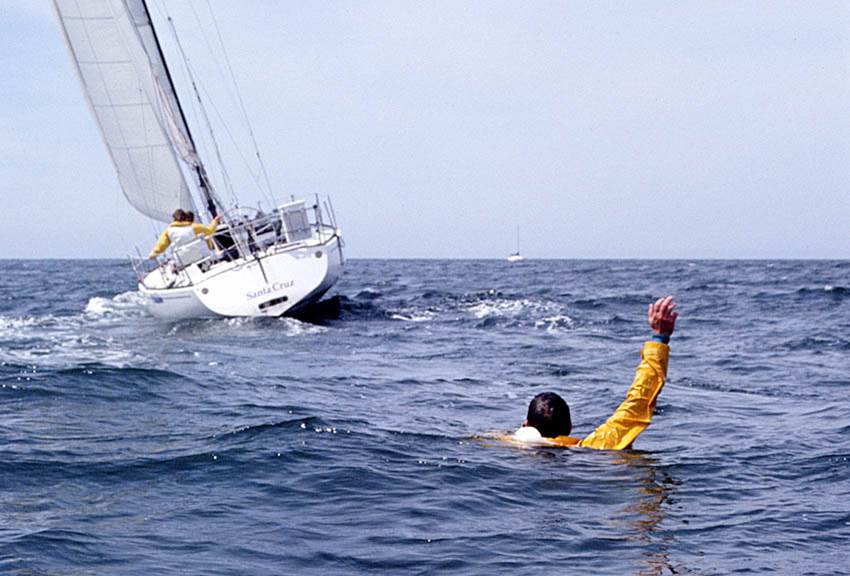
The responding vessel approach and crew transfer pose significant risk to the vessel-in-distress, the responding vessel, and their crews. Primary risks during the responding vessel’s approach include collision, fouling of the responding vessel’s propeller, damage (e.g., accidental jibe) to either vessel while maneuvering, and crew MOB or injury. On the vessel-in-distress, the life raft can be deployed from midships or the stern. A vessel lying beam to the waves and swell will have less stern pitch, and one lying bow to the waves and swell will have less beam roll. The two vessels should develop and agree on a detailed plan for abandonment, responding vessel approach, and transfer. It may be preferable to delay abandonment until daylight or improved weather, if possible, and a decision should be made about whether to leave an EPIRB aboard the vessel-in-distress.
Bringing the Vessel-in-Distress Crew Onboard the Rescue Vessel
In most circumstances, the best method of transferring crew from the vessel-in-distress to the responding vessel is via life raft or dinghy; bringing the vessels alongside or swimming is fraught. High winds or seas can make deploying the life raft difficult. If possible, transfer all crew in one trip. Do not initiate the transfer until the skippers have agreed on the method, timing, and gear to bring to the responding vessel, and crews have been fully briefed. Whether to embark aboard the responding vessel midships or at the stern depends on boat orientation, boat design, and conditions.
A life raft, designed for stability, is extremely difficult to move, placing large loads on the painter in high wind or seas. It may be necessary to use a winch on both the vessel-in-distress and the responding vessel. Life rafts typically lie with the drogue to windward and the entrance to leeward. Bringing the responding vessel alongside the raft may require multiple attempts; making the life raft fast to the responding vessel can be facilitated by using a throwline from the life raft in a leeward-side approach, or by deploying a drift line buoyed by a fender from the responding vessel in a windward-side approach. Ensure that the responding vessel’s propeller is not fouled by any lines; a reconnaissance circle around the life raft at a safe distance to refine the approach and identify hazards is recommended. The embarking vessel-in-distress crew will need assistance in boarding. In most cases, no EPIRB or PLBs should be left in the raft.
Post-Rescue Issues
Embarking the vessel-in-distress crew presents additional challenges. Prompt medical and emotional assessment is paramount, and plans for treatment or evacuation should be made. Contact should be made with SAR organizations and the families of the vessel-in-distress crew. Because the responding vessel will likely not have a life raft large enough for both crews, special attention should be given to the safety of the responding vessel, including the additional stress on responding vessel systems and supplies from the increased crew. The vessel-in-distress skipper should continue to lead the vessel-in-distress crew in following the responding vessel skipper’s instructions. The responding vessel skipper should give clear instructions on the roles of the vessel-in-distress crew, especially if the responding vessel continues racing or proceeds to its next planned port. The responding vessel skipper should determine when and where to disembark the vessel-in-distress crew.
For the full report, which includes recommendations, incident reviews, and more, visit cruisingclub.org/news/yacht-yacht-rescue-report.
The Cruising Club of America is a collection of 1,400 ocean sailors with extensive offshore seamanship, command experience, and a shared passion for making adventurous use of the seas. Their experiences and expertise make them, collectively, one of the most reliable sources of information on offshore sailing.