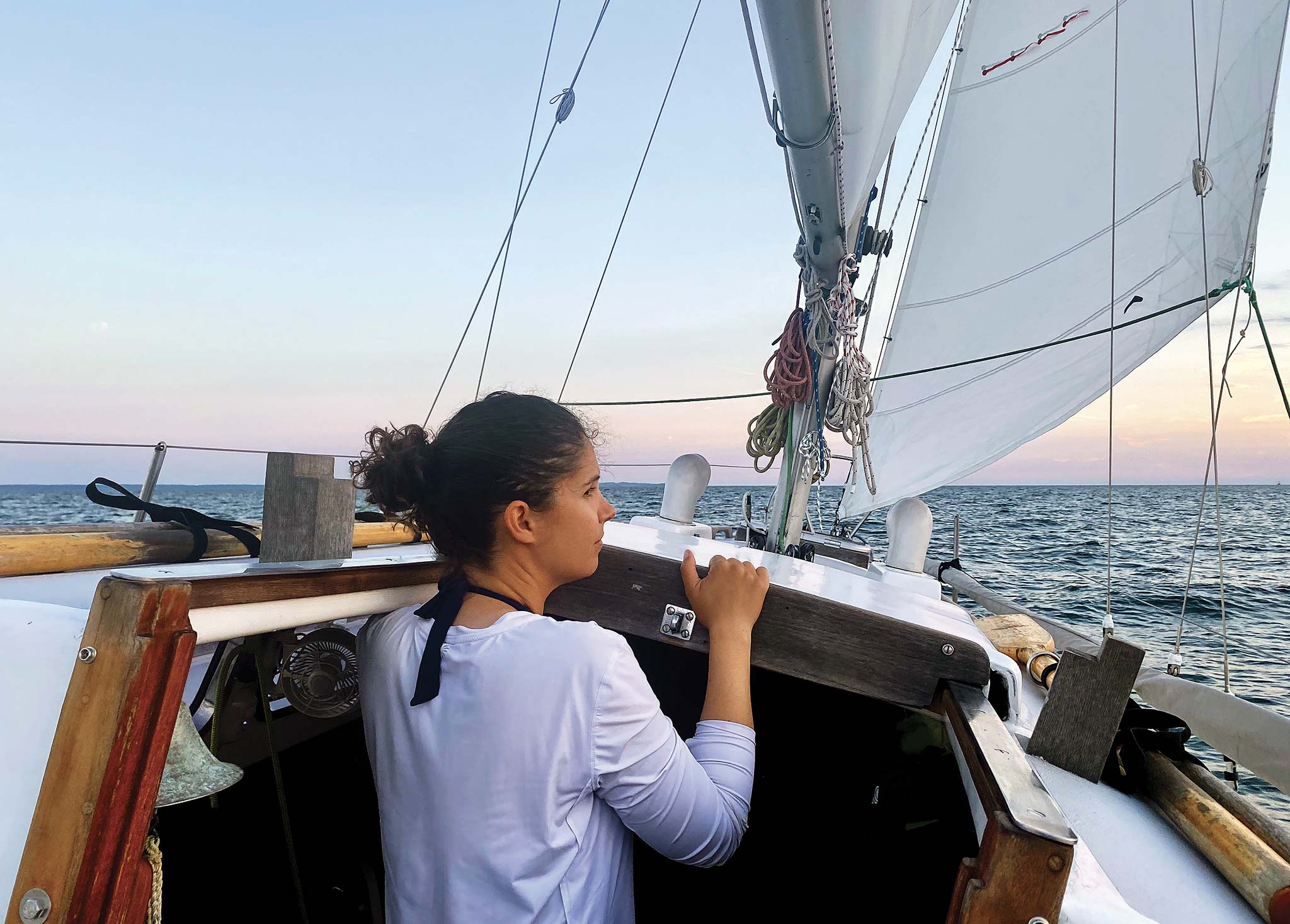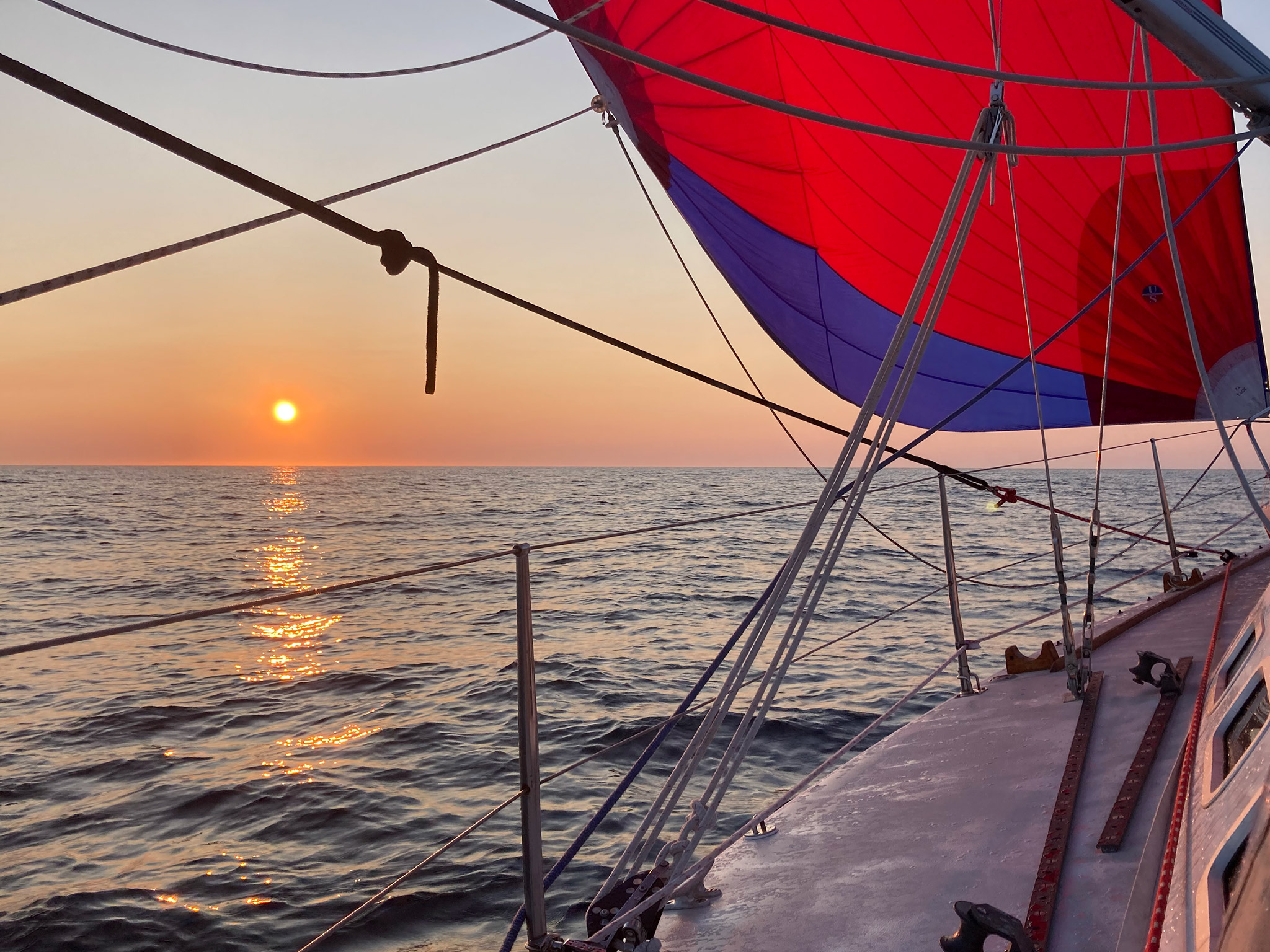
I just ducked out of Road Town, Tortola, after dropping off my girlfriend to catch a series of flights back to the States. It was late in the day, I was now singlehanded, and I wanted a quiet and cozy spot to tuck into for the evening. The trades set up a beautiful 4-mile reach south to Peter Island where there is a well-protected harbor on the north side of the island: Great Harbour. Easy decision.
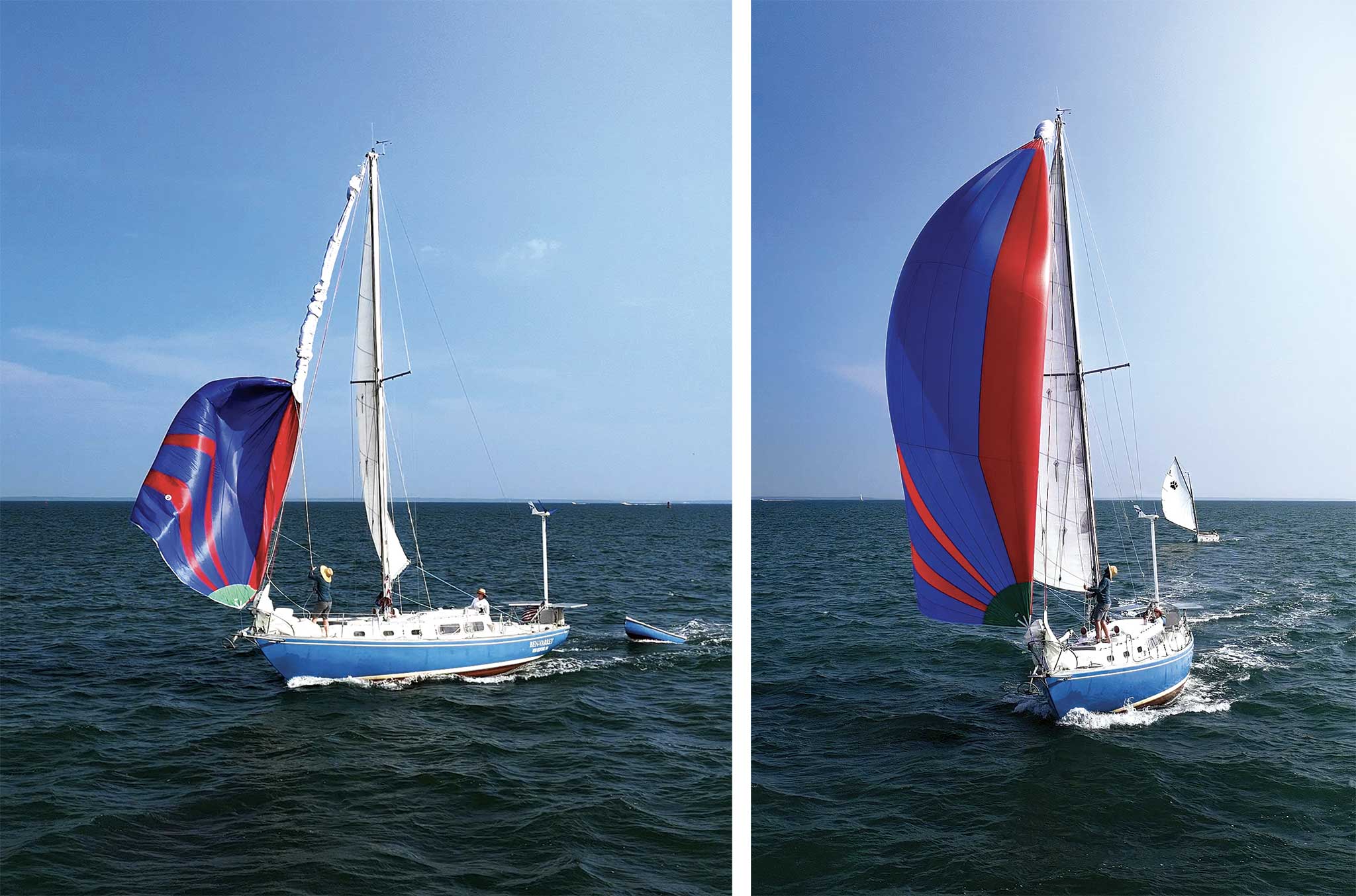
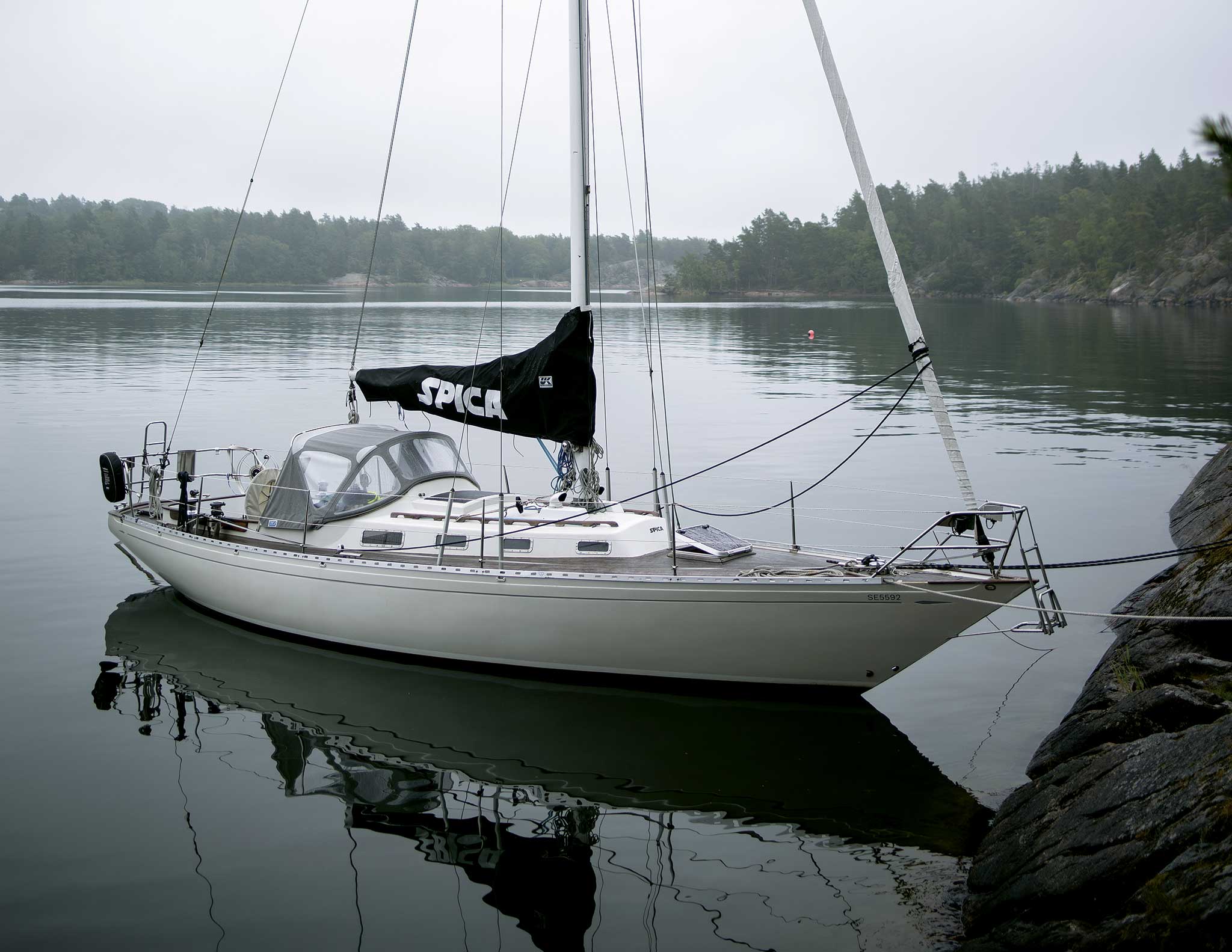
In a little over half an hour, I hardened up around Great Harbour Point and could see only a couple other boats anchored. A nice lift caught Ben-Varrey, my Luders 33, quickly followed by a header, then another lift. A series of puffs and lulls worked their way into that sequence too. I engaged my autopilot and shortened sail early, dropping Ben-Varrey’s jib, then prepped the anchor windlass and took the safety line off the anchor.
Back at the helm, and with two tacks, I squiggled Ben-Varrey upwind to a nice sandy patch in flat water. I brought her head to wind, released the main halyard, and let the anchor drop. The chain clanked out to 4:1 scope as Ben-Varrey drifted back. I’m typically moving into cleanup mode next, where I’ll let her settle in before setting the snubber and final scope, but something already wasn’t quite right. I was drifting back over the anchor and the breeze was blowing over the transom.
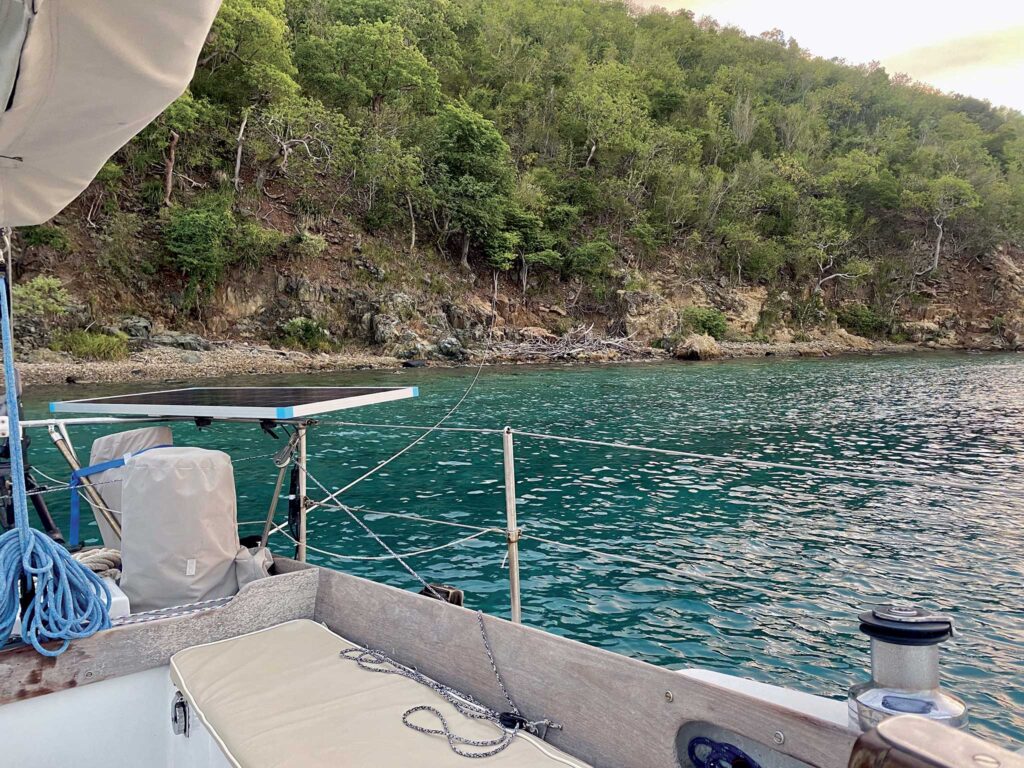
The steep hills that protect this anchorage from the east also cause the wind to swirl. Ben-Varrey would be dancing around her anchor all night, putting her within striking distance of other swinging boats as the harbor filled up.
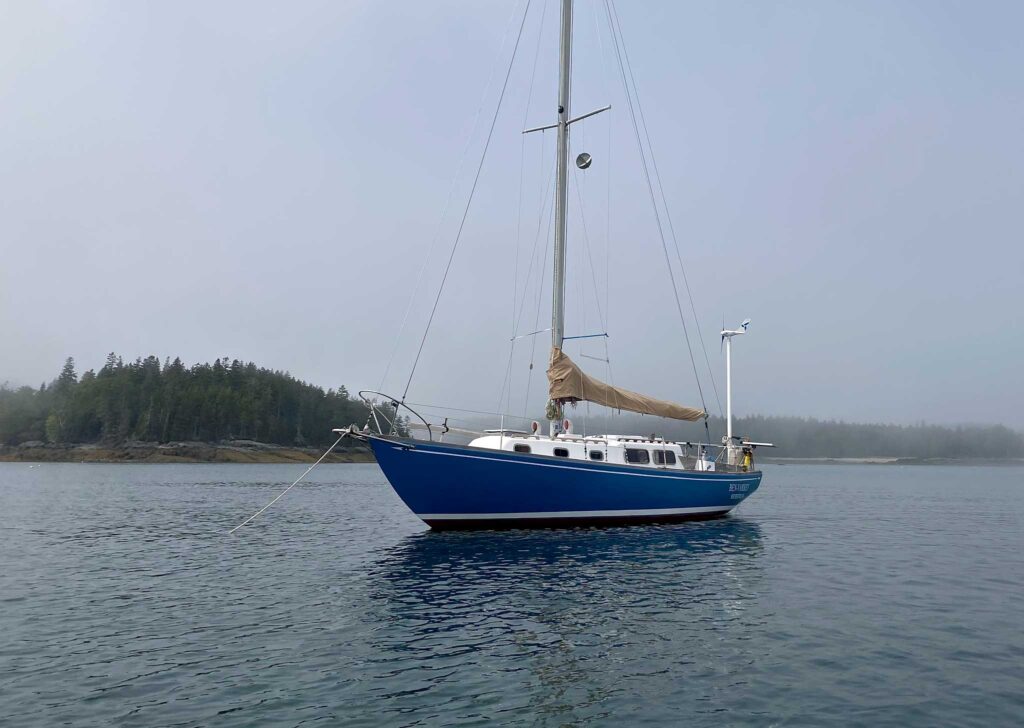
The solution was quick to implement. I rowed my warping line ashore, making sure to dodge the sea urchins as I stepped out of the dinghy, and tied it, adding some chafing gear, to a solid tree ashore. The other end, I made fast to a stern cleat on Ben-Varrey. The dramatic boat movement transformed into nothing more than a gentle sway, and I was ready to enjoy a quiet evening.
Anchoring is different every time, even if it’s in the same harbor. Variables, from wind and current to tidal range and congestion, are ready to add challenges. The ability to anchor creatively opens possibilities in beautiful places, like Great Harbour. It’s also kept me out of trouble when I’ve been waiting for the wind to fill or have just been in need of some rest.
Creative anchoring starts with reliable equipment. I’ll defer on the anchor debate but will note that I’ve found the styles built by Mantus Marine and Rocna to be exceptionally versatile and trustworthy. I’ve also never been caught by surprise with my primary anchor sized as a storm anchor. As for rode, I’ve had equal holding success with all chain and combination rodes, but have ultimately found that ideally you match surrounding boats, otherwise the different swing patterns cause issues; that suggests all chain. Secondary anchors, extra rodes, and spare cordage are encouraged here and add to an arsenal of possibilities.
Before dropping the hook, some light research and observation is advised: bottom conditions and profile, depth, tide swing, present and forecast wind, current, and obstructions, are all factors to consider. The following scenarios lay out combinations of these factors and provide approaches to solve the challenges.
Disagreement Between Wind and Current
Wind opposing current is one of the more challenging situations to handle. And, more than likely, the wind and current are actually at some skewed angle to each other, causing further confusion. Observation of already anchored boats doesn’t help much, as the varying above and below water profiles will cause different positioning and movement (a full keel monohull is likely to sit entirely different from a shallow draft multihull). And where are their anchors anyway? At the very least, a chaotic-looking anchorage is a hint to be cautious.
Start by giving other boats plenty of space—it eliminates any guesswork. If current is running through an anchorage, with rare exception it will eventually reverse. This means full swing clearance should be provided since each boat will perform its own dance.
To paint a better picture of where a boat will initially lay to an anchor, come to a complete stop nearby the desired anchor location. Then drift with the wind and current. Observe the change in position by using bearing points on land or a chartplotter. The course traveled indicates the approximate direction a boat will lie to an anchor (but not necessarily the direction it will point). The reciprocal of this course also indicates the preferred approach route to drop anchor. Once the anchor rode feels tension, the boat’s position may shift slightly based on lift created over the below and above water shapes. There is always the possibility of some strangeness (likely caused by mermaids).
In the case this exercise isn’t practical, approach from downcurrent or downwind, whichever is the perceived stronger factor. Standby as the boat settles and be prepared for a second attempt if the positioning isn’t comfortable–this is the empirical approach.
Under sail, with the exception of extreme current, I find it easiest to approach from a leeward position and take into account the expected current drift to reach a target drop point. The anchor rode will not lead straight off the bow as it is eased out, but the mainsail can be dropped cleanly, if you’re prompt, and the boat will turn appropriately in time.
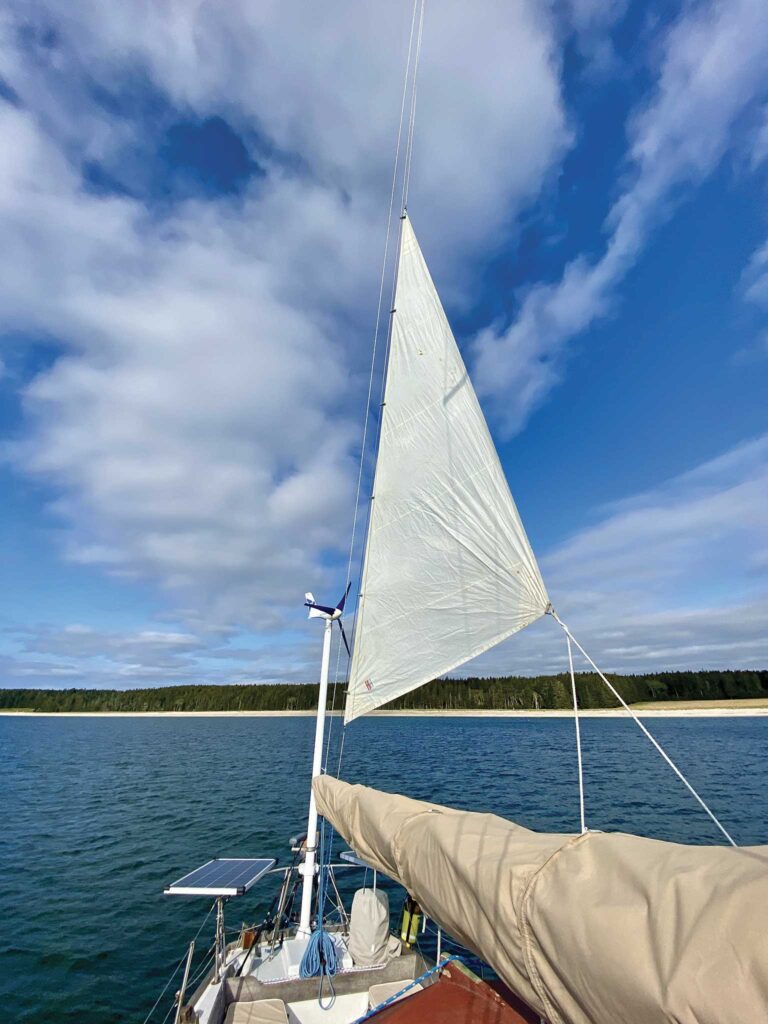
The real creativity in these situations is getting the boat to point somewhat into the wind for good ventilation and a comfortable motion. A yawl is simple—hoist the mizzen—but even a sloop rig can take a similar approach. I’ve hanked a storm jib onto my backstay, sheeted forward, to create the same effect. A dedicated riding sail is the ideal setup. Locking off the rudder at a different angle can also help correct heading.
In a narrow cut, with overriding current, a Bahamian moor can be used—a technique that calls for two anchors and limits the shift in position from current change. But I’d use this method sparingly for these reasons: It takes time to deploy and retrieve, and if not set up properly the rode can wrap around the keel. It can also create a mess (and tension with your neighbors) if the boats around you are traditionally anchored and swinging on their rodes, while you are not. Lean towards simplicity when possible and remember the importance of a dependable primary anchor that resets quickly.
If you do choose to Bahamian moor, first set the primary anchor, letting the boat fall back with the current. Then ease out the anchor rode to twice the desired scope. Drop a second anchor and pull back up on the primary anchor to halfway between the two anchors, easing out scope on the secondary. Secure the secondary rode to the primary rode (a soft shackle works for chain to chain and a secure hitch for rope to chain). Lastly, ease the primary rode until the secondary rode is pulled underwater and clear of the keel; set the snubber.
Swell on the Beam
Ocean swells can bend around the coast, and when on the beam can render an anchorage untenable. Facing the bow into the swell can make all the difference. A second anchor may be an option, but there is a more straightforward approach: a bridle.
Secure a line to the anchor rode, just as you would a snubber. The greater the angle difference between the wind and the swell, the farther this line will need to be secured down the rode. Run this line entirely outboard and through an aft block and to a winch (or directly through an aft chock and cleat for lower loads). Tension the line until the boat points into the swell. Depending on the swell direction, the bridle will either need to be set to port or starboard. The anchor load is now shared between the snubber off the bow and this secondary bridle line.
Tight Spots
Sand or marshland on either side of a tight cove isn’t too worrisome, but when the shoreline is rocky, there is more cause for concern. Take Damariscove Harbor in Maine, for example. It’s more of a narrow inlet than a harbor at roughly 250 feet wide. I’ve also found myself between a rockpile and a hard coast along the Inside Passage of British Columbia with about 120 feet of width.
Consistent wind or current can mostly keep us out of trouble, and other times these anchorages just aren’t safe. For security in the good times, a second anchor off the transom is a quick addition and can be added by falling back from the primary anchor, dropping the second anchor, and then coming back up on the primary. The secondary can also be set with a dinghy if swinging under more scope poses a risk. The boat is now limited in its ability to swing. A benefit of this arrangement is that the second anchor can quickly be cast off with a fender and retrieved later if there is a sudden problem. Watch out for others anchored astern or this arrangement can also make for some wonderful tangles.
If there are hardpoints ashore, take note from the opening story on Peter Island: running lines ashore is an alternative to a second anchor. Make sure to protect the bark when using trees.
Rafting
Surely the easiest approach is to let someone else anchor for us? Anchored in Cuttyhunk’s outer harbor on our own, I once awoke to a strange creaking noise and a boat pinned perpendicular to our bow. Fortunately, our anchor held and our chain kept the uninvited guest off of Ben-Varrey.
As they drifted off, with a bit of persuasion, their anchor rode was hanging nearly straight down, indicating little to no scope in a basin where the depth is reasonably consistent. To raft correctly, ensure you are invited, and then prevent damage by making certain conditions are calm, there is an adequate amount of fendering, and the masts are not lined up (to stop them from hitting from something as small as a wake). A single anchor prevents tangles, but make sure to have an oversized anchor, plenty of scope, and excessive swing room. And, unlike my encounter, have adequate clothing nearby your bunk to handle any late night issues on deck—I found that August night in New England to be cool in just my underwear!
Thinking back to that initial anchorage off Peter Island…that girlfriend I dropped off in Tortola is now my wife. We’ve continued to tackle interesting anchoring situations on our own and together, but we’ve never stopped learning. In some cases, we’ve abandoned anchorages altogether—the tradeoffs don’t always add up. We’ve also discovered some gorgeous spots because we were curious and willing to try new techniques.
June/July 2025