The Maverick asks a useful question: how are people actually spending time on the water? Increasingly, finding a versatile, low maintenance, and fun option is the priority. That certainly isn’t to say there’s no room in the small boat market for a beautifully varnished wooden daysailer, but it’s a different target audience, and plastic boats have made strides in design and sailing capability.
The Maverick is, at its core, a fun boat. It’s a transformer. Let’s say you have a lakefront house. Your partner wants to take advantage of the morning calm with a paddle on a SUP. You prefer to wait for the breeze and go sailing. Your kid wants to learn to windsurf. You can fill up the garage with everyone’s toys and accessories, or you can get it all in one lime green package.
Designed by Daniele Vitalli, who also created the Open Bic (now Open Skiff), the Maverick is five boats in one, with two “traditional” sailing set ups (one regular and one larger square-topped main), a windsurfer sail, a wingfoil sail, and a SUP paddle. All sails are Dacron. The manufacturer says that the boat will handle in up to 20 knots and beyond that it’s “up to the skill of the sailor.” The smaller 53-square foot sail can be reefed by rolling it around the mast, but the larger 67-footer cannot because it has battens, necessitating a forecast check before rigging up.
There are slightly different recommendations for how much weight the boat can optimally handle given its different uses, but it’s roughly an adult and a child or two teens. The spars are aluminum and the hull weighs less than 100lbs, making it light enough for easy transport. It can also be transported on top of a car if needed. The hull is solid polyethylene, which needs next to no maintenance and is damage resistant whether it’s being beached, bumped, or dragged ashore.
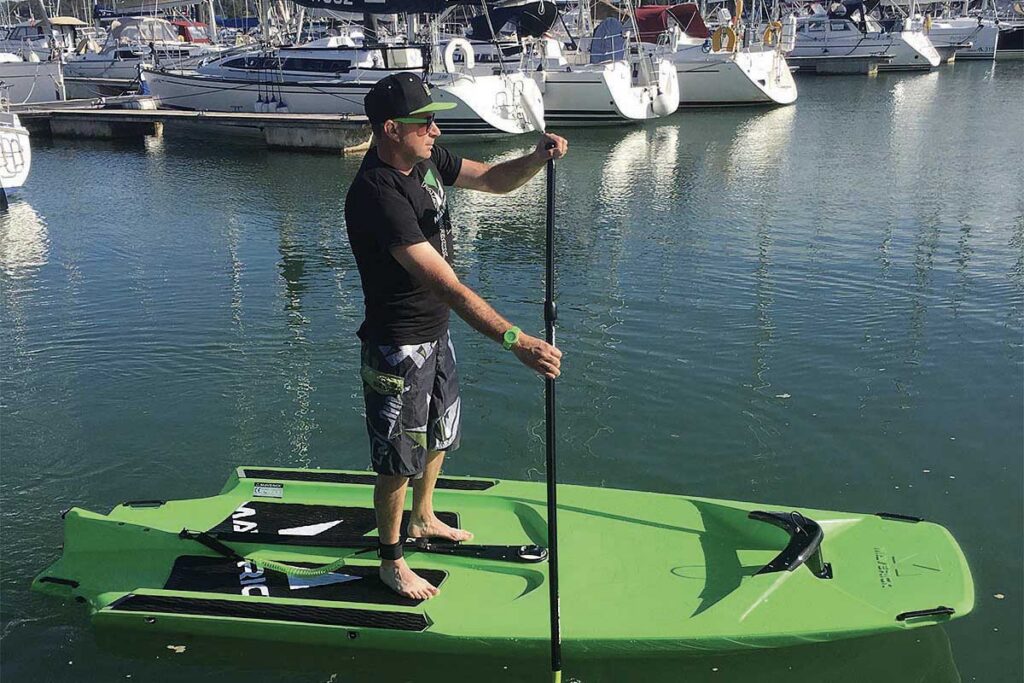
The boat can “transform“ into five different propulsion modes, including use as a SUP.
Photo courtesy of Maverick
According to the manufacturer, it can be rigged in five minutes, but on test-day, it took several times that so I can’t confirm. In fairness, test-day almost always features a few sleep-deprived sales reps and a boat that’s so fresh from the factory it still needs some assembly. Add in a reviewer taking notes while breathing down their necks, and it’s usually just about the slowest the boat will ever be rigged. So while I can’t confirm that rigging in five minutes is possible, I can pretty much promise it’ll never take more than a half an hour.
Is it a svelte and perfectly engineered sailing machine? No. There are always compromises, especially when designing a hull that is generalized towards multiple uses. But with that caveat out of the way, I will say that I was very impressed with its genuine sailing capability.
With inflatable perches to get the skipper up and out of the boat for hiking and visibility, it compensated well for the fact that the hull is essentially a glorified SUP, less than 10 inches deep. Reaching was fast and sporty, and though the tacks were a little clumsy, my own fumbling was at least partially to blame for that. I tested with the square-topped main, and the boat was well canvased for its weight. I felt that the acceleration was excellent. The blade grip was good and proportional to the sails, and the tiller weight was manageable enough that children could certainly handle it. I envision them being popular at summer camps, vacation rentals, and with private owners who have waterfront property.
The Maverick is not going to become an Olympic class any time soon, but if you’re looking for a ILCA, buy an ILCA. That’s not the point here. The point is to get more people out on the water, enjoying themselves in a fun and sporty way and maybe even trying out a new way to harness the wind. And personally, I think the Maverick accomplishes all of that beautifully.—LM
- LOA 10’10”
- Beam 3’ 11” (without tubes) 4’ 4” (with tubes)
- Draft 9”
- Displacement 95lbs
- Sail Area 53sq ft (standard) 67sq ft (sport)
This article was originally published in the June 2026 issue.