Adam Cove and I headed back down to Newport after this year’s boat show to catch the Storm team before they headed south to show off their new boat to yet another curious crowd. As newcomers to the market, they had put out a prototype last year, and this year launched a revamped model, the Storm 18.
It was a warm, bright September morning though we could’ve used a touch more breeze for ideal test sail weather. I’d estimate we saw a maximum of 7 knots of wind.
Designed by Bob Ames, the boat itself is an angular day sailer with quite a flat hull making for easy maneuverability around the deck. It was built as a club boat, so racing, teaching, and cruising around are all in the boat’s future.
It’s optimally raced with three people, though there’s plenty of space for an extra person or a handful of kids onboard, which will make for an easy set up when clubs want to put an instructor in with the youth sailors. Also on the learn-to-sail front, the boat only really needs two people to manage the controls, so it’s perfect for getting beginners out on race days. Let them watch during the race and teach them to drive or trim spin on the way in and out, and voilà, the fleet has a new member in no time.
The boat can be set up to fly a symmetric or asymmetric spinnaker, again making for versatile training options. All the control lines for the head sails are led forward and around the mast, which makes for a bit of a spaghetti situation, but they are fairly short and color-standardized so it’s quick to sort out. Plus a neat set of sectioned bags keep the spinnaker where it belongs. The bags are mesh and removable for easy washing or bringing the spinnaker ashore without having to repack it.
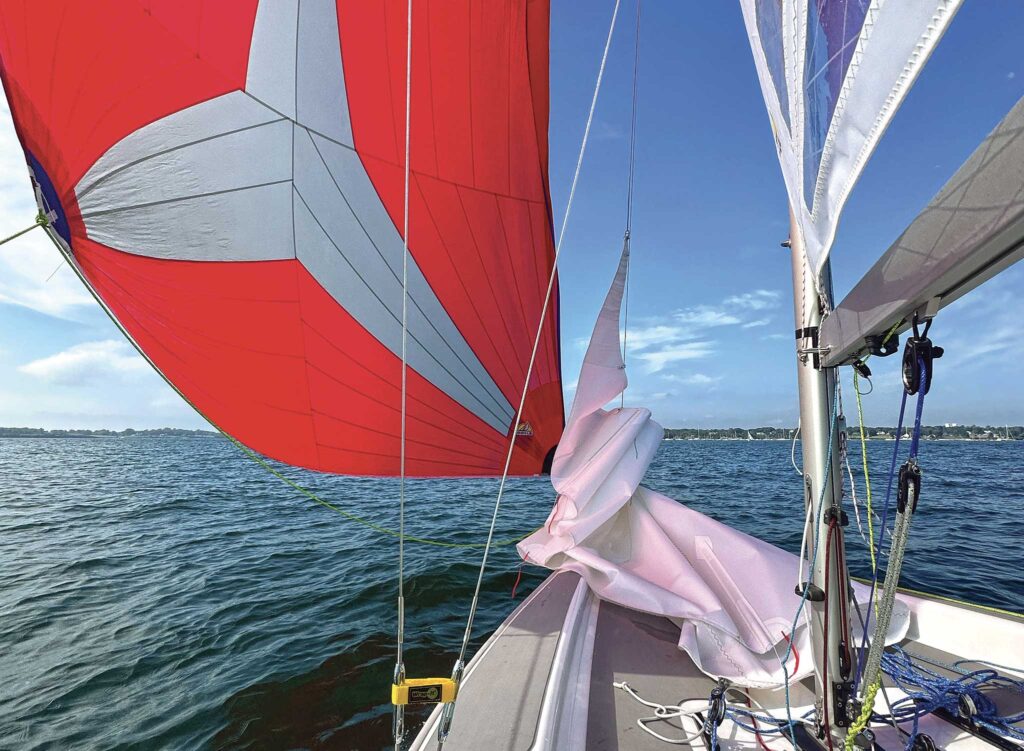
The layout on deck reminded me somewhat of a bigger Club420 at first, but the Storm 18 has a keel and therefore moves quite differently from a dinghy. It’s stable and has the smooth acceleration of a keelboat, though with the light breeze of our test sail, I found myself missing the pep of a dinghy a bit. However, when we crossed the wind shadow of a massive cruise ship, I was glad that the boat continued to glide forward on our previous momentum, happily heading for the next breeze line with scarcely any trouble. The keel also lifts, making the boat trailerable, and the mast can be removed and installed by just one person in a pinch.
The transom has been cut low to make it easy to get people back onboard after a swim (intentional or otherwise), and holes punched out make the cockpit self-draining without an autobailer. The one thing we did notice was that when standing all the way aft, the drainage holes do let in a bit of water, so be careful where you step.
The keel and rudder are slightly oversized, making the boat ultra responsive and able to pivot on a dime—and the Storm team has a heap of broken rudders to show for the design process. In fact, the whole boat is extremely use friendly. The helm is light, and the square top main is designed to twist and spill off breeze if it’s overpowered. The sail area made sense for the displacement, and the boat felt appropriately powered (though again, we didn’t see it in a stiff breeze).The kite and jib can be launched or doused in a matter of seconds.
Two hiking straps add extra security, though Storm co-founder Bill Crane says you probably won’t need them much, they’re more for peace of mind. I personally like being able to get my head far out of the boat when driving, so I quite liked having the option. They’re both forward of the mainsheet, encouraging the skipper to sit in the proper helming position, which is further up than you might have a natural tendency to put yourself. According to Bill, moving the weight fore and aft results in as big of a performance difference as keeping the boat flat would, so it’s really a double benefit.
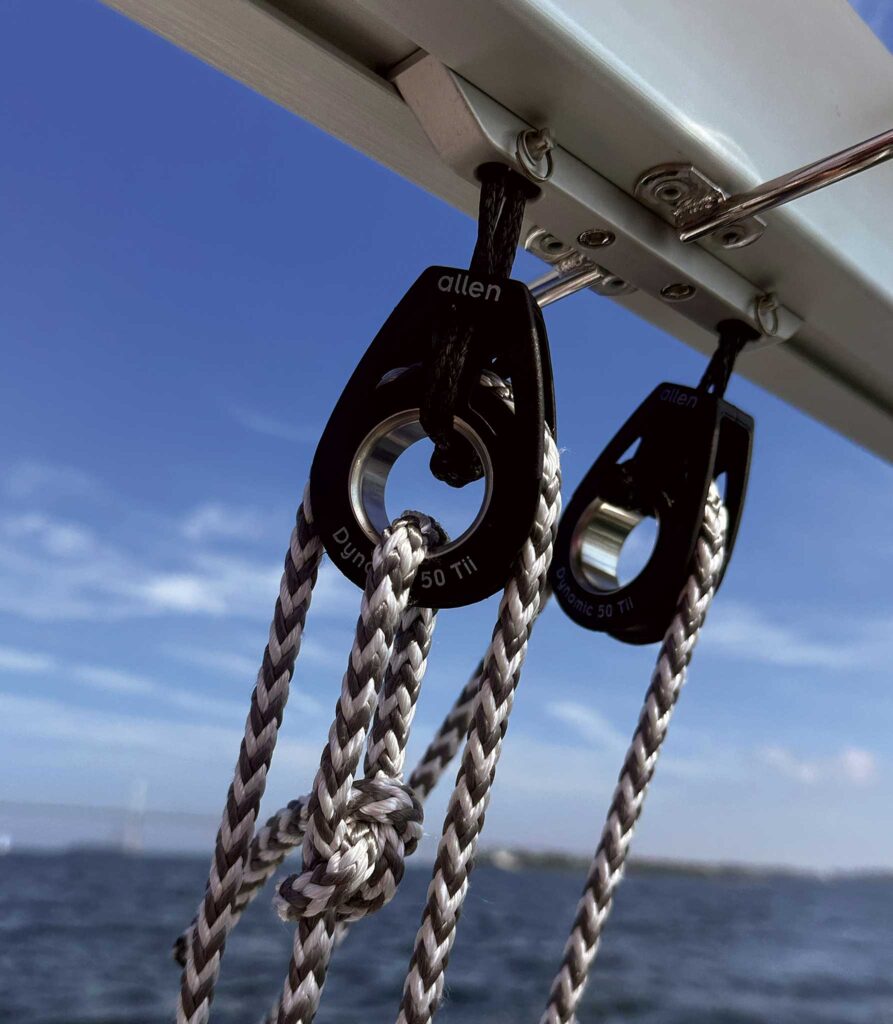
A broad, flat foredeck with SeaDeck makes more space for working on the bow or lounging (I was picturing a dog being very happy up there). It’s out of the way of most of the running lines, though tacking would require any passengers up there to duck. A hatch in the floor opens up to reveal a compartment below for stowing gear, including a paddle or small anchor, which the manufacturer says is sometimes necessary in tidal areas that are prone to light winds. Adam and I both noted that the boat was rigged with lines a little thinner than we might have expected, and Bill acknowledged that it was feedback they’d heard before. But if you like the feel of something with a little more weight, swapping a few lines out is certainly doable. All the hardware is made by Allen Bros, and the sails are Doyle.
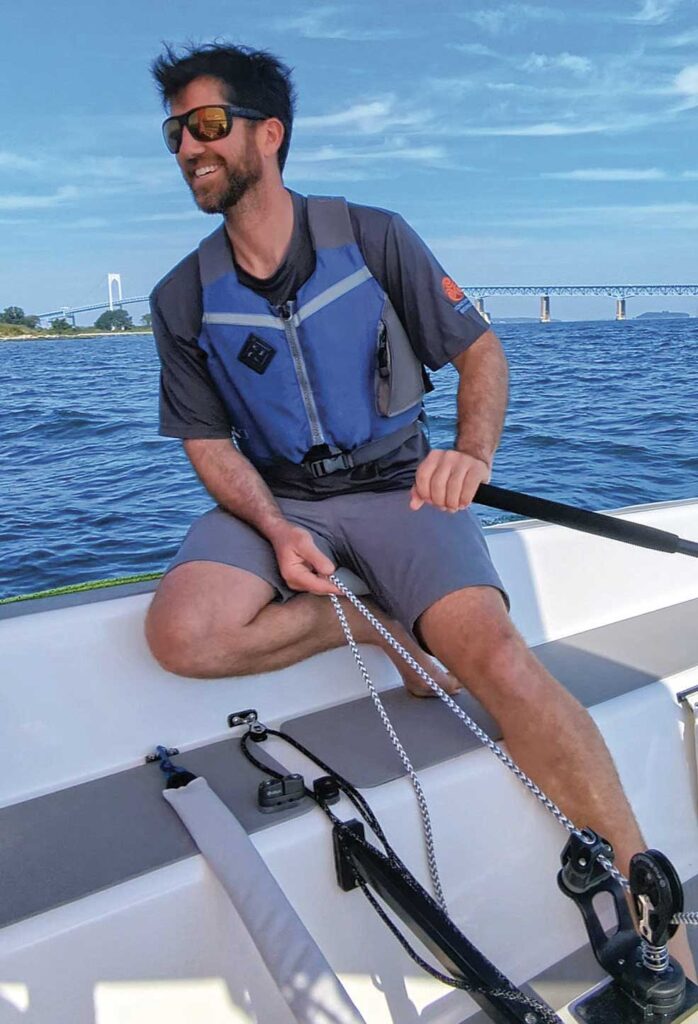
When it was time to go in, we were headed back to the post-show chaos. The docks were midway through being disassembled, so when we were ushered over to a tiny space in between them with barely a boat length and a half to turn up into the wind and stop, I handed the tiller to Bill. There was no way we were getting in there, especially not with the boat’s inclination to glide. To my absolute shock, he expertly spun the boat in a tiny circle and with a little catching help, brought us seamlessly beam-to.
The boat was designed as a club boat, and therefore needs to be easy to learn on, fun to sail, and racing friendly, all of which the Storm 18 pulls off really nicely. It was an extremely friendly boat, and I can perfectly imagine evening races or kids spending long summer afternoons making memories aboard.
LOA 18’6”
Beam 6’10”
Draft 4’1”
Displacement 1,322 lbs
Ballast 655 lbs
Sail Area 206 sq ft
Designer Bob Ames
Manufacturer Storm Marine Group
January/February 2025