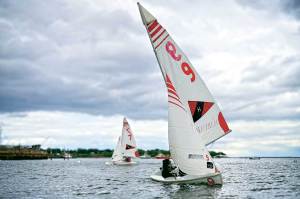
I tied in a reef, reducing the sail area so our 12-foot Barnstable catboat Finn wouldn’t have too heavy a weather helm in the gusts. I stood in the cockpit, readying myself to jump onto the foredeck to release the mooring line, eyeballing the surroundings once more. The weather conditions were spectacular—temperature in the mid-70s, sky duck-egg blue, wampum-colored clumps of cloud progressing along the northern horizon, air clean and dry, visibility vivid and unlimited. The only hitch was that the wind was gusting to 15 knots out of the northwest—an unusual direction for Buzzards Bay in August.
August 13. A Friday.
My eyes lit on another hitch—the black fangs of rocks exposed by low tide jutting up only a few feet ahead of Finn, right in our path.
I struck on a solution: gain headway fast by cleating off the mainsheet before I let go the mooring. That way I could come about before we reached the rocks.
 Photo courtesy of Craig Moodie
“Cleat the mainsheet before you’re off the mooring?” an inner voice asked. “Are you nuts?”
“You can pull it off,” said another. “You’ll be underway in seconds. Besides, Finn is beamy—stable as an old workboat.”
The wind slackened. My heart whirred. Could I count on Neptune to see me through?
This was it: a lull. I cleated the sheet and vaulted onto the deck. I was still untying the line when the inevitable happened. Another gust hit. I was crouched on the lee side, making the boat list, and the boat rounded into the wind. She heeled over with a jerk, and I jumped up to shift my weight to the windward side, but because the sheet was cleated the sail stayed stiff, taking the full force of the gust instead of luffing. The starboard rail tipped higher. I felt myself sliding.
“Is this happening?” I heard a voice—my voice—say out loud.
It was happening. I slipped off the deck into the water like a seal on a zoo slide.
Surfacing, I was sure I’d lost my glasses, but my bleary eyesight was only the seawater sluicing off my lenses. At first I couldn’t believe I had put the boat on her side. The mast and sail lay flat in the water.
Then I realized what I had to do—and it wasn’t to flog myself for making a greenhorn’s mistake even though I’d been sailing for five decades, Finn for almost two. I swam around to the centerboard sticking out into the water and set my feet on it.
I reached up and grabbed onto the rail to heft backwards to lift the boat with the force of my weight as you would with a Sunfish. But our catboat has a cockpit as big as a jumbo hot tub, and it was already awash in outer Megansett Harbor seawater by the time I made my first attempt. No go.
I retrieved the boom crutch and a cushion that were floating away. Clinging to the coaming, I stuffed them into the submerged compartment beneath the foredeck. I scanned underneath for my two bailers and my hand pump, but I couldn’t see them. I reached underwater to release the sheet, then swam back out so I could drop the sail, so to speak, by tugging it through the water on the horizontal while treading water. Finally I lashed the sail with the sheet and swam around to try to right her a second time.
No go again. I had to try to bail her out, but the water—clear and relatively warm for New England—was washing over the coaming and pouring in through the centerboard trunk, the rudder hole, and the mast hole in the foredeck. She seemed seconds from sinking—and settling on the rippled sand below.
 Photo courtesy of Craig Moodie
But when I leaned my whole weight on the starboard side, I could get the coaming far enough out of the water so no more water sloshed in. If the wind had been blowing southwest, the way it usually does in the summer, waves would have been fighting each other to be first to climb in. The northerly wind, today’s nemesis though it was, broke up over the landmass beyond, and the water was only scalloped with wavelets even in the gusts.
In the midst of all my attempts to right our boat, I noticed that the submerged cockpit was thick with translucent bell-shaped organisms—ctenophora, or comb jellies, organisms that don’t sting but glow with bioluminescence at night. They turned our swamped cockpit into a community pool, backstroking while I broke my back trying to save our yachtlet.
I was heaving back on the rail again when Jay Smith, a fellow catboat sailor and a retired physician in tiptop shape, swam out and grabbed two bailers off his boat, which was moored next to ours.
With the two of us bailing, we finally succeeded in getting enough water out of the boat so the entire bay was no longer pouring into Finn. I liberated my hand pump, crawled into the cockpit, and finished off the job. At last Finn was bobbing gull-like as she usually does.
Don’t ask me how many times I kicked myself for making such a blunder. I still do to this day. I’d done the impossible, or what I thought was impossible: flipped Finn without even leaving the mooring.
But at least I never needed to use the brush and dustpan I’d brought down to clean the cockpit of accumulated sand. After her saltwater bath, our little boat was clean as she has ever been.
Oh, did the old superstition of never setting off on a voyage on a Friday, let alone a Friday the 13th, come into play?
Let’s just say my quick course in capsizing made me realize, no matter which day you’re setting off, never count on Neptune to bail you out of a nutty decision.

January/February 2024