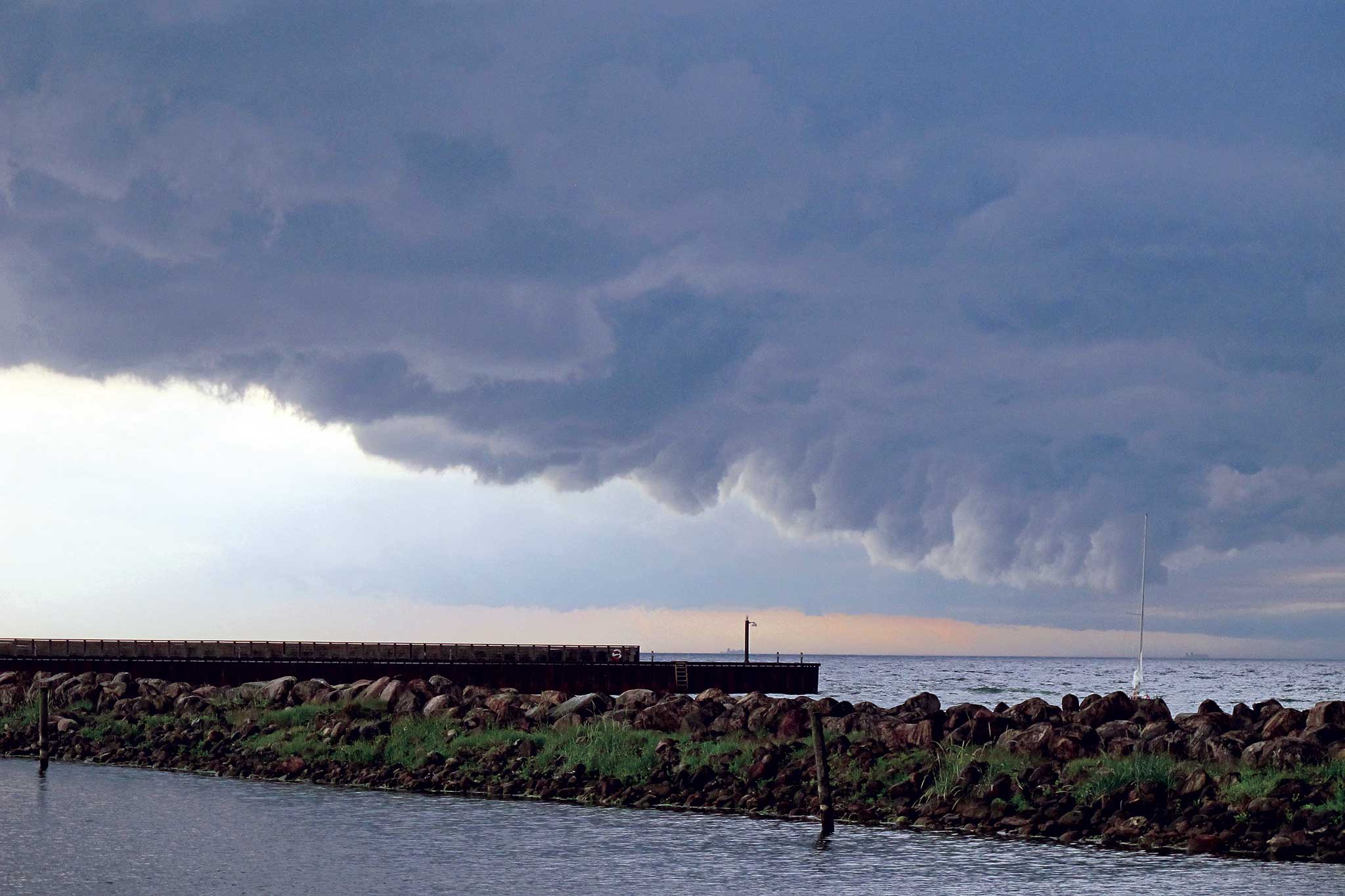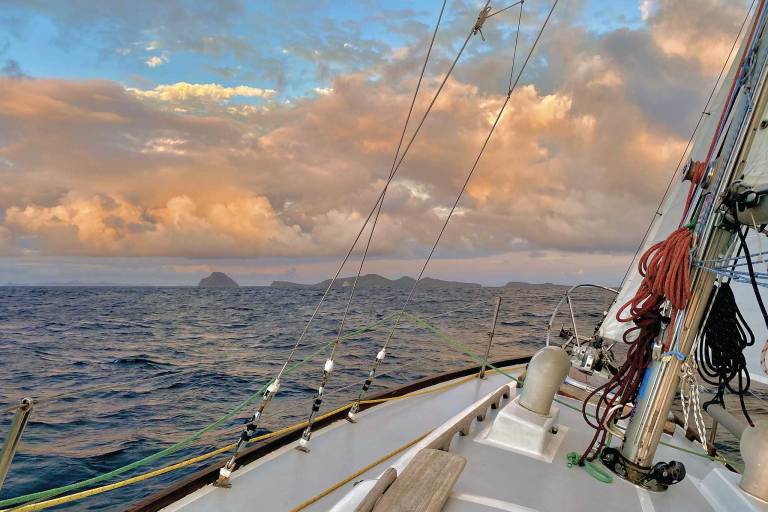
I had way too much sail up, even with a reef. Nearing the northern end of Vancouver Island, the spray was cool as it repeatedly struck me in the face. Short-period waves marked over a third of Wildcat’s length with their height. The close-hauled course for progress to the distant finish line was futile and darkness lay only a couple hours away.
Call it a lapse in judgement—I hadn’t slept much for a few days and had been pushing the boat hard to get north. The conservative move would have been a second reef before leaving Johnstone Strait and facing the full force of the Pacific Ocean. I bet incorrectly that the breeze funneling between the mountains would be more than in open water.
The change in breeze and sea state came on suddenly, the current wasn’t helping, and I was glued to the tiller, working each wave and puff carefully to keep Wildcat on her feet. The goal had shifted from racing to survival, and getting into the lee of a nearby island was my best play.
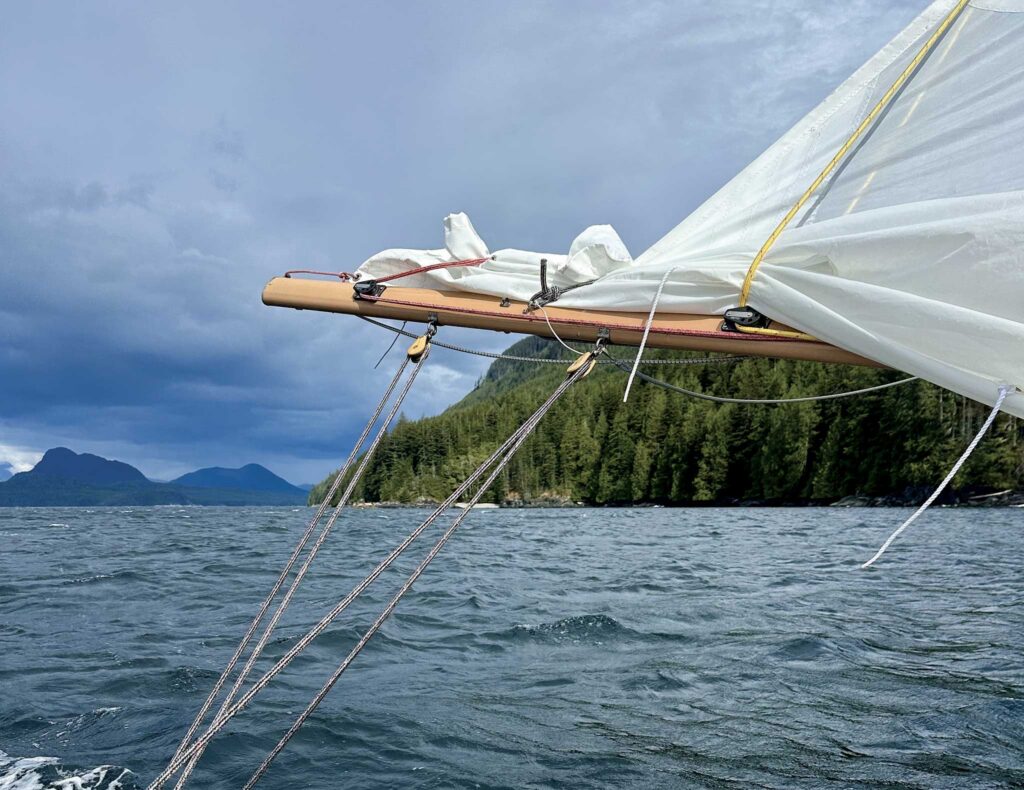
I’ve sailed a handful of boats with gaff rigs, but none for such an extensive distance and across such varied conditions. Still, I had a technique in my toolbox that works well to quickly depower: scandalizing. The gaff (spar that supports the head, or top edge, of a four-sided sail) is hoisted by two halyards: throat and peak. The throat halyard lifts the forward end of the gaff along the mast, and the peak halyard controls the outboard end of the gaff, and therefore, the angle. Slacking the peak halyard leaves just a triangle of working sailing area, much like a trysail.
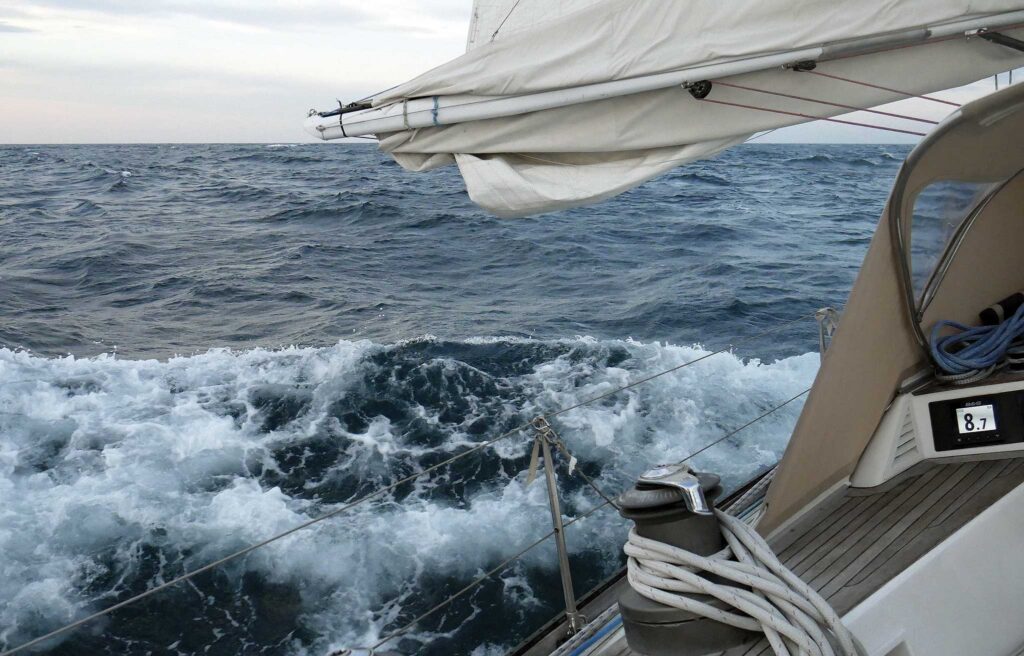
Fully scandalizing the sail would leave me with too little power to maintain momentum in the rough seaway. So I blended this technique with feathering after quickly jumping forward to drop the peak halyard a foot. It allowed me to power up, as needed, without risking heeling so much that the cockpit would take on water over the leeward coaming.
Over the next hour I worked my catboat behind Malcolm Island and then fought my way to weather in a progressively calmer sea. Finally dropping anchor, I watched the sun dip below the horizon, ate a hot meal, and slept to wait out the dangerous conditions.
It’s not the first time I’ve been caught in unexpected breeze, and I doubt it will be the last. While reefing early is the preferred and sustainable approach, there are a few methods to handle these conditions temporarily on any boat:
Feathering
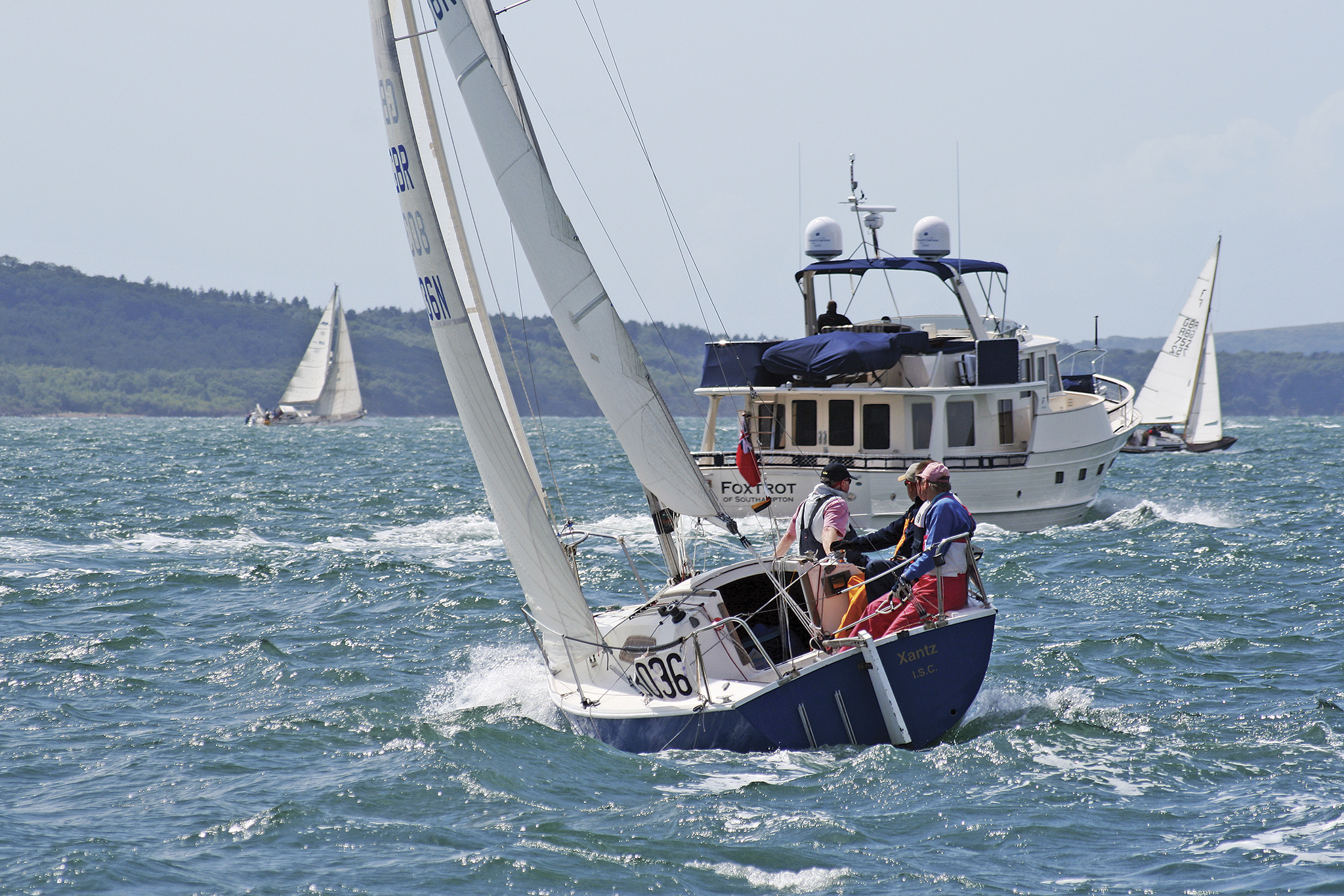
Shifting focus back to more popular sloop and cutter rigs, or actually any rig, feathering is a simple way to reduce power. It’s accomplished by slightly under trimming sails or heading up a few degrees higher. A bubble forms in the luff of the sails. Easing sheets further or heading higher increases the area of this backwinded area in the forward portion of the sails and decreases power even more…taking it too far will mean flogging or getting pushed across head to wind and onto the opposite tack in a heave-to position.
Feathering requires concentration: watching the sails closely and adjusting course precisely to match shifts and puffs. Use the heel angle of the boat as a guide, holding it steady, and altering the degree of feathering—it could be that telltales can be left fully streaming aft in the lulls. Steering this fine line is almost always too much for an autopilot, but with practice it becomes second nature to a helmsman. This skill can be built up by practice in any conditions.
Dropping the Traveler
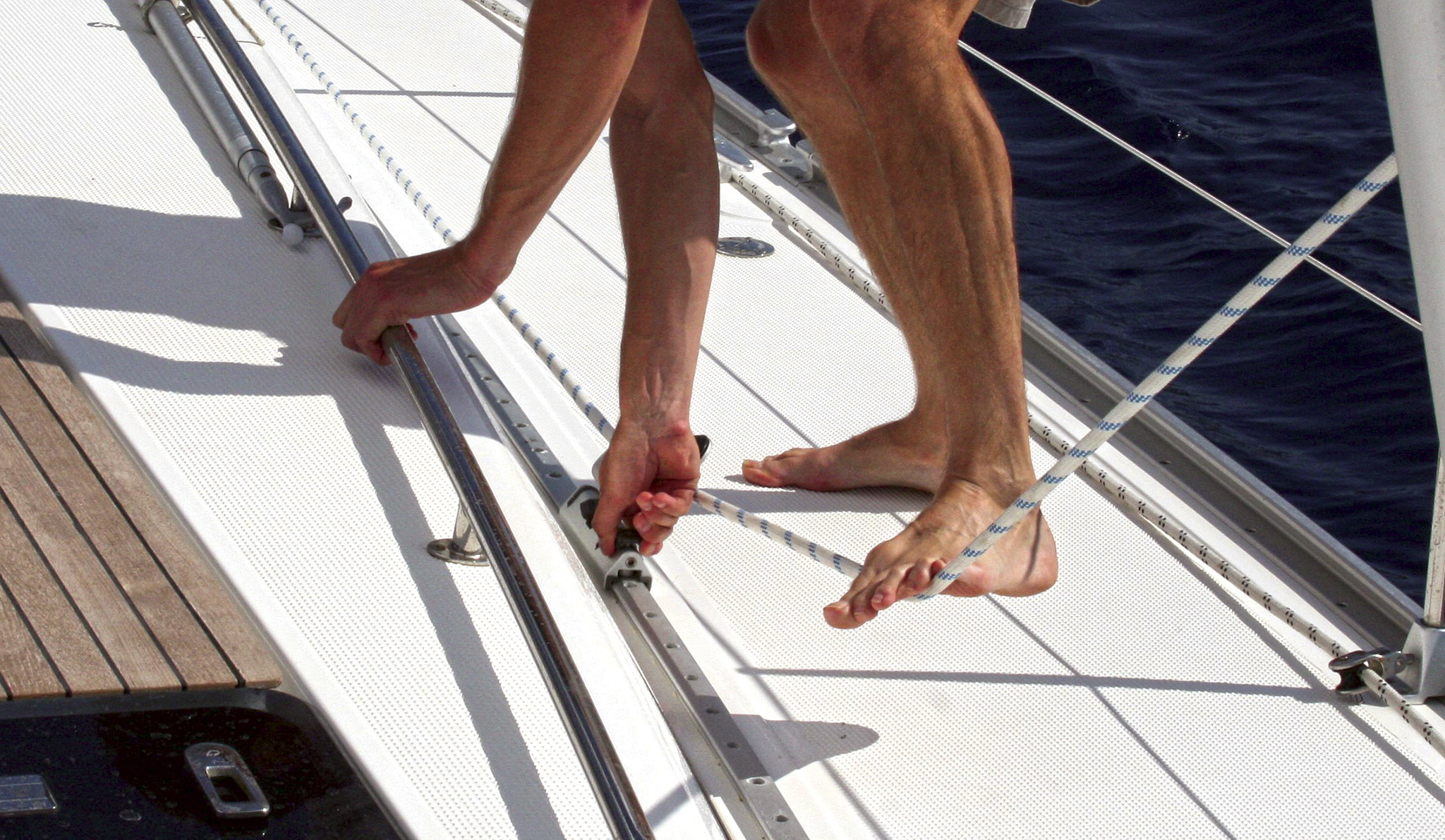
In some sea states, feathering won’t provide enough boat speed to maintain forward momentum. This is especially true for headsail driven boats. Sail area still needs to be sacrificed to gain control, so try dropping the traveler. The headsail can continue to work, while the main is depowered (feathered on its own). If the traveler track is too narrow to be effective, shift to vang-sheeting: a tight boom vang maintains leech tension and the mainsheet is eased to let the boom further outboard. Be cautious of vang-sheeting in large waves. If the end of the boom gets caught in the top of a wave, it can snap the boom at the vang.
Adding Twist
If the main is still too powered up, adding twist will further reduce its power. Ease the mainsheet and vang; the end of the boom will rise and the leech will open up, spilling wind off the upper portion of the sail. The same can be done for the headsail with small eases to the sheet.
Secondary Adjustments
The focus is on depowering methods that can be made quickly from at or near the helm. Boats set up for shorthanded sailing will make this easier, but deck layouts can also be altered to add more flexibility. Quick access to tighten the backstay, cunningham, and outhaul, along with shifting headsail cars aft, would add even more possibilities to depower.
Furling
Although this is a form of reefing, it’s simplicity requires its mention. Partially furling a headsail (if so equipped) may also offer reprieve. The sail shape will be poor, but it’s less canvas. Cutter rigs, depending on where the wind stacks against the bent on inventory, will have a nice advantage here by keeping full sail shapes. The process is bound to cause a racket and be a distraction from controlling the boat, so communication and situational awareness is important before rolling into this maneuver.
Lift the Centerboard
If onboard a boat with a centerboard, consider partially raising it. This reduces the healing moment of the boat (by shortening the distance between the vertical center of effort of the sails and the vertical center of lateral resistance of the underwater body). Added leeway is the tradeoff—be mindful of your new limitations. In cases where the centerboard is extraordinarily heavy, the effects may be negated by the loss in righting moment.
Changing Course
The simplest option to depower may just be changing course. Reaching towards a protected harbor or running off (to decrease the apparent wind) are changes in plans, but may result in a better day on the water. Take time to regroup, change sails, or put in that extra reef that’s needed. In a similar sense, heaving-to can gain a bit of calmer problem-solving time, but can be unwise with excessive headsail area is up.
I set out to write this piece on advanced traditional reefing techniques. Although we could have discussed system improvements over the basics, like layout, the use of low-friction rings and blocks, and high-tech cordage, I concluded that advanced reefing is really in how we can reef more subtly: handling unexpected breeze and pushing ourselves a bit harder. This is far more challenging a task than putting in a reef ahead of time and requires a well-practiced feel. Not to say that reefing early isn’t the seamanlike move, it is, every time. Reefing early is the safer and easier path, and better for the boat. If forecasts were always accurate, this would all be simpler, but they’re not and we need to be ready for the curveballs that mother nature throws at us.