 Photo: Janice Anne Wheeler
Sleeping on a sailboat can be incredibly peaceful and soothing, perfect, really, when waves lap the hull and the gentle roll rocks you into a sense of security. This night, though, the cold wind came up hard, rousing me instantly. Ruefully, I noted that the forecast was remarkably accurate—a front was due around 3 a.m.; my clock read 2:48. The wind had gone from dead calm to 20-plus knots in minutes; stronger gusts whistled through our 65-foot rig as a reminder that we were vulnerable, always vulnerable.
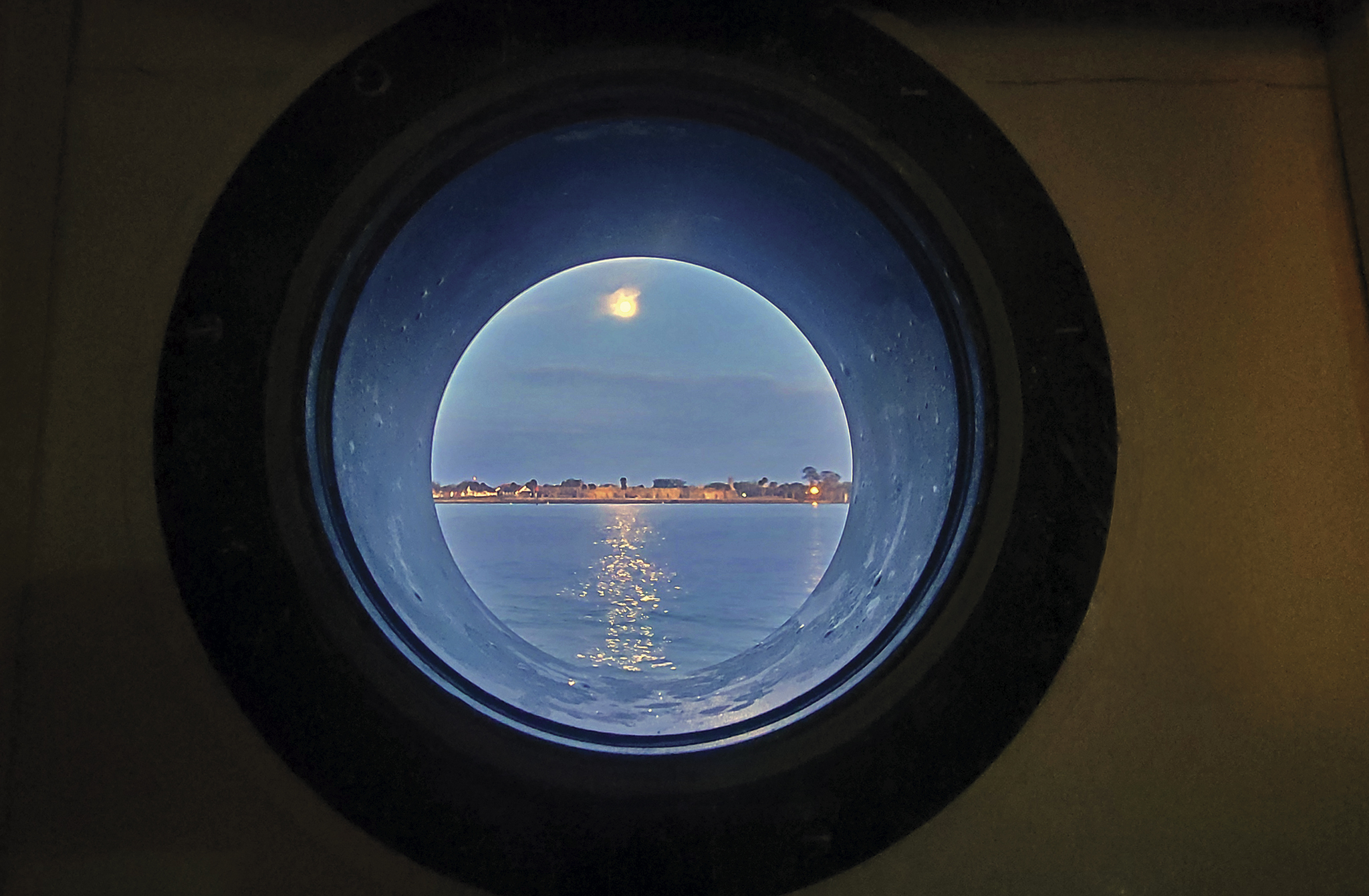
Tucked under three blankets in the aft cabin, with the thick wooden hull of our 56-foot, 1934 William Hand Jr., ketch between me and the elements, I felt safe enough. I was still waiting for my alarm to go off at 4 a.m. to watch a lunar eclipse (Celestial events! So romantic!). I could see the moon reflected disjointedly on the ever-increasing waves; it was still completely full.
I dozed, my face inches from the round bronze port and 2 feet above the waterline. Living on a boat you learn to rest whenever you have the opportunity, no matter what the circumstances may be. We had slept through much worse, or so we thought.
I dozed hard, I suppose; the beeping seemed very far away, much less insistent than when I had last heard it, months ago. And then the adrenaline hit. That insistent beep meant that despite the 400 (or so) pounds of ground tackle we had laid in the Chesapeake Bay mud three days ago, Steadfast was dragging. Stark naked, I mounted the hatchway to the helm. Similarly unclad, my husband, Steve, was already there, transfixed by our AIS anchor watch component. The Etch a Sketch-style screen glowed an eerie whitish-green, telling us that we were 222 feet from the anchor, 72 feet farther than we should have been. We had dragged, but not tremendously far.
And now it held; 218, the electronics told us, then 220. The display was somehow dimly reflected on Steve’s concerned brow. The distance dropped more, 215 feet, 211, then bounced up, then back down in a fairly regular rhythm, what we wanted to see. We dressed, then lingered despite the 40-degree chill and hoped that Steadfast would stay there, that her anchor had locked back into the bottom. High above, the eclipse had begun, the romance of it forgotten, manifesting as a murky shadow partway across the November Beaver Moon by the time I returned to my blankets.
I dozed again, in the same position, always facing the century-old port. The anchor alarm seemed much more urgent the second time. Steve flew out of bed. Seconds later, our big Detroit roared to life, and I knew we were in trouble, grabbed clothes, even put boots on, a rare thing indeed. Without a word, I slid the teak pilothouse door open, lost my breath to a gust of salty, bone-chilling wind, and zig-zagged forward to retrieve the anchor. Bent into the onslaught, off balance in more ways than one, I grabbed the furled jib for support and peered around the bay. The shadow now covered over half the moon as the eclipse spun on.
 Photo: Janice Anne Wheeler
On her high, rolling bow I dropped to my knees under the anchor light and peered over the rail while Steve configured our old-fashioned windlass to retract, and the drifting Steadfast turned her hull side to the wind, heeling over. Everything happened incredibly fast. I chided myself and made a mental note to always re-engage the giant steel gears instead of carelessly leaving them in release mode, regardless of how calm the conditions. It was a step we shouldn’t have had to take.
The boat was sliding backward through the black water at an alarming rate, honestly, and there were no shortcuts here; all steps needed to be taken, in the correct order, to get us to a less dangerous place. We pulled the half-inch chain up just enough to remove the snubber line; precious seconds went by as my stiff fingers struggled with the slippery soft shackle. Released at last, I dropped the line through the hawse pipe and retrieved it over the side. Finally, I pressed the up button, and the windlass protested both the pressure of the wind and the 40 tons of boat with continual creaks and groans. I had heard them before, but never at such volume.
Her hydraulic retrieval system did not falter, and the rugged chain ascended like magic from the water, marching obligingly into the locker below my feet. I am always grateful that Steve is so meticulous about making sure things work every time you need them. We pretended to be calm, but the adrenaline flowed freely. He thought there might have been a small monohull beyond our transom, but neither of us was absolutely sure; if there was one, it was unlit, undetectable, in the failing moonlight.
Long minutes later the 125-pound CQR broke the surface astonishingly mud-free and clanged dutifully onto the starboard bow. I locked it into place with both mechanisms as the wind whipped hair into my eyes and mouth. A raucous wave struck the hull and I stumbled briefly, grabbed the lifeline, and made my way back to the pilothouse, ineffectively wiping at the black gear grease on my cold palm. Our U.S. flag on the stern was straight out, snapping like a firecracker above the intermittent howl of the wind, and it jangled my taut nerves.
That cantankerous diesel came through for us, and we crept forward into the darkness. Our electronics glowed too brightly with all the information they could offer. It wasn’t enough, and I slung the door back, waited for my eyes to readjust, and hoped for a more accurate assessment of what was ahead of us as well as what was behind. We had dragged hundreds of feet, and it took a seemingly interminable amount of time to regain that ground.
When we finally got to where we had first anchored, it was a mutual decision to pull our old wooden girl a little closer to the cluster of anchor lights off our bow. The landmass just beyond them should shelter us from the brunt of the blow that was predicted to worsen—north-northeast, for days. When we arrived, the wind had been light and southerly. Sometimes a 180-degree swing combined with a quick escalation can loosen even a well-dug-in anchor with ample scope.
We searched for the safest spot, handicapped by darkness and weather. I glanced at the anemometer, which careened between 24 and 34 knots. The ghost-like shape of a hull appeared off our port side; we were close enough. “Let her rip,” Steve said, and I ducked into the gale. Windlass mechanisms quickly reversed, black grease on my pantleg this time, the heavy CQR splashed back into 20 feet of rough, brackish water. After the first initial rush it hit bottom, and I willed the anchor to flip over as it should, dig in, and hold. I knelt once again for safety as the bow went up and down like a seesaw. I tried with limited success to hold my light on the color-coded chain as it rattled out of the locker below. At the 150-foot mark I ceased the exodus and flipped the worn steel stop into place. The chain looked powerful and reassuring as Steve tested the set with full throttle reverse. No shimmy, no drag. Locked in.
“Should be 160,” I told him, far above the recommended five-to-seven-times-depth guideline for scope. Only the howling could be heard as we saw the anchor watch agree with my assessment, 160. We held our breaths, and then the reading did what we wanted it to do, dropped to 156, then 152, then 160, the rhythm indicating that she would go back no further. I ventured out one final time to attach the snubber with chafe gear, switched the hulking windlass to retract, and admired the burnt-orange, fully eclipsed moon. I could smell the coffee brewing that would warm my hands and calm my spirit. How ironic that I would have been up anyway and that the moon was full but blocked by our planet when we needed that light the most.
Predawn appeared opposite the eclipse, hiding it in plain sight. The motion of Steadfast was as it should be, the familiar rhythm that puts me to sleep most nights. Seated at the helm, I closed my eyes briefly.
“There is a boat back there!” Steve exclaimed when it was light enough to be sure. My eyes flew open, not really wanting to know that we had endangered someone else as well as ourselves. “We must have come damn close to them. Damn close.” His eyes locked on mine as the realization dawned on both of us with the rising sun.
The pastels brightened as I listened to the continual howl of Mother Nature testing our new rigging just as she tests our resolve. I said nothing else as there was nothing else to say. Pensive but safe, we watched the first gentle rays of sunshine bounce off the water. The golden hour.
“You live on a sailboat!? That looks like fun! And so romantic!” I mimicked to Steve, laughing. He returned my grin, hair and clothes in remarkable disarray. As it turns out, there’s a whole lot of romance in just surviving unscathed to watch another sunrise. Dressed in layers against the fall chill, covered in salt spray with a dash of gear grease, boots still on, I sipped my sweet, strong coffee and felt the heat seep into my veins and gradually, ever so gradually, replace the adrenaline.

June/July 2024