The wind built faster than it was forecasted to. We ate dinner with full sail, close-reaching on a building SSW’ly breeze. Before dark we had two reefs and a partially furled headsail. Ryan, our apprentice, a newly minted Yachtmaster, sharp and calm under pressure, was scheduled to be on the post-dinner evening watch. We didn’t expect the front to pass over us until sometime between 2am and 4am, so Ryan was going to do an extra hour or so so that I could be up when we got the expected big wind shift.
Falken, our Farr 65, was sailing her first passage of 2026, down the Baja Coast from San Diego to Cabo San Lucas in mid-January. For context, we were sailing with 11—eight paying crew plus two professionals and an apprentice—on a 3-on, 6-off rotation. This stretch of coast this time of year is often benign, and in fact for three days we’d had frustratingly light winds. Then, about three-quarters of the way through the passage, a cold front that had been on-again, off-again in the long-term GRIB forecasts materialized, and we were in for a wild night.
Everything happened sooner than we thought and stronger than we thought. Before my first mate—and one of our full-time skippers—Mary came off watch she set the staysail, furled away the yankee, and put the third reef in the main. I went to bed but was pretty anxious, so I didn’t sleep much. Ryan took on the first big squall—just sideways, crazy downpour rain. “You needed a windshield wiper just to see the compass,” one of the crew joked.
When I came up on watch, we had a bit of a lull and decided to jibe. I half expected that maybe we were out of the woods, that it would start to clear behind the front on the NNW’ly wind… nope.
Around 1am, an hour into my watch, we had another huge squall. By then, we had combined the watches from three into two, so we had more people on deck. One person stayed at the nav station to monitor radar and AIS. We had a few ship crossings and a few CPAs at about a mile or so. There was no possible way for us to change course. The wind was howling, blowing well over 40 knots. The sky was so thick that the masthead tricolor light was reflecting green and white light off the rain, creating this eerie glow aloft. You could just make out some of the wave crests—most of which were flattened by the sheets of rain—but otherwise there was zero distinction at all between sea and sky. Falken handled wonderfully, even as we barreled along and hit surfing speeds over 14 knots. The crew did a remarkable job keeping a good course, as the stakes were high. One wrong move and things can go sideways fast—don’t accidentally jibe.
One after another, the heavy squalls continued all through my watch. The sky was teasing us—sometimes between them, a few stars would come out and we’d think it was clearing. I went down around 2:30, then Mary called me up again at about 3:30 to jibe, as we were getting a little too close to some offshore seamounts where the bottom rises up from the abyss. I finally went to sleep and slept like a zombie. It’s so nice having a co-skipper you can 100% fully trust—Mary is very confident, decisive, and just on it—so it was easy to fall asleep.
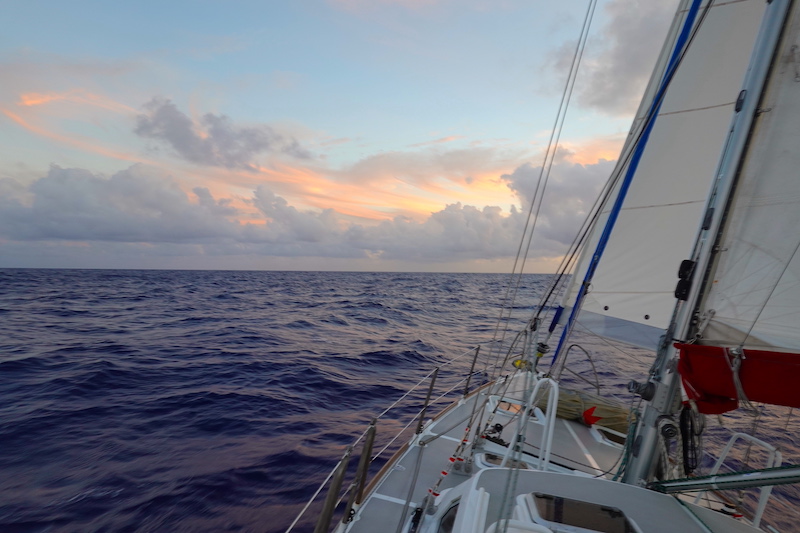
By the time I woke up, the day had broken, the skies had cleared, and the crew had shaken some reefs. Since I’ve been back on watch, Falken was back to full sail. We jibed again and set the pole, and were finally aiming straight for Cabo, 80 miles away.
So, good story? Good seam’nship? We later debriefed that night with the crew and emphasized how easy we made that night feel and that it wasn’t an accident—we knew the weather was coming; we snugged down the boat ahead of time (and before dark); we followed the wind shift; all that was left to do was hang on, drive the boat, and see who could hit the top surfing speed!
Nothing went wrong that night—and that’s exactly why it’s a story worth telling. My kind of sea story.
This article was originally published in the April 2026 issue.