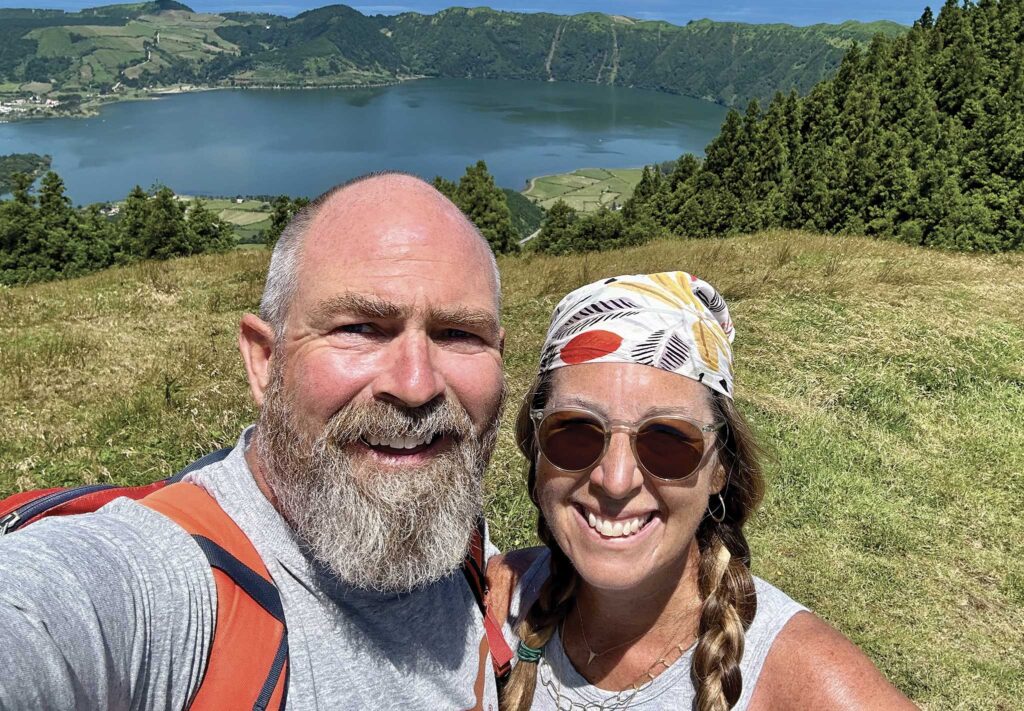
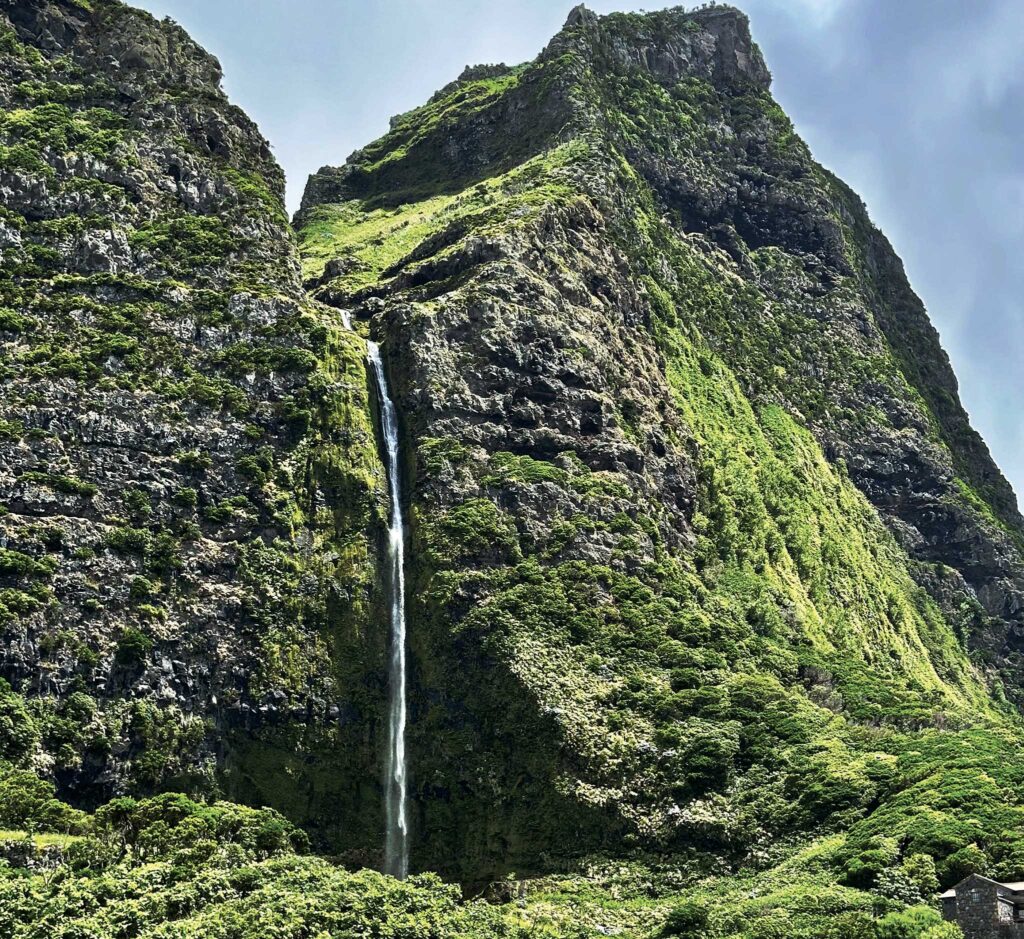
“Alex! Everything is so European-looking here!” I stammered to my wife repeatedly during our first few hours ashore in the Azores. I don’t know why this came as a surprise to me. Flores, the island we made landfall on, is the westernmost point of Europe so we were, in fact, standing on European soil. Maybe my brain was struggling to find a storage slot for the shocking reality of our arrival after sailing across a vast ocean at a slow walking pace. Or maybe the celebratory bottle of champagne we drank for breakfast after rafting up on the harbor wall had left me a little punchy.
Our first long strides ashore in weeks took us up switchback lanes of black and white Portuguese paving stones past rows of (European-looking) houses to a church with a commanding view over the harbor. Planting heel to toe on hard land was euphoric, and there was no stopping those legs of ours. They whisked us beyond town, up steep farm roads between lush cow pastures, to a summit viewing platform. Green fields segmented by rows of blue and white hydrangea sprawled for miles on either side of us, undulating in bright sunshine up over ridges and down into shadowed valleys. It’s always smart to pay attention to animals, and we took our cue from the cattle in the fields. They looked particularly content while grazing and gazing out over the terracotta-roofed villages dotting the foothills below. We joined their stares and were overwhelmed with gratitude for the blue sea shooting out to the horizon providing foundation for all.
Later, back aboard the boat and stretched out in our bunks, we couldn’t decide if we were tired or not after two weeks at sea. In the calm dusk, thousands of Cory’s shearwater serenaded us to sleep with their strange, baleful song from the cliffs above the port. When we woke at a reasonable hour the next morning, we finally concluded that we must have arrived well rested despite the relentless watch schedule demanded by passage-making.
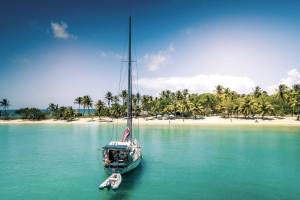
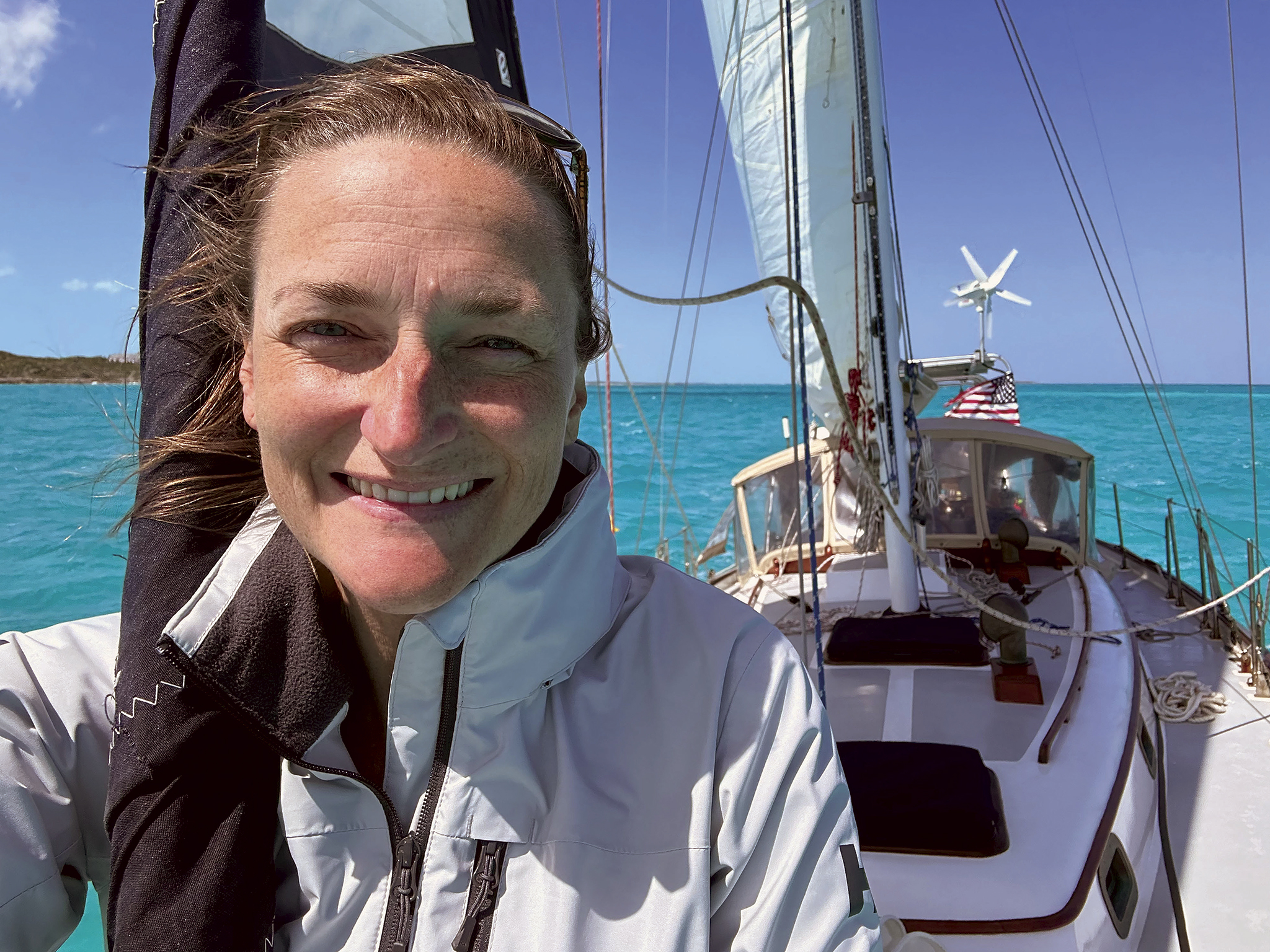
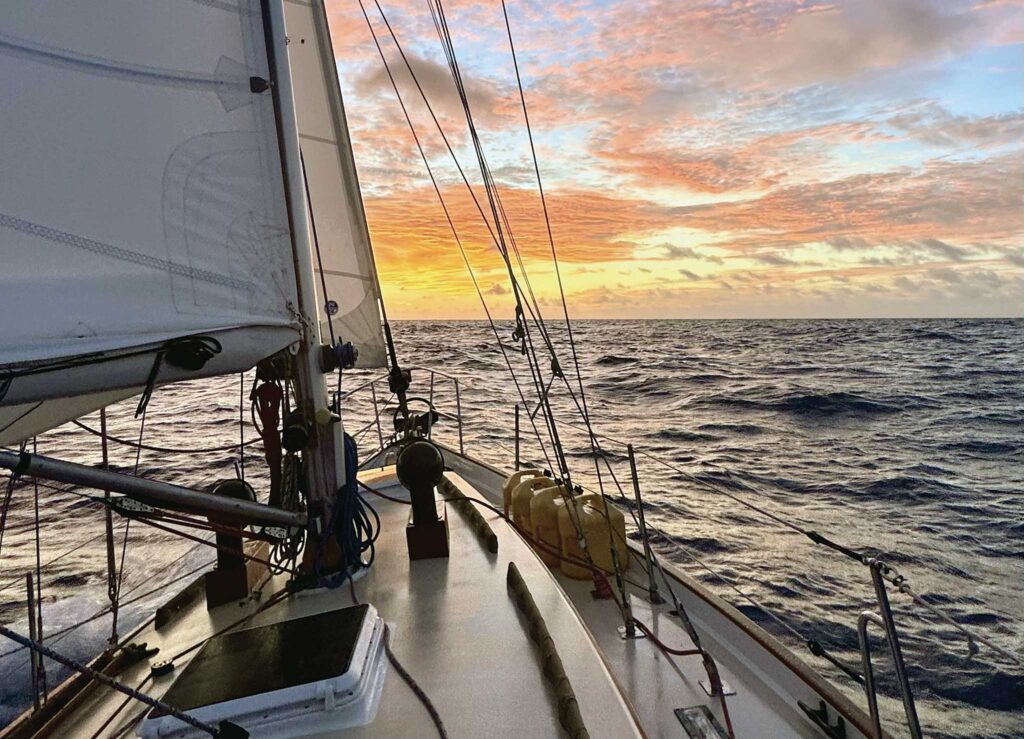
Like so many other sailors, we had stopped in the Azores during an Atlantic crossing. The crew list aboard our 36-foot Morris Justine included just me and Alex. Our float-plan took us from the Bahamas to the south coast of England, including stops in Bermuda, the Azores, and the Isles of Scilly. The sailing had been excellent for the first two legs of our trip. Aside from a few windless spells, we coasted easily on a starboard tack reach in a moderate breeze the whole way.
During the leg from Bermuda to Flores, we logged 1,783 nautical miles over 14 days between June 7 and June 20, in 2024. Sailing hours: 318. Engine hours: 2. It was a mesmerizingly tranquil passage. We never saw more than 25 knots of wind and were never pressed into sailing close-hauled. Our guest list included dolphin, flying fish, and an increasing number of Portuguese Man-O-War as we worked our way east. We had few sail changes on this passage, saw few ships, and on most watches nothing happened aside from our steady advancement across the ocean.
When we were totally becalmed on the better part of days 10, 11, and 12, motoring forward would have only delayed the return of the forecasted wind, so instead we dropped our slatting sails and waited on a slate, flat sea for a few days enjoying the rest. Just the two of us in stillness with Gillian Welch on our little Bluetooth speaker singing fittingly about an “empty trainload of sky.”
A Nine Island Oasis Found
The Azores stole our hearts during that initial hike up the hillside in Flores. We planned to stay for two weeks in this Portuguese archipelago and ended up staying for six. The islands sprawl over 375 miles in the middle of the Atlantic, offering an expansive and varied cruising ground. We only visited four of the nine major islands there, and departed with the feeling that we had just started to get to know the place.
Volcanoes created the Azores, and the islands are still growing. The archipelago gained 593 acres (and lost 300 houses) when the Capelinhos volcano on Faial erupted in 1957-58. The surrounding vegetation is colonizing the new-ish soil ever so slowly, and much of the eruption site resembles a strangely barren moonscape today. Active and inactive volcanic peaks and calderas dominate the landscape everywhere in the archipelago, and the potential for new eruptions is a constant threat.
Because of its origin, the Azores surge nearly straight up from the seabed, and most of the coves and bays along the island shores are extremely deep and rocky. Suitable anchorages are scarce and rarely free from a rolly ground-swell. Fortunately, excellent municipally run marinas provide safe harbor and can be found on all the islands. Floating docks are available in many places, and rafting along a seawall contends with overflow berthing demands. Med-moor stern-to-the-dock habits haven’t crept out to sea and into Azorean mindsets. Instead, an alongside tie-up is the norm.
The islands of São Miguel and Terceira have the busiest international flight schedules and are as a consequence the most touristed. The other seven islands are quieter and still maintain their rural, agrarian character. Majestic Mount Pico towers 7,713 feet above sea level and dominates the view in the central islands of Faial, São Jorge, and Pico. Santa Maria pokes through the sea farthest south and is known for receiving an abundance of sunshine. Flores and Corvo stand off to the west. These are the most sparsely populated islands and hang on to a wild frontier spirit.
Given adequate time, the volcanic soil coupled with the mild climate supports robust vegetation growth. The hydrangea are what you just can’t believe—especially in Flores. Millions of their blue, white, and pink blossoms sprawl over stone walls defining the edges of most fields and roads. Countless other flower blossoms join in to give the lush, green hillsides the look of mint ice cream with rainbow sprinkles. “Flores” means flower in Portuguese, and the island is aptly named.
We arrived into port with no significant boat issues to address. The usual work of laundry and food reprovisioning progressed at a languorous pace with frequent breaks for pastel de Nata and coffee at the O Arruda cafe. We spent many happy hours at that friendly, European-looking eatery, basking in the sun and chatting with other sailors while breakfast turned to lunch and loads of laundry slowly progressed toward completion in the marina laundry room down the block.
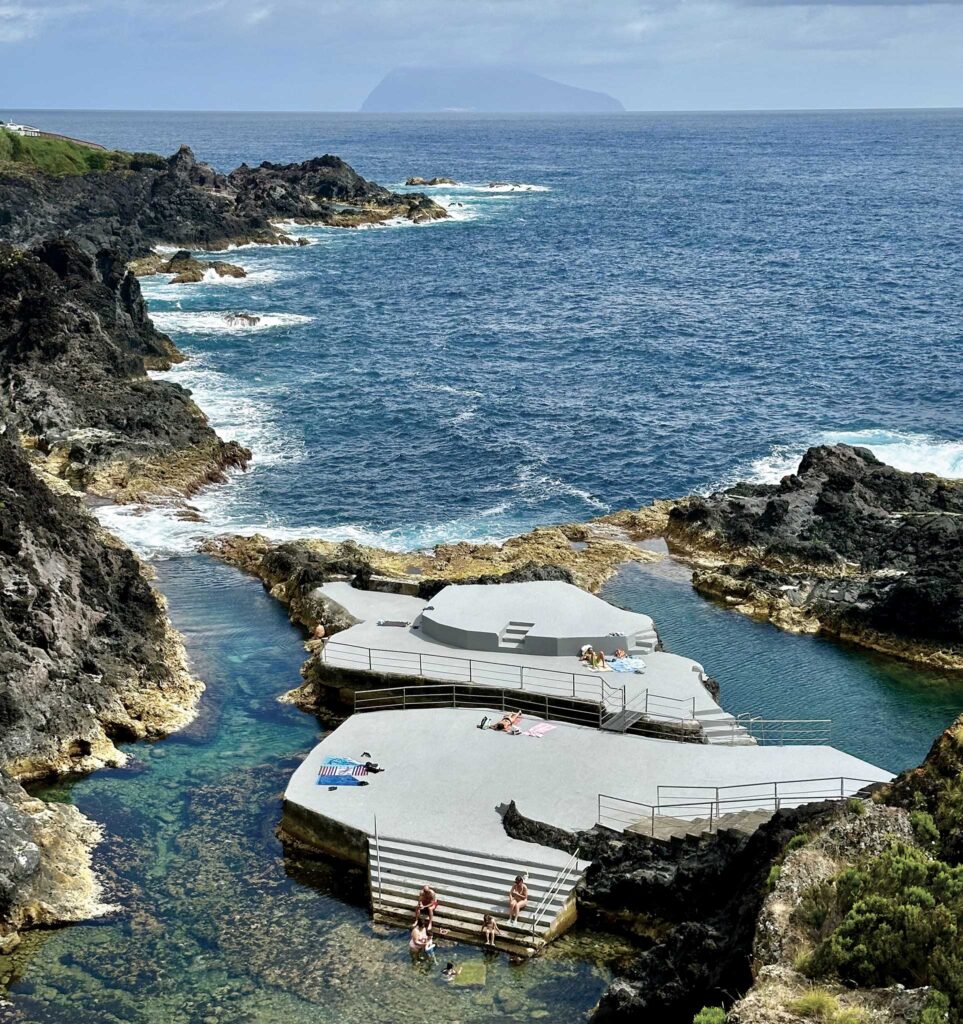
Blissful hikes and swims helped us while away the majority of our remaining daylight hours. The Azores are not known for its beaches and the delights of swimming in this Portuguese archie (Europeans love to refer to their archipelagoes as “archies”) came as something of a surprise. Instead of beaches, the locals have ingeniously built many complex wood and cement swimming pavilions that avail themselves to the contours of the natural rocky shoreline creating idyllic, tide-swept pools and unique diving platforms amidst exceptionally clean seawater. The sunlight refracts dynamically down into the depths of the clear, cobalt-blue, mid-ocean sea, giving the water that surrounds these islands a complex visual richness. The summer temperatures of both air and water are perfect for long soaks followed by a lazy spell drying off while sprawled out on a warm volcanic rock. These facilities are wildly popular with the town residents, and the people watching is top-notch. Changing rooms, freshwater showers, and a cafe are often onsite making these swimming holes the perfect place to spend an afternoon after a long hike or a complex laundry wait.
During our week-long stay in Flores, sunset would usually find us sitting on the outside patio at the Club Naval on the hillside above the harbor. The Sagres beer was cheap there, a friendly parrot was also an attraction, and most of the newly arrived sailors made the hike up to swap stories about the boats and the sailing that had delivered us all to this small gem of an island. Perhaps most memorable was a French family sailing with three kids under the age of six, plus two dogs on a 32-foot boat—bare aluminum hull floating under a cloud of cigarette smoke as is the French way—just in from a 20-day, heavy-weather passage up from Guadeloupe. They won the prize for most laundry. They also exemplified the nonchalant, can-do sensibility that’s typical of the sailors you encounter at a mid-ocean crossroads.
On to Horta
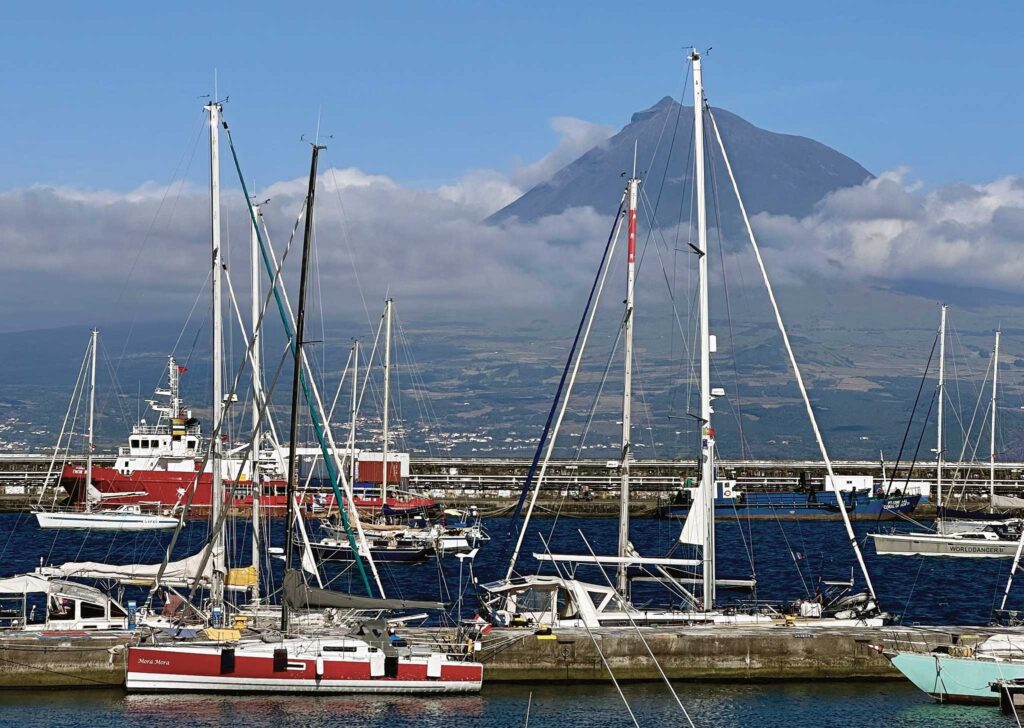
Eventually we dropped lines and sailed out of Lajes das Flores to make the 130 nautical mile hop over to Horta on the island of Faial. We were sad to say farewell to Flores but the allure of Horta was huge. Most of the great voyaging books make mention of a stop in this convenient port, and the harbor walls have become legendary for the art they host and the boats and crews they’ve seen.
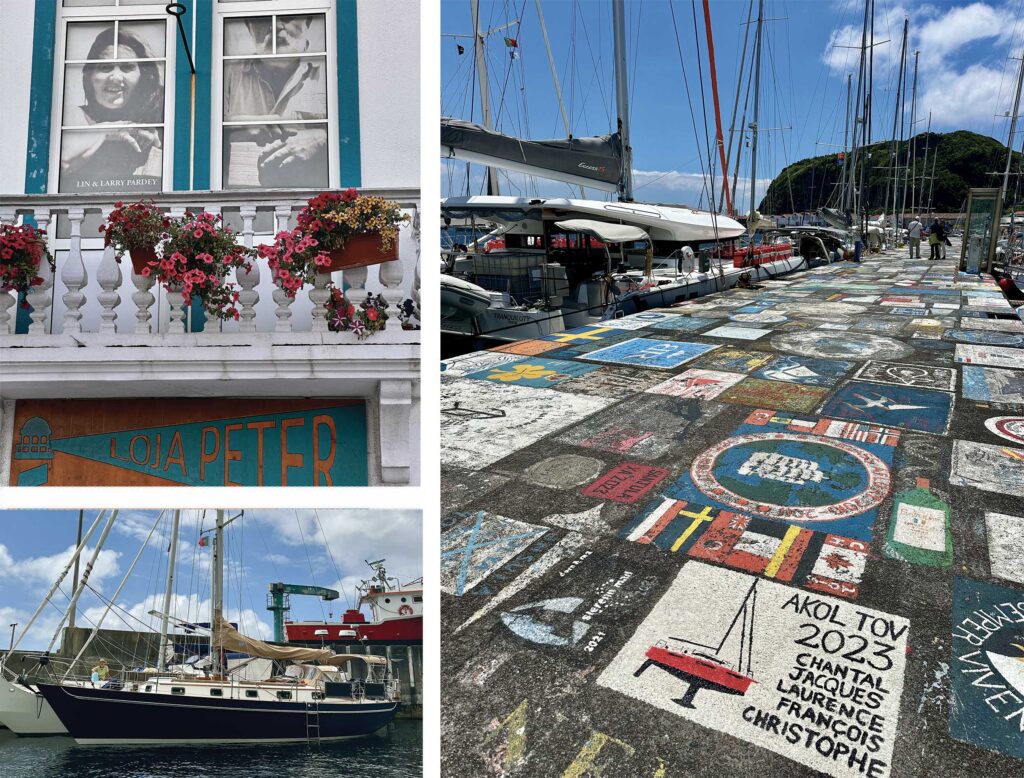
A super-sized, black and white image of Lin and Larry Pardey fills the windows above the door at Peter’s in Horta. They are just two of the many luminaries of the sailing world to have crossed the threshold of the famed Horta establishment at one point or another. This iconic watering hole has become popular with tourists of all types, but it still feels like a relevant waypoint worthy of a visit for any sailor who manages to get there. Finding a seat and ordering a drink in this hallowed cafe after sailing across the ocean is sure to plaster a smile on your face and envelop you in a satisfying feeling of accomplishment. You did it. You made it. Exhale. Imbibe.
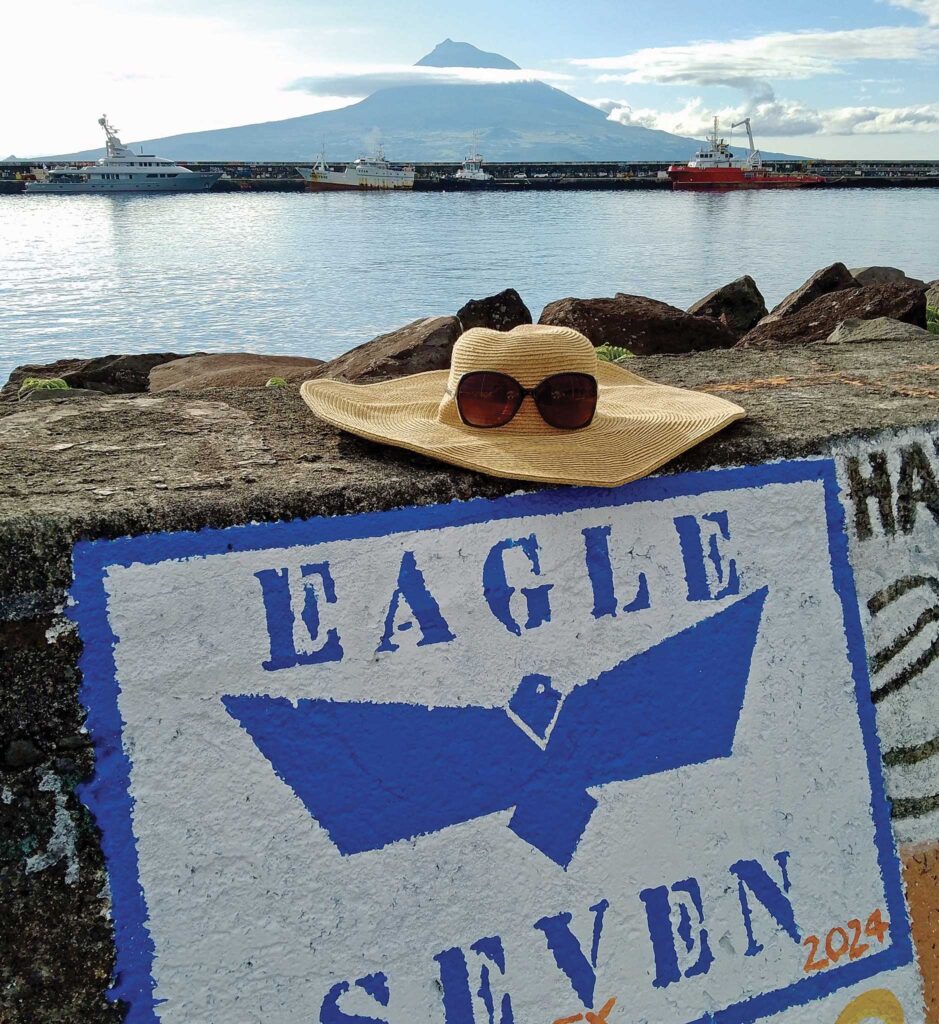
As is often the case with legendary ports, there’s a reason why Horta has such a longstanding popularity amongst sailors. The port is well-protected, an abundance of boat parts and services are available, and a well-stocked market makes for excellent reprovisioning. Peter’s is one of many delicious restaurants. The center island caldera hike is epic. The swimming pavilions are top-notch all around the island, and there’s even a rare sandy beach. But most alluring of all is the view you enjoy from Horta of Mount Pico across the bay. Photos fall short. This proud horn with aligned sides and a jaunty twitch at the peak is one tall drink of water with an intriguing aftertaste of foreboding. At more than twice the height of any of the surrounding island peaks, it’s a grand spectacle to behold. It dominates every view and elevates every spectator’s mood whenever it is in sight. It’s worth sailing across an ocean just to see the majesty of this behemoth, and witness the interplay between the clouds it divides and the clouds it creates.
You can hike to the summit of Pico, and getting to the trailhead isn’t a problem. Frequent ferry and plane service make island hopping a breeze, and public buses roam the curves of the steep Azorean roads in great number. We never did hike Pico, but we rode the buses frequently. When I unexpectedly had reason to fly out to Boston during this stop in our voyage, I worked my way to the international airport in Ponta Delgado utilizing both the buses and the local SATA airline shuttle service. These planes run a busy schedule and are a bit like flying buses. The small bird I rode on started taxing down the runway before everyone even sat down. There was no beverage service and twenty minutes later we were landing.
Revelers utilize all forms of transportation to make their way to Horta on July 4th each year. This is the anniversary of the founding of the city, and Horta throws itself a massive party to celebrate. Alex and I were already accustomed to celebrating this particular date, and we were more than ready to join the fun. Food trucks and beer vendors rolled in to bolster the offerings provided by the waterfront restaurants and bars. Bands played traditional and modern music on multiple stages, and UV black lights were set up to accentuate the traditional white party dress code. We found our own white-ish clothes—there’s only so much a laundry machine can do to a sailor’s clothes—and joined in the revelry, wandering between the music stages, eating and drinking too much, and making new friends. The Azoreans welcomed us here and at every turn. Our tourism was never received as a plague in these islands as it is in much of the rest of Europe these days.
Instead, visiting sailors like us are treated as a welcome and historically significant part of the Azorean society. Nowhere is this more true than in the massive public art exhibit that is the harbor seawall. They say it’s bad luck to sail out of Horta without leaving your mark on this wall. Being a superstitious lot, sailors have complied by the drove, and the patchwork art installation this tradition has created stretches literally for miles along the cement harbor walls. We recognized the logos left behind by several famous sailing YouTubers, and several other colorful sketches added by a few of our lesser-known sailing friends as well. Not feeling super artsy, Alex and I were planning to skip this tradition when we sailed in, but eventually we bowed to peer pressure and added our attempt at art. It’s pleasing to know that a little part of us is still there in that oasis. If you come across our Eagle Seven graphic when you’re next in Horta, please snap a photo and email it along to me to help me relive that fulfilled day of amateur art making.
A Worthy Summer Destination
We eventually sailed on to São Jorge where we found perhaps the most perfect village in the Azores. And to São Miguel where we found perhaps the most perfect botanical garden in the world. Then the seasons called, and we were offshore, northbound for England to complete our crossing.
Most sailors layover briefly in the Azores as a pitstop along their way across the Atlantic. I came away thinking of the archipelago as a destination in and of itself. Low hurricane risk and spectacular scenery make this pocket of the Atlantic a fine place to stop and spend the summer exploring by sail. Aside from the people and the sights, the Azores is physically a comfortable place too. We suffered from few bugs and slept well aboard at night. It was never oppressively hot, and not once during our six week stay were we chilled enough to think about pulling on a jacket.
For a North American boat working its way south to the Caribbean for the winter, a June route through the Azores, followed by change-of-season stops in Madeira and the Canaries, is likely to feature smoother sailing than does a November route to the Caribbean through Bermuda. I posit the longer route with a bonus summer in the Azores to be worthy of consideration.
Alex and I each sailed through a new personal Point Nemo, a place of maximum remoteness, on our way east to the Azores. For us, this was a point 591 nautical miles from Flores, and also 591 nautical miles from Cape Race, Newfoundland. This is nothing compared to the ultimate Point Nemo in the South Pacific, but for us, it felt like the far side of the moon. The main ports in the Azores are on a well-beaten path through the center of the North Atlantic, but sidestepping only a few miles to quiet islands like São Jorge or Flores allows you to regain the mystical remoteness that this latitude and longitude are ready to deliver.
You never forget your first Azorean island. The contented look on the faces of the cattle living on the hillside we met on day one in Flores has stayed with me. I sometimes fantasize about a future life as a bull living in that field, spending my days walking the hillside pastures hemmed with hydrangea while gazing out at the blue sea. Endless food, good bovine companions, never too hot or too cold, it would be like the happy life of a cruising sailor come ashore without the hangover. I would never have to sail on. Or suffer the indignities of a marine head. Then, come sunset, no matter if it’s the butcher or the volcano, the end would be swift and I’d be sure to expire without seawater in my lungs. I’m not sure how much control I have over such things, and it may not come to pass, but that’s the best alternative to a sailing life that I’ve been able to come up with so far.
Whaling
The New Bedford whaling ships of yesteryear took advantage of the fair winds and stopped in the Azores to reprovision just like Alex and I did. But unlike us, the whaling captains also saw the stop as an opportunity to bolster their crew lists with capable Azorean sailors. Those sailors quickly rose to dominate the whale hunting business both in New England and in their home island waters. The whaling industry has come to an end in the Azores, just like it has in New Bedford, Massachusetts. But the connection between these two places forged during the whaling years lives on. An excellent museum located in an old Flores whale oil processing factory explains the nuts and bolts of how the industry worked and also explains how the geographical bond across the Atlantic to America was forged.
Waiting in a long airport line to check in for an early morning flight is usually a quiet and somber slog. This was not the case at Logan Airport for my return to the Azores after my brief trip to Boston. Half of New Bedford was in line with me and excited to fly out and see family and friends in their Azorean home-away-from-home. Everyone waiting in line knew each other and the banter was lively, you could even say raucous. This bubble of international connection is a remnant from the chase for Moby Dick more than a hundred years ago.
SAIL Contributing Editor Christopher Birch is the founder of Birch Marine Inc. in Boston. He and his wife, Alex, are now cruising full-time aboard their 36’ Morris Justine. Follow their voyage at eaglesevensailing.com