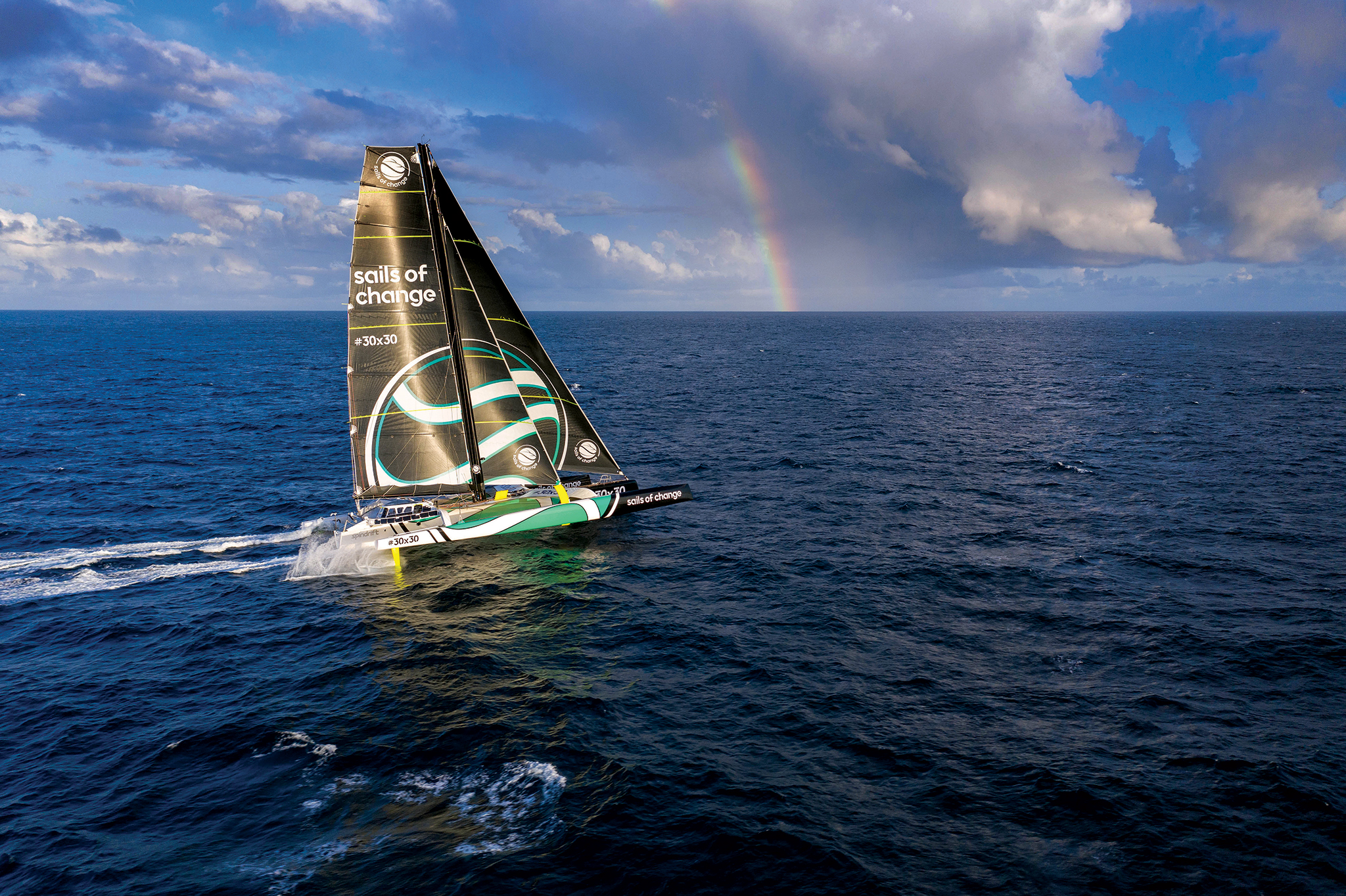
For years foiling has been at the developmental cutting edge of professional sailing, garnering a certain amount of skepticism from the nostalgic purists. If I had a nickel for every time I heard someone say, “The America’s Cup doesn’t look like the sailing we do anymore,” I’d be able to finance my own challenge. But gone are the days when that has to be the case. If flying above the water sounds exciting, this one’s for you. The trickle-down technology has reached us regular sailors, and though the Ioda isn’t the first foiling dinghy available to the public, it’s certainly a strong addition to the fleet.
The main highlight is just how simple and accessible they’ve made foiling. A variation on the theme of the Birdyfish S launched in 2024, the Ioda is a smaller version designed to be sailed by one person or even a child (ideally 75 to 165lbs). Birdyfish imagines the target audience for this boat to be young people looking for a fun and sporty race boat. With a significant recommended crew size overlap with that of the Optimist, they hope to get the next generation of foilers involved young. Though it’s too early to know yet, a competitive one design fleet could be in this boat’s future. For now, though, it’s just great fun.
The boat is extremely easy to sail, and you’ll likely be foiling within minutes. That being said, it’s still a different experience than the displacement dinghies you might be used to. The helm is more sensitive, and the maneuvering can take a little getting used to. The fore and aft balance as well as vang adjustments will also have a slight learning curve, but with a little practice, you’ll be foiling through tacks.
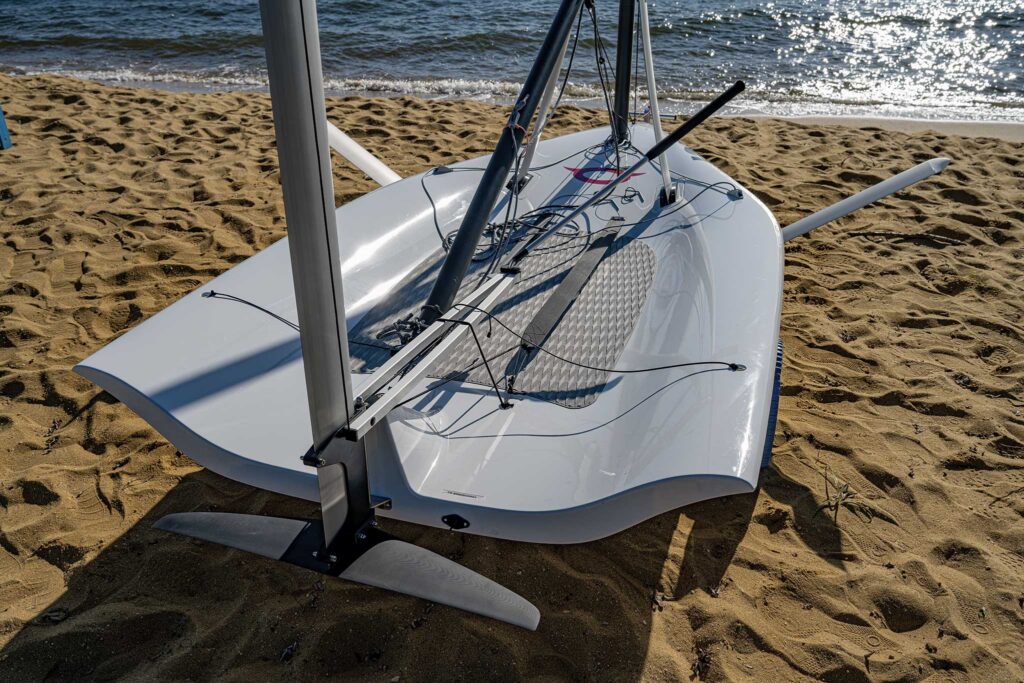
The boat operates on two G foils that generate plenty of lift while a T foil rudder regulates the pitch. This means that the flight control is managed by crew displacement, not an additional control system.
“The idea was to create foils that auto regulate because of their form, not by mechanical system,” says Birdyfish CEO Pierre Rhimbault. When the boat is slower and low in the water, he explains, the foils have lots of water flowing over them to generate lift and get the boat up to speed. When the boat is moving fast and out of the water, the reduced flow then regulates the lift. This makes the boat extremely simple to get foiling, and weighing in at just 120lbs, it doesn’t take much to get it out of the water. The take off speed is reported to be around 8 knots, and once the hull is out of the water, it can reach speeds of up to 23 knots.
The use of G foils also caters to the boat’s ease of use, with the port and starboard foils working together to balance each other out, unlike T foils used on some other foiling dinghies, which require more longitudinal balance from the sailors.
The Ioda is made in Nantes, France. The hull construction is a vacuum infused fiberglass and polyester resin, and the boat has a carbon mast and boom. Rigging it is quick and simple with a process similar to that of a Laser. The foils are made from anodized aluminum and are constructed in three parts, which can be replaced in the event of damage. The sail is woven milar. The Ioda can also be transported on the roof of a car or launched off a beach or boat ramp.
From a sailing stand point, this boat couldn’t be more exhilarating and fun. Agile, quick, and simple enough not to stress you out, it’s an all-around winner with a cool factor that will certainly excite young sailors.
- LOA 10’ 6”
- Beam 4’ 3” (hull), 8’ 9” (max with foils down)
- Draft NA
- Displacement 120lbs
- Sail Area 57 sq ft
This article was originally published in the June 2026 issue.