On a recent voyage from Tahiti to Hawaii, Ka’iulani Murphy was starting to get nervous. She was nearing the end of the 2,400-mile upwind journey and couldn’t get an accurate fix on the boat’s position—not because the chartplotter was broken, but because it had been cloudy for the past few days. It was mid-June in the middle of the North Pacific and her last chance to see the Southern Cross (Hānaiakamalama) upright on the horizon just after sunset.
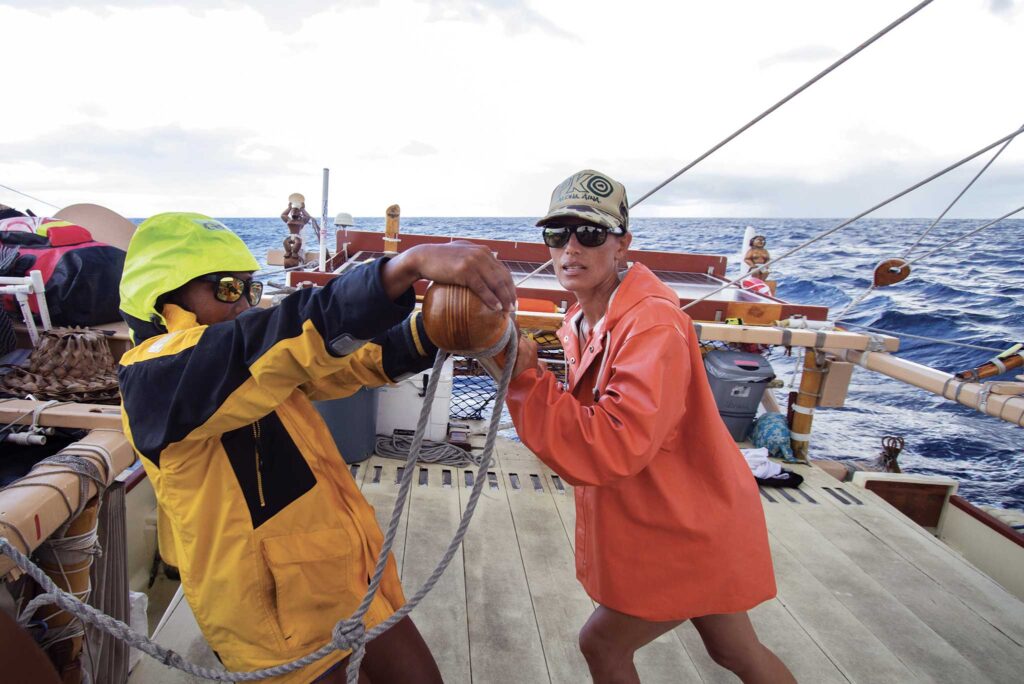
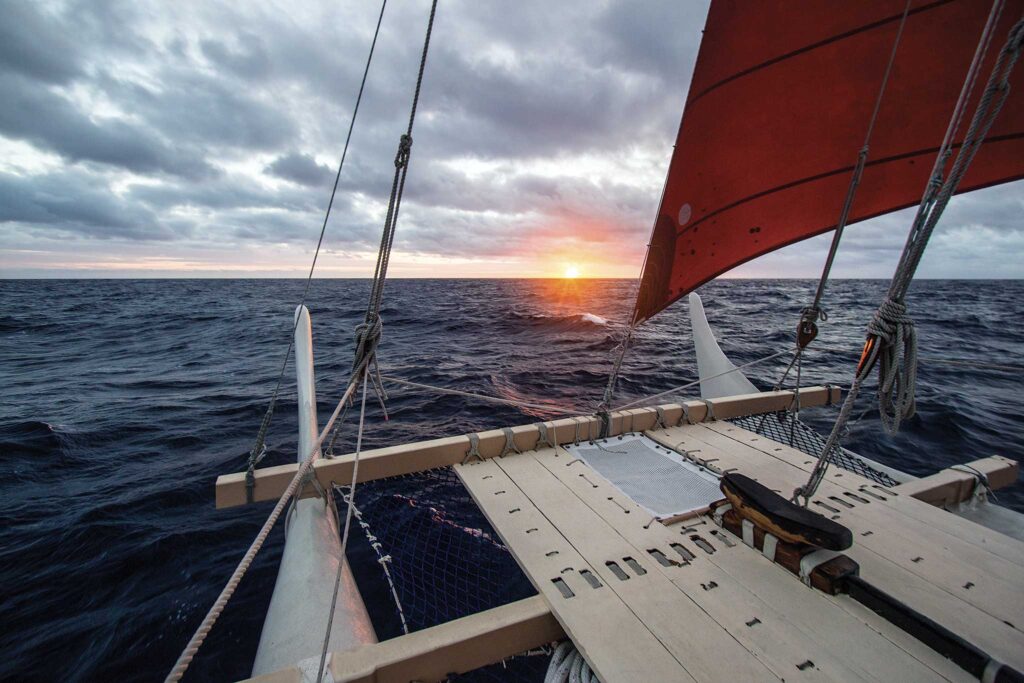
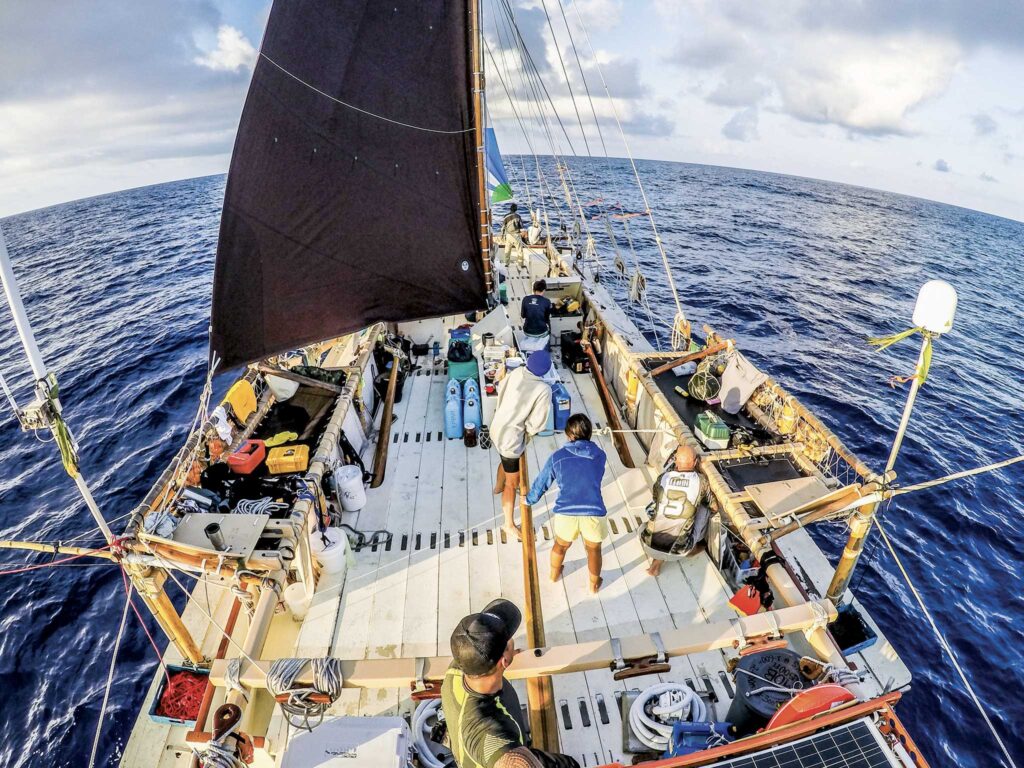
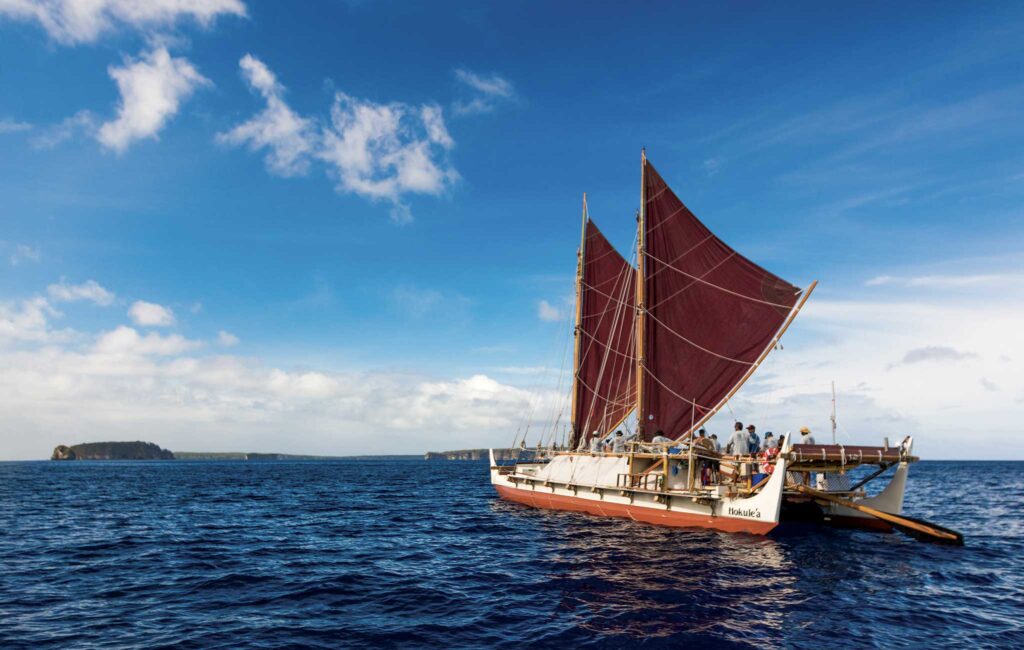
Murphy was the lead navigator for Hōkūle’a, a beloved 50-year-old traditional Polynesian sailing canoe that sparked a renaissance in wayfinding. This boat has no cockpit, no cabin, no compass, no GPS, no cell phone, not even a wristwatch aboard. What it does have is a 20-foot-wide rectangular deck stretched between two hulls, two red crab-claw sails, one long steering oar, some sleeping mats set beneath canvas tarps, and a dozen crew members determined to use nothing but nature to guide them safely home.
Murphy had barely slept in weeks, constantly observing the position of the sun and stars, the direction of the waves, the colors of the clouds, and the flight paths of birds. She was attuned to the slightest change in movement in the canoe. And she was fairly certain it was time to head west. If they waited too long to turn, Hōkūle’a would sail right past the Hawaiian islands. Murphy needed a clear view of the sky at sunset to see her cue to adjust course: when the distance between the top and bottom stars in the Southern Cross was equal to the distance between the bottom star and the horizon.
Murphy decided they would make the downwind turn that night, even if she couldn’t confirm their latitude. The sun set. The crew gathered around, waiting and watching and praying. At first, clouds obscured the horizon, hiding the constellation yet again.
“But then just for this magical moment,” Murphy recalls, “the clouds cleared and it was right there. We all got in our hand measuring, and it feels like you’re not alone, right? Like these are your kūpuna (ancestors) and they’re helping you out. They’re your friends up there in the sky, the stars. There are lots of moments like that, I would say.”
Murphy is one of dozens of women wayfinders who are reviving the ancient art of traditional navigation and voyaging. These women are sailing like their ancestors did a millennia ago, using clues from the environment to find a tiny island amid an immense watery wilderness. Not only are they teaching the next generations of Polynesians to continue this cultural tradition, they are inspiring people around the world to embrace navigating by nature.
Inviting Women Onboard
Murphy was mentored by the first wave of modern Hawaiian wayfinders, led by Nainoa Thompson, the CEO of the Polynesian Voyaging Society (PVS). Thompson was the first Polynesian in 600 years to use traditional navigation techniques for long-distance, open-ocean voyaging. These skills, along with many other important cultural customs, were lost after Hawaii was colonized by westerners and then annexed by the U.S. in 1898. After PVS built Hōkūle’a in 1975, they searched high and low for someone who could teach them how to sail it the way their ancestors did. They found Mau Piailug, a master navigator from the island of Satawal in Micronesia, who agreed to train the Hawaiians.
In Micronesian culture, however, women are not allowed to step foot on a boat. PVS bucked this taboo from the get-go. Two women were part of Hōkūle’a’s return crew for the canoe’s inaugural voyage from Tahiti to Hawaii in 1976.
Murphy, part of the second wave of wayfinders to learn traditional navigation, says she remembers driving Piailug around when he visited Oahu to teach wayfinding.
“I asked him once, ‘What do you think about women and navigating?’ And he’s like, ‘When men get lost, women know the way.’ ” Murphy laughs, then adds, “The knowledge of navigation actually comes from a woman in Micronesian tradition. When they were pregnant with their child, they would sing so that the child in the womb is hearing these songs about navigation and voyaging.”
“We had to have women on board to settle new islands,” Murphy points out. “Pele and other of our powerful women who were like goddesses, we know that they were on canoes and they were voyaging. So I don’t think it was forbidden in Hawaii or Polynesia.”
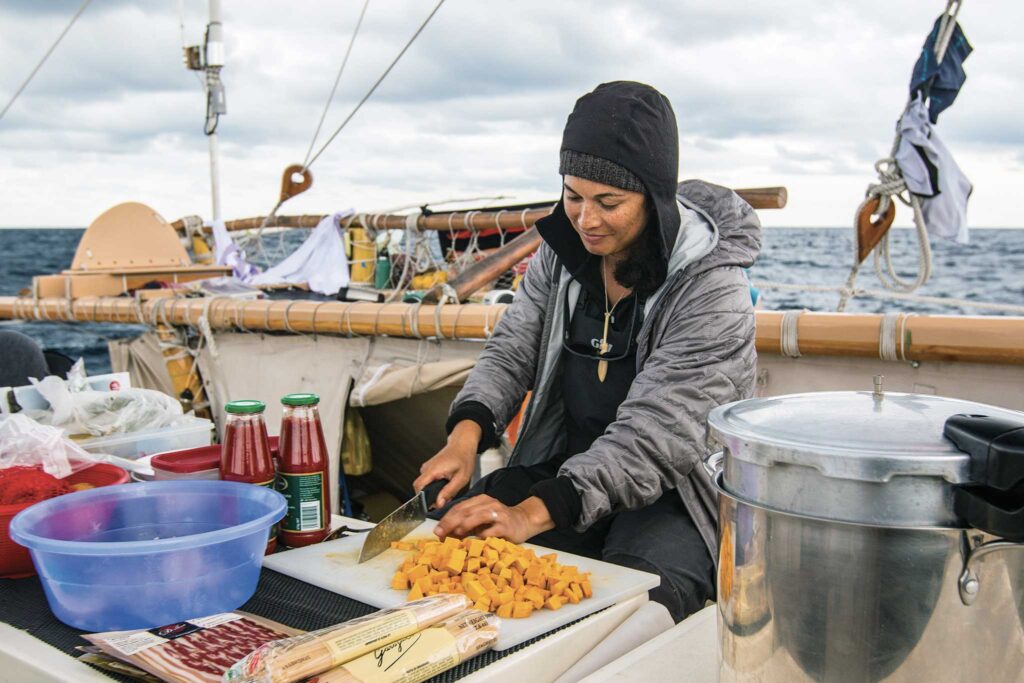
Today, women often comprise half or more of the crew on the traditional sailing canoes that are found throughout the Pacific islands. Ranging from teenagers to retirees, these women fill all of the rolls aboard, from cook to quartermaster, safety officer to captain.
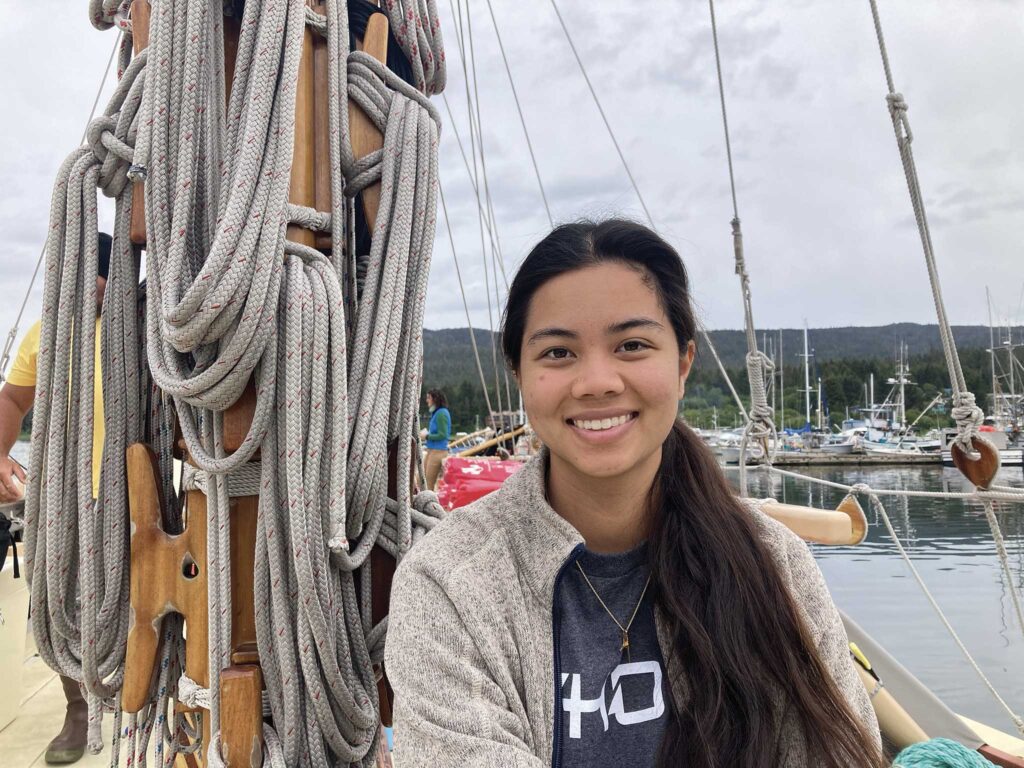
“There’s an equal space for us that’s not better or less. Women contribute to the balance of the canoe in so many different ways,” says Tehinamai Tafiti, a newer crew member with PVS whose family has roots in Tonga and Samoa as well as Hawaii. As a mother of two young boys, Tafiti says she is drawn to sailing Hōkūle’a because she wants to feel more connected to her culture.
“I’ve always been someone who wants to get to the source of things,” Tafiti explains. “I feel like to have a real conviction for something like this requires a lot of sacrifice. It requires not just your time but allowing it to transform you.”
Role of the Navigator
Transformation seems inevitable during a deep sea voyage aboard a bare-bones canoe like Hōkūle’a, living in close quarters completely exposed to the elements.
“The beauty of it is the simplicity,” says Lehua Kamalu, the voyaging director for PVS and a world-renowned wayfinder who consulted on the production of the Moana films. Along with impressive sailing chops, Kamalu also has a ready laugh and a contagious sense of humor. She admits that the first few days of a long voyage “are quite painful” as the crew adjusts to living aboard. “Everything is distilled down. Like, this one bucket is everything: It’s your bathroom, it’s your laundry, it’s your kitchen. It takes away so much distraction.”
Avoiding distraction is the name of the game for wayfinding, a task that requires intense focus to keep the canoe on track 24 hours a day for many days on end.
“You’re always trying to compare changes going on in the sky with what’s going on in the ocean to figure out how you’re picking your way across the water,” Kamalu explains. This means paying attention not just to the watery path ahead, but also to the trail you’ve left behind. We only know where we are if we know where we’ve come from is a sentiment voiced by many voyagers—good advice for life as well as sailing.
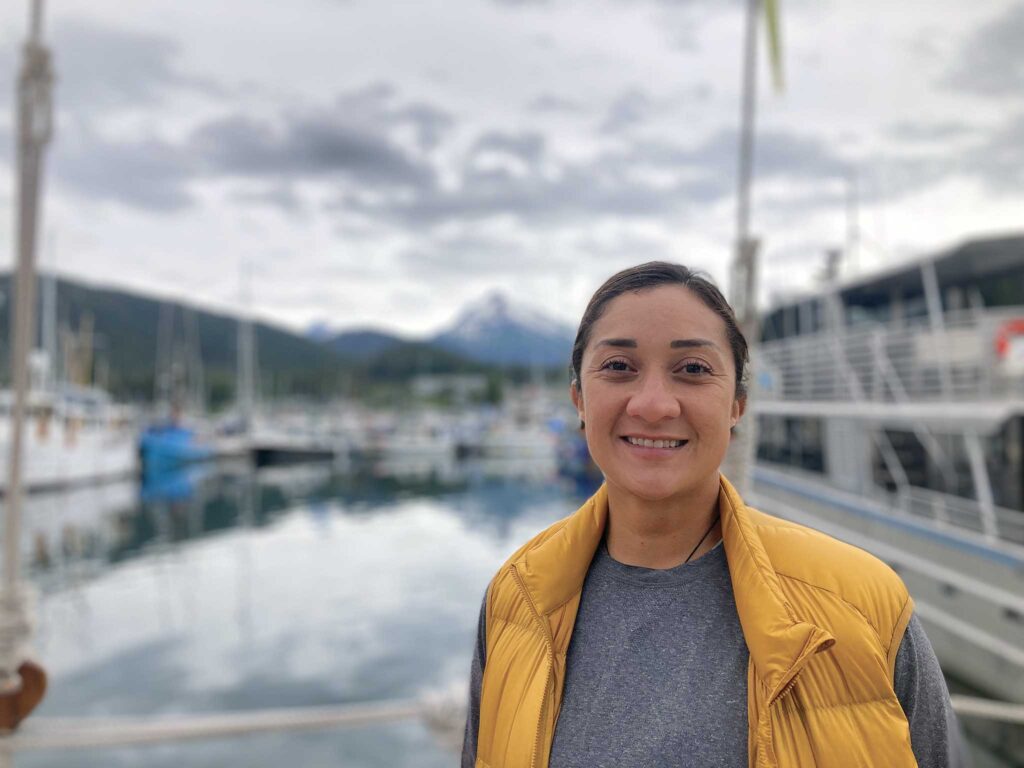
Wayfinding is often summarized as navigating without modern instruments like compasses or GPS. However, wayfinders actually use two very important instruments, according to Kamalu: their body and the canoe itself. Hands are critical for measuring the distance and position of the sun and stars, while the senses are tools to feel the waves, smell signs of land, and see everything happening around you. The other instrument is the boat, with its intentionally designed angles and shapes.
“Canoes follow a very specific ratio so that you can use them as an extension of your navigation,” Kamalu explains. “And everyone on your crew is there to care for the canoe to make it all work.”
While Kamalu believes that navigation is the thing that is “uniquely special” about Polynesian voyaging, she says that none of the wayfinding can happen without a solid team onboard. Forming the crew is one of the trickiest and most pivotal tasks on any pre-voyaging checklist. “I haven’t sailed with the same crew twice. We want to build that chemistry and that really good working ability. The best crews I see are, like, psychic—there’s not a lot of talking.”
Crews are often picked based on who shows up to help maintain the canoes when they are in dry dock.
“There’s always something to sand,” Kamalu jokes. “Plus, once you get on the water, you start to see things that you did on the canoe, and you understand better how she’s put together.”
An ‘Ohana of Ocean Ambassadors
Over the past year, Kamalu directed the Polynesian Voyaging Society’s Statewide Sail. Hōkūle’a visited dozens of Hawaiian ports, bringing schoolchildren aboard while also training the next generation of wayfinders—what PVS calls the fourth wave of traditional navigators.
One of the most active of these young apprentices is Lucy Lee, 23, who began learning celestial navigation in high school and has crewed on several voyages. For Lee, navigation at its core is about learning how to make decisions.
“Our generation is now getting to rise to the occasion and step up to the plate,” she says. “We’ve been fortunate to be the beneficiaries of a lot of hard workers who paved this path for us.”
The main reason Lee devotes most of her free time to caring for and crewing on replicas of ancient sailboats is because she loves the family-like community—the ‘ohana—that these canoes create, particularly during a long voyage.
“You’re at nature’s mercy in the craziest ways possible,” Lee says. “And that causes you to really be at the service of everyone around you and at the service of the canoe, constantly looking for ways to make someone else’s load lighter. And I know that they’re doing the same for me.” She pushes her waist-length black hair behind an ear and sums it up beautifully: “On the canoe, I feel like we all get to become the truest versions of ourselves.”
These wayfinders, new and not-so-new, are more than simply sailors. They are also role models for Indigenous mariners worldwide. The cultural renaissance that emerged from resurrecting traditional navigation has rippled well beyond Hawaii. Hōkūle’a and her voyagers have inspired Indigenous coastal communities around the globe to re-embrace their seafaring roots.
“I realized voyaging culture and navigation tradition can connect ocean people from different countries or islands,” says Tamiko Fernelius, a captain aboard Hōkūle’a who is originally from Okinawa, Japan. “I hope to share the story of voyaging with my people to remind them what a wonderful culture we have.” Fernelius worked as a mariner with a U.S. Coast Guard captain’s license for a decade before moving to Hawaii in 2009 where she learned traditional navigation. She believes that it’s still important to practice these ancient techniques in a modern world because it’s a pathway for people to respect nature and take care of the environment.
Wayfinding goes hand-in-hand with protecting nature. Because of that, the Polynesian voyagers often “become ambassadors for all things ocean,” Kamalu says. “People call to talk about what’s going on in the water and where are the fishes at, and everything under the sun.” Kamalu participates in meetings with everyone from Disney to Google to leading scientists. In turn, these conversations help crew members better understand the seas they sail upon, which “connects so many more of the dots for navigation,” Kamalu says.
Lee thinks voyaging is one of the best ways to connect more people to care for the ocean, especially in the face of a changing climate.
“Stories are one of our greatest tools. That’s what makes people care about things and want to create change. I think that the Pacific and its people hold stories that have the power to change the world. I’m really excited to be able to hear some of them, experience some of them firsthand, and to have stories to go home with.”
Passing the Torch
In the next few years, Murphy and Kamalu are expected to be among the first women in known history to be granted pwo, master navigator status, by the current masters: five Hawaiian men who were granted pwo by Mau Piailug in 2007. Murphy views pwo as the highest form of kuleana, or responsibility. “It’s the next phase of the journey,” Murphy says, in the navigation role she’s been trained for over the past three decades.
Both Kamalu and Murphy used the word “terrifying” to describe the weight of responsibility that comes with stepping into the leadership role as the first generation of modern wayfinders moves on.
“The navigation piece is, I think, the most stressful of the different kuleana. There’s always this fear, ‘What if you’re not successful?’ And at the same time, our teachers are always like, ‘We’re not going to let you fail,’ ” Murphy says. “We are lucky to be the ones bestowed with this knowledge. It is a privilege. An honor.”
As pwo, the women will have to make decisions about so much more than the course of one boat on one voyage. They will have to navigate how to keep wayfinding alive and thriving in the Pacific and beyond.
“You’re applying navigation skills to everything. What should I be mindful of? Why should I be taking this journey over here? Who should we be talking to?” Kamalu says. “There is so much emotion and spirituality and healing and all sorts of things that are wrapped into what Hōkūle’a does and where she goes.”
When the time comes to take the helm, Kamalu and Murphy and their co-navigators will face their fears, as all sailors do when a long voyage lies ahead.
“Sometimes you have to jump in without knowing how deep the water is,” Kamalu reflects. “This is not just a lifelong commitment. This is lifetimes long.”
Read more of Brianna Randall’s stories at briannarandall.com.