Sailing is already expensive, and if you take the boat show salespeople at their word, it’s astronomical. Even if you could afford the new boat, between the electronics, watermakers, furling systems, electric winches, FLIR cameras, and vaporware sails you could add several lifetimes of selling plasma to your cruising kitty and still not get close to getting the things they say you need to cast off.
Once you buy the boat and kit it out, it would take another 1.6 plasma selling lifetimes to sail to the exotic bucket list destinations you’ve been dreaming about. You’d need to cross oceans, which means rigging upgrades, system redundancy, insurance, training runs to gain offshore experience, months for transits—the list goes on. All the while you’re still dealing with some version of the adult responsibility grab bag of job/mortgage/kids/aging parents/your free-range neighbors/their free-pooping dog.
Who has the money? Who has the time?
What if I told you I have a hack that lets you sail in exotic locales, on your own boat, with the skills you already have, and never pay for moorage or compete for anchorages? What if I told you that you could also spend zero time fixing the heads, swearing at watermakers, and worrying about how cold your freezer is? Too good to be true? Depending on your perspective, it mostly is, which also means that it’s possible it mostly isn’t.
While you make sense of the last sentence’s self-impressed Zen riddle, let the rest of your brain wrestle with this: All of that utopia is attainable at a fraction of the cost of that new roller furling re-rig you’re willfully justifying against the rest of life’s priorities: It would make striking sail so much easier, college funds are for cowards, and you’re pretty sure your mom doesn’t really need that organ transplant. Pretty sure.
Don’t worry, Mom, there’s another way.
Uncancel your kid’s SAT, call your mom’s surgeon and tell them you’re an eligible donor after all. I’m living proof that you can accomplish bucket list sailing adventures without mortgaging your relative’s futures, you just might need to redefine what you mean by “bucket.”
The life hack answer to you and your mom’s prayers? Two words: lower standards.
Dirtbag Cruising
Yes, I said it. The D word. When you’re done unbunching your khakis and clutching your yacht club pearls, read on.
Trekkie, Swiftie, Redneck. Few words in the English language have the power to cleave the world in two—those who aspire to that identity and those who want to leave whatever room it walks into as fast as possible. Dirtbag is such a cleaver, and to know what side of the cleft you are on, you’ll need to know more about what the hell we’re even talking about.
As I define it, dirtbag cruising boils down to this: Go somewhere awesome, buy a crappy boat, use the hell out of it, have the time of your life at a fraction of the cost. Don’t cross oceans, don’t spend years building skill or building a boat. Find a boat you can tolerate where you want to sail, use it, and if you need to, walk away from it at the end of the trip like the main character walks away from explosions. Don’t flinch and don’t look back.
Boom.
Over the past 20 years our family has dirtbagged the globe, starting here in our Pacific Northwest home waters, then branching out to international trips where we have secured boats in mid three-, to low four-figure deals.
Being clear, ruthless practicality is common practice in the rest of the world. The patron saints who inspired my dirtbag-level practical thriftiness were the Belizian captain and crew of the Dell, a 32-foot, 100-year-old, engineless, double-ended gravel carrier that Oscar and Oliver operated between the beaches where they shoveled sand into their boat and the construction sites where the sand was turned into concrete condos for tourists. They had sailed into Caye Caulker for groceries, I talked my way onboard for their sail to Belize City. It cost me two bottles of rum. We drank one on the way.
Their sail was patchwork Sunbrella from cruisers’ biminis damaged in recent storms. Their mast hoops were hose clamps, running rigging poly-pro from beachcombed fishing gear and feathered out by years of UV. Their crown jewel was the solar powered light with a sensor that made it flash every four seconds when it got dark. “Automatic!” beamed Oscar, taking a pull of rum. In a moment of building bridges across cultures, I said I was familiar with those kinds of lights, but in the U.S., we only had them on buoys. “This came from a buoy!”
We laughed all the way to Belize City—four hours of a trade wind beam reach, inside the reef, plowing a wide furrow with our rudder due to the massive weather helm. It remains one of the best sails of my life. It had everything to do with the context, a little to do with the rum, and nothing to do with the tech. A dirtbag was born.
So it’s not new gear, it’s also not high-hewn craftsmanship. This isn’t the 1970s Lin and Larry Pardey wooden boat utopia when people had enough time, resources, and cheap materials to head to the hills and spend four years crafting a wooden boat, hand stitching sails, and living off of eggs and beans, or whatever. In the words of the immortal meme, “Aint nobody got time for that.”
This is 2025. A supermarket egg costs roughly a dollar (A DOLLAR!), 2x4s are six dollars, and because he’s dead I can say with confidence that you’re not Larry Pardey. You’re not building your own boat. You don’t have time, and you don’t know how. Neither do I.
Enough of what it isn’t. What dirtbag is, is the contemporary answer to three questions:
1. How do I maximize sailing in cool places?
2. How do I do it at the lowest cost possible?
3. How do I make sure I end up pooping in a bucket? (No. 3 is actually just what happens when you prioritize the others…at least number two.)
Walking the Talk
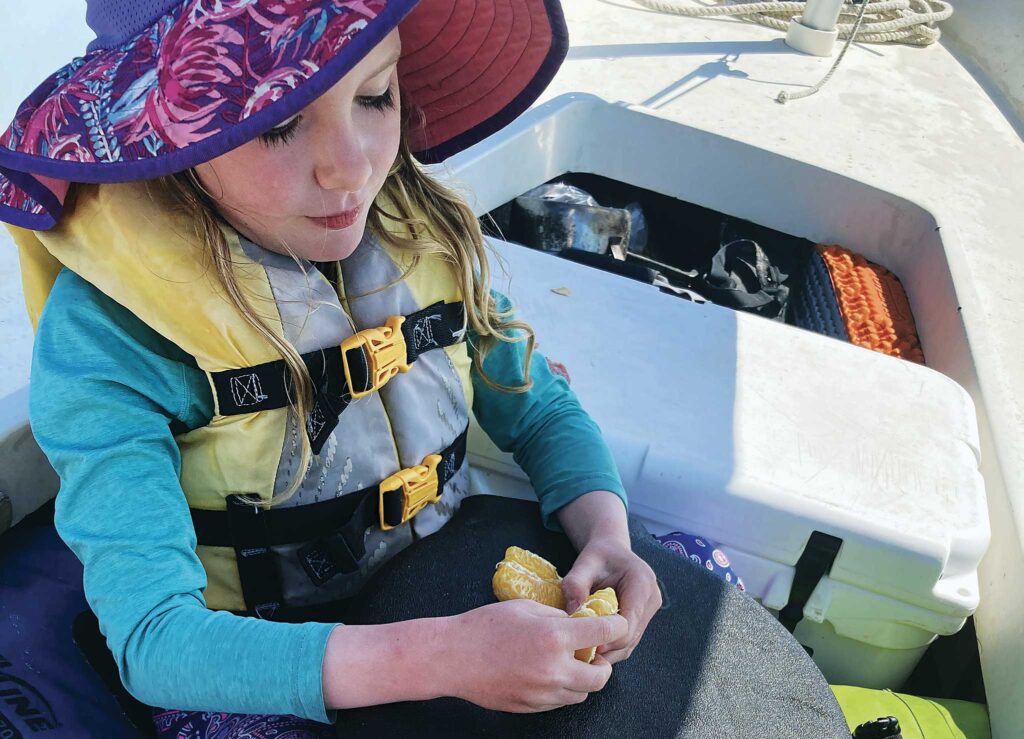
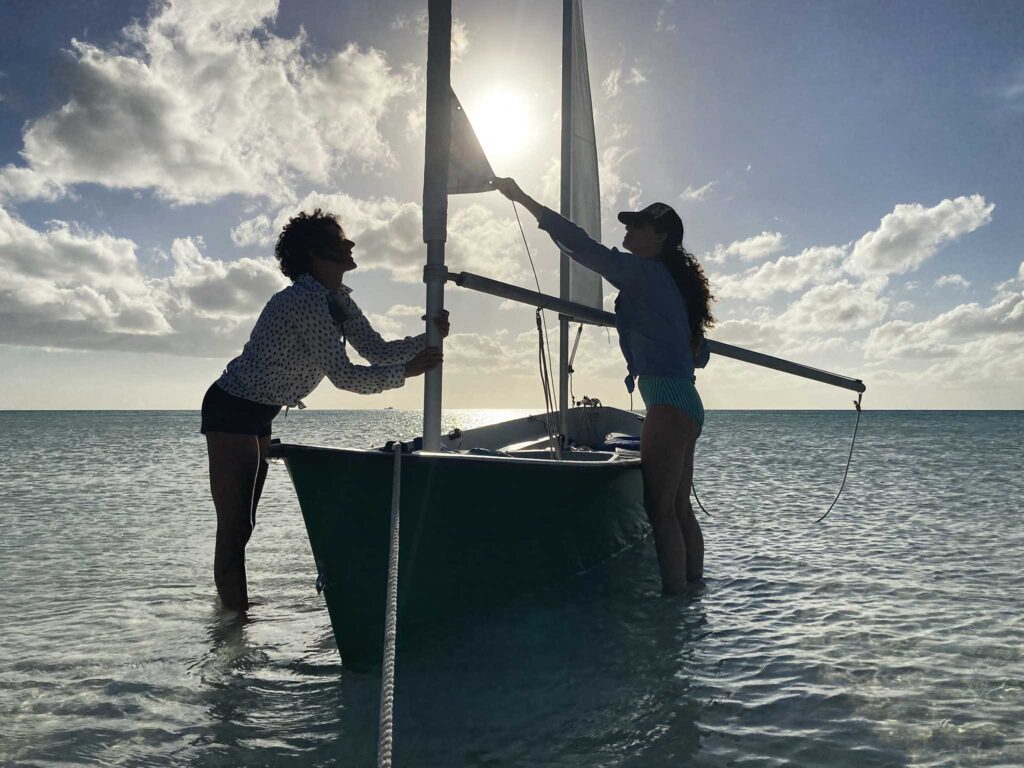
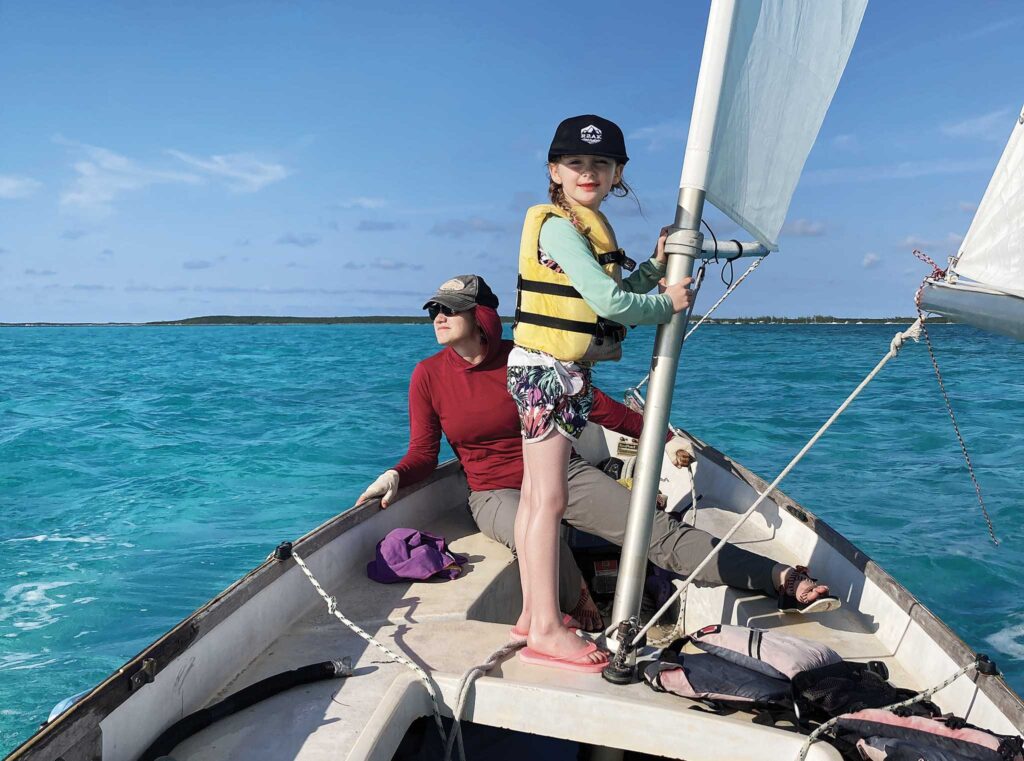
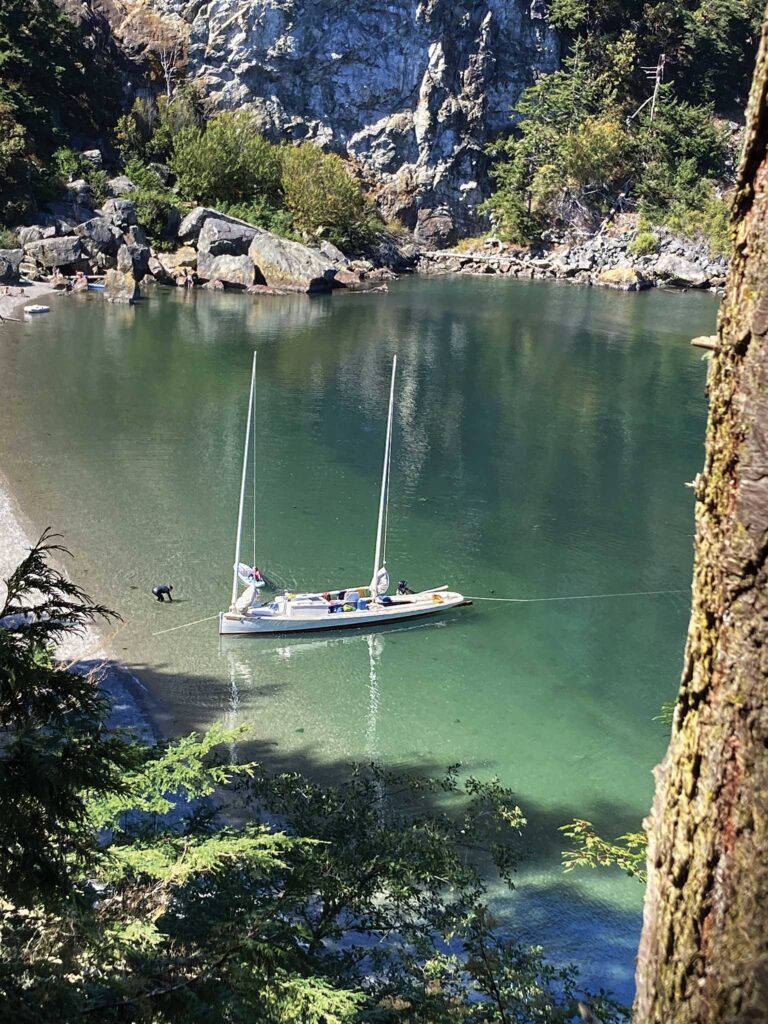
Here in the states, our family’s penultimate dirtbagger is the New Haven Sharpie, Betsy D. It was owned by a museum until it got too long in the tooth and we traded them a dinghy for it, patched it up, and used it ever since. Dead simple, flat-bottomed, and handy to sail. Unless you like going to windward, it’s an ideal boat for protected waters. We’ve camp-cruised the 35-foot open boat for two weeks every summer since my daughter was 1. Pull the centerboard and sail right up onto the beach, no dinghy needed, then anchor in 8 inches of water while everyone else stresses about finding a spot. It will plane downwind and avoids moorage fees on a trailer in our driveway. It’s perfect enough.
Since I am the CEO of a maritime organization in Port Townsend, Washington, the West Coast epicenter for wooden boat mythology, if you started reading here you might well imagine our sharpie as a pristine museum piece.
Not quite.
The boat is…fine. She’s got beautiful lines, but the sails are 30 years old, the sheets are mismatched, we don’t have pets but rather “rescue fenders” we found underway. Are there still halyards with blue tape on the ends from when they were cut? Absolutely, because aint nobody got time for that either.
To say that the accommodations are spartan is to underplay the luxuriant quality of Rubbermaid tubs. Our boat lacks a single cabinet or locker, and rather than take the time that aint nobody got to build some, we went to aisle 34 and 10 minutes later walked out with a cartful of all of the watertight storage we could ever want. Is it irritating to have to paw through all the tubs to find what you are looking for? Absolutely. So we labeled them, Sharpie on the duct tape left over from making chafing gear for our dock lines. Because classy.
Our galley is four tubs, two coolers (aisle 35), and a Coleman stove. Our nav suite is a paper chart I sneak laminated at work. Our handheld VHF was garage-saled, we haul the anchor by hand, our depth sounder is our centerboard. Fewer systems mean fewer things to break, and smaller boats mean the forces are just less. Without keel or cabin, our 35-foot sharpie only weighs 2,200 pounds, so our swap meet 25-pound Bruce on nylon works just fine. Other than our 5-horse outboard “main engine,” there are literally no systems to fail. There isn’t even a winch to seize up—all of the sheets are handlined with a mix of scavenged Sailor and Harken blocks. Plus, there’s the bucket. Never had to rebuild that.
“But, Jake,” you ask, “that’s all well and good, but what if you want to adventure somewhere else? You’re not going to sail that crappy boat to warmer waters.”
First of all, take that back: I’m the only one who gets to call my boat crappy.
Second of all, of course we’re not crossing oceans, but as it turns out there are crappy boats pretty much everywhere, and in addition to sailing our own dirtbag queen we have taken multiple international trips organized around a similar theme.
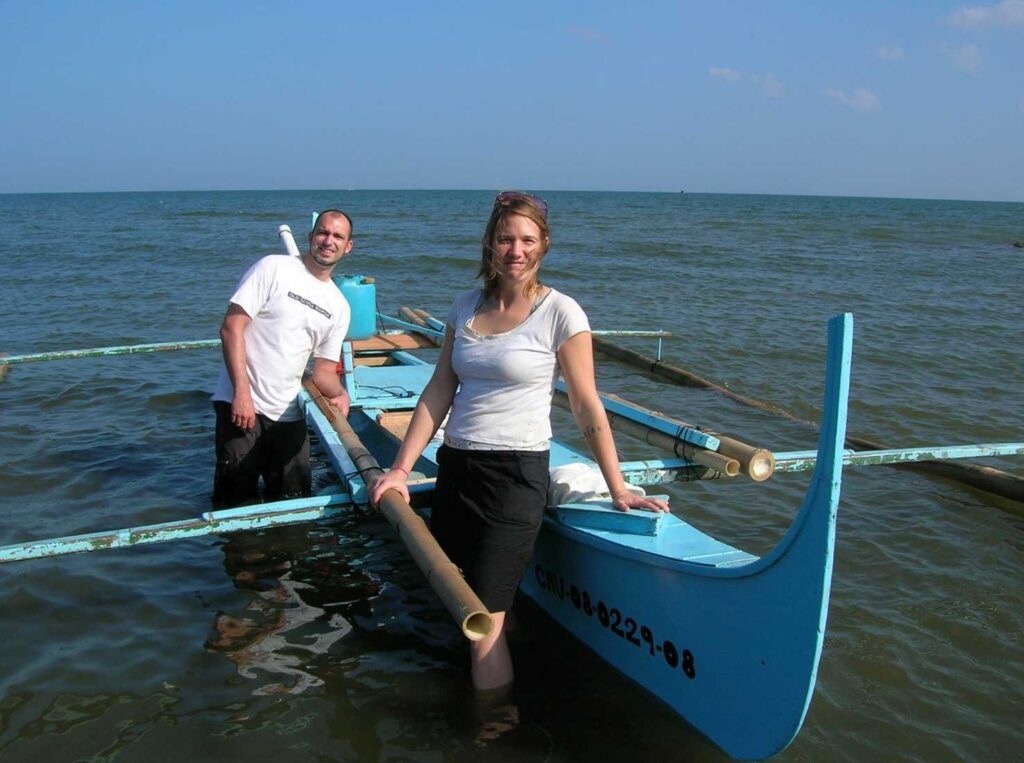
Philippines: Coron to El Nido, six weeks, 18-foot banka: My wife and I bought an 18-foot banka (think motorized canoe with bamboo outriggers) powered by an unmuffled 10-horsepower lawnmower engine. We bought the boat on Craigslist, sight unseen, for $600, flew to Manila with luggage full of West System, tools, and used sails we hoped to retrofit to a bamboo mast we had yet to build. We then spent two weeks fixing it up in a fishing village a three hour bus ride from the airport. The trip was unreal.
Once we got the boat situated, we motored to Manila, loaded it onto the deck of the sketchiest of ferries, then spent 36 hours slow-boating to Palawan, Philippine’s westernmost archipelago. Our boat never sailed well, the lawnmower was loud, and I can still taste gasoline from having to syphon fuel into our day tank every two-and-half hours, but we saw sights that weren’t just off the beaten path, they weren’t even knowable from it. Palawan is a UN Natural Heritage site with nearly 1,800 islands. The tourists see gorgeous parts, but its nooks and crannies are sublime and largely unknown.
More than the scenery, our banka got us closer to the people of the Philippines. We never even saw a cruising sailboat, but we talked to the locals a lot, sometimes out of curiosity, often out of necessity. We were a curiosity. We were Americans in the middle of nowhere, on a boat that we literally had to get permission from the mayor to let us leave the area we bought it in. People didn’t do what we were doing, especially people who looked like us. Double takes abounded as we lawnmowered past similar boats full of fishermen.
We would often need to ask permission to camp on the beach of a simple home or fishing village and would inevitably share time and a meal. We also gained friends from our constant repairs. I can say “propeller shaft” in Tagalog and at least four regional languages. No braggies.
A story in itself, we sold the boat for $300, a beer, and a ride to the airport mere minutes before our flight left. At the time, the $300 loss made it the most profitable boat I’d ever owned.
Sea of Cortez: Loreto to La Paz, three weeks, Hobie 16: Again it was Craigslist, sight unseen, $600. Flew down with supplies, spent two days repairing stress fractures and replacing long oxidized pop rivets.
Packing the boat, it was clear that weight was our biggest issue. The Baja shore of the Sea of Cortez is a sparsely populated desert with scant opportunities to fill water. We had to keep enough water onboard to stay alive but not so much that we submerged the hulls. Hobies aren’t pack mules, so we streamlined as much as we could, but the boat was so overloaded it didn’t sail to weather. At all.
The Sea of Cortez in December tends to blow hard and north, great for our overall trajectory but it created a “one strike and you’re out” approach to picking campsites. We would see incredible beaches, tack over to make the layline, and if we got swept past there was no going back once we were downwind of it. “Next time!” we’d shout to each other.
We saw Baja’s cruiser anchorages as we sailed past but got to immerse ourselves in the places without people. We camped on uninhabited islands, cooked our food on twiggy mesquite fires for two weeks after our scant camp fuel ran out. The scenery was awe inspiring, and slowing down to make fires to cook relegated a pace of deliberate leisure I rarely get in my regular life—all played out in hidey-holes too small for cruisers but perfect for beachable folks like ourselves.
We sold the boat for $600 near La Paz, breaking even. This remains the most profitable boat I’ve ever owned.
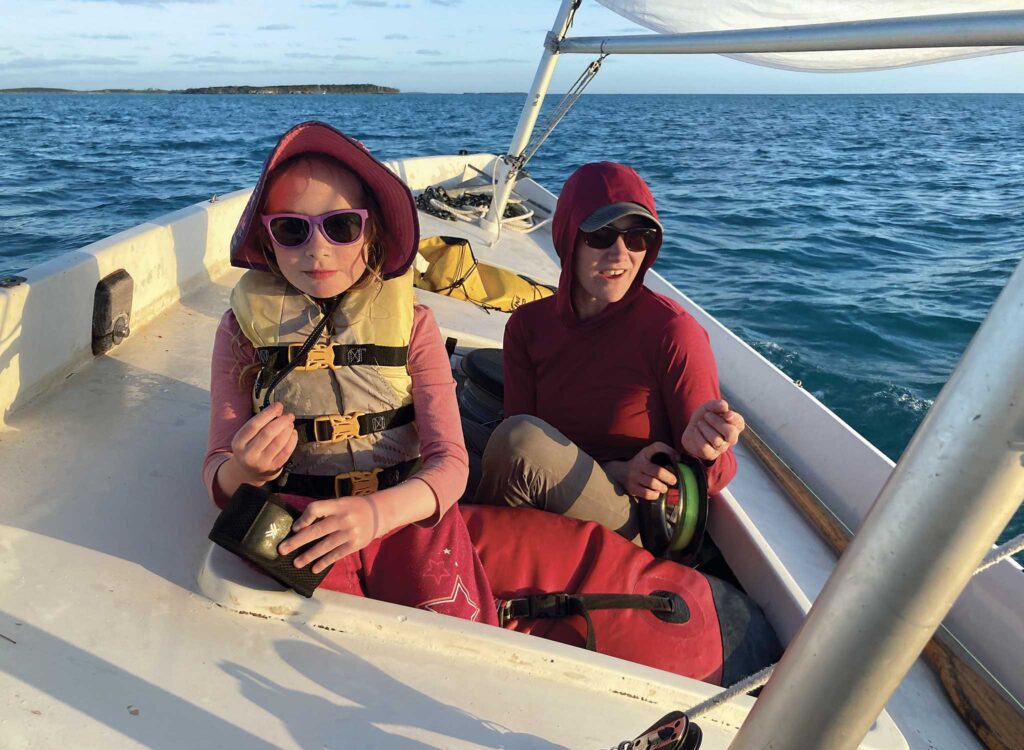
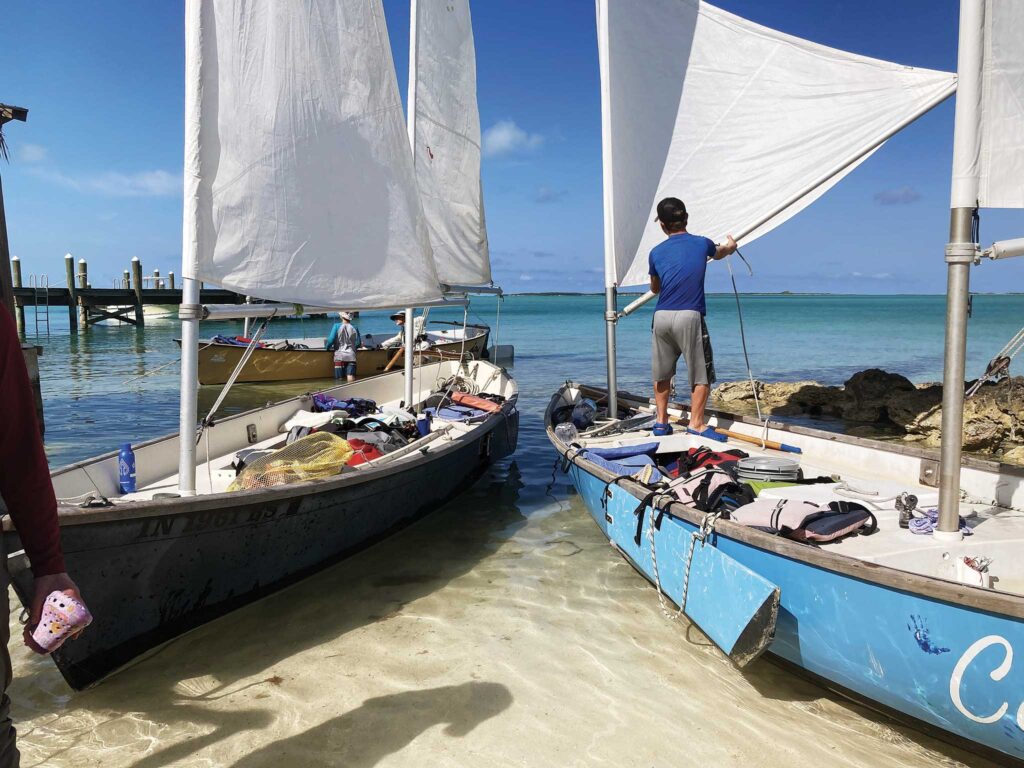
Bahamas: Exuma Cays, two-week round trip on rented 21-foot Sea Pearls: Older, wiser, a group of us rented small open boats and camping gear out of Great Exuma. I was disappointed that the cost of renting was more expensive than the $600 entry fee to international cruising I’d grown accustomed to, but even at twice that price for two weeks it was still a bargain compared to other comparable charter options.
While the price was disorienting, lucky for me the boats were familiarly crappy. We mended sails mid-trip, repaired fiberglass, swapped out lines, and pumped a lot of bilge. I was home.
Twelve of us ages 6 to 80 took three boats for two weeks of close reaching up and broad reaching down in the lee of the fabled Exumas island chain. As in Baja, we went to the cruiser destinations to get water and fresh vegetables, but we camped each night on beaches that were all our own. Every night was like our personal island resort, without the resort. The three oldest members of our armada had all met in the Exumas in the 1970s Pardey wooden boat hippie heyday. They had extensive local knowledge they acquired running bales of marijuana (allegedly) from the Exumas to Miami in the innocent days of drug dealing before the cartels made everything so dangerous and decapitate-y.
We had great sailing, beach iguanas, swimming pigs, snorkeling in the Thunderball Grotto—the whole Exumas experience, all without once worrying if anyone’s anchor was dragging.
What does it all mean?
Maybe this: Try less.
Dirtbagging isn’t for everyone and is “less” in every sense of the word other than the experience. Bucket life is no joke, and there’s no part of me that would want to spend too much longer on any of the boats that we’ve dirtbagged, but the same way that REI tapped into people who wanted to go camping in something that wasn’t an RV, there’s another way to sail the world without crossing oceans in what is functionally a floating Winnebago.
I recently concluded that as much as I love sailing, I might hate boating (at least the Winnebago parts). I want to be sailing, in nature, ideally both. I don’t need colder ice, another place to watch Netflix or make margaritas. If I wanted comfort I’d stay home. I want to be out there, in the wind and on the beach, reconnecting with the blue parts of this incredible blue marble. If you find yourself wanting more, give less a try. I’ll send you a bucket.
June/July 2025