It is said that if you want to understand the tides you must first know the moon. That big, beautiful orb that shines down upon us all is master of our oceans and must be fully appreciated before traveling safely on salty water.
A moonlit night has always been particularly welcome on my boat; it illuminates the waters ahead and takes some of the anxiety out of a night passage, helping pass the time through the middle watch until dawn. And like migrating birds, seals, and sea turtles, the moon assists me in staying on course. But it’s also a reminder that the ocean is constantly changing.
With nary a whisper, the moon pulls upon our oceans and creates the tides, playing its part in a never-ending celestial tug-of-war with the Earth. As the moon travels it creates a “tidal bulge” of water on the near and far sides of the world, drawn from the sides which are at a 90-degree angle to its meridian. And though the sun contributes, it is the moon that has more influence by virtue of its proximity to our planet.
Depending on where you boat, the tides vary greatly, from barely noticeable in the Mediterranean, to roiling tumults that empty entire bays in the Canadian maritime provinces, creating “reversing falls rapids” in narrow passages. Many North American rivers like the St. Johns or Sacramento reverse their flow four times per day and push saltwater upwards of 30 miles upstream. In Turnagain Arm near Anchorage, daily tidal bores create long standing waves that carry wet-suited surfers on a thrilling ride that can last up to ten minutes. But the most terrifying tides occur in the whirlpools of Passamaquoddy Bay, Maine, and Skookumchuck Narrows, British Columbia, where it’s best to stay well clear until slack water.
Many new boaters learn the hard way about moon and tides. It’s embarrassing to say this, but there was a time when I was so green I thought spring tides happened in the spring. No, I learned, they occur every two weeks just after the moon is full or new. And the soundings we see on charts, it’s not uncommon for actual depths to be less than what is printed at spring lows!
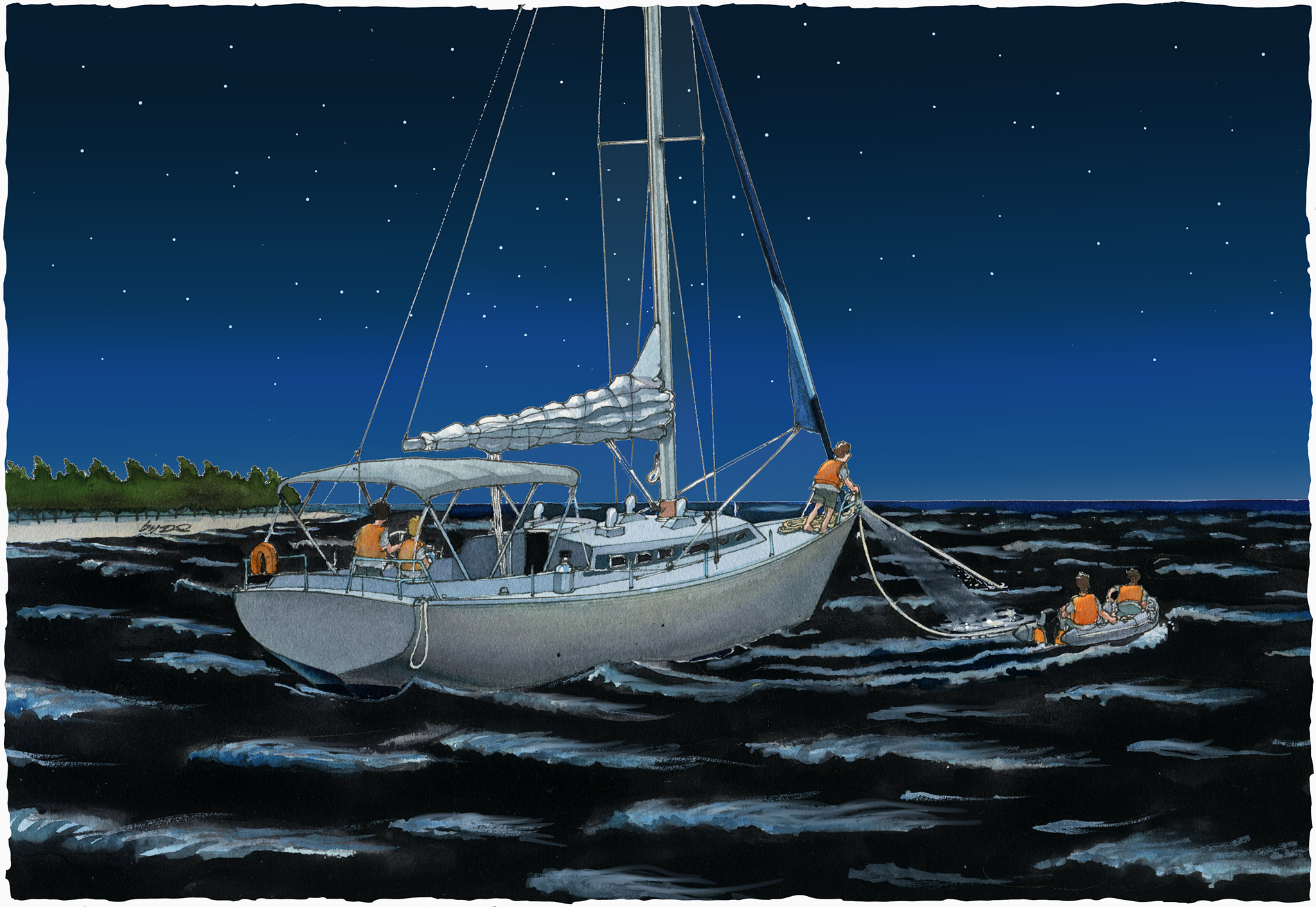
My hard lesson came after missing a nav aid and running aground in my new boat near Sugarloaf Key. I flipped through the tide tables and was mortified to see that we were at high tide. The towboat guy arrived and was optimistic but realistic: “Well,” he said. “At least it’s not a spring tide, you’d be stuck here for two weeks. Let’s try again in 10 hours.” And off he went. All night I sat there in my cockpit being eaten by bugs, staring at a scornful moon as we listed hard over. “Never again!” I shouted back. Oh boy, was I naïve.
Even without tide tables, anyone can see what the moon phase is. Full or new means higher and lower tides; a quarter or half tells us that tides should be around average for that location. And in the northern hemisphere, if you can reach up and “cup” the moon with your right hand it’s waxing, with your left hand it’s waning.
Another moon myth is that high tides occur when the moon is above you, or on the opposite side of the Earth. No, the Earth is an imperfect sphere, with myriad land masses and varying ocean depths that greatly affect the traveling bulge of the lunar tide. Imagine dumping a bucket of water on the peak of your roof. By the time it gets to the gutter the shingles will have diverted and slowed it into many trickles. And I should add that Pink Floyd was incorrect when they sang, “I’ll see you on the dark side of the moon.” There is no dark side, just a near and far side locked in place due to Earth’s gravitational pull.
The tides come in different flavors: one high and low, or diurnal tide cycle, in the Gulf of Mexico and western Alaska; semidiurnal on the East Coast; to mixed semidiurnal along the West Coast. Tidal information is easily obtained online at one of the various NOAA websites. Do not overlook, however, that the tides are “predictions.” The true tides can at times vary greatly from what was posted, depending on various environmental factors and weather events. And perigean spring tides, something we’re seeing a lot these days, occur when the moon’s elliptical orbit brings it closer to the Earth and raises tides enough to flood streets.
So next time you’re underway look upward and take note of the moon’s appearance. Its shape will give you a good idea of what the tide will be like and how to avoid an unplanned shouting match with the sky.
This article was originally published in the August/September 2026 issue.