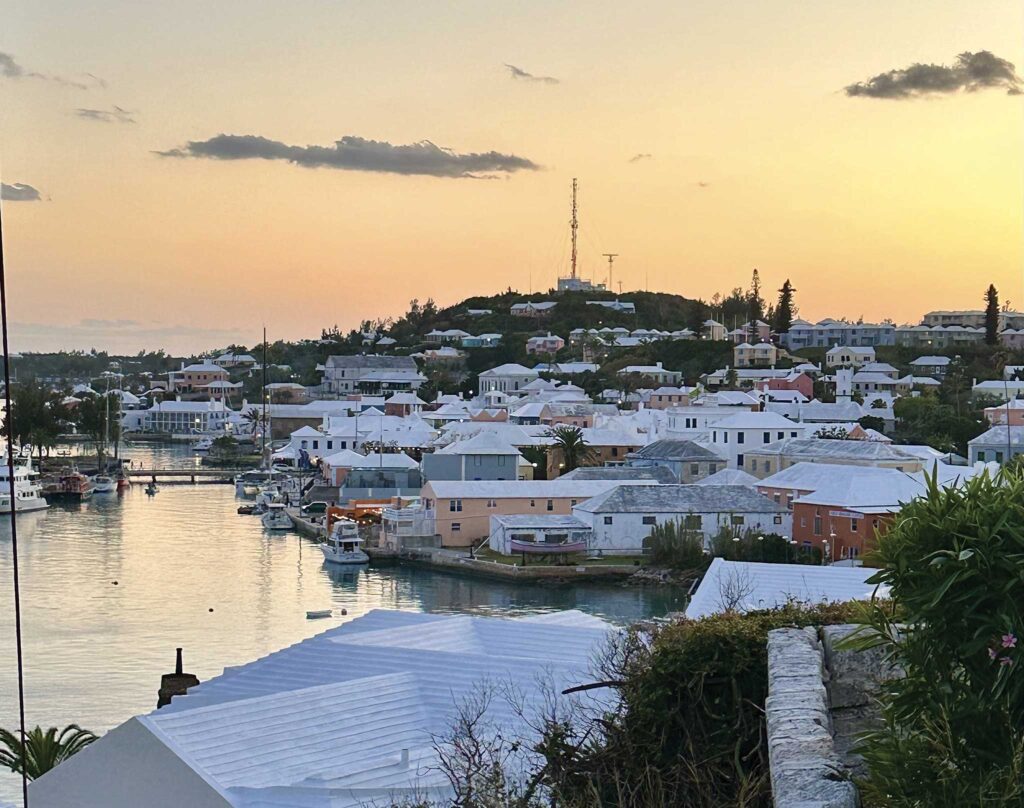
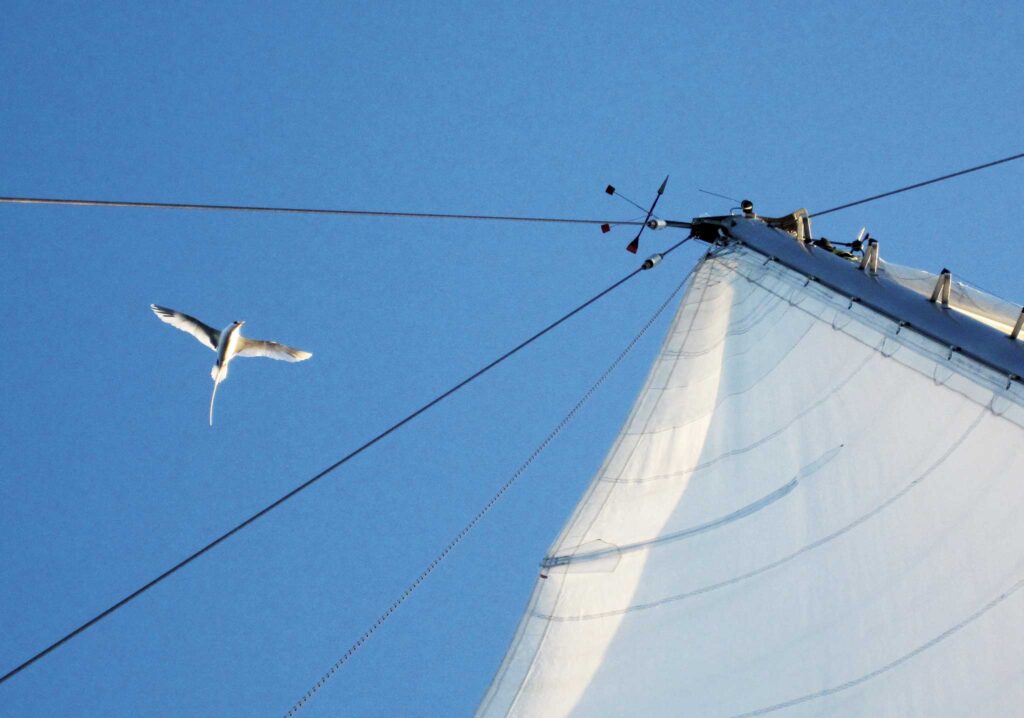
Heavenly bodies soared out to greet us on our approach to Bermuda. First, an angelic tropicbird dazzled with her tail and her grace as we closed within a few hundred miles of the island. Later, at 30 miles out, Bermuda Radio boomed aboard from the dark of night like the Voice of God. The shockingly loud and clear VHF transmission rang with definitive authority, artfully balanced against a calm tone of welcome. It was the first outside voice we’d heard in a week. With our anchor down inside the perfect protection of St. George’s Harbor, the blissful calm after constant motion at sea helped reinforce our suspicion that we had died and floated into heaven.
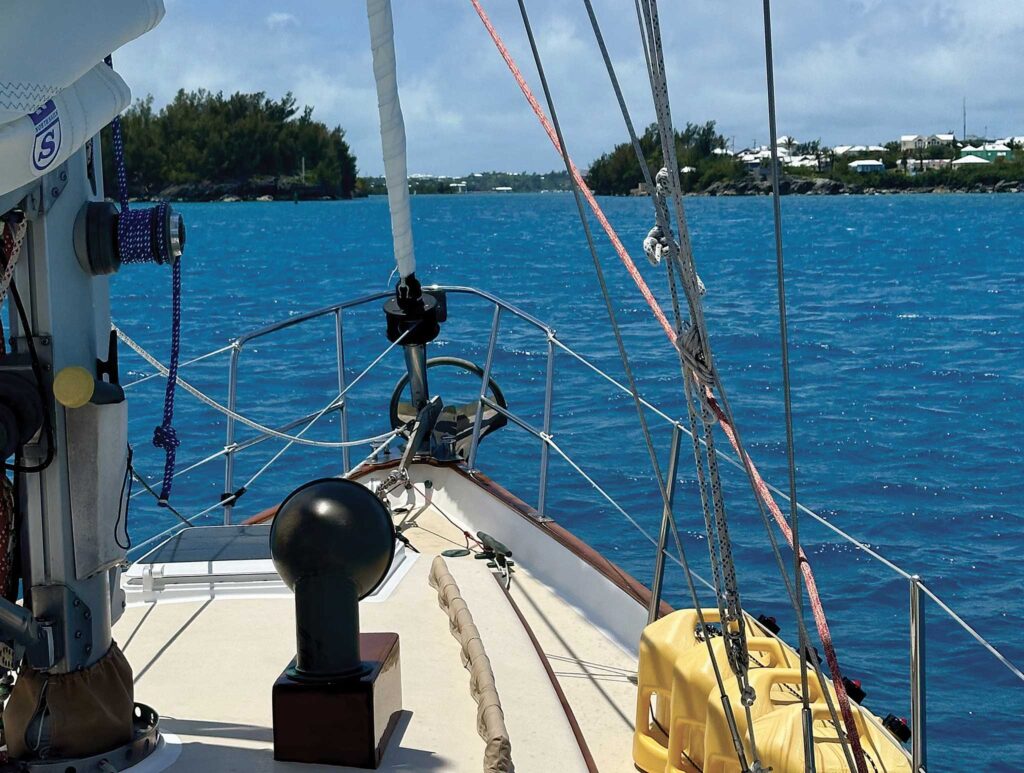
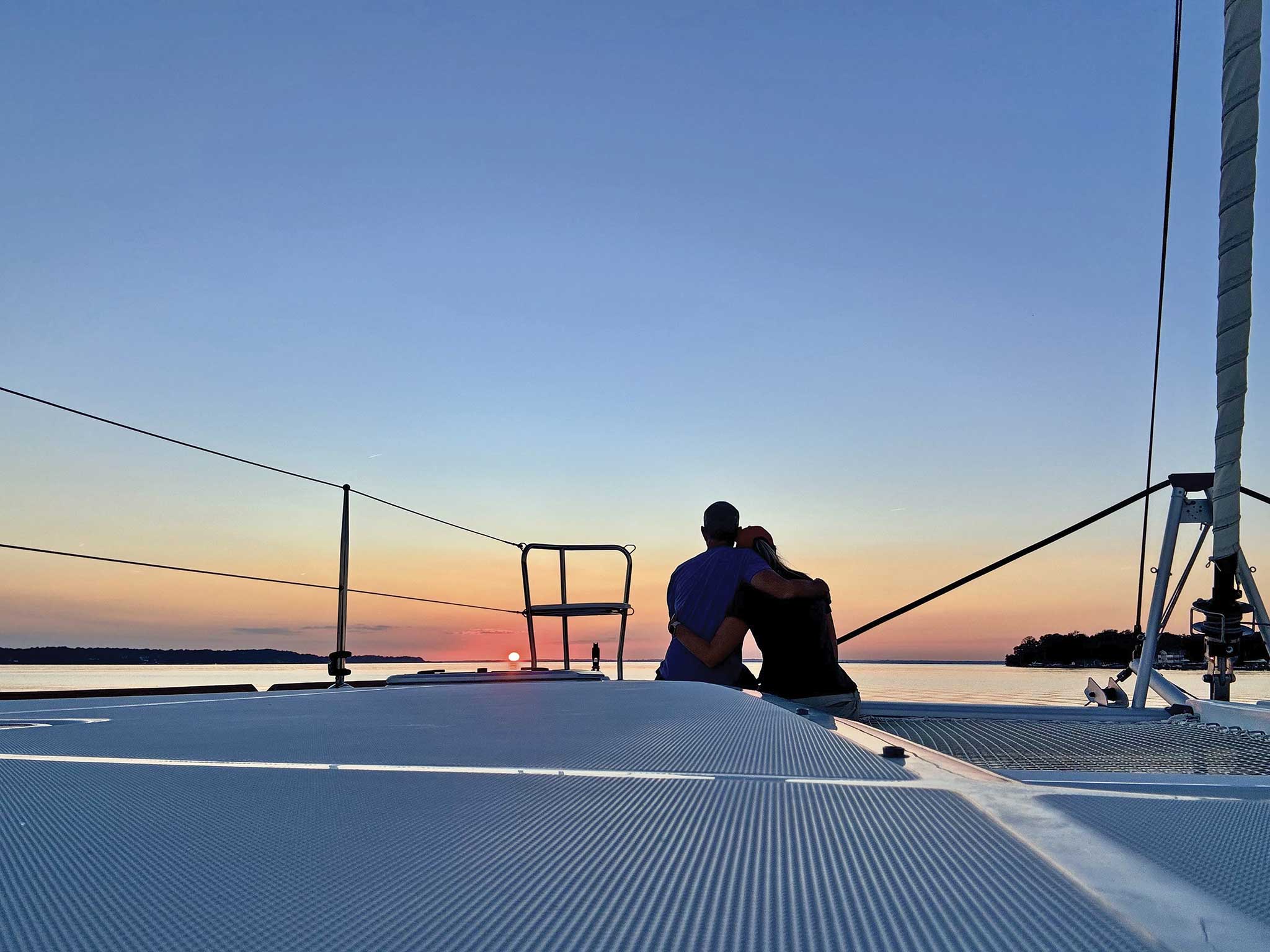
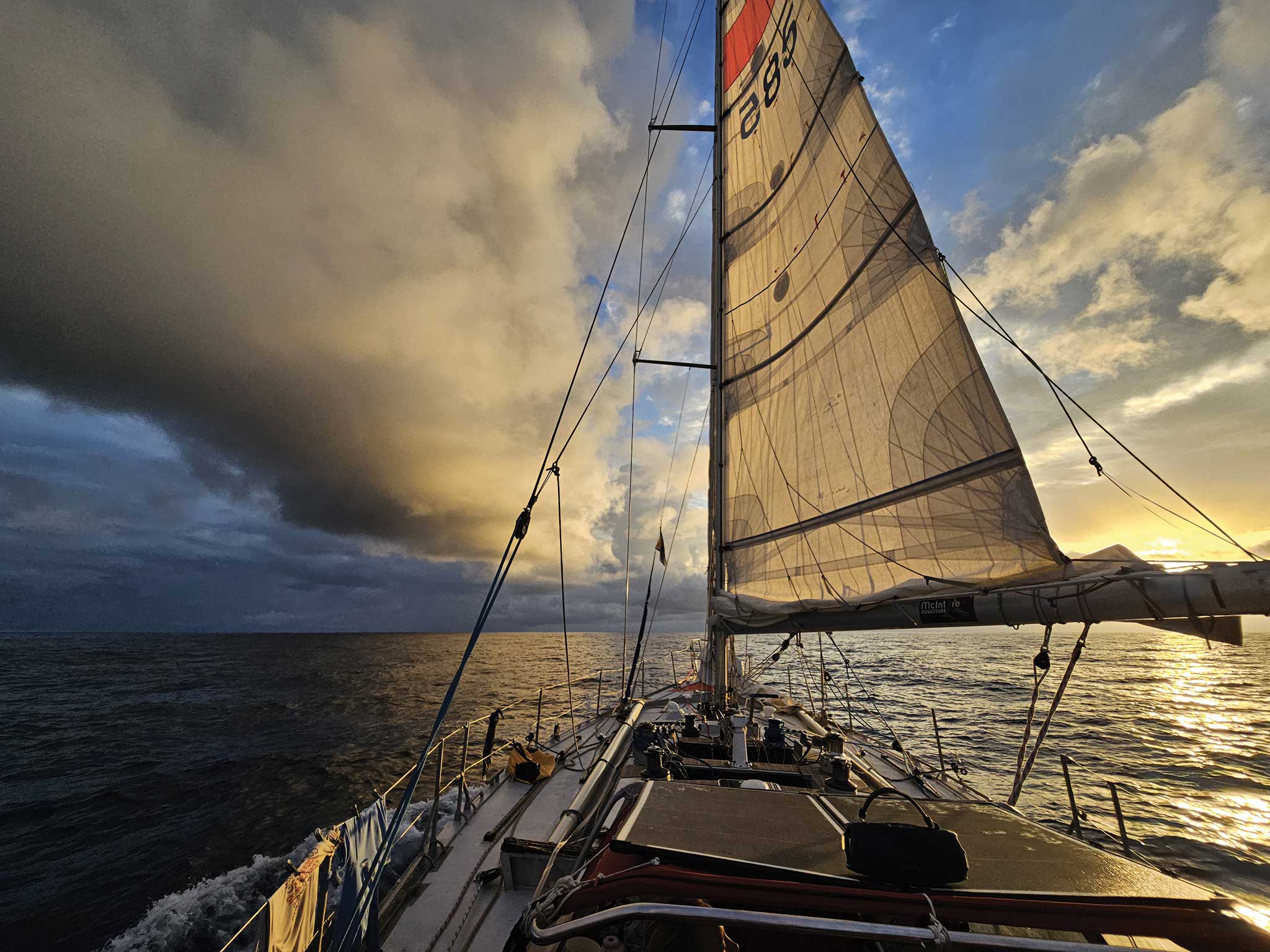
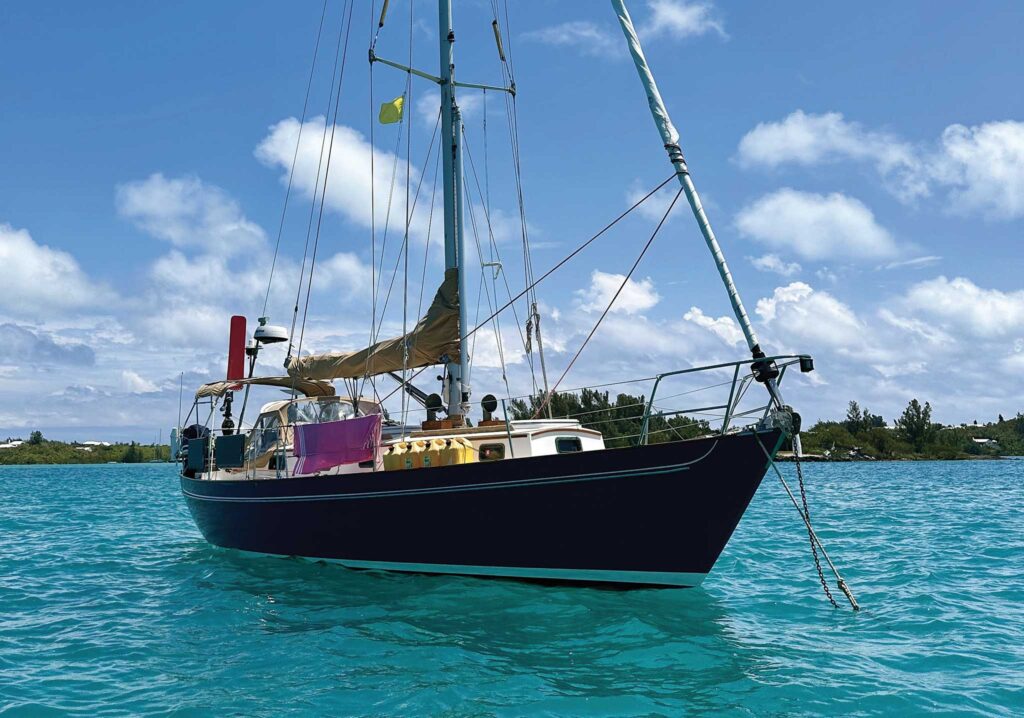
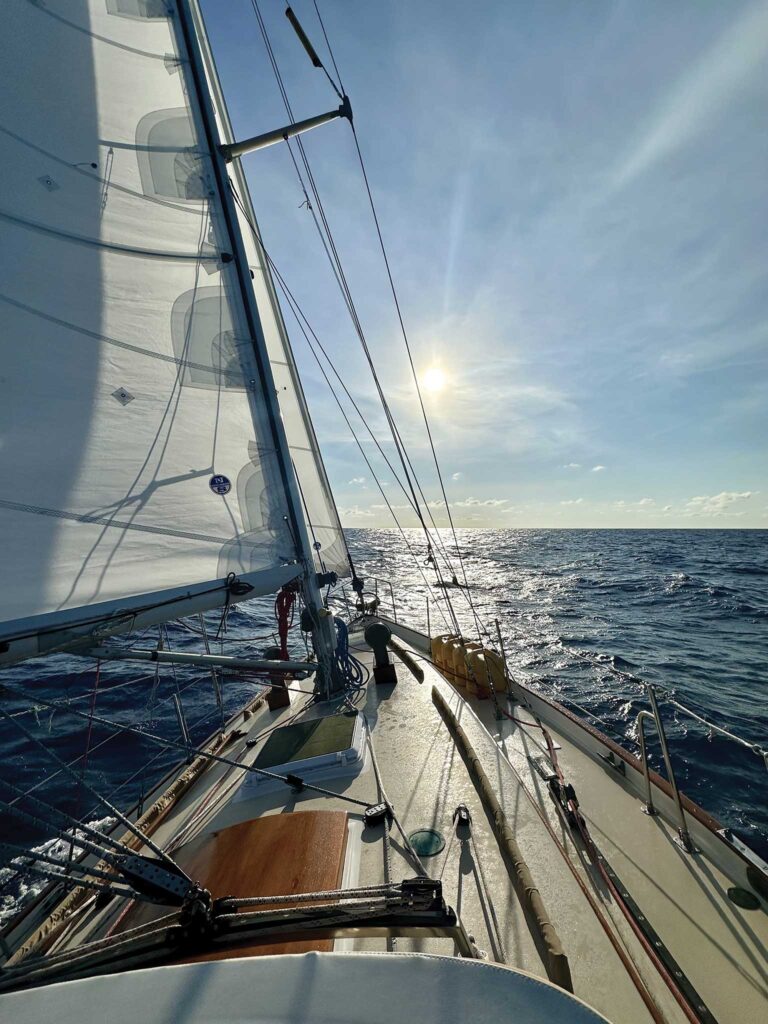
This was May of 2024, when my wife, Alex, and I sailed our 36-foot Morris Justine from the Bahamas to Bermuda as the first leg of our transatlantic summer sail to England. We navigated the Bermuda Triangle for the entirety of this leg, but nothing untoward happened. In fact, we never even needed to tack, jibe, reef the sails, or run the engine during any part of our 758-mile passage. A moderate and steady southeast wind kept us on a comfortable starboard tack reach the whole way, making for a pleasant five days at sea. We saw none of the squally cells of thunder and lightning often found in these waters this time of year. Our biggest misfortune was a brief period of complete calm during which we dropped our slatting sails and bobbed. Four hours later, the old southeast wind returned as predicted, and off we went on a familiar starboard tack, same as it ever was.
Arrival Notes
Visiting yachts are required to contact the all-powerful and omniscient Bermuda Radio on VHF-16 when on approach. If you don’t call them, they will call you.
All cruising sailors arriving independent of a scheduled race event are required to clear in at the customs and immigration offices on the east end of Ordnance Island in Saint George’s Harbor.
During our visit in the summer of 2024, Covid protocol requiring an expensive cruising permit or transient permit had just been relaxed, and no alternate protocol had been enacted in its place. After filling out a few simple forms, we were welcome to stay in the country for up to six months at no charge. Don’t expect it to stay this way. A new cruising permit protocol and matching fee structure is rumored to be drafted soon.
Along the way, we saw a pair of German warships, a lone oil tanker, several testy spats of fish-on-fish violence, hundreds of dolphins, thousands of flying fish, one idle shark, and one idle plastic beverage crate. Then, on day three of our passage, while becalmed, the bird showed up. Our spirits were already high, and this white-tailed tropicbird mirrored them perfectly. She soared majestically around us, the tangent of her arc just missing our rigging again and again. She vanished periodically, flying off to who knows where, only to return and grace us with her company anew, each fresh arrival delivering another thrill guaranteed to plaster smiles on our faces. At her insistence, she escorted us all the way to our landfall. The bird cut an elegant profile, and it turns out we weren’t the only ones enamored by her beauty. Bermuda has adopted her as its national bird, and you’ll find her depicted on the back of every one of that country’s 25-cent coins.
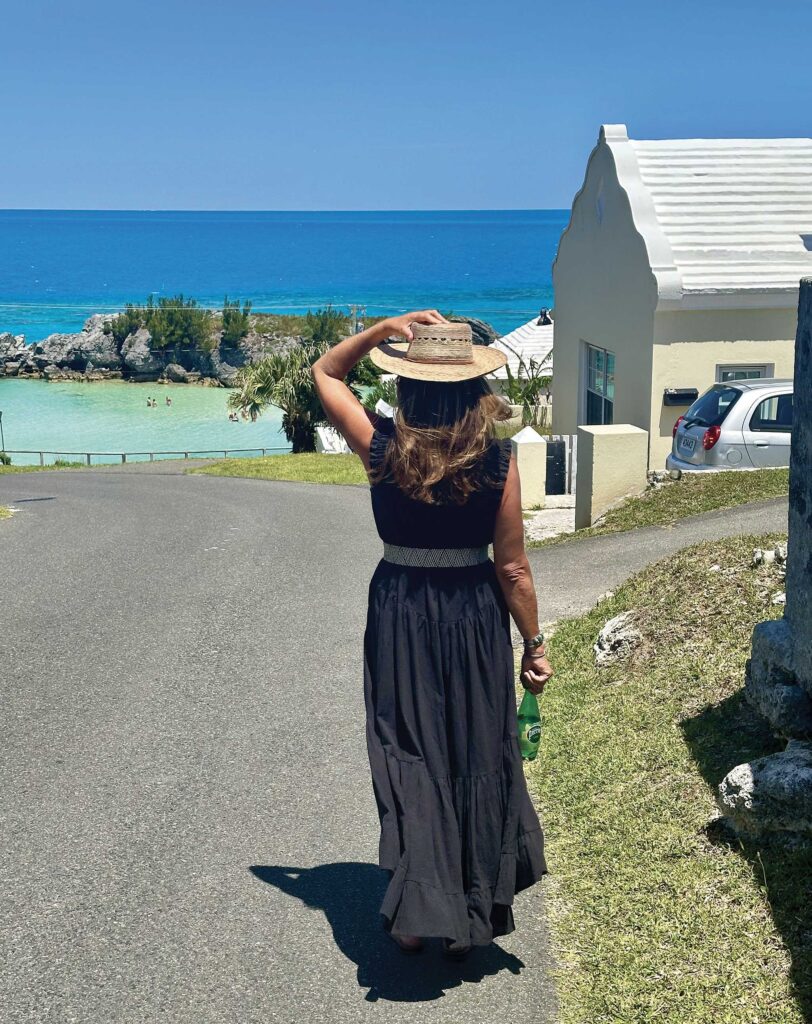
Spaniard Juan de Bermudez discovered this small panicle of islands in the middle of the Atlantic Ocean back in 1505. The English arrived next and set up shop in the early 1600s. Bermuda remains a British Overseas Territory today. The 21-square-mile island nation is actually composed of 181 different islands and islets tightly clustered together, with many connected by narrow, limestone-wall-lined roads channeling a never-ending buzz of scooter traffic. In case you’re wondering how this scattering of islands was flung this far out in the Atlantic, here’s some explanatory info from Britannica: “The coral islands of Bermuda are composed of a layer 200 feet (60 meters) thick of marine limestone that caps an extinct and submerged volcanic mountain range rising more than 14,000 feet (4,300 meters) above the ocean floor.”
As is often the case in sailing, there’s a big difference between racing and cruising to Bermuda. During our stay, none of the big races were on (the biennial Newport-Bermuda being the best known and most venerable), and the island was not full of racing sailors from Newport or Annapolis. Instead, we sailed in alongside a solo sailor on a green steel boat from Argentina. He hadn’t answered the celestial calls from Bermuda Radio, which I overheard coming at him repeatedly. Maybe his English was frail, or maybe he didn’t have a working radio aboard. One thing he did have aboard, I soon learned, was a big gun, and that weapon and its quiet owner were slowing up the flow of business ahead of us at customs and immigration in a big way.
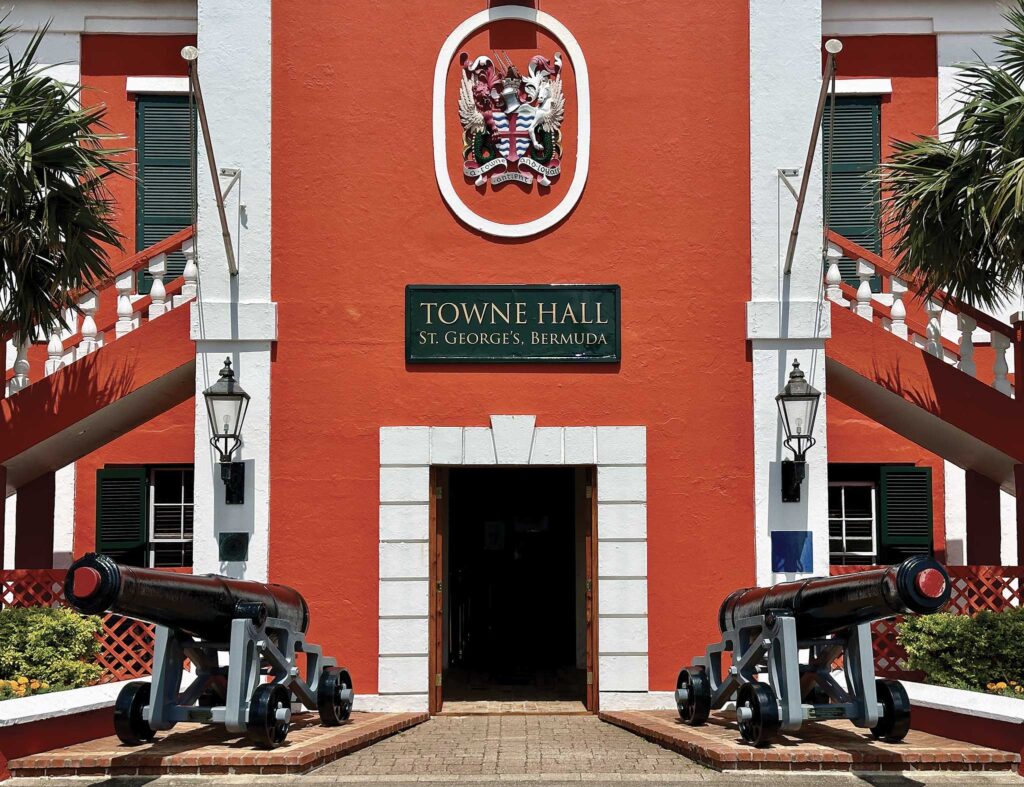
The rifle in question sat on a table in the office, surrounded by a team of uniformed Navy officials, each holstering a gun of their own and locked in some sort of debate. Meanwhile, the Argentinian sailor stood outside with me, looking uneasy. I guessed he wasn’t part of a race committee and the gun wasn’t a sanctioned race committee tool of the trade. My new friend’s English was every bit as bad as my Spanish, so we just stood there sweating and thinking our own thoughts, him smoking and me not. Fortunately, all the bullets stayed in all the guns, and eventually, everyone went on their way peacefully. We would later see the same green Argentinian boat and the same solo sailor, still smoking, in Horta. Whether or not he’s still toting that firearm around remains an open question.
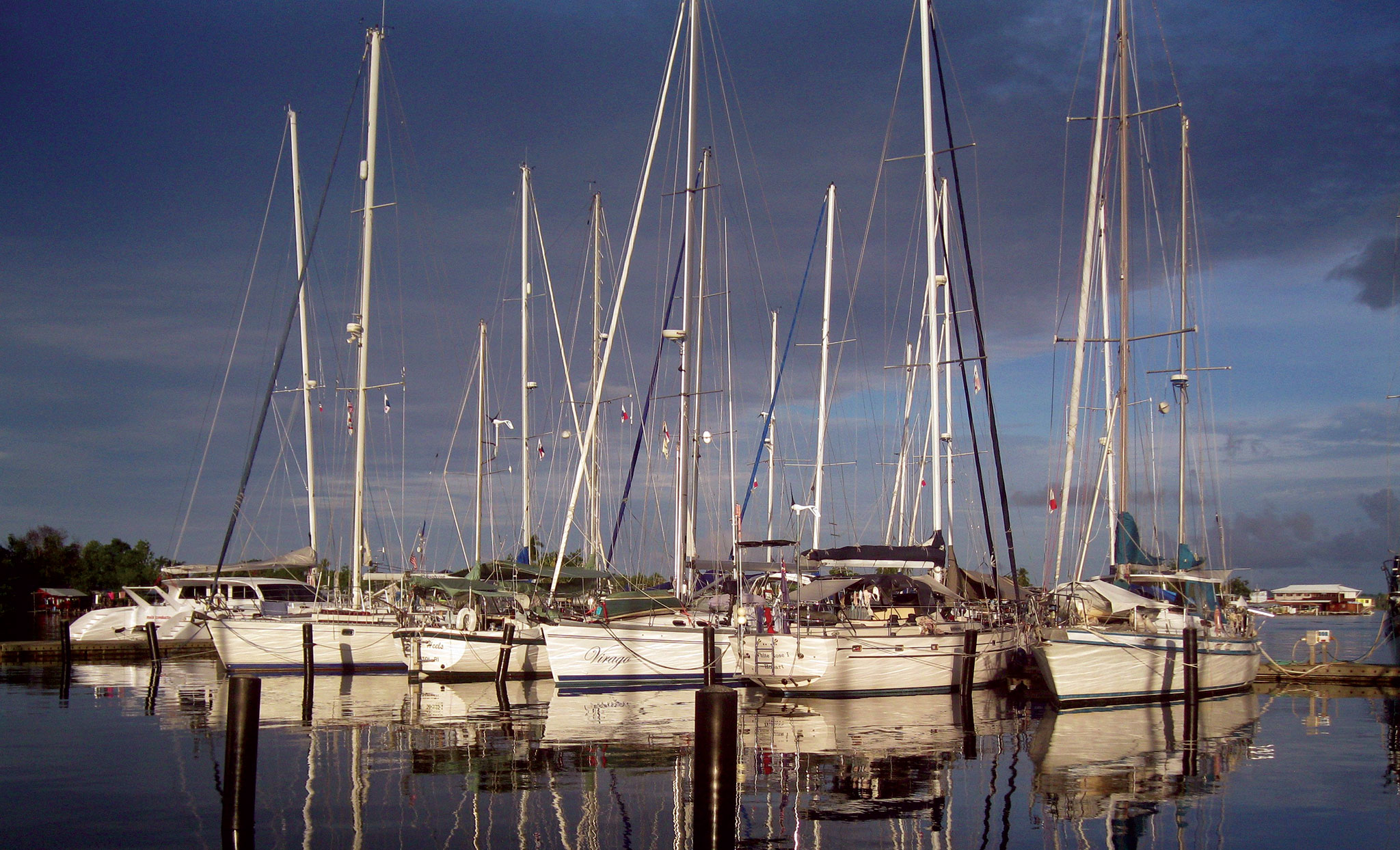
After our tense moments clearing in, the mood in the anchorage was relaxed. The languorous song of whistling tree frogs filled the night (two species call Bermuda home, and their trilling love songs are as signature a sound track here as the ubiquitous scooters during the daytime). Youth sailors parading under bright pink sails took over the entertainment during our morning coffee. This time through Bermuda, we were decidedly in a cruising gear, and so was everyone else.
The island lies along several popular ocean cruising routes, and as is typical for such far-flung crossroads, the sailors came from all over. Some, like us, were outward bound, sailing for distant horizons. Others were making a final stop in Bermuda before heading home after a long voyage. Bermuda is remote, and every sailor anchored in the harbor had put in significant sea miles to get there. Luckily for us, we got to meet a few of them.
The friends you make on the dinghy dock are one of my favorite aspects of voyaging under sail. Where else would you find so much in common with a complete stranger? Despite the fact that we’re all awkwardly clambering in and out of small boats on hands and knees, most of us still muster the courage to say hello. Once upright and eye to eye, sailors of different ages, budgets, and nationalities form community with remarkable ease on these floats. I’ve noticed that beautiful tropical fish congregate in the water around the dinghy dock in St. George’s, and I think they gather there to be entertained by us humans when and where we are at our best.
We swapped books and scheduled yoga classes with the American crew on Altair, who were en route from the Chesapeake to the Virgin Islands. Then we swapped weather intel and route planning opinions with the Dutch crew from Sea Monkey, who like us, had plans to sail on toward the Azores. New French sailing friends were made in the Finish Line Laundromat nearby, and there were others with whom we exchanged smiles in Bermuda and later exchanged formal introductions after completing the crossing to the Azores. For us, Bermuda was a pearly gateway opening toward an Atlantic summer spent sailing in community.
The Town of St. George’s, draped in the delicate and seductive smell of oleander and frangipani, has much to offer the visiting sailor. There is no shortage of places to enjoy a dark ’n’ stormy upon arrival. (Side note: The official dark ’n’ stormy is always made with Goslings dark rum and ginger beer—originally Barritt’s, also Bermuda made—and it’s purportedly the island’s national drink. A quick Wikipedia check reveals a remarkable amount of litigation surrounding the cocktail, which happily does nothing to diminish its spicy goodness and popularity among sailors.) To sober up, a rail trail stretches along the north coast and provides miles of hiking or running with a view. The beaches at Tobacco Bay, Gates Bay, and Drew’s Bay are all walkable, and the well-run Bermuda public bus system makes the rest of the island readily and affordably accessible.

Fortunately for us, the needs of our boat were few. She was running strong, and we had no boat repair issues to address. We make our own water and didn’t need fuel, so other than provisioning with fresh perishable foods, we were entirely ready to keep sailing.
This meant that instead of boat work during our stay, Alex and I took advantage of the public transit option for a day trip down to the beautiful pink sands of Elbow Beach on the island’s south shore. Another pink bus, on another day, took us to see the capital city of Hamilton, site of the 35th America’s Cup, a fact that is still being celebrated. Hamilton is also home to an excellent kitchen store where we found a much needed corkscrew and a colander to help keep our little ship running smoothly. The proprietor used to be a commercial fisherman. He knew the local waters well and loaded us up with facts about our favorite tropicbird: She mates for life and lays only one egg per year. She spends summers in Bermuda and winters at sea. The older she is, the longer her tail. In Bermuda, her nickname is “The Longtail.”
The man in the store also told us where to go to lunch and what to order. Lunch ashore is always a luxurious treat for a cruising sailor, and this is especially true in Bermuda, where a unique fish sandwich on raisin bread is an island specialty. After the first bite, we were hooked and needed more of this delicious and unusual collection of ingredients. Without even knowing it, the corkscrew/colander/bird man had started us on a quest to find the best fish sandwich on the island. Lunch stops became a focus of our days for the remainder of our time in Bermuda. Raisin bread, who woulda thunk? Is that really what makes the sandwich so special? Or is it the sauce? Alex and I chewed over that question for days without arriving at a definitive answer. Eventually, we were able to unanimously agree that, regardless of what made it work, the sandwiches at the iconic, no-frills lunch spot, Munchies, in St. George’s, are the best on the island. By the look on his face, my Argentinian solo sailor friend seemed to agree with us, but once again the language barrier denied confirmation.
We also made new friends in God’s house. With the heavens on the brain, we figured it would be prudent to drop by a church once ashore. Truth be told, we routinely attend religious services of all stripes while in foreign lands because we find the practice offers an interesting window into the culture of a place. So as not to offend, we always make a point to stay from start to finish. Sometimes our patience has been tested—that three-hour service in Sri Lanka, none of which was in English, comes to mind—but in general, we find the habit rewarding.
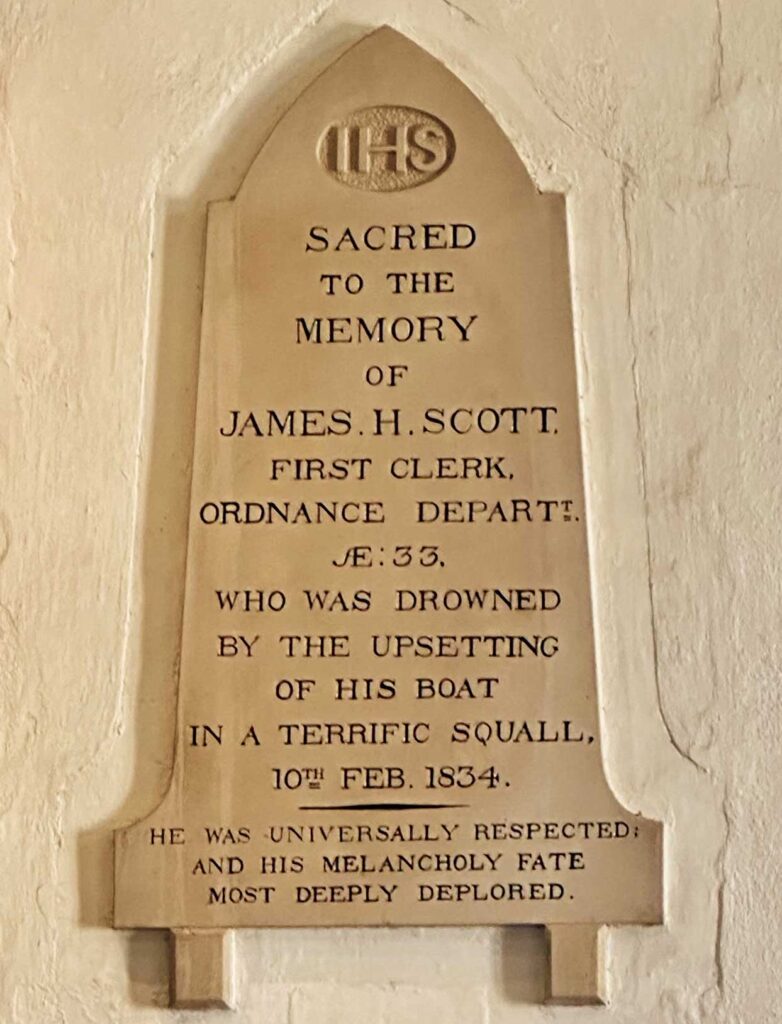
Our visit to St. Peter’s Church, mere steps away from the dinghy dock in the Town of St. George’s, was no exception. The service served up some ye olde Church of England vibes with prim-and-proper efficiency. Connections to the surrounding ocean were impossible to miss within. According to ornate wall plaques, many of those entombed in the church had lost their lives at sea. Maritime history was etched into stone walls with a chisel and worn into pew railings by salty palms. Their Majesties Chappell, Saint Peter’s Church was established back in 1612, making it the oldest Anglican church in continuous use still standing outside of the British Isles.
The congregation was comprised of locals and visiting sailors from the anchorage, and we met many of them after the service. An inspiring crew on a catamaran was returning to the U.S. for good after a decade of sailing the Eastern Caribbean. We also met a Canadian sailor who was boat-sitting a sloop anchored near our own, and two young German brothers who had logged an impressive number of miles on a small boat with a tight budget. After a while, it started to feel like we were back on the dinghy dock, but that notion faded quickly when we met a Brit who now resides on the island and droned on at length about golf.
The church announcements made mention of a big, island-wide, majorette and dance team showcase event that just so happened to coincide with our stay in the harbor and was conveniently located on a playing field within walking distance of the dinghy dock. Yes, we went. And yes, it was awesome. I’m happy to report that the art of formation baton twirling in bedazzled costumes is alive and well in the middle of the Atlantic Ocean. We might have even found a food truck serving a fish sandwich on raisin bread there too.
At one point during our carousing ashore, we ended up at the East End Mini Yacht Club bar. As luck would have it, the club was hosting a raffle that night to benefit their youth sailing program. A handsome collection of moderately valued and highly desirable items was on offer—a Bluetooth speaker, a jumbo-sized box of peanut M&Ms, a colorful pair of palm tree-themed oven mitts—all things that could truly make your boat a better place. But there was one prize towering over the rest, both literally and figuratively, that had everyone lining up to purchase raffle tickets in bulk, myself included. That prize was a 15-pack of paper towels.
What is it about a paper towels that makes them so deeply appealing to the cruising sailor? Paper towels are a bad habit, after all, and you’re meant to learn to live without. Really, you’re supposed to just push around a dirty rag instead and ignore that nagging suspicion that you’re now cleaning the galley counter with the same rag you wiped the engine dipstick with last week. Paper towels are ethically compromised, wasteful, bulky to stow on a small boat, and expensive—especially when you’re outside the U.S. on a small island in the middle of the Atlantic Ocean. But they solve so many problems on a boat so effectively, and they are just so clean and so damn desirable.
I was wrestling with a forbidden fruit conundrum, and the beer wasn’t helping. I bought another dozen raffle tickets, as did everyone else in the bar. The kids in this youth program were surely going to be sailing those shiny new ClubSwan 36s next summer by the time this raffle ticket frenzy was over. On day five in Bermuda, I found the serpent in her Garden of Eden. That’ll happen when you go carousing ashore. And what exactly does the prudent mariner standard say about navigating the muddy waters of the River Styx? Is making that crossing with a 15-pack of paper towels stowed in your V-berth an acceptable practice? Or not? Unclear. Also, for us, irrelevant because we didn’t win that prize. Or any prize.
When a weather window for departure onward to the Azores presented, several boats sailed out Town Cut along with us, taking advantage of the same weather to get to the same destination. We chatted with a few of these crews during our 13-day sail into the rising sun, comparing sea conditions and weather forecasts as we progressed. Then, when we were all finally tied up in the westernmost point of Europe, we gathered ashore, where the hours unspooled late into the night as we traded stories over 1€ Sagres beers up on the hillside at the Club Naval in Flores. There is no better way to bond with your fellow human than to sail across the same ocean at the same time. For this sort of connection, Bermuda is every bit as much of a starting line as it is a finish line.
When we finally reached England, it was the dance of the heavenly white-tailed tropicbird escorting us across the sea toward Bermuda that Alex remembered most fondly from our summer sail. And it was the profile of this winged seraph she chose to have tattooed on her arm to commemorate our Atlantic crossing. It would be her first tattoo.
How Remote is Remote?
Bermuda is the fourth most remote island in the world. Put that in your pipe and smoke it.
Wait a minute; this can’t be right. Bermuda is just out there off North Carolina. What about all those faraway islands in the Southern Ocean and distant South Pacific?
Well, look at these numbers. The top five most remote islands in the world are:
1. Bouvet Island. Closest land is Antarctica, 1,018 miles away.
2. Ascension Island. Closest land is Saint Helena Island, 799 miles away.
3. Saint Helena Island. Closest land is Ascension Island, 799 miles away.
4. Bermuda. Closest land is Cape Hatteras, 643 miles away.
5. Trinidade and Martim Vaz. Closest land is Ilha de Santa Barbara, 634 miles away.
These familiar names might not be as remote as you had thought:
Tristan da Cunha Island. Closest land is Gough Island, only 200 miles away.
Elephant Island. Closest land is Antarctica, only 152 miles away.
Easter Island. Closest land is Isla Salas Y Gomez, only 200 miles away.
The Kerguelen Islands. Closest land is Heard Island, only 240 miles away.
Pitcairn Island. Closest land is Mangareva Island, only 427 miles away.
So, is distance from another land mass a fair way of thinking about the concept of remoteness? You be the judge.
June/July 2025