
The dog days of summer are upon us, and while warm winds and brilliant sunshine are a sailor’s dream, there’s not so much to enjoy when you’re at anchor or on a mooring on a windless day with the sun beating down. The balmy night temperature that was perfect for sleeping can become oven-like as the boat heats up in the afternoon and what’s worse, the heat often lingers down below even after it’s cooled down outside.
Short of owning a boat equipped with a generator and air-conditioning, there’s not much you can do about keeping your cool in summer heatwaves—or is there? There are actually a number of ways to keep onboard temperatures if not fridge-like, then within the bounds of comfort. Prime among them are shade and air flow.
Throw some Shade
If there’s one instinct common to humans and animals it’s the need to seek shelter from the heat of the sun. Biminis are ubiquitous in southern waters and are increasingly seen on boats in the north. Over the years these have morphed from modest sunshades that screen the helmsman and can easily be folded out of the way to extravagant affairs that cover the entire cockpit and are, in effect, permanent structures. More commonly, existing dodgers can be modified with infills that zip between the dodger and bimini to protect the crew. Of course, these restrict the view of the sails so are best left unrigged while underway.
I’ve noticed an increasing number of longterm cruising boats equipped with full cockpit enclosures, from within which the occupants peer out at their surroundings like aquarium fish. To tell the truth, I wished for one myself while on the ICW last November, but it’s the last thing you want in the summer when airflow is paramount. Detachable side screens of Sunbrella or shade cloth, which you can buy from hardware stores, are a more sensible idea for the typical sailing boat.
A Shadetree awning can be left up underway
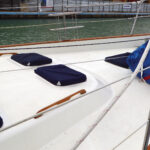
Homemade fabric hatch covers help keep the interior cool
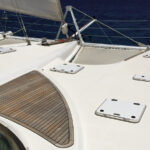
Hatch covers like these from Outland help keep your boat cool
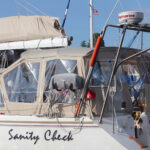
This longterm cruiser has a full enclosure
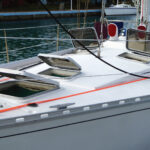
Plenty of opening hatches keep air moving

An inexpensive tarp adds to the protection of the bimini
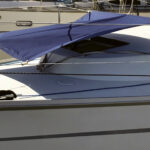
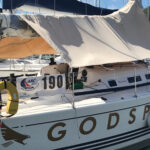
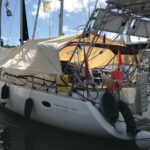
When in doubt, cover it all up
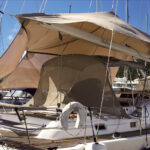
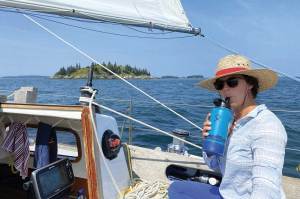
The crew of this bluewater boat have learned a thing or two about shade
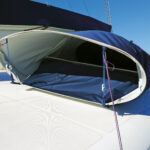
ATN’s Dorcap lets the breeze in but keeps rain out
Regardless of whether or not a boat has a bimini, a fabric awning that drapes over the boom is a good idea, for it shades more of the boat and keeps the sun from heating up the deck. Many longterm cruisers adapt their awnings to catch rainwater. A basic awning is easy to make if you have a sewing machine and the skill to use it and not expensive to have made professionally. More sophisticated awnings are also available, such as the Shadetree, a Conestoga-like curved awning that is mounted high enough to walk under.
It’s one thing to keep the sun off the boat; it’s another to keep it out of the boat. Even the best of awnings can’t shade all of the hatches and portlights all of the time. As well as heating up the interior, sunlight fades interior furniture and fabrics. On one boat I sailed on recently, the owner had cut up a couple of the reflective sheets you put in car windscreens and stuck them to the inside of the portlights with Velcro. Unlike curtains, which absorb heat, these reflect sunlight. The trick also works on deck hatches.
However, it looks better and doesn’t cost much to have Sunbrella fabric covers made to slip over the outside of your hatches. These are attached with snaps or tensioned under the hatch lip with a drawstring. Another approach is the nifty made-to-measure expanded PVC hatch covers made by Outland Hatch Covers, attached with twistlock fasteners. Whichever way you go, you’ll find hatch covers have the added bonuses of delaying the inevitable crazing of the plexiglass in hatches and keeping your sleeping cabin nice and dark.

Chute the Breeze
On those scorching high-pressure afternoons where scarcely a ripple of breeze teases the water, it’s essential to make the most of whatever wind there is and keep it moving both over the boat and through it. The go-to for many sailors is the Davis Windscoop, made of lightweight nylon, which works very well when the boat is facing into the wind. Four-way scoops that funnel winds from abeam or astern are more versatile; examples include the Breeze Bandit from Cruising Solutions and Plastimo’s Omnidirectional Wind Scoop.
These must be rigged on a halyard or topping lift; if you prefer free-standing scoops, the Breeze Booster can be secured to any opening hatch and face in any direction. The same company makes a portlight wind scoop, which would be a boon for anyone sleeping in a stuffy aft cabin.
One issue with wind scoops is the scramble to take them down and close the hatches in a rain squall. ATN’s Dorcap, a freestanding scoop with a baffle to keep out rain, looks like a good answer to this problem.
As with most other items of canvaswork on a boat, any sailor who is competent with a sewing machine could easily make his or her own wind scoops.
To keep air moving, a fan in every sleeping cabin and as many as you like in the saloon and galley will be a blessing. Twelve-volt fans like those made by Caframo or Hella use little current and most can be angled to point at wherever you are currently snoozing. Caframo’s Hatch Fan is secured under a deck hatch by suction cups and can be switched to expel air from the cabin. Speaking of which, getting rid of stale or hot air is as important as a supply of fresh air. On my 34-footer I had two solar ventilators set to exhaust, which had a significant effect on the temperature belowdeck.
None of these remedies will cool your boat to the extent of air conditioning, but nor will they enslave you to a noisy generator or entrap you in a slip tethered to shorepower.
RESOURCES
ATN atninc.com
Breeze Booster breezebooster.com
Caframo caframo.com
Cruising Solutions cruisingsolutions.com
Davis Instruments davisinstruments.com
Hella Marine hellamarine.com
Outland Hatch Covers outlandhatchcovers.com
Plastimo plastimo.com
Sailrite sailrite.com
Shadetree Fabric Shelters shadetreefabricshelters.com
Sunbrella sunbrella.com
July 2019